Best AI PPC Management Tools in 2026: Complete Buyer's Guide

Angrez Aley

Angrez Aley

Senior paid ads manager

February 202616 min read

The AI PPC tool market has exploded. There are now dozens of platforms claiming to optimize your ad spend with machine learning, predictive bidding, and autonomous campaign management. Some deliver. Most overpromise.
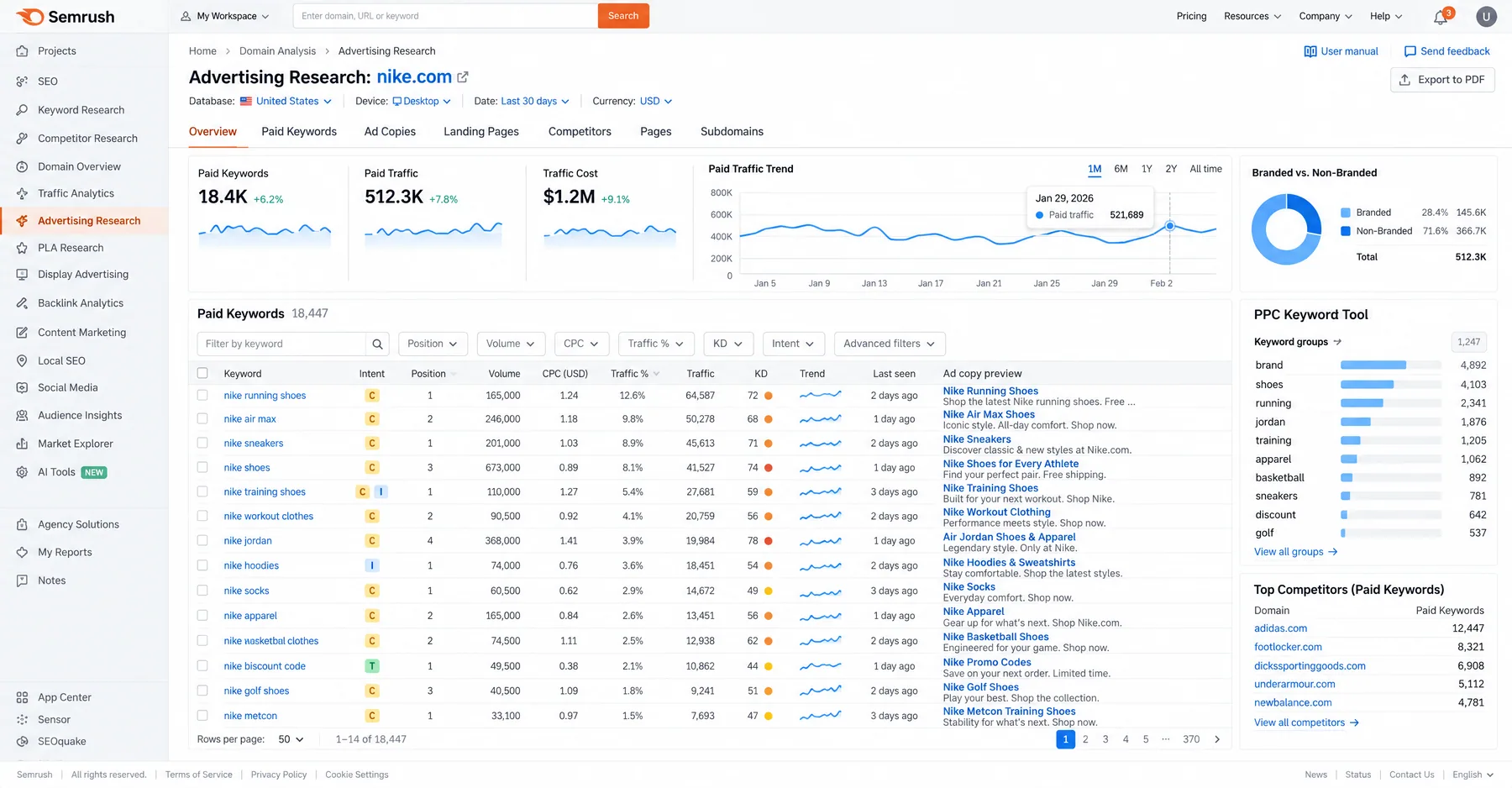
We spent four months testing 12 of the most prominent tools across Google Ads, Meta Ads, Amazon Ads, LinkedIn Ads, and TikTok Ads. We evaluated each on real campaigns with real budgets. This guide gives you everything you need to pick the right tool for your specific situation: budget, platform mix, team size, and use case.

Short on time? Here are our top three picks:

  • Ryze AI — Best all-in-one for Google + Meta. Managed service from $100/mo, ChatGPT MCP integration, API access with 150+ tools, 2,000+ clients, $500M+ ad spend managed.

  • Optmyzr — Best for Google Ads power users who want granular control and script-level customization.
  • Smartly.io — Best for enterprise teams running large-scale social campaigns across Meta, TikTok, and Pinterest.

Now let's get into the details.


Our Top Picks

Before the deep dive, here is how the top three tools stack up on the criteria that matter most:

CriteriaRyze AIOptmyzrSmartly.io
PlatformsGoogle, MetaGoogle, MicrosoftMeta, TikTok, Pinterest, Snapchat
Starting priceFrom $100/mo managed$249/moEnterprise (custom)
AI depthAutonomous optimization + MCPRule-based + AI suggestionsCreative DCO + predictive
Best forSMBs and agencies wanting full-service AIIn-house teams with Google focusEnterprise social-first brands
Unique advantageChatGPT MCP + 150+ API toolsCustom scripts and rule engineDynamic creative at scale

How We Evaluated

Every tool in this guide was evaluated against seven criteria, each weighted by practical importance for PPC managers:

  • AI capability depth (25%) — Does the tool use genuine machine learning, or is it rule-based automation with an AI label? We tested whether the platform could surface non-obvious optimizations that a human analyst would miss.
  • Platform coverage (20%) — Which ad platforms does it support natively? We prioritized tools that cover Google and Meta at minimum, since those represent over 60% of digital ad spend.
  • Ease of onboarding (15%) — How long does it take to connect accounts, configure settings, and start getting value? Tools that required weeks of setup lost points.
  • Pricing transparency (15%) — Is pricing published, predictable, and reasonable for the value delivered? Hidden fees and opaque enterprise quoting were penalized.
  • Reporting and insights (10%) — Can it generate actionable reports, not just dashboards full of vanity metrics?
  • Integration ecosystem (10%) — Does it connect with your CRM, analytics, and other marketing tools?
  • Support quality (5%) — Responsiveness, expertise of support staff, and availability of documentation and training resources.

We also factored in real feedback from PPC managers at agencies and in-house teams who have used these tools in production for at least three months.


Full Comparison Table

Here is the full 12-tool comparison. Scroll horizontally on mobile to see every column.

ToolPlatformsPrimary AI CapabilityBest ForStarting PriceFree Trial
Ryze AIGoogle, MetaAutonomous cross-platform optimizationAll-in-one managed PPC + APIFrom $100/moFree consultation
OptmyzrGoogle, MicrosoftRule engine + AI suggestionsGoogle Ads power users$249/mo14 days
AdalysisGoogle, MicrosoftAutomated ad testing + quality scoresSearch-focused advertisers$149/mo14 days
MadgicxMetaAudience intelligence + automationE-commerce Meta advertisers$44/mo7 days
SkaiGoogle, Meta, Amazon, Apple Search, WalmartPredictive bidding + cross-channelEnterprise retail and e-commerceEnterprise (custom)Demo only
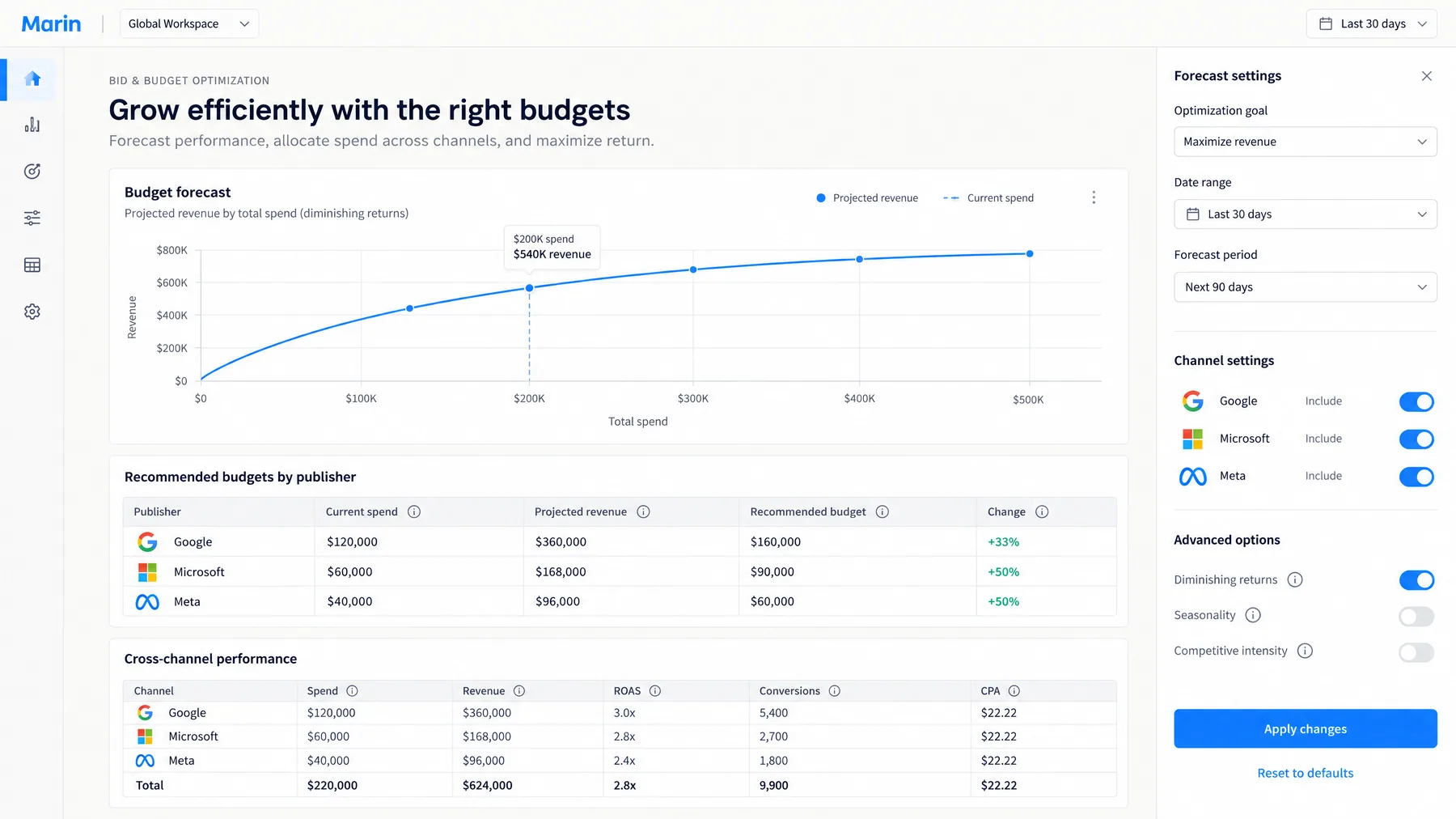
Marin SoftwareGoogle, Meta, Amazon, MicrosoftCross-channel budget optimizationAgencies managing large portfoliosEnterprise (custom)Demo only
AdzoomaGoogle, Meta, MicrosoftAutomated recommendationsSmall businesses and freelancersFree (paid from $99/mo)Free tier
WordStreamGoogle, Meta, MicrosoftSmart recommendations + 20-min work weekSMBs new to PPC$49/moFree trial
Albert.aiGoogle, Meta, YouTubeFully autonomous campaign executionBrands wanting hands-off AIEnterprise (custom)Demo only
RevealbotMeta, Google, TikTok, SnapchatAdvanced rule automation + AI suggestionsPerformance marketers wanting control$99/mo14 days
AdCreative.aiPlatform-agnostic outputAI creative generation + scoringTeams needing creative volume$29/mo7 days
Smartly.ioMeta, TikTok, Pinterest, Snapchat, GoogleDynamic creative optimizationEnterprise social advertisingEnterprise (custom)Demo only

Tool-by-Tool Reviews

1. Ryze AI

Best for: SMBs, agencies, and growing brands that want unified Google + Meta management without hiring a full PPC team

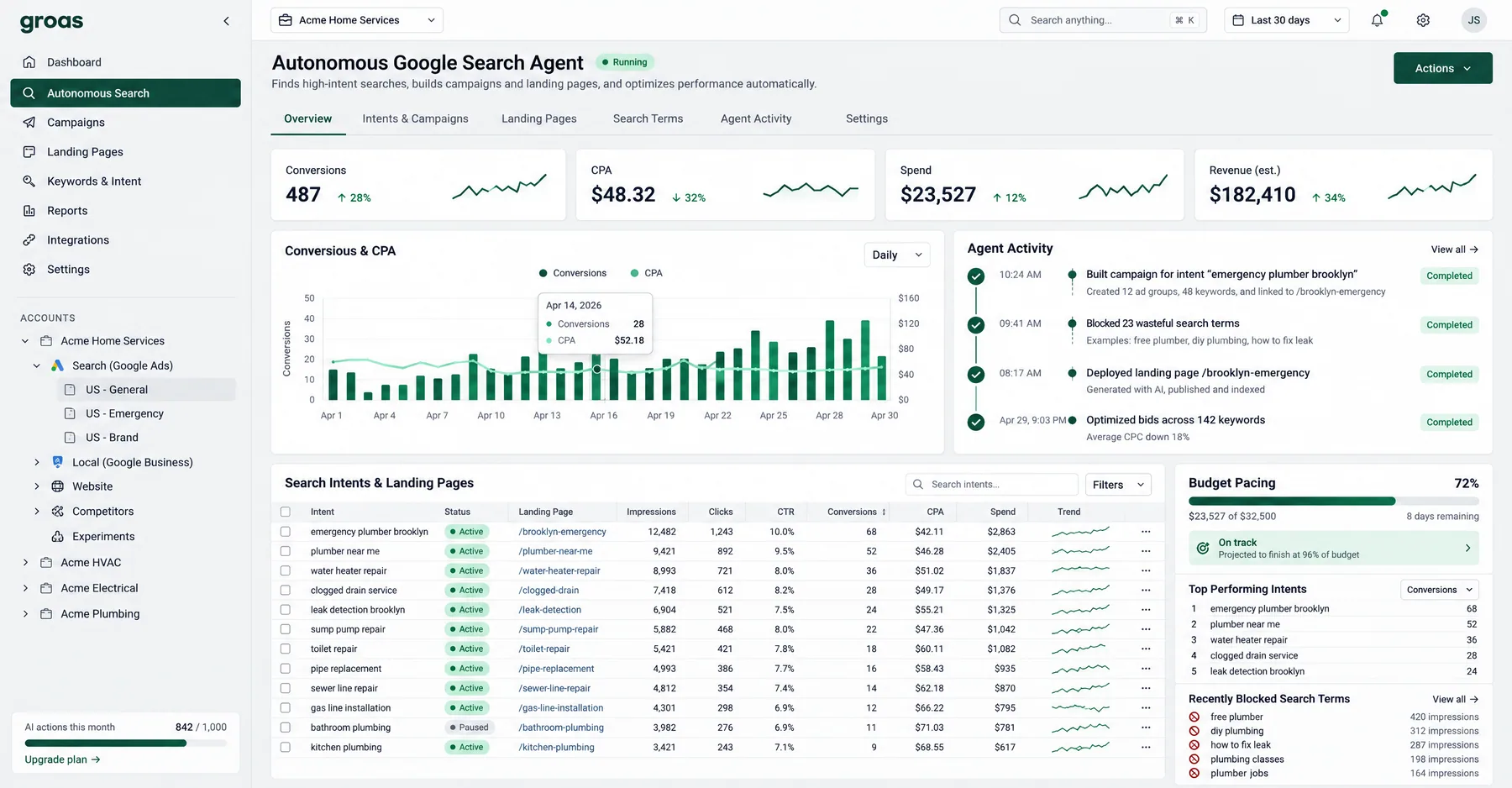
Ryze AI is a fully managed PPC platform built around AI-driven optimization. Rather than giving you a dashboard and expecting you to pull the levers, Ryze handles campaign execution end-to-end. What sets it apart from other managed services is the technology layer underneath: a proprietary AI system trained on data from over 2,000 clients and more than $500 million in managed ad spend.

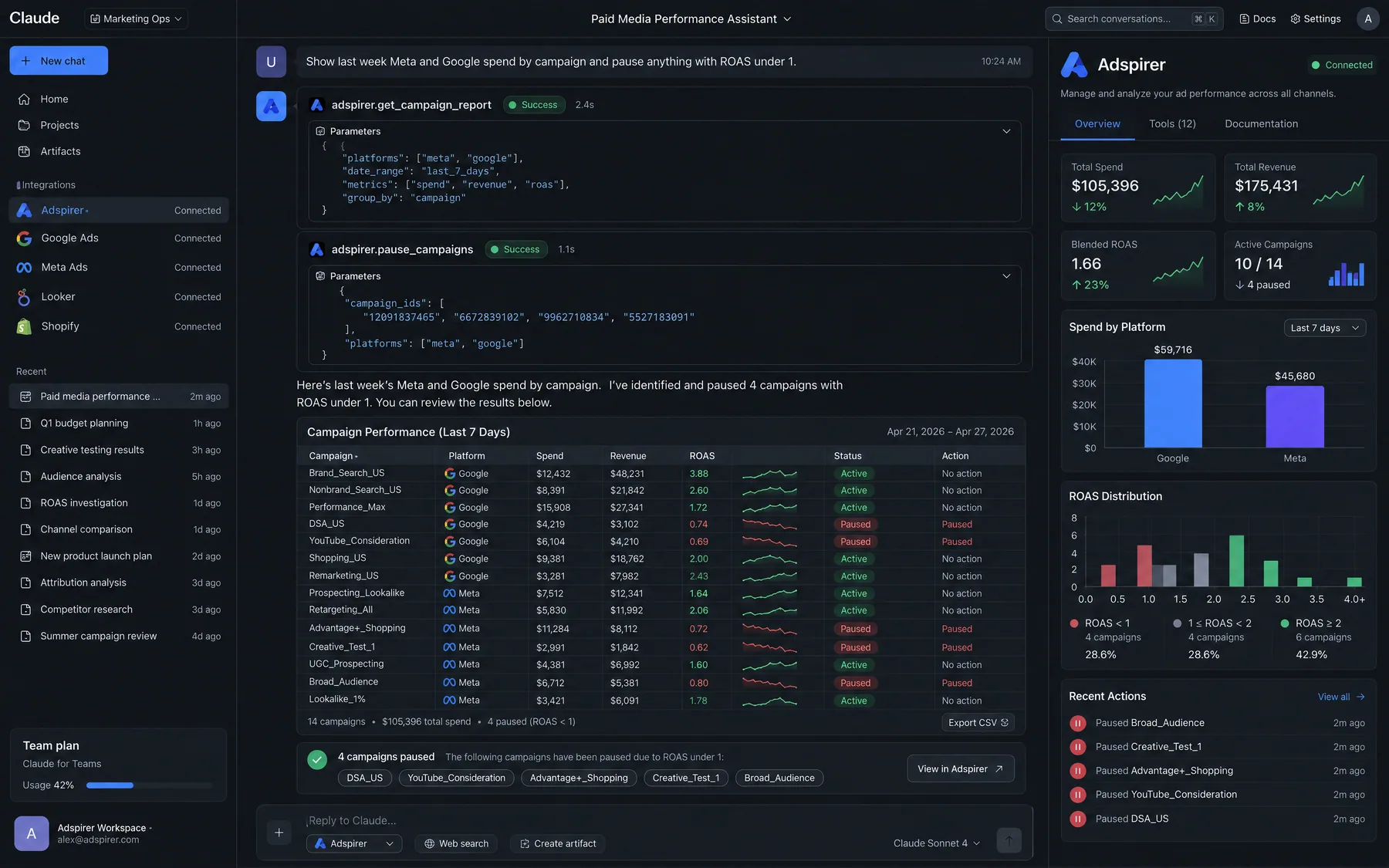
The ChatGPT MCP (Model Context Protocol) integration is genuinely novel. It allows you to interact with your ad accounts through natural language inside ChatGPT. Ask questions like "What's my best performing campaign this week?" or "Pause all ad groups with CPA above $40" and the system executes the action. This is not a gimmick — it is an actual API bridge that connects your ad data to a conversational interface.

The API access layer provides 150+ tools for bid management, budget allocation, keyword research, audience analysis, creative testing, and reporting. For agencies that want to build their own workflows on top of Ryze's optimization engine, this is a significant differentiator.

Pricing: Managed service starts from $100/mo, scaling with ad spend. API access available on higher tiers.

Strengths:

  • True cross-platform optimization between Google and Meta with unified budget allocation
  • ChatGPT MCP integration for conversational campaign management
  • 150+ API tools for custom automation workflows
  • Managed service eliminates the learning curve entirely
  • Proven at scale: 2,000+ clients, $500M+ in managed spend

Limitations:

  • Currently focused on Google and Meta (no native Amazon, LinkedIn, or TikTok)
  • Managed model means less hands-on control for teams that want to do everything themselves

2. Optmyzr

Best for: Google Ads specialists and agencies that want deep customization and script-level control

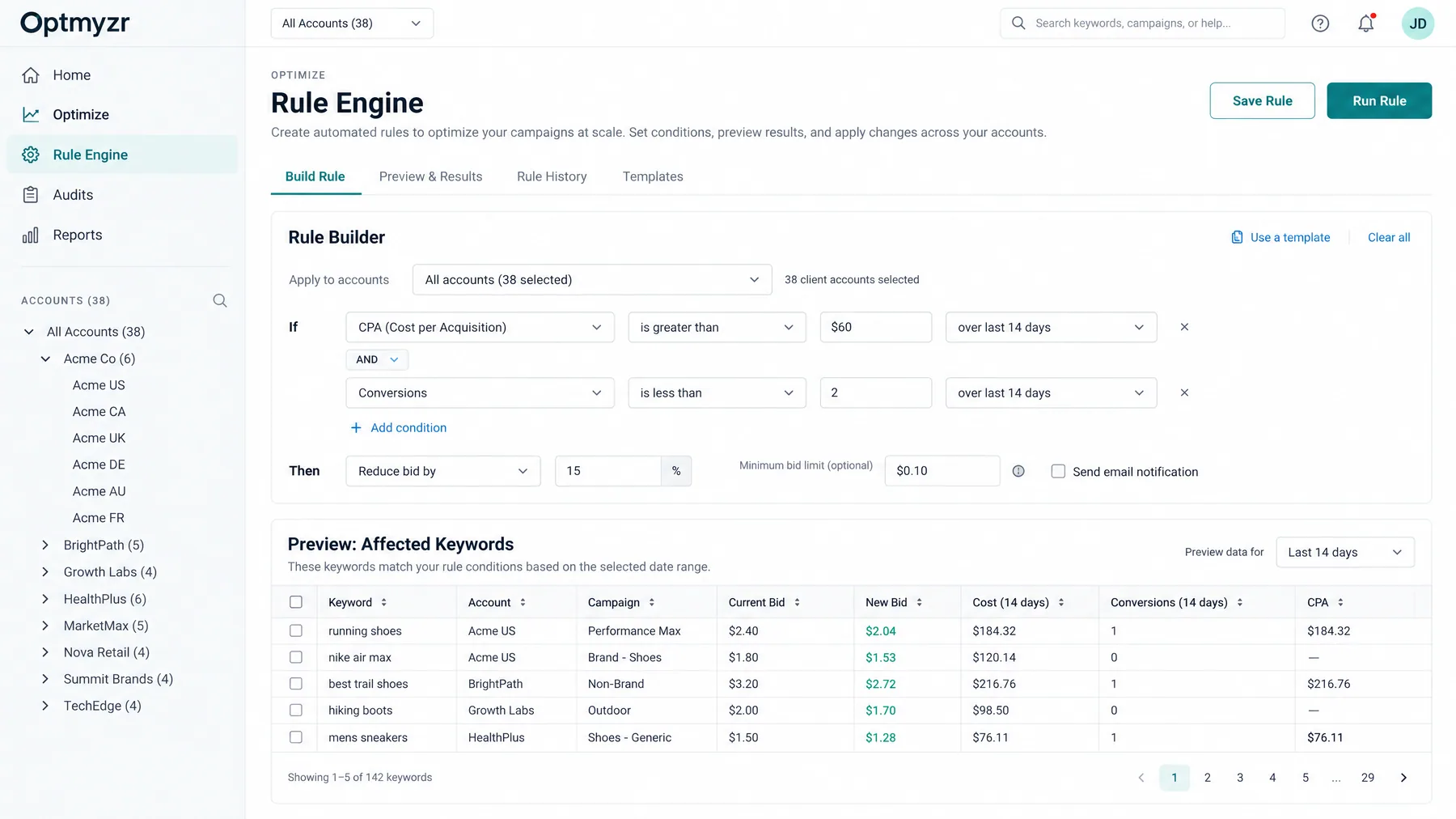
Optmyzr was built by former Google Ads engineers, and it shows. The platform gives you an incredibly granular rule engine, pre-built optimization playbooks, and the ability to write custom scripts that automate virtually anything in your Google or Microsoft Ads accounts.

The AI component surfaces suggestions based on your historical performance data — things like bid adjustment recommendations, budget reallocation opportunities, and keyword expansion ideas. These are not fully autonomous; they are presented as recommendations that you approve or reject. That design philosophy appeals to experienced PPC managers who want AI-assisted decision-making rather than AI-replaced decision-making.

Pricing: Starts at $249/mo for up to $10K in managed spend. Scales up based on ad spend volume.

Strengths:

  • Industry-leading rule engine and custom script capability
  • Excellent Google Ads and Microsoft Ads coverage
  • One-click optimizations that save hours of manual work
  • Strong reporting and client-facing dashboards for agencies

Limitations:

  • No Meta Ads support — search-only focus
  • Steep learning curve for non-technical users
  • Pricing can get expensive at higher spend tiers

3. Adalysis

Best for: Search advertisers who want automated ad testing and quality score monitoring

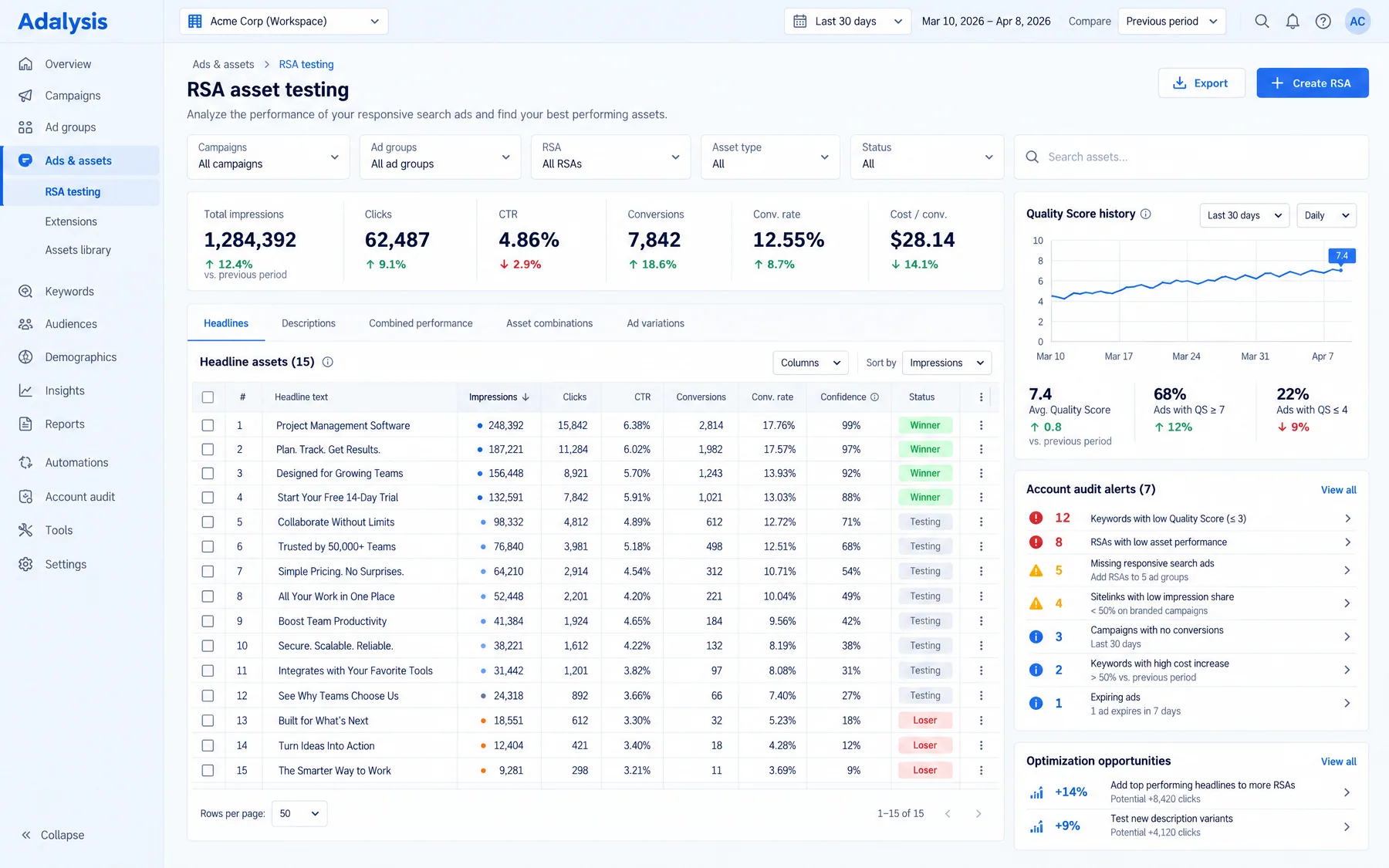
Adalysis focuses on one thing and does it well: automated ad copy testing for Google and Microsoft Ads. The platform continuously monitors your ad variations, identifies statistically significant winners, and flags underperformers. It also tracks quality scores at the keyword level and alerts you to changes before they impact performance.

The AI is narrow but effective. It does not try to manage your entire account. Instead, it handles the tedious, data-heavy work of ad testing that most teams neglect because it takes too long to do manually.

Pricing: Starts at $149/mo. Pricing based on ad spend volume.

Strengths:

  • Best-in-class automated ad testing for search
  • Quality score tracking and optimization alerts
  • Clean, focused interface without feature bloat

Limitations:

  • Search-only: no social, display, or video ad management
  • Limited automation beyond ad testing
  • No bid management or budget optimization features

4. Madgicx

Best for: E-commerce brands running Meta Ads who want audience intelligence and creative analytics

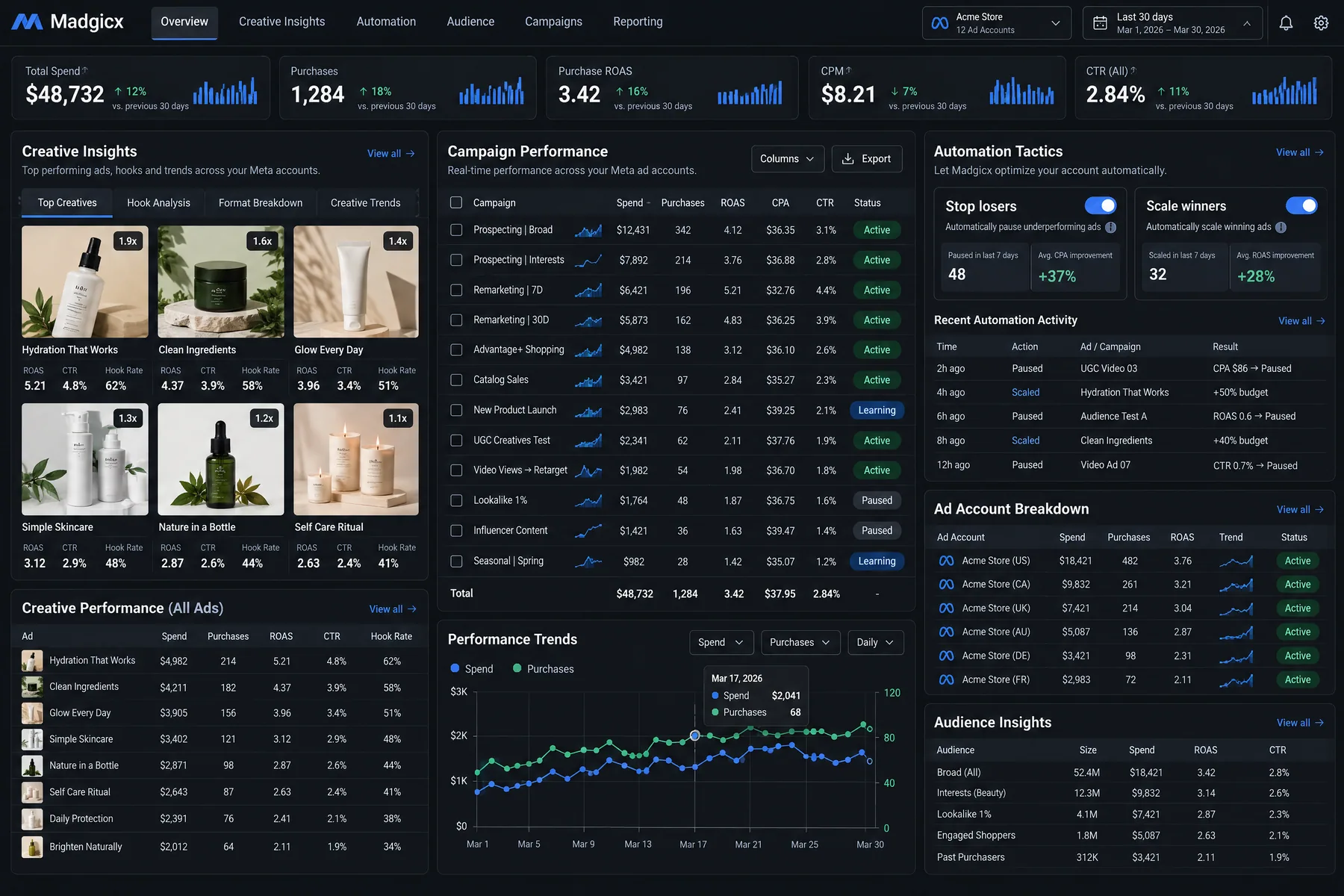
Madgicx has carved out a niche as the go-to Meta Ads optimization tool for e-commerce. Its AI Audience feature analyzes your existing customer data and builds lookalike segments that go beyond Meta's native audience tools. The creative analytics dashboard breaks down performance by visual element — colors, layouts, copy themes — to help you understand what actually drives clicks.

The automation tactics feature lets you set rules that manage budgets, pause underperformers, and scale winners across your Meta campaigns. It is straightforward and effective, though not as deep as Revealbot's rule engine.

Pricing: Starts at $44/mo for a single ad account. Scales with features and account volume.

Strengths:

  • Affordable entry point for small e-commerce brands
  • Strong audience intelligence and creative analytics
  • One-click audience launcher saves significant setup time

Limitations:

  • Meta-only: no Google, Amazon, or other platform support
  • AI capabilities are more analytical than autonomous
  • Can feel overwhelming with the number of features crammed into one dashboard

5. Skai (formerly Kenshoo)

Best for: Enterprise retail and e-commerce brands managing ads across search, social, and retail media

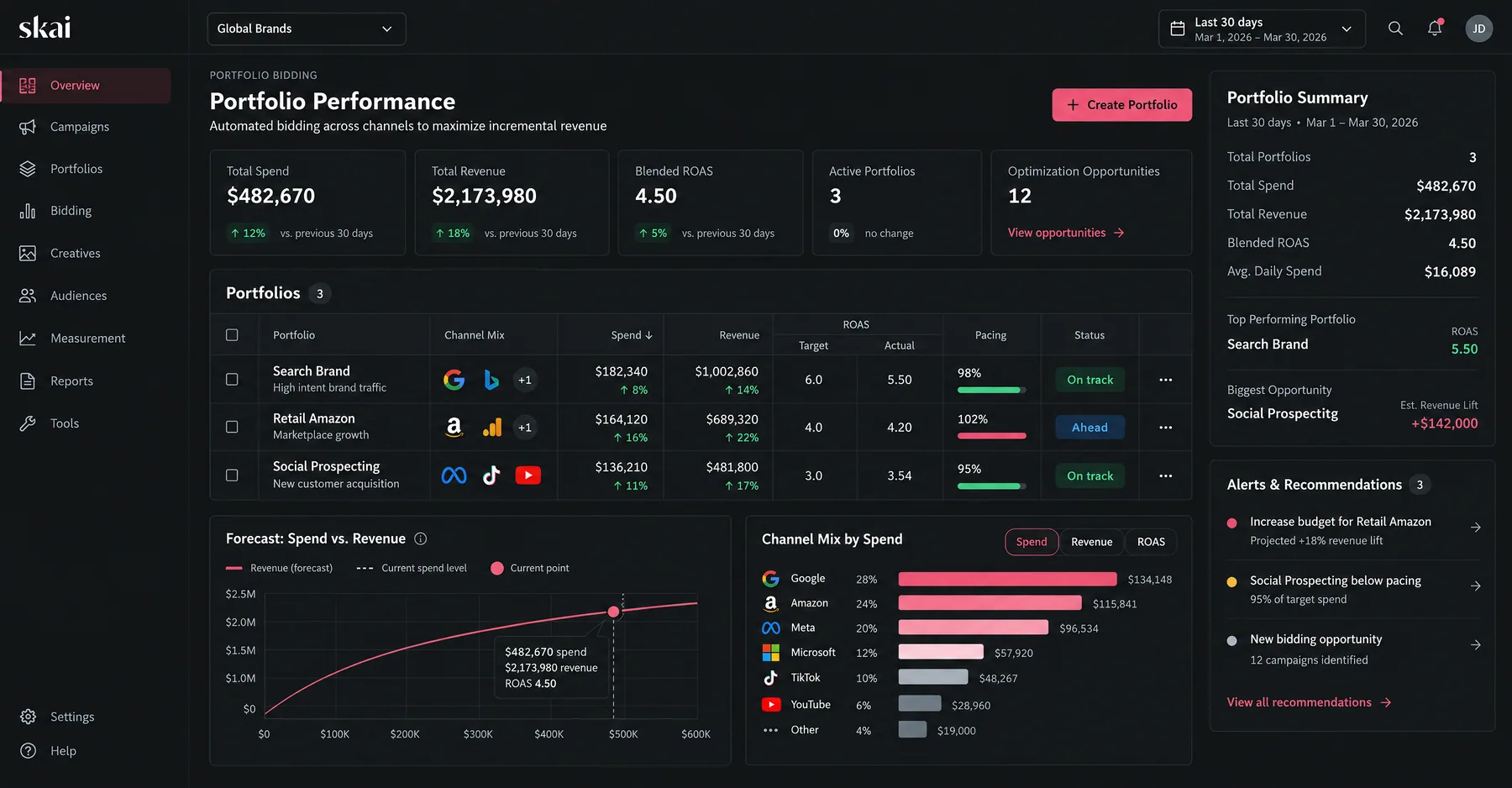
Skai is an enterprise-grade platform that connects Google, Meta, Amazon, Apple Search Ads, and Walmart Connect in a single interface. Its predictive bidding engine uses machine learning to forecast performance and allocate budgets across channels automatically. If you are spending six or seven figures monthly across multiple platforms, Skai gives you the cross-channel visibility and optimization that smaller tools cannot.

The retail media capabilities are particularly strong. Skai was one of the first platforms to treat Amazon Ads as a first-class citizen alongside Google and Meta, which matters enormously for brands where Amazon represents a significant revenue channel.

Pricing: Enterprise custom pricing only. Expect five-figure annual contracts.

Strengths:

  • Broadest platform coverage including retail media networks
  • Genuine predictive AI for bidding and budget allocation
  • Strong measurement and incrementality testing features

Limitations:

  • Prohibitive pricing for small and mid-sized businesses
  • Long onboarding and implementation timelines
  • Requires dedicated team to get full value from the platform

6. Marin Software

Best for: Large agencies managing cross-channel portfolios with complex budget allocation needs

Marin Software is a veteran in the PPC management space, and its MarinOne platform has evolved to incorporate AI-driven budget allocation and bid optimization across Google, Meta, Amazon, and Microsoft. The platform excels at portfolio-level management — when you need to distribute budgets optimally across hundreds of campaigns on different platforms.

The AI focuses on cross-channel budget optimization: given your total budget and performance targets, it determines how much to allocate to each channel and campaign to maximize overall return. This is genuinely useful for agencies juggling multiple clients with different platform mixes.

Pricing: Enterprise custom pricing. Typically starts at $2,000+/mo.

Strengths:

  • Mature cross-channel budget optimization
  • Strong agency workflows and client management features
  • Covers search, social, and e-commerce channels

Limitations:

  • Interface feels dated compared to newer competitors
  • Onboarding is slow and requires significant setup investment
  • AI capabilities lag behind purpose-built newer platforms

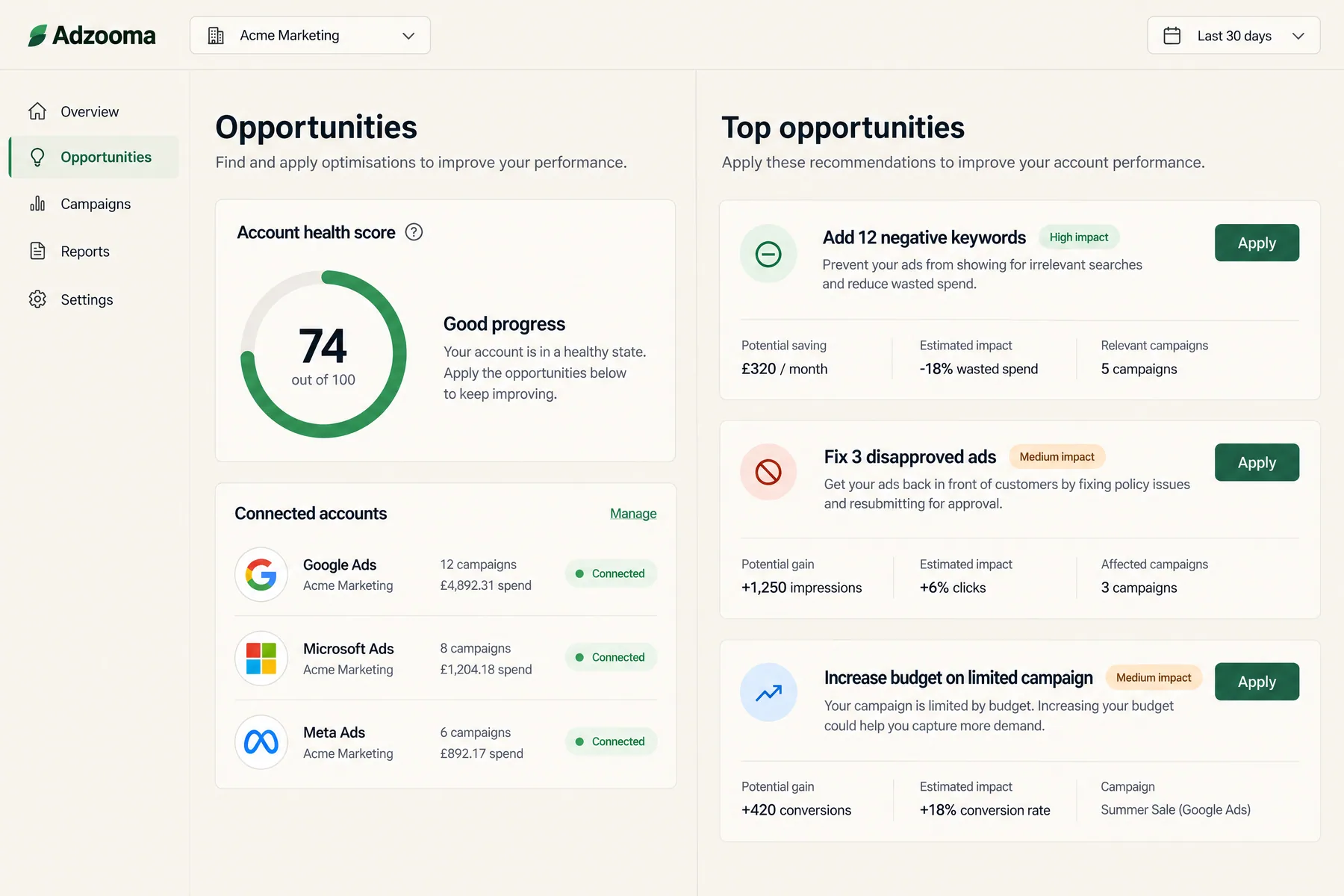
7. Adzooma

Best for: Small businesses and freelancers who want a free starting point for PPC management

Adzooma offers a genuinely useful free tier that connects Google, Meta, and Microsoft Ads accounts and provides automated optimization recommendations. The AI scans your accounts weekly, identifies opportunities, and presents them as one-click actions: pause this underperformer, increase budget here, add these negative keywords.

For small businesses spending under $5K/mo who cannot justify a premium tool, Adzooma provides real value at zero cost. The paid tiers add automation rules, custom reporting, and a marketplace for agency services.

Pricing: Free tier available. Paid plans from $99/mo.

Strengths:

  • Generous free tier with real functionality
  • Covers Google, Meta, and Microsoft in one place
  • Simple interface that does not overwhelm beginners

Limitations:

  • AI recommendations are basic compared to premium tools
  • Limited customization and rule-building capabilities
  • Reporting is functional but not deep

8. WordStream

Best for: SMBs and PPC beginners who want guided optimization without the learning curve

WordStream (now part of LocaliQ) pioneered the "20-minute work week" concept: log in, review AI-generated suggestions, approve or reject, and move on. The platform is designed for business owners and marketers who are not PPC specialists but need to run paid ads effectively.

The AI surfaces recommendations for Google, Meta, and Microsoft Ads in a prioritized list. Recommendations include bid adjustments, negative keyword additions, budget changes, and ad copy suggestions. Everything is presented in plain language with clear expected impact.

Pricing: Starts at $49/mo. Higher tiers unlock more features and support.

Strengths:

  • Most beginner-friendly interface in the category
  • Guided workflow reduces PPC management to minutes per week
  • Good educational resources built into the platform

Limitations:

  • Too simplistic for experienced PPC managers
  • Limited automation compared to Optmyzr or Revealbot
  • Feature development has slowed since the LocaliQ acquisition

9. Albert.ai

Best for: Brands that want a fully autonomous AI to execute campaigns with minimal human input

Albert.ai takes the most aggressive approach to AI-driven advertising. You provide creative assets, define your target audience and goals, and Albert handles everything else: channel selection, audience targeting, bid optimization, budget allocation, and performance monitoring. It operates across Google, Meta, and YouTube with genuine autonomous decision-making.

The tradeoff is transparency. Albert makes thousands of micro-decisions daily, and understanding why it made specific choices can be difficult. Teams that need to explain every optimization decision to stakeholders may find this frustrating.

Pricing: Enterprise custom pricing. Typically requires $50K+ monthly ad spend minimum.

Strengths:

  • Most autonomous AI in the category — genuinely self-optimizing
  • Reduces need for dedicated PPC specialists
  • Can discover audience segments and opportunities humans miss

Limitations:

  • Black-box decision-making limits transparency
  • Very high spend minimum and enterprise pricing
  • Limited control for teams that want hands-on management

10. Revealbot

Best for: Performance marketers who want powerful rule-based automation with AI enhancement

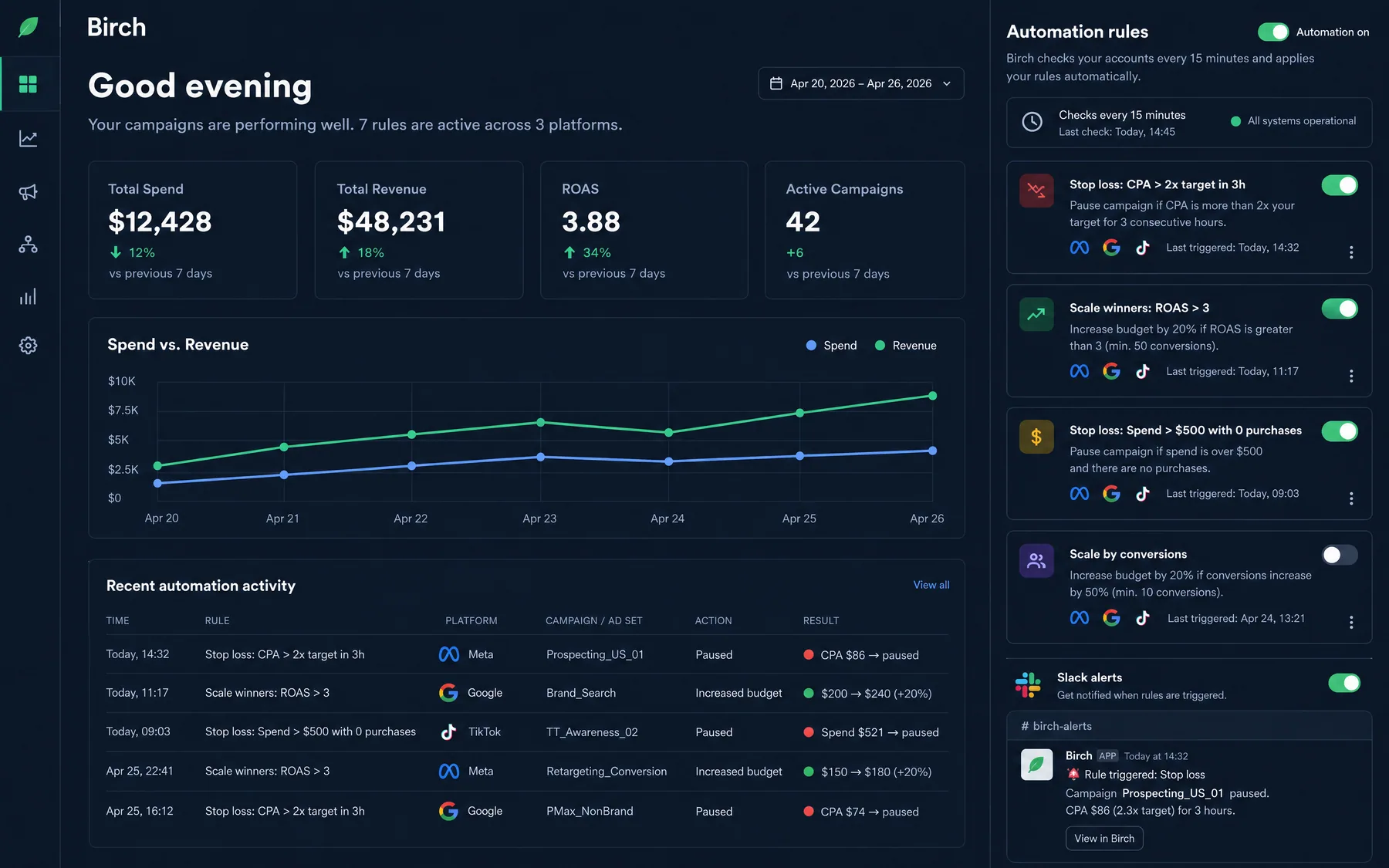
Revealbot offers the most sophisticated rule builder in the category. You can create multi-condition automation rules that span across campaigns, ad sets, and ads on Meta, Google, TikTok, and Snapchat. The AI layer sits on top: it analyzes your rules' performance and suggests improvements, and can predict when certain rules will trigger before they do.

The Slack and email integration is well-executed. Revealbot sends real-time notifications when rules fire, budgets change, or performance anomalies are detected. For teams that manage campaigns collaboratively, this transparency is valuable.

Pricing: Starts at $99/mo based on ad spend. Scales with account size.

Strengths:

  • Best rule-based automation engine for social ads
  • Multi-platform support including TikTok and Snapchat
  • Excellent Slack and notification integrations

Limitations:

  • Rule-first approach requires PPC expertise to set up effectively
  • AI component is more suggestive than autonomous
  • No creative or landing page features

11. AdCreative.ai

Best for: Teams that need high-volume ad creative generation and performance scoring

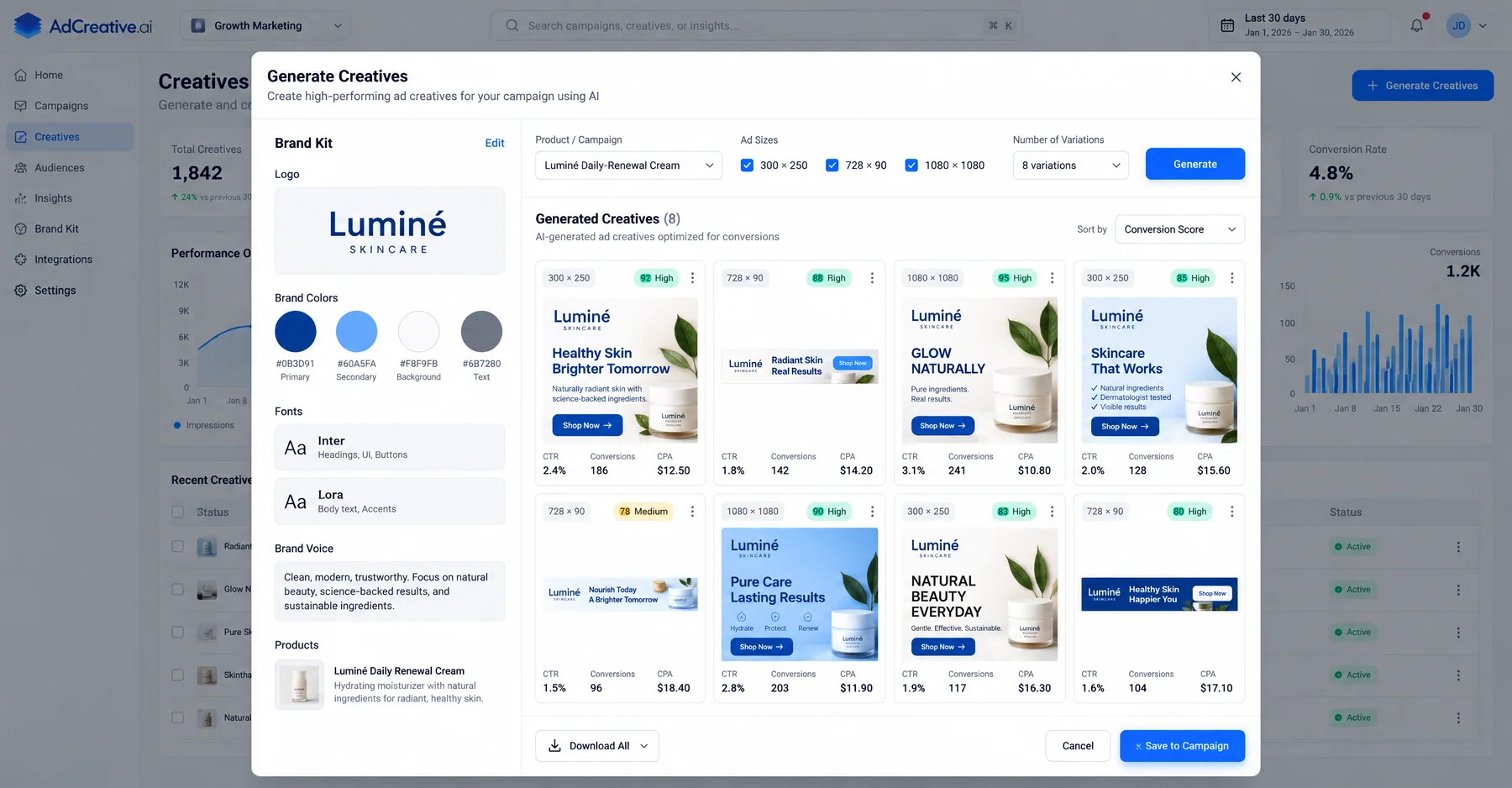
AdCreative.ai is not a PPC management tool in the traditional sense — it is an AI creative engine. You input your brand assets and campaign objectives, and it generates hundreds of ad creative variations with predicted performance scores. The AI scores each variation based on patterns from its training data, helping you prioritize which creatives to test first.

The output is platform-agnostic: you export the creatives and upload them to whatever ad platform you are using. This makes it a complement to management tools like Ryze AI or Optmyzr rather than a replacement.

Pricing: Starts at $29/mo for 10 downloads. Higher tiers for volume users.

Strengths:

  • Fastest way to generate ad creative variations at scale
  • Performance scoring helps prioritize testing
  • Very affordable entry point

Limitations:

  • Not a PPC management tool — creative generation only
  • Quality of AI-generated creatives varies significantly
  • Performance scores do not always correlate with actual campaign performance

12. Smartly.io

Best for: Enterprise brands running large-scale social advertising across multiple platforms

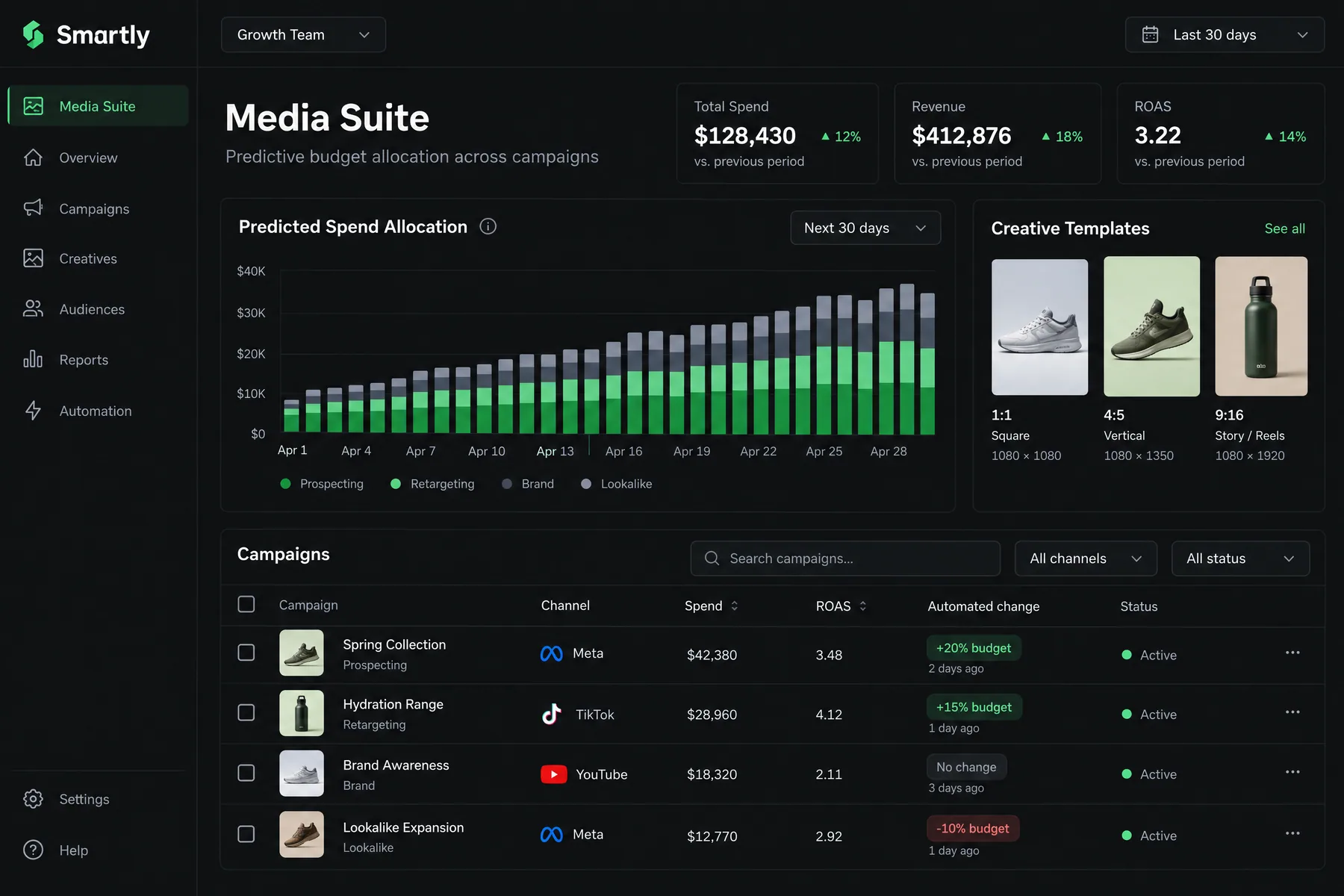
Smartly.io is the enterprise standard for social ad management. It combines dynamic creative optimization (DCO) with predictive budget allocation across Meta, TikTok, Pinterest, Snapchat, and Google. The DCO engine automatically assembles ad variations from your asset library and serves the best-performing combinations to each audience segment.

The platform handles massive creative volumes — brands using Smartly typically run thousands of ad variations simultaneously. The AI continuously tests and optimizes creative elements, copy, and audience combinations without manual intervention.

Pricing: Enterprise custom pricing. Minimum spend requirements apply.

Strengths:

  • Best-in-class dynamic creative optimization
  • Broadest social platform coverage in the category
  • Handles enormous creative volume and variation testing

Limitations:

  • Enterprise pricing puts it out of reach for SMBs
  • Social-first: Google Ads support is secondary
  • Requires significant creative assets to leverage DCO fully

Decision Guide by Budget

Your monthly ad spend and tool budget determine which tier of tools makes financial sense. Here is a practical decision tree:

Under $1,000/mo in ad spend

At this level, you cannot justify expensive management tools. Your priority is getting fundamentals right without wasting budget on software.

RecommendationToolWhy
First choiceRyze AIManaged service from $100/mo eliminates the learning curve. Let AI handle optimization while you focus on your business.
Budget alternativeAdzoomaFree tier provides basic recommendations across Google, Meta, and Microsoft.
Creative add-onAdCreative.ai$29/mo for ad creative generation if you lack design resources.

$1,000 - $10,000/mo in ad spend

This is the sweet spot where AI tools start delivering measurable ROI. You have enough data for machine learning to find patterns, and enough spend for small percentage improvements to translate into real dollars.

RecommendationToolWhy
Google + MetaRyze AIUnified cross-platform optimization with managed service. Best value for teams that do not have a dedicated PPC hire.
Google-only focusOptmyzrDeep Google Ads optimization with custom rules and scripts.
Meta-only focusMadgicx or RevealbotMadgicx for audience intelligence, Revealbot for rule-based automation.

$10,000+/mo in ad spend

At this level, every percentage point of efficiency improvement has significant dollar impact. Premium tools pay for themselves quickly.

RecommendationToolWhy
Cross-platform (Google + Meta)Ryze AIAPI access with 150+ tools. Managed optimization plus the flexibility to build custom workflows at scale.
Search + retail mediaSkaiEnterprise cross-channel with Amazon and Walmart support.
Social at scaleSmartly.ioDCO and automated creative testing across all social platforms.
Autonomous hands-offAlbert.aiFully autonomous AI for brands that want minimal manual management.
Agency portfolioMarin SoftwareCross-channel budget optimization for agencies managing many clients.

Decision Guide by Platform

If your decision is driven primarily by which ad platforms you use, here is the clearest path:

Google Ads

  • Best overall: Ryze AI (managed optimization + API)
  • Best for power users: Optmyzr (custom scripts, deep rule engine)
  • Best for ad testing: Adalysis (automated search ad testing)
  • Best budget option: WordStream (guided optimization for beginners)

Meta Ads (Facebook and Instagram)

  • Best overall: Ryze AI (cross-platform with Google)
  • Best for e-commerce: Madgicx (audience intelligence + creative analytics)
  • Best for automation: Revealbot (advanced rule builder)
  • Best at enterprise scale: Smartly.io (DCO + predictive budgeting)

Amazon Ads

  • Best overall: Skai (strongest Amazon Ads integration with cross-channel visibility)
  • Portfolio management: Marin Software (cross-channel budget allocation including Amazon)

LinkedIn Ads

  • Best option: LinkedIn's native Campaign Manager with AI features remains the strongest option. Third-party tools have limited LinkedIn support. Marin Software and Skai offer basic LinkedIn integration for enterprise accounts.

TikTok Ads

  • Best overall: Smartly.io (native TikTok support with DCO)
  • Best for automation: Revealbot (rule-based TikTok ad management)
  • Creative generation: AdCreative.ai (TikTok-format creative generation)

Multi-Platform (Google + Meta combined)

  • Best overall: Ryze AI — purpose-built for unified Google + Meta management with AI-driven cross-platform budget allocation
  • Enterprise alternative: Skai or Marin Software for teams also running Amazon, Walmart, or Apple Search Ads

What to Look For When Choosing an AI PPC Tool

Before signing any contract, evaluate these factors:

1. Verify the AI is real

Ask specifically: "What does your AI do that rule-based automation cannot?" If the answer is vague or focuses on speed rather than intelligence, you are likely paying for automation with an AI label. Real AI should surface insights and make decisions that a human building rules would not think to create.

2. Check data requirements

Machine learning needs data to learn. Ask about minimum conversion volumes, account history requirements, and how long it takes for the AI to calibrate on your specific account. Tools that claim instant results are either not using real ML or are using generic models that may not fit your business.

3. Understand the control spectrum

Tools range from fully autonomous (Albert.ai) to fully manual with AI suggestions (Optmyzr). Neither is universally better. Match the control level to your team's expertise and comfort level. If your team has deep PPC expertise, you may want more control. If you are capacity-constrained, more autonomy can be better.

4. Calculate total cost of ownership

Tool subscription is only part of the cost. Factor in onboarding time, training, integration work, and ongoing management overhead. A $250/mo tool that requires 10 hours of setup and 5 hours/week of management is more expensive than a $500/mo managed service that requires zero ongoing effort.

5. Test with real campaigns

Never commit to an annual contract without running the tool on real campaigns first. Use free trials to connect your actual ad accounts, let the AI run for at least two weeks, and compare its suggestions or actions against what you would have done manually. If the tool is not finding opportunities you missed, it is not adding value.

6. Evaluate the exit path

What happens if you stop using the tool? Can you export your data, rules, and campaign structures? Tools that create lock-in through proprietary formats or dependent workflows are riskier long-term bets. Prefer tools that enhance your existing ad accounts rather than replacing them.


Frequently Asked Questions

Do I really need an AI PPC tool, or can I just use Google and Meta's built-in automation?

Platform-native automation (Performance Max, Advantage+) is good and getting better. But it optimizes within a single platform and serves that platform's interests (spending more of your budget). Third-party AI tools optimize across platforms and serve your interest (maximum return per dollar). If you run ads on only one platform and spend under $2K/mo, native tools may be sufficient. Beyond that, a third-party tool typically pays for itself within the first month.

How long does it take for AI PPC tools to start delivering results?

Most tools need two to four weeks to calibrate on your account data. During this period, the AI is learning your patterns — what converts, which audiences respond, where budget gets wasted. Expect the first meaningful optimizations after week two, with compound improvements building over the first three months. Tools that promise immediate results are either making pre-baked recommendations (not personalized) or using very basic rules that do not require learning.

Can AI tools replace my PPC manager or agency?

Not entirely, and that is not the right framing. AI tools replace repetitive execution tasks: bid adjustments, budget pacing, A/B test rotation, and reporting. They do not replace strategy, creative direction, competitive analysis, or business context. The best setup is a skilled human making strategic decisions with AI handling the execution and surfacing insights the human would not have time to find manually.

What is the minimum ad spend needed for AI tools to be effective?

Machine learning needs enough conversion data to identify patterns. As a general rule, you need at least 30 to 50 conversions per month per campaign for AI optimization to outperform manual management. In dollar terms, this typically means $1,000+/mo in ad spend, though it varies by industry and average order value. Below that threshold, you are better off with rule-based automation or a managed service like Ryze AI that can leverage aggregate learnings from its broader client base.

Are AI PPC tools safe? Can they waste my budget?

Any tool that can change bids and budgets can theoretically waste money if misconfigured. The safeguard is guardrails: maximum bid caps, daily spend limits, and approval workflows for large changes. Most tools in this guide let you set these guardrails. Start with conservative limits, monitor closely for the first two weeks, and gradually loosen controls as you build confidence in the tool's decisions.

What is the ChatGPT MCP integration that Ryze AI offers?

MCP stands for Model Context Protocol. It is a standardized way for AI assistants like ChatGPT to connect directly with external tools and data sources. Ryze AI's MCP integration lets you manage your ad accounts through natural language conversations in ChatGPT. You can ask questions about performance, request changes, and generate reports just by typing or speaking. Instead of navigating dashboards and clicking through menus, you interact with your campaigns conversationally. It is particularly useful for quick checks and ad hoc analysis.

Can I use multiple AI PPC tools together?

Yes, and many teams do. A common combination is a management tool (Ryze AI, Optmyzr) paired with a creative tool (AdCreative.ai). The management tool handles optimization and bidding while the creative tool generates ad variations. Be careful about using two management tools on the same campaigns, though — conflicting automation rules from different tools can create unpredictable behavior. If you stack tools, make sure each one has a clearly defined, non-overlapping role.

How do I measure whether an AI PPC tool is actually helping?

Run a controlled comparison. Before activating the tool, document your key metrics (CPA, ROAS, conversion rate, spend efficiency) for the previous 30 to 60 days. After activation, compare the same metrics over an equivalent period. Account for seasonality and external factors. A well-performing AI tool should show measurable improvement in at least two of these metrics within 60 days. If it does not, the tool is not adding enough value to justify the cost.


Verdict

The AI PPC tool you choose should match three things: your platform mix, your budget, and your team's capacity.

If you run Google and Meta together — which is the most common combination for most businesses — Ryze AI is the strongest option. The managed service model means you get AI-powered optimization without needing to become an expert in the tool itself. The ChatGPT MCP integration and 150+ API tools add a flexibility layer that no other managed service offers. And starting from $100/mo managed, it is accessible at every budget level.

If you are a Google Ads specialist who wants maximum control, Optmyzr gives you the deepest customization. If you are an enterprise brand running social at scale, Smartly.io's DCO engine is unmatched. And if you need retail media coverage across Amazon and Walmart, Skai is the clear choice.

The worst choice is no AI tool at all. Manual PPC management in 2026 means leaving money on the table. These tools are not replacing human judgment — they are amplifying it. The question is not whether to use AI for PPC, but which AI matches your specific needs.

Start with a free trial or consultation with your top pick. Test it on real campaigns. Measure the results. Then commit.

Manages all your accounts
Google Ads
Connect
Meta
Connect
Shopify
Connect
GA4
Connect
Amazon
Connect
Creatives optimization
Next Ad
ROAS1.8x
CPA$45
Ad Creative
ROAS3.2x
CPA$12
24/7 ROAS improvements
Pause 27 Burning Queries
0 conversions (30d)
+$1.8k
Applied
Split Brand from Non-Brand
ROAS 8.2 vs 1.6
+$3.7k
Applied
Isolate "Project Mgmt"
Own ad group, bid down
+$5.8k
Applied
Raise Brand US Cap
Lost IS Budget 62%
+$3.2k
Applied
Monthly Impact
$0/ mo
Next Gen of Marketing

Let AI Run Your Ads