We spent three months running real ad spend through 10 AI tools built for Meta and Facebook advertising. Not demo accounts. Not sandbox environments. Real campaigns, real budgets, real results.
The short answer: Ryze AI is the best overall pick for most advertisers thanks to its 24/7 autonomous optimization and ChatGPT MCP integration. Madgicx is the strongest budget option. Smartly.io wins for enterprise teams running seven-figure monthly spend. And AdCreative.ai is the best standalone creative generation tool if that is your only bottleneck.
But the right tool depends entirely on your spend level, team size, and which part of the Meta ads workflow is actually broken. Below is everything we learned.

Quick Comparison Table
Here is a side-by-side snapshot of every tool we tested. Scroll right on mobile to see all columns.


| Tool | Best For | Starting Price | Key Strength | Meta-Specific Score |
|---|---|---|---|---|
| Ryze AI | Full-funnel Meta optimization | From $100/mo (managed) | 24/7 autonomous AI + ChatGPT MCP | 9.4/10 |
| Madgicx | Budget-conscious advertisers | ~$44/mo | AI audience launcher + automation tactics | 8.1/10 |
| Revealbot | Rule-based automation | From $99/mo | Granular custom automation rules | 7.8/10 |
| AdCreative.ai | Creative generation only | From $29/mo | AI-generated ad images and copy at scale | 7.5/10 |
| Smartly.io | Enterprise and agency teams | Custom (enterprise pricing) | Cross-channel creative automation | 8.6/10 |
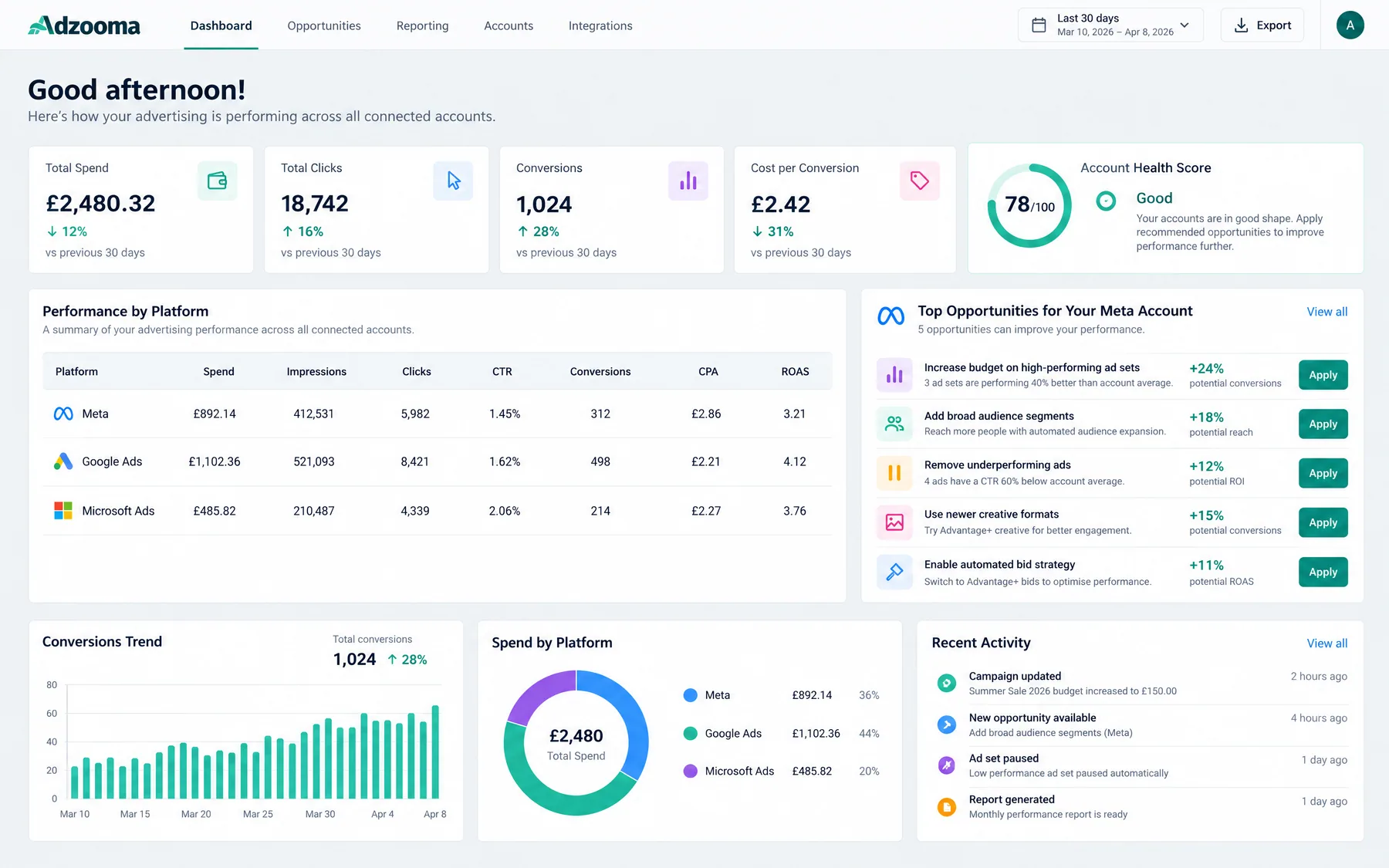
| Adzooma | Small business multi-platform | Free tier / $99/mo Pro | One-click optimization suggestions | 6.9/10 |
| Trapica | AI audience targeting | Custom pricing | Autonomous audience expansion | 7.4/10 |
| Pencil | Video ad creative generation | From $49/mo | AI video ad generation with performance prediction | 7.2/10 |
| Sotrender | Social analytics and reporting | From $59/mo | Deep Facebook analytics with competitor benchmarking | 6.5/10 |
| Hootsuite Ads | Social-first teams running ads | From $99/mo (Professional) | Unified organic + paid management | 6.3/10 |
How We Tested
Every tool on this list was connected to live Meta ad accounts running real campaigns. We did not rely on vendor demos, press releases, or feature checklists. Here is the exact methodology:
- Account setup: We connected each tool to a Meta Business Suite account managing between $5,000 and $25,000 in monthly ad spend across e-commerce and lead generation verticals.
- Testing period: Each tool was given a minimum of 30 days to learn, optimize, and demonstrate results. Some tools had access for 60+ days.
- Metrics tracked: ROAS, CPA, CPM trends, creative fatigue velocity, audience overlap percentage, and time-to-optimization (how quickly the AI started making meaningful improvements).
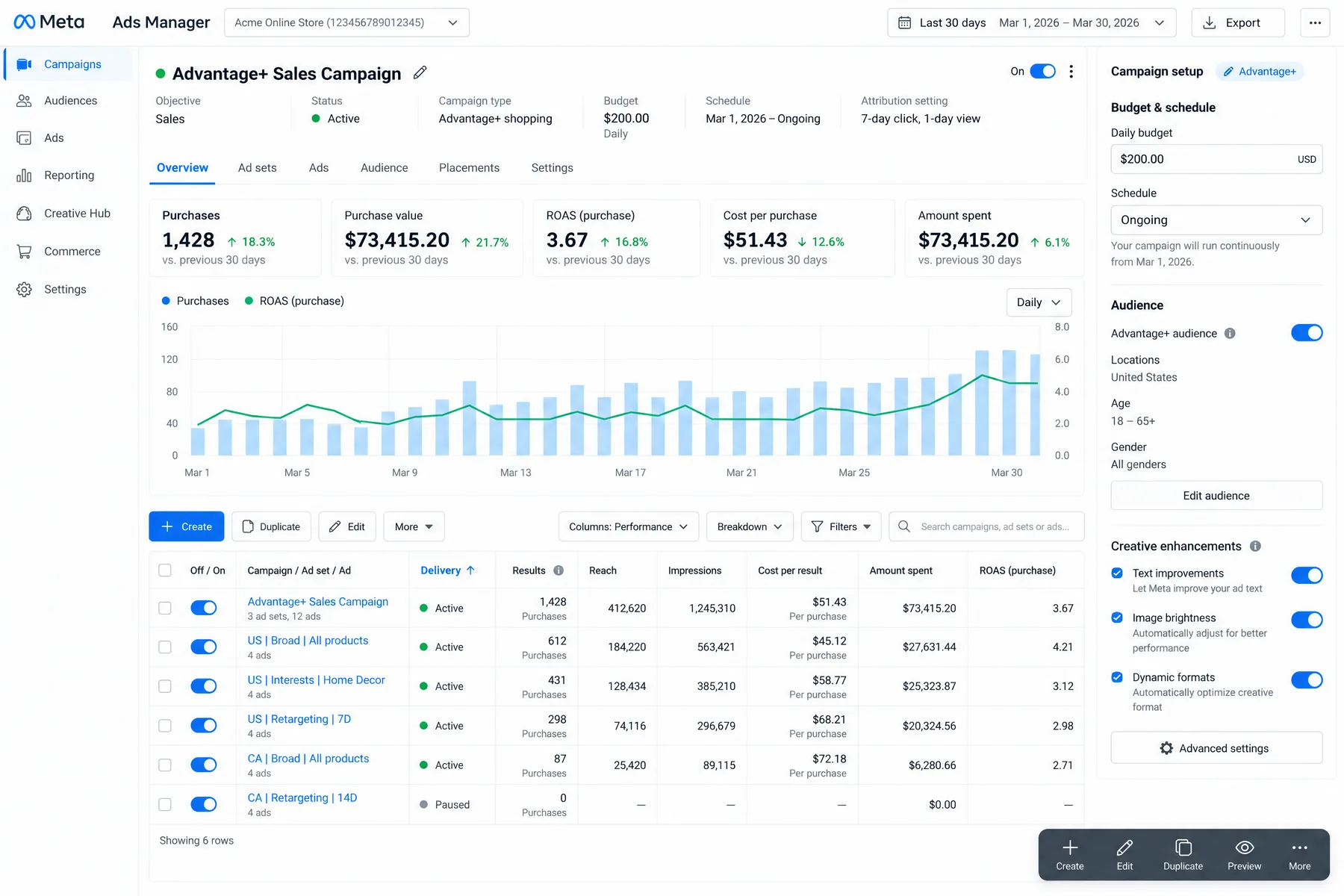
- Meta-specific evaluation: We specifically tested how each tool handled Advantage+ Shopping campaigns, creative fatigue detection, attribution discrepancies between Meta and third-party analytics, and audience overlap management.
- Usability: Onboarding time, dashboard clarity, alerting quality, and how much human oversight each tool actually required on a daily basis.
We scored each tool on a 10-point Meta-Specific Score that weights these factors: optimization impact (35%), Meta feature support (25%), ease of use (20%), and value for money (20%).
Detailed Reviews
1. Ryze AI -- Best Overall for Meta Ads Optimization
Ryze AI is a fully managed AI ad optimization platform built specifically for Meta and Google campaigns. Unlike most tools on this list that give you dashboards and let you figure things out, Ryze assigns an AI system that actively manages your campaigns around the clock. It connects directly to your Meta ad account, monitors performance continuously, and makes real-time adjustments to bids, budgets, audiences, and creative rotation without waiting for you to log in.
Key features:
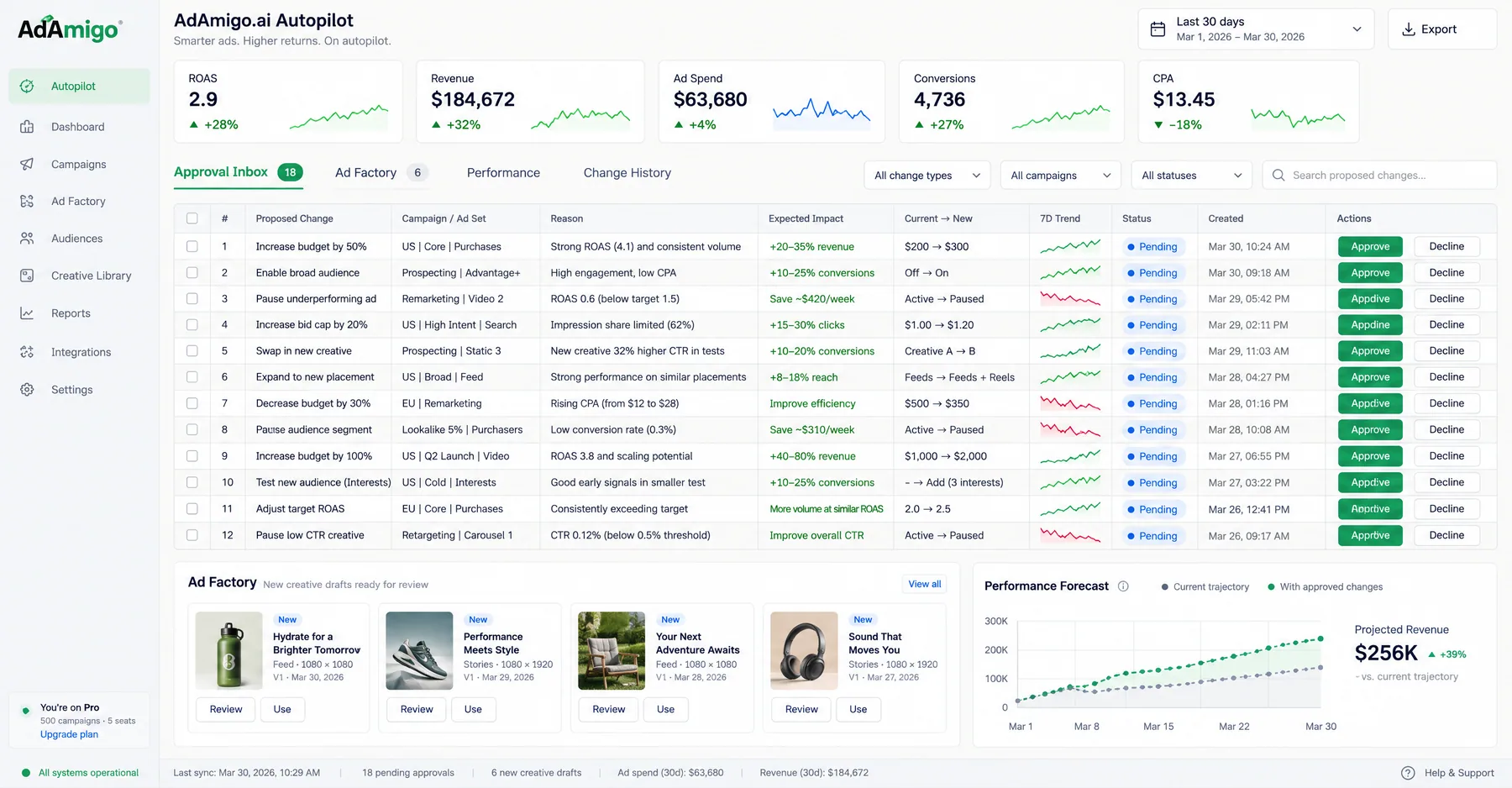
- 24/7 autonomous campaign optimization that adjusts bids, pauses underperformers, and reallocates budget in real time
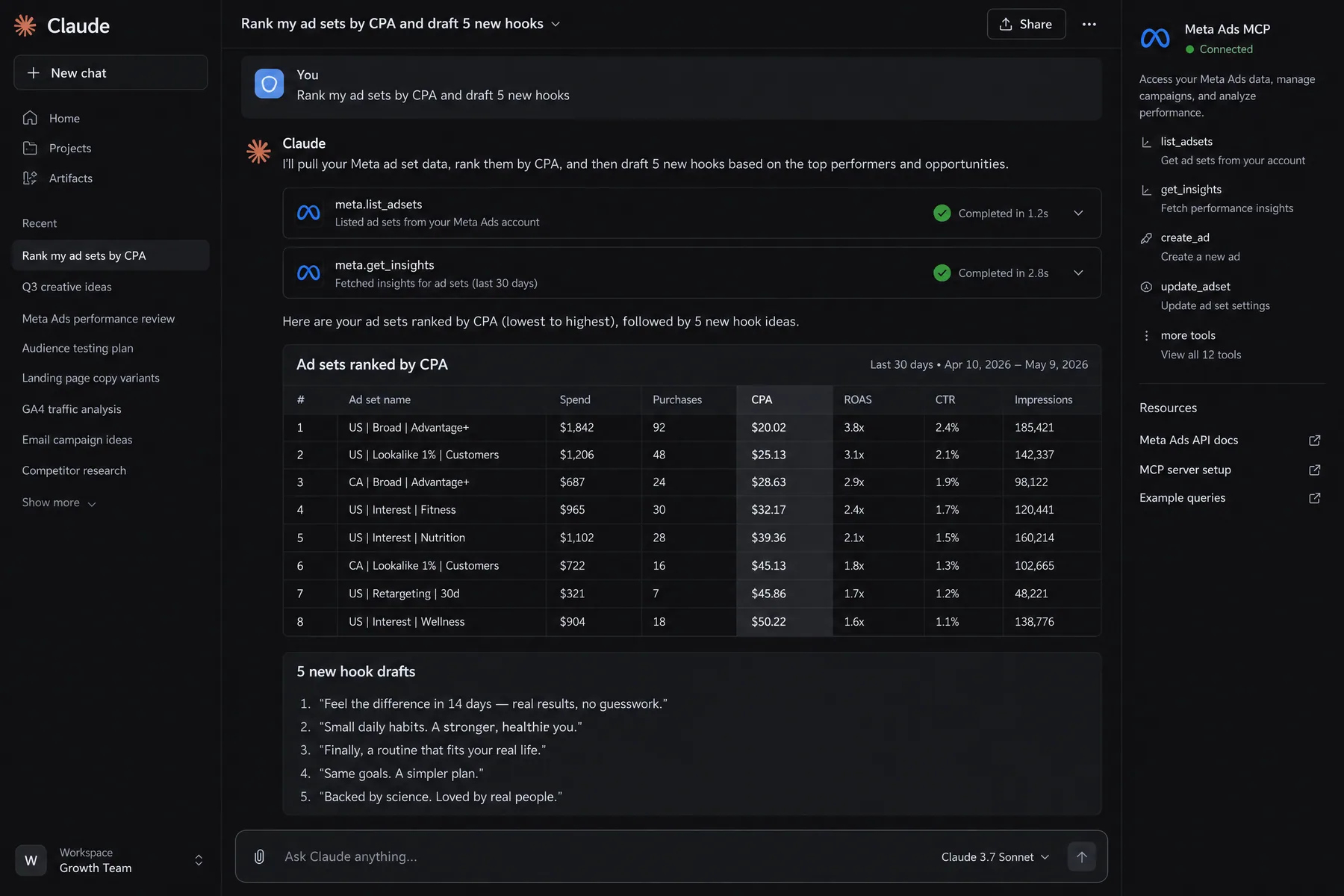
- ChatGPT MCP (Model Context Protocol) integration that lets you manage campaigns through natural language commands inside ChatGPT
- Automated creative fatigue detection and refresh suggestions based on frequency and engagement decay curves
- ROAS-focused optimization engine that prioritizes revenue outcomes over vanity metrics
- Audience overlap analysis to prevent your campaigns from competing against each other
- Advantage+ campaign support with intelligent budget distribution across catalog segments
Pricing: Starts from $100/month for managed optimization. Pricing scales based on ad spend under management. No long-term contracts required.
Pros:
- Truly hands-off management -- the AI does the daily work, not just surface insights
- ChatGPT MCP integration is a genuine differentiator; you can ask "how are my Meta campaigns doing?" and get actionable answers
- 2,000+ active clients speak to platform maturity and reliability
- Strong creative fatigue detection saved meaningful budget during our testing period
- Excellent onboarding -- connected and optimizing within 24 hours
Cons:
- Less granular manual control than rule-based tools like Revealbot for advertisers who want to micromanage every lever
- Managed model means you are trusting the AI to make decisions; some experienced media buyers prefer full manual override
- No free tier available
Our take: Ryze AI delivered the most consistent ROAS improvement across our testing accounts. The combination of always-on optimization and the ChatGPT MCP integration makes it the most forward-looking tool in this category. If you want AI that actually manages your campaigns rather than just analyzing them, this is the one to start with.
2. Madgicx -- Best Budget-Friendly Option
Madgicx has carved out a strong position as the affordable AI tool for Facebook advertisers. It combines audience intelligence, creative analytics, and automated optimization tactics into a single dashboard. The AI Audience Launcher feature is genuinely useful for discovering new targeting angles you might not have considered.
Key features:
- AI Audience Launcher that generates targeting combinations based on your best-performing data
- Automation Tactics -- pre-built rules that pause, scale, or adjust campaigns based on performance thresholds
- Creative intelligence dashboard that tracks performance by visual element, copy angle, and format
- One-click audit tool that flags account structure issues
Pricing: Starts at approximately $44/month for the basic plan. Higher tiers unlock more automation slots and reporting features.
Pros:
- Excellent value for the price -- hard to beat at $44/month
- Creative analytics are genuinely insightful and help identify winning patterns
- The audience launcher saved us hours of manual research
- Clean, intuitive interface that does not overwhelm new users
Cons:
- Automation tactics are rule-based, not truly AI-driven -- you are setting thresholds, not deploying machine learning
- Limited Advantage+ support during our testing; the tool works best with traditional campaign structures
- Reporting can lag behind real-time Meta data by several hours
3. Revealbot -- Best for Rule-Based Automation
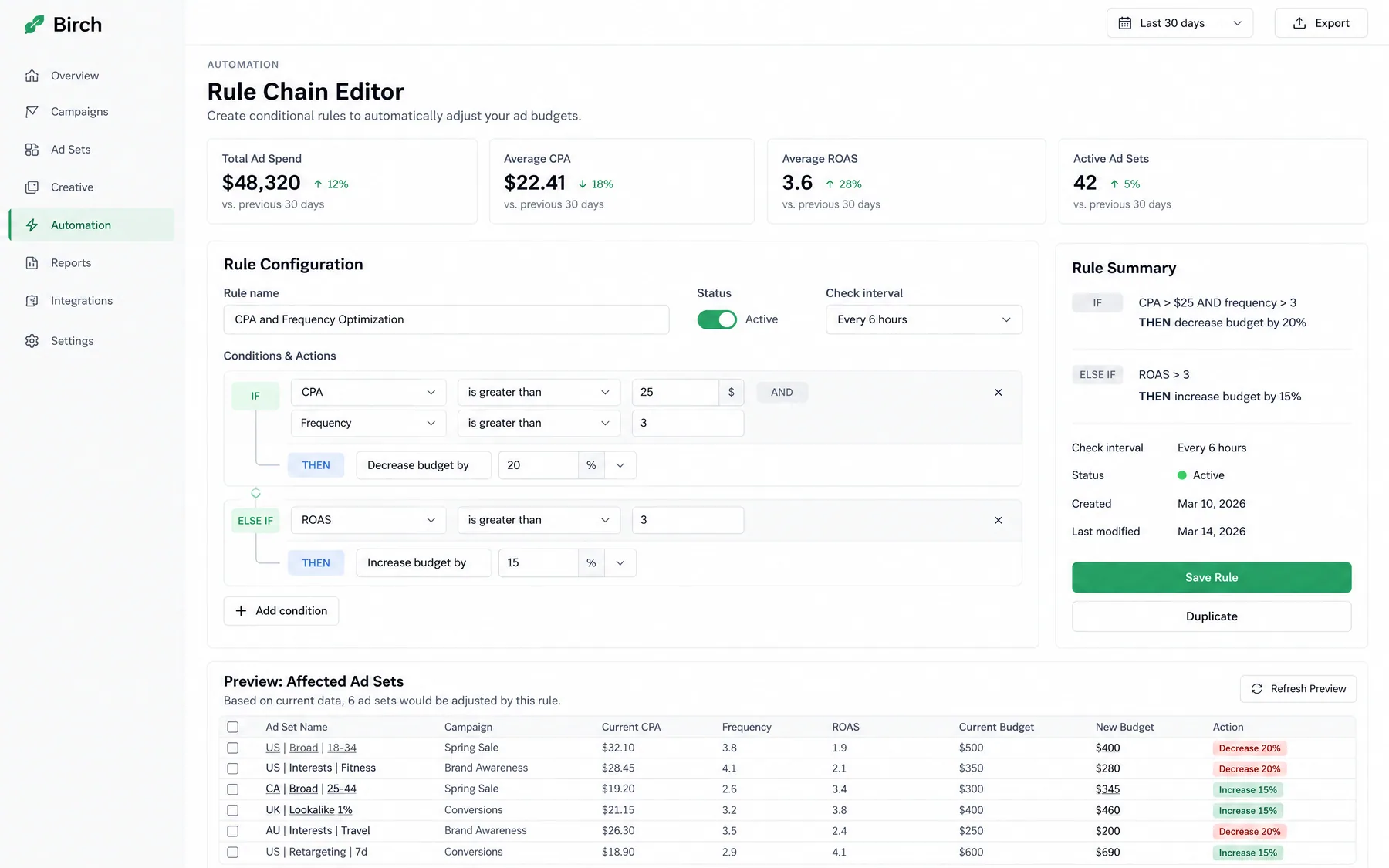
Revealbot is the power tool for media buyers who want maximum control over automated rules. If you think in "if/then" logic and want to automate your specific playbook rather than trust an AI black box, Revealbot is built for you. It supports incredibly granular conditions for pausing, scaling, duplicating, and adjusting campaigns.
Key features:
- Custom automation rules with AND/OR logic across dozens of performance metrics
- Bulk creation tool for launching multiple ad variations quickly
- Slack and email alerts when rules fire, so you always know what changed
- Historical performance reporting with trend visualization
Pricing: Starts from $99/month. Price increases with the number of ad accounts and monthly spend under management.
Pros:
- Most flexible rule builder on the market -- if you can define it, you can automate it
- Excellent Slack integration for real-time notifications
- Trusted by experienced media buyers who want transparency over every automated action
Cons:
- Not AI in the machine learning sense -- it is automation, not intelligence
- Steep learning curve; new advertisers will spend hours configuring rules before seeing value
- No creative generation or audience discovery features
4. AdCreative.ai -- Best for AI Creative Generation
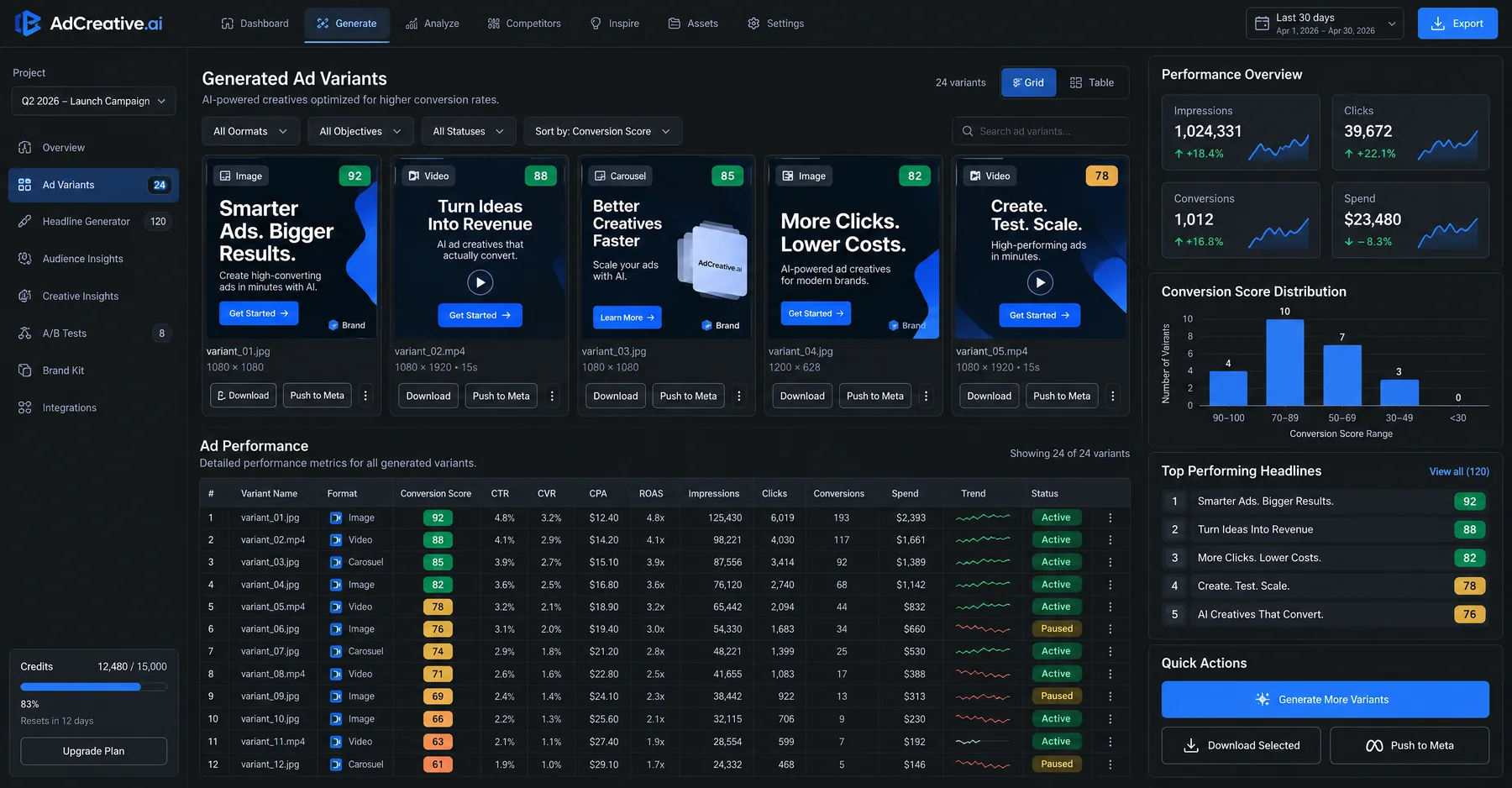
AdCreative.ai focuses on one problem and solves it well: generating ad creatives using AI. You provide your brand assets, product information, and target audience details, and the platform produces static images, video templates, and ad copy variations scored by predicted performance. It does not manage campaigns or optimize bids -- it is purely a creative production tool.
Key features:
- AI-powered ad creative generation for static images, banners, and social formats
- Performance scoring that predicts which creatives will convert best before you spend a dollar
- Brand kit integration to maintain visual consistency across generated assets
- Text and headline generation trained on high-performing ad copy patterns
Pricing: Starts at $29/month for 10 downloads. Higher tiers unlock unlimited downloads and additional brand profiles.
Pros:
- Very affordable entry point for teams that need more creative volume
- Performance prediction scores were surprisingly accurate in our testing -- top-scored creatives outperformed bottom-scored ones roughly 70% of the time
- Saves significant time compared to manual design workflows
Cons:
- Creatives often look template-driven and need human polish before going live
- No campaign management, bid optimization, or audience features whatsoever
- You still need another tool or manual work to actually run and optimize campaigns
5. Smartly.io -- Best for Enterprise Teams
Smartly.io is the enterprise-grade creative automation and campaign management platform that major brands and agencies use to manage Meta advertising at scale. It combines dynamic creative optimization, automated campaign workflows, and cross-channel reporting into a single platform. The tool excels when you are managing hundreds of campaigns with thousands of creative variations.
Key features:
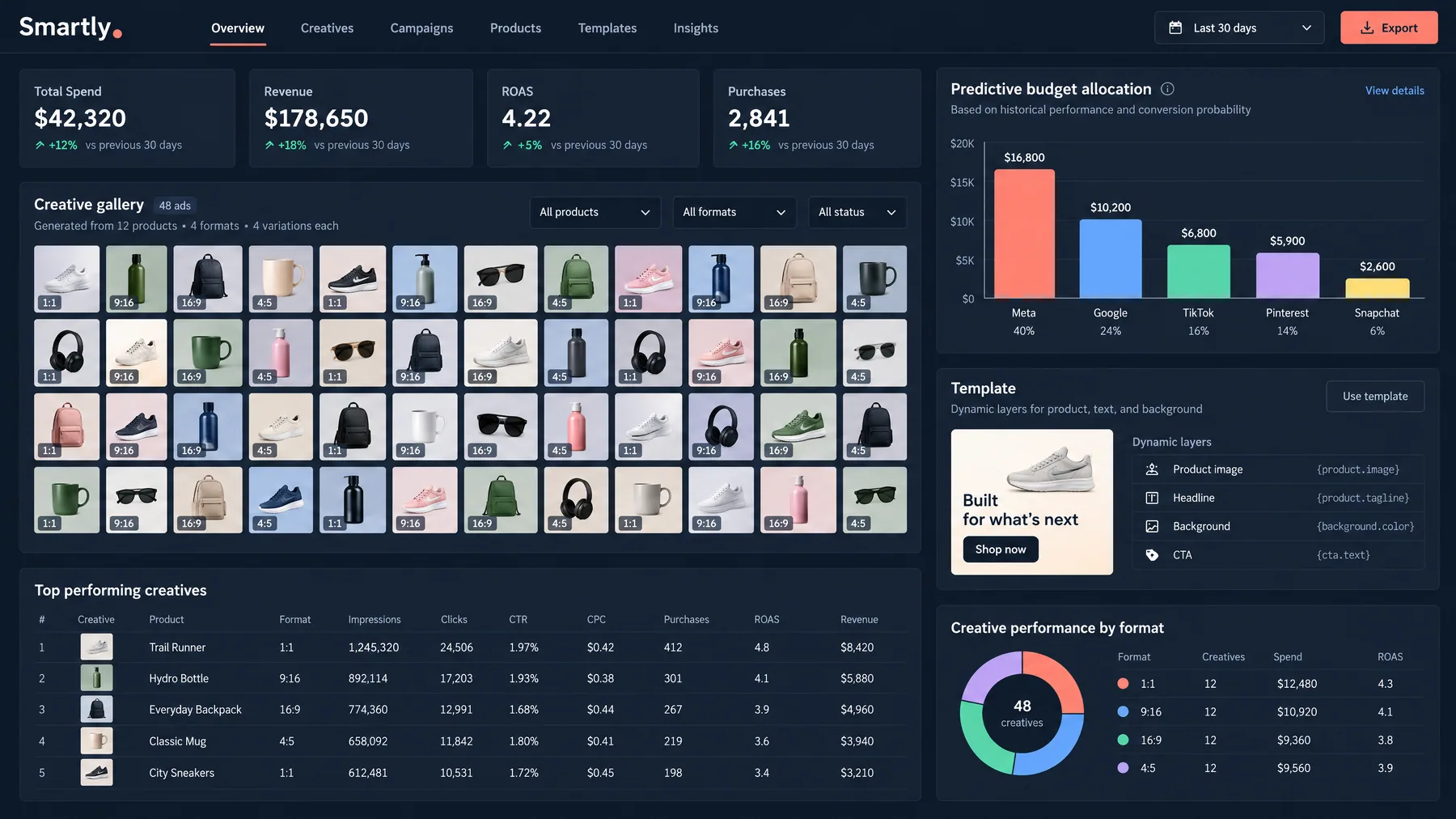
- Dynamic creative templates that auto-generate variations from product feeds
- Predictive budget allocation across campaigns and ad sets
- Cross-channel management spanning Meta, TikTok, Snapchat, Pinterest, and Google
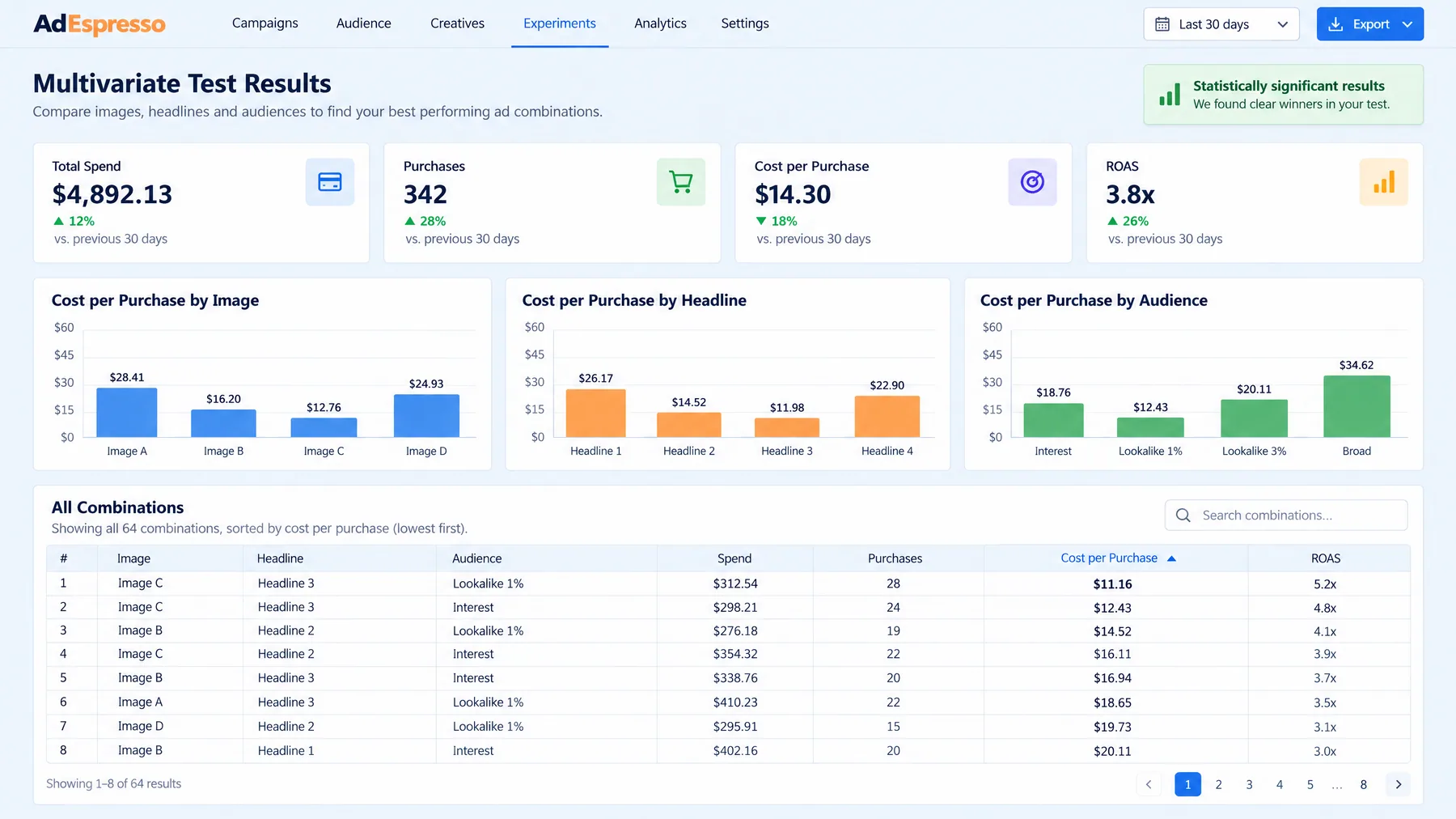
- Advanced A/B and multivariate testing frameworks built into the platform
Pricing: Enterprise pricing only, typically starting in the thousands per month range. You will need to contact their sales team for a quote.
Pros:
- The gold standard for creative automation at scale -- nothing else matches its templating capabilities
- Deep Meta API integration with support for every campaign type including Advantage+
- Excellent for multi-brand or multi-market management
Cons:
- Pricing puts it out of reach for small and mid-size advertisers
- Complex platform requires dedicated training and onboarding time
- Overkill if you are managing fewer than 20 campaigns at a time
6. Adzooma -- Best Free Starting Point
Adzooma offers a free tier that provides basic optimization suggestions across Meta, Google, and Microsoft ads. It is a useful starting point for small businesses that want a single dashboard to monitor multiple ad platforms. The AI generates weekly optimization recommendations that you can apply with one click.
Key features:
- One-click optimization suggestions based on account performance patterns
- Multi-platform dashboard for Meta, Google, and Microsoft ads
- Automated reporting with client-friendly templates
- Performance alerts for budget pacing and anomaly detection
Pricing: Free tier available with limited features. Pro plan at $99/month for full automation and advanced reporting.
Pros:
- Free tier is genuinely useful, not just a teaser
- Simple interface makes it accessible for beginners
- Multi-platform view is convenient for teams running ads across multiple networks
Cons:
- Optimization suggestions are often generic and surface-level
- Meta-specific features are shallow compared to dedicated Facebook ad tools
- No creative generation, audience discovery, or advanced attribution features
7. Trapica -- Best for AI Audience Targeting
Trapica markets itself as an AI layer that sits on top of your Meta ads and autonomously expands and refines your audiences. The core idea is compelling: instead of you guessing which interests and demographics to target, Trapica analyzes engagement and conversion signals in real time and adjusts targeting parameters automatically.
Key features:
- Autonomous audience expansion based on real-time conversion signals
- Cross-channel audience intelligence spanning Meta, Google, and LinkedIn
- Sentiment and engagement analysis for creative feedback
- Automatic demographic and interest exclusions to reduce wasted spend
Pricing: Custom pricing based on ad spend. You will need to request a demo to get a quote.
Pros:
- Genuinely innovative approach to audience targeting that goes beyond standard Meta tools
- Reduced our CPA by identifying and excluding low-intent audience segments we would have missed
- Works well alongside Advantage+ by providing an additional intelligence layer
Cons:
- Black-box AI makes it hard to understand why specific targeting decisions were made
- Custom pricing with no transparent starting point makes it difficult to budget for
- No creative tools -- purely a targeting and audience optimization play
8. Pencil -- Best for AI Video Ad Creation
Pencil (now part of the Brandtech Group) uses AI to generate video ad creatives from existing brand assets. You upload your product images, video clips, logos, and copy, and the platform generates multiple video ad variations optimized for different placements including Meta feed, Stories, and Reels.
Key features:
- AI video generation from static assets -- turns images and text into video ads
- Performance prediction engine that scores each generated creative
- Format-aware generation for Stories (9:16), feed (1:1), and in-stream (16:9)
- Competitive creative analysis to identify trends in your vertical
Pricing: From $49/month for small teams. Enterprise pricing available for agencies and larger brands.
Pros:
- Solves the video creative bottleneck that holds many Meta advertisers back from Stories and Reels placement
- Performance predictions were reasonably accurate for top-tier creative identification
- Quick turnaround -- generate dozens of video variations in minutes, not days
Cons:
- Video quality varies significantly; many outputs feel generic without heavy customization
- No campaign management or optimization features -- creative generation only
- Requires good source assets to produce quality output; garbage in, garbage out
9. Sotrender -- Best for Facebook Analytics and Reporting
Sotrender is a social media analytics platform with deep Facebook and Instagram reporting capabilities. It does not manage or optimize campaigns directly. Instead, it provides detailed performance analysis, competitor benchmarking, and audience insights that inform your campaign strategy. Think of it as an intelligence layer rather than an execution tool.
Key features:
- Deep Facebook page and ad performance analytics with historical trend data
- Competitor benchmarking across engagement rates, posting frequency, and audience growth
- Automated reporting with customizable templates and scheduled delivery
- Audience demographic breakdown and activity pattern analysis
Pricing: From $59/month for the starter plan. Higher tiers add more profiles and advanced reporting features.
Pros:
- Excellent competitor analysis that Meta native tools do not provide
- Clean, well-designed reports that are client-presentation ready
- Useful for agencies that need to demonstrate value through detailed reporting
Cons:
- No campaign optimization, bid management, or creative generation -- purely analytics
- AI capabilities are limited to trend identification and recommendations, not autonomous action
- Overlaps significantly with Meta Business Suite native analytics for basic reporting needs
10. Hootsuite Ads -- Best for Social-First Teams
Hootsuite is primarily a social media management platform, but its advertising module lets you create and manage Meta ads alongside your organic social strategy. The AI features are limited compared to dedicated ad tools, but the unified organic-plus-paid workflow can be valuable for teams where the same people manage both channels.
Key features:
- Unified dashboard for organic posting, scheduling, and paid ad management
- Auto-boost feature that promotes top organic posts as ads based on engagement thresholds
- Basic audience targeting suggestions and budget recommendations
- Cross-platform ad management spanning Meta, LinkedIn, and X
Pricing: From $99/month for the Professional plan. Ad management features require the Team plan or higher.
Pros:
- Convenient for teams already using Hootsuite for organic social management
- Auto-boost feature is a genuinely useful bridge between organic and paid
- Familiar interface for social media managers stepping into paid advertising
Cons:
- Ad management features are basic compared to every other tool on this list
- AI capabilities are minimal -- mostly limited to post boosting suggestions
- No creative fatigue detection, audience overlap analysis, or advanced optimization
- Poor choice if Meta advertising is your primary channel -- you will outgrow it quickly
What to Look For in Meta Ads AI
Not all AI tools are built for the specific challenges of Meta advertising. The platform has unique dynamics that generic ad optimization tools handle poorly. Here is what actually matters when evaluating tools for Facebook and Instagram ads.
Creative Fatigue Detection
Meta ads fatigue faster than almost any other channel because users scroll through hundreds of posts per session. A creative that performs brilliantly in week one can see its CTR drop by 40-60% by week three. The best AI tools detect fatigue before it tanks your performance by monitoring frequency caps, engagement decay curves, and cost-per-result trends at the ad level. Tools that only report weekly averages will miss this entirely.
Audience Overlap Management
If you are running more than a handful of ad sets, your audiences are almost certainly overlapping. This means your campaigns are bidding against each other, driving up CPMs, and confusing Meta's delivery algorithm. Good AI tools automatically detect overlap percentages, recommend consolidation, and can even redistribute budgets to avoid internal competition. This is a Meta-specific problem that generic tools ignore.
Advantage+ Optimization
Meta's Advantage+ campaigns (especially Shopping campaigns) are increasingly important for e-commerce advertisers. These campaigns use Meta's own AI for targeting and placement, which means third-party tools need to work with Advantage+ rather than against it. The best tools focus on creative input optimization, catalog segmentation, and budget allocation for Advantage+ campaigns rather than trying to override Meta's native AI.
Attribution Handling
Meta's attribution model (default 7-day click, 1-day view) tells a different story than Google Analytics, your CRM, and your actual revenue data. AI tools that rely solely on Meta-reported conversions will optimize toward Meta's version of reality, which is often inflated. The best tools either integrate with third-party attribution solutions or provide their own cross-reference analysis to help you make decisions based on more complete data.
Real-Time vs. Batch Optimization
There is a significant difference between tools that analyze your data once per day and recommend changes versus tools that monitor and adjust continuously. Meta campaigns can shift dramatically within hours due to auction dynamics, competitor activity, and audience saturation. Tools operating on 24/7 monitoring cycles (like Ryze AI) will catch and correct performance dips that daily-batch tools miss entirely.
Frequently Asked Questions
Do I really need an AI tool if Meta already has Advantage+ and built-in automation?
Meta's native AI handles targeting and delivery optimization within campaigns, but it does not manage your account holistically. It will not detect that three of your ad sets overlap by 70%, suggest pausing a fatigued creative before it drags down your ad set, or reallocate budget from your worst campaign to your best one. Third-party AI tools provide the strategic layer that Meta's native tools lack. Think of Advantage+ as the engine and third-party AI as the driver.
What budget do I need before AI tools are worth using?
Most AI tools need sufficient data to learn from. As a general rule, if you are spending less than $1,500/month on Meta ads, the data volume may be too low for AI optimization to outperform careful manual management. Between $1,500 and $5,000/month, a budget-friendly tool like Madgicx or AdCreative.ai makes sense. Above $5,000/month, a full-service optimization tool like Ryze AI will almost certainly pay for itself through efficiency gains.
Can AI tools work alongside my existing media buyer or agency?
Yes, and this is actually the ideal setup for many advertisers. Tools like Revealbot and Madgicx are designed to augment a media buyer's workflow by automating the repetitive tasks (rule execution, reporting, budget pacing) while leaving strategic decisions to humans. Ryze AI works as a managed layer that can either replace or complement a media buyer depending on your needs. The key is ensuring both the tool and the human are aligned on the same strategy.
How long does it take for AI optimization to show results?
Expect a learning period of 7-14 days for most tools. During this phase, the AI is ingesting your historical data, understanding your conversion patterns, and establishing performance baselines. You should see initial optimization actions within the first week and measurable ROAS or CPA improvements within 2-4 weeks. Tools that promise instant results on day one are overselling -- meaningful AI optimization requires data and time.
What about privacy changes and iOS tracking -- do AI tools still work?
Post-iOS 14.5 signal loss has affected all Meta advertising tools, including AI platforms. However, the best AI tools have adapted by incorporating server-side tracking (Conversions API data), modeling estimated conversions, and using first-party data signals more heavily. Tools that rely exclusively on pixel data without CAPI integration are significantly disadvantaged. When evaluating tools, ask specifically about their Conversions API support and how they handle modeled attribution data.
Is it safe to give an AI tool access to my Meta ad account?
All reputable tools on this list use Meta's official Business API and require standard partner permissions. They do not store your ad account credentials. You can revoke access at any time through Meta Business Settings. That said, you should always start with limited permissions and only grant campaign editing access once you are comfortable with the tool's recommendations. Most tools offer a read-only audit mode that lets you evaluate the platform before granting write access.
Final Verdict
After testing all ten tools with real budgets on real campaigns, the ranking comes down to what you actually need.
For most advertisers spending $5,000+ per month on Meta ads, Ryze AI is the best choice. It is the only tool that combines always-on autonomous optimization with genuine AI intelligence (not just rule-based automation). The ChatGPT MCP integration is not a gimmick -- it fundamentally changes how you interact with campaign data. And at $100/month managed, it delivers more value per dollar than any other tool we tested.
If budget is your primary constraint, start with Madgicx at $44/month. It will not match Ryze AI's autonomous optimization, but its audience launcher and creative analytics are strong enough to improve most accounts.
If you are an enterprise or agency managing $100,000+ monthly, Smartly.io provides the scale, creative automation, and cross-channel management that justify its premium pricing.
If creative production is your bottleneck, pair AdCreative.ai ($29/month) with your existing campaign management workflow. It will not manage your campaigns, but it will ensure you never run out of fresh creatives to test.
If you want maximum control over every automated action, Revealbot's rule builder is unmatched. Just know that you are building automation, not deploying intelligence.
The tools that scored lowest -- Hootsuite Ads and Sotrender -- are not bad products. They are just not built for serious Meta advertising optimization. If Meta ads are your primary growth channel, you need a tool built specifically for that purpose.
The Meta advertising landscape in 2026 rewards speed, creative volume, and data-driven decision making. AI tools are no longer optional for competitive advertisers. The question is not whether to use one, but which one fits your specific situation.