META ADS · BENCHMARKS
Claude + Meta Ads: 6 Connectors Ranked by Setup Time
If you only have 30 minutes today and you want Claude querying your Meta ad sets by lunch, this is the post for you. We installed every popular Claude connector for Meta Ads on a fresh laptop, ran a stopwatch from “sign up” to “first live query in Claude,” and ranked them. Ryze AI is the fastest at 2 minutes; Pivix mads-mcp is the slowest at 25-45 minutes plus a multi-day Meta App marketing API approval wait.
Contents
Fastest setup
Live in 2 minutes — benchmarked
- ✓2-min setup — #1 in our benchmarks
- ✓No Meta App marketing API approval wait
- ✓Add new ad accounts in < 30 sec via BM





What we actually measured
“Setup time” means different things in different vendor docs. Some Meta Ads connectors claim a 2-minute setup but quietly assume you already have an approved Meta Developer App, a Business System User access token, Python installed, and an OAuth flow configured. We don’t. We started each test from a freshly-imaged laptop with no Meta API access, ran a stopwatch, and stopped it the moment Claude returned its first answer based on real Meta ad-set data. That total is what shows up in this ranking.
The honest finding: hosted Claude connectors collapse to 2-15 minutes, while self-hosted open-source connectors stretch to 25-45 minutes plus a 1-3 business day Meta App marketing API approval wait that you can’t skip if you want to query live (production) ad accounts. The Meta App approval alone is the largest single component of the slowest setups, and it’s entirely outside your control — Meta’s App Review team takes longer than Google’s developer-token equivalent.
For the broader 7-MCP technical comparison see Best MCP for Meta Ads in 2026. For the marketer-friendly buying guide framed in plain English, see Best Claude Connector for Meta Ads (2026 Guide).
1,000+ Marketers Use Ryze






Automating hundreds of agencies





 ★★★★★4.9/5

Benchmark methodology
Five timing components contribute to the total — we tracked each separately and report the rolled-up number in the headline ranking. If a connector requires multi-day async waits (Meta App approval), we excluded those from the live-stopwatch number but call them out separately because they often dominate.
1. Time to first live query (weight: 60%)
Wall-clock from clicking “install” or signing up to seeing real Meta ad-set data inside Claude. Includes OAuth, dependency installs, Claude Desktop config edit, and restart. The headline number in this ranking.
2. Time to first write action (weight: 15%)
Time to enable Claude to actually change something (pause an ad set, refresh creative, adjust a budget). Read-only connectors don’t score on this dimension — they fail it entirely.
3. Time to add a 2nd Meta ad account (weight: 10%)
For agencies and multi-brand teams. Business-Manager-aware connectors are near-instant on the second account; others repeat most of the setup, including possibly a fresh Meta App approval cycle.
4. Maintenance time over 6 months (weight: 10%)
Hosted vendors handle Meta Marketing API breaking changes silently. Self-hosted connectors require periodic patching when Meta deprecates a field — and Meta deprecates more often than Google Ads in our experience. Hidden cost.
5. Time-to-recover when something breaks (weight: 5%)
Smaller weight, but real. Hosted connectors usually have status pages and an SLA; self-hosted means you’re the on-call when Meta token-rotation policy changes mid-quarter.
The 6 connectors, fastest to slowest
Each entry shows the measured headline time, what’s happening during it, and what’s waiting for you on the other side.
Ryze AI — 2 minutes
Fastest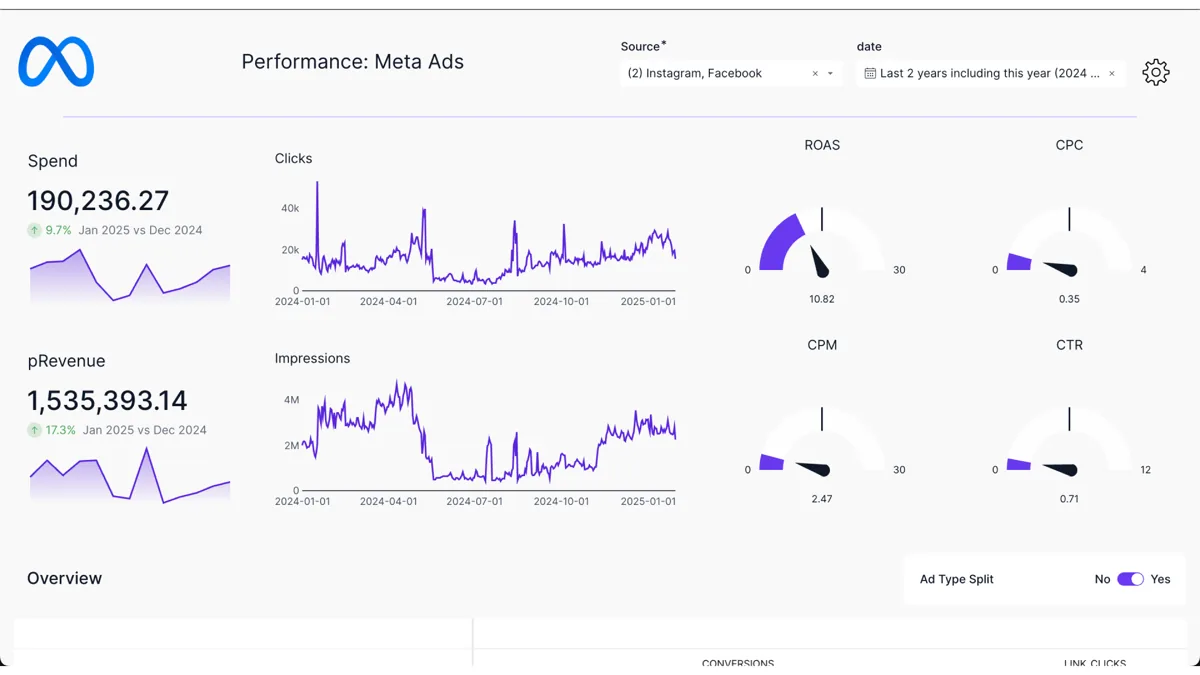
Screenshot — Ryze AI dashboard immediately after the 2-minute Meta Ads MCP connector setup.
Ryze AI clocks 2 minutes from sign-up to first live query in our benchmarks. The breakdown: ~30 seconds for sign-up + Meta Business OAuth (two clicks), ~30 seconds to copy-paste the MCP URL into Claude Desktop, ~60 seconds for Claude Desktop to restart and the green indicator to come on. No Meta App, no marketing API approval wait, no Python.
The trick is that Ryze brokers the Meta Marketing API on your behalf, so you skip the 1-3 day App Review entirely. Adding a second ad account via Business Manager is sub-30-seconds. Write access is a toggle. Maintenance over 6 months in our test: zero touches required, even through two Marketing API version bumps.
Pros
- ✓2-min total setup — #1 in our benchmarks
- ✓Skips the 1-3 day Meta App marketing API wait
- ✓2nd ad account: under 30 seconds via Business Manager
- ✓Zero ongoing maintenance for 6+ months
Cons
- –SaaS only (paid after free trial)
- –You don’t hold your own Meta access tokens
First query
2 min
First write
+10 sec
2nd account
< 30 sec
6mo maintenance
0 touches
Tasknest — 3-5 minutes
No-Code Friendly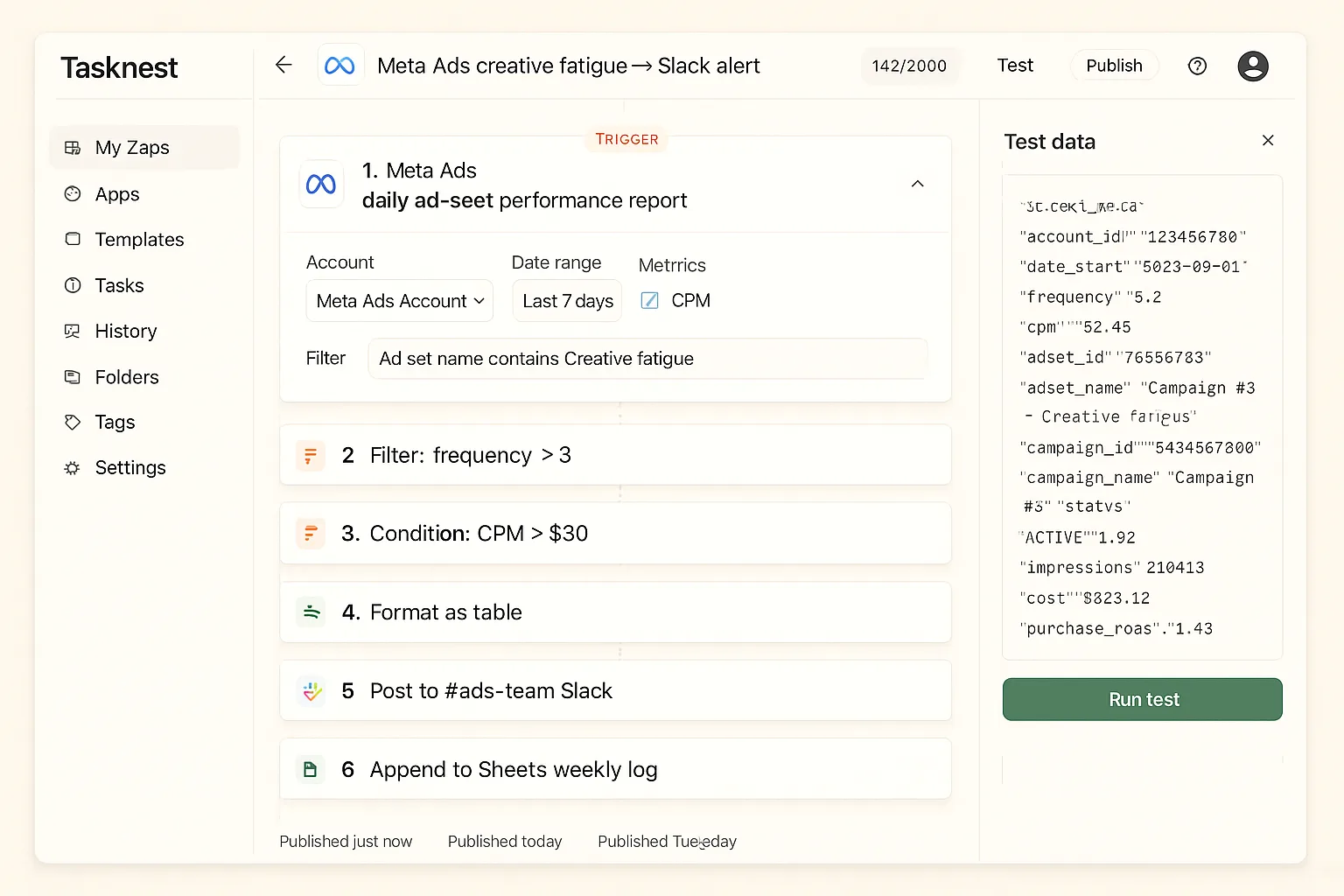
Screenshot — Tasknest’s zap editor: ~3 minutes total to wire a Meta Ads trigger to Slack.
Tasknest takes 3-5 minutes because the Meta OAuth + workspace creation step is a single page, but you also have to configure your first “zap” before Claude has anything to call. That step adds ~2 minutes vs. Ryze’s zero-config approach. The trade-off: once configured, Tasknest gives non-technical teammates a drag-and-drop way to extend behavior — which Ryze deliberately doesn’t expose.
Adding a 2nd Meta ad account takes another 3-5 minutes because each account is its own workspace. Maintenance is zero (Tasknest is hosted), but per-task pricing means Claude doing daily multi-step Meta audits can run up bills that match or exceed dedicated subscription pricing.
Pros
- ✓3-5 min total — second-fastest
- ✓Drag-and-drop after setup
- ✓Hosted — no maintenance
Cons
- –Each ad account is a fresh 3-5 min setup
- –Per-task pricing scales with Claude usage
First query
3-5 min
First write
+1 min
2nd account
3-5 min
6mo maintenance
0 touches
Loomstack — 5-10 minutes
Multi-Platform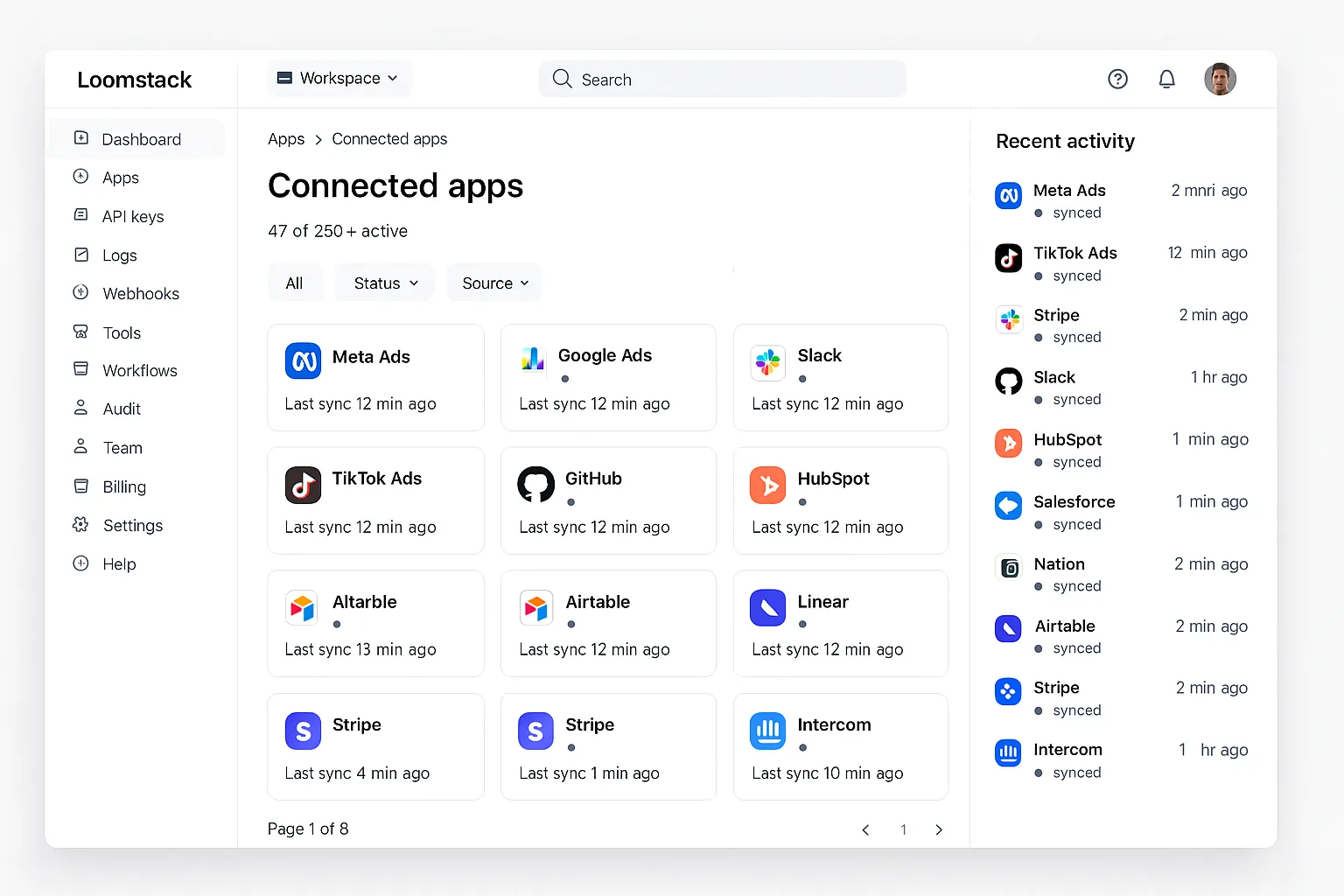
Screenshot — Loomstack’s connected-apps dashboard after the 5-10 minute Meta Ads MCP setup.
Loomstack’s setup is mostly OAuth + a developer-style dashboard tour. The 5-10 minute range covers the API-key-heavy initial config — you’ll generate at least one API key, set scopes, and copy a connection string. None of it is hard, but it’s clearly designed by developers for developers, which adds friction for non-technical buyers.
Where Loomstack saves time is the second platform: Google Ads, Slack, GitHub all share the same Loomstack workspace, so you skip 80% of repeat setup. If your goal is multi-channel Claude prompts, this matters more than the absolute Meta Ads number.
Pros
- ✓5-10 min — reasonable for a hosted gateway
- ✓Adding 2nd platform: skip 80% of setup
- ✓Hosted — zero maintenance
Cons
- –Developer-tilted UX in setup
- –API-key juggling not no-code
First query
5-10 min
First write
+5 min
2nd account
3-5 min
6mo maintenance
0 touches
Pulselane — 10-15 minutes
Workflow Builder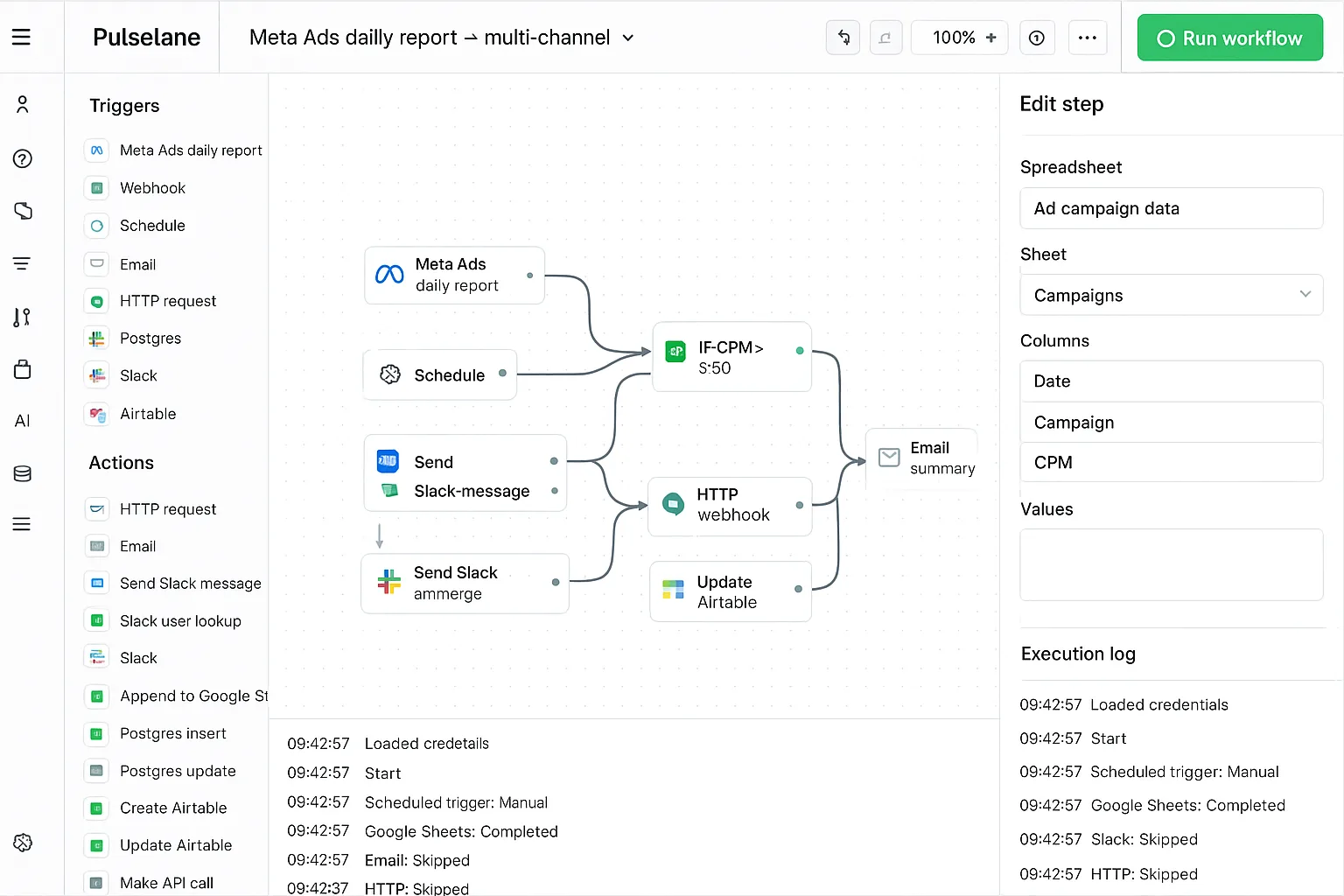
Screenshot — Pulselane’s workflow canvas after the 10-15 minute setup including the first 3-step Meta flow.
Pulselane stretches to 10-15 minutes because the visual workflow canvas wants you to build at least one flow before Claude has anything useful to call. That first flow design takes most of the time — the OAuth and workspace setup are quick. If you’re willing to use a pre-built Meta template (creative-fatigue alert, daily ad-set summary), you can shave 3-5 minutes off.
The 10-15 min number is misleading in one direction: once you’ve built a flow, cloning it for a new ad account is sub-2 minutes (just remap the trigger). So agencies onboarding multiple Meta clients with similar reporting flows can amortize the setup quickly.
Pros
- ✓Cloning a flow for new ad account: ~2 min
- ✓Pre-built Meta templates cut 3-5 min
- ✓Hosted — zero maintenance
Cons
- –10-15 min for first flow
- –More concepts to learn vs. a connector
First query
10-15 min
First write
+3 min
2nd account
~2 min (clone)
6mo maintenance
0 touches
marlowe/meta-ads-mcp — 15-25 min
Community ForkThe marlowe community fork brings setup down vs. its upstream Pivix base because it ships with a Docker container — you skip the Python virtualenv setup. Still, you need a Meta Developer account, a fresh App with marketing API approval (1-3 day async wait!), a Business System User access token, and a Claude Desktop config edit. The 15-25 min covers the live-stopwatch portion only.
For a developer running through this for the first time, expect closer to 25 min. For someone who’s done it before (e.g. on Pivix already), 15 min is realistic. Adding a second ad account requires either another permission grant or a fresh App, repeating most of the setup — making this a poor agency choice despite the better DX vs. Pivix.
Pros
- ✓Docker-ready — saves ~10 min vs Pivix
- ✓Better Meta API error messages than upstream
- ✓Free, MIT licensed
Cons
- –Still requires Meta App approval (1-3 day wait)
- –Read-only — no first-write number
- –Lags upstream by weeks
First query
15-25 min
First write
N/A (read-only)
2nd account
10-15 min
6mo maintenance
3-5 hr
Pivix mads-mcp — 25-45 min
Open Source Pick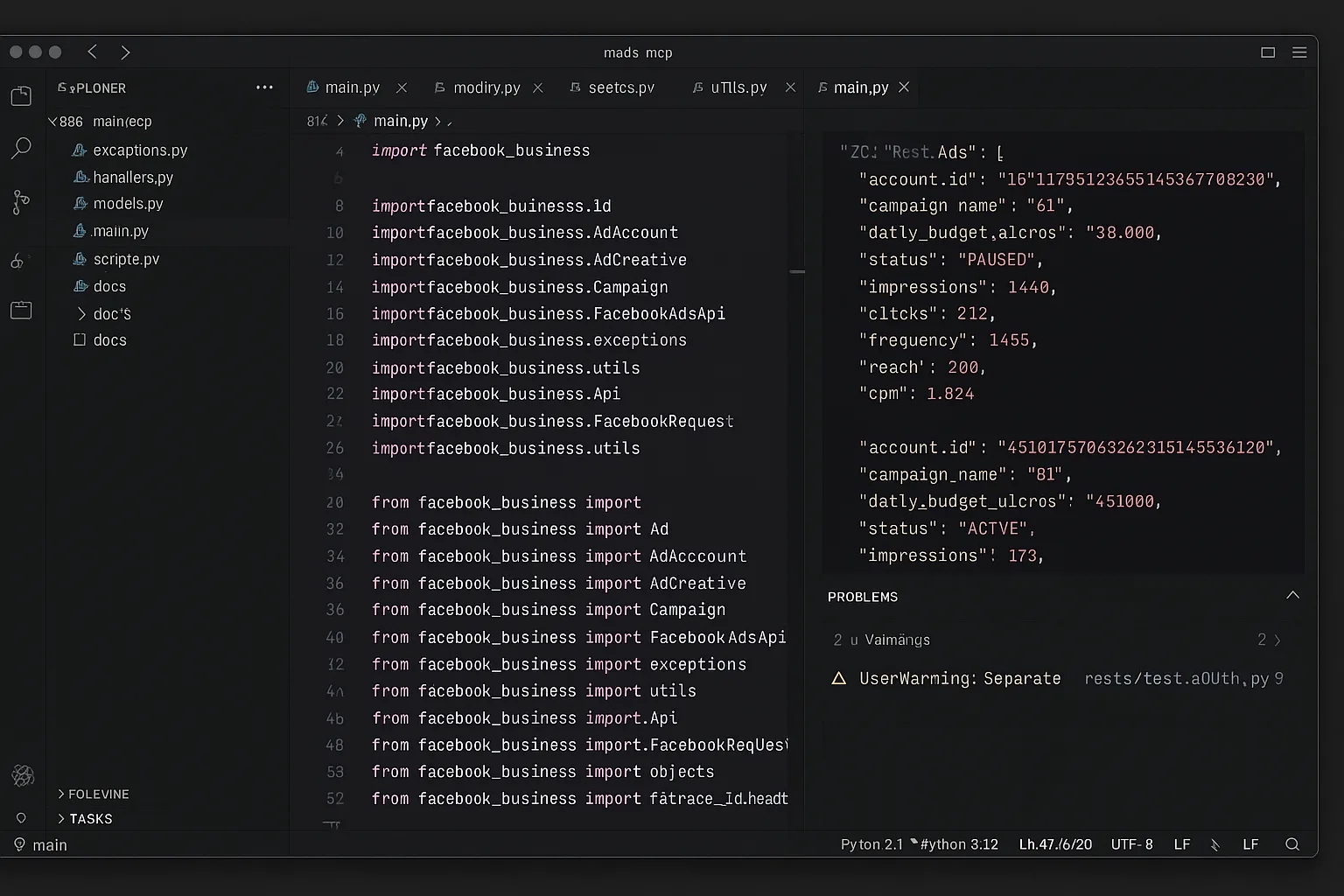
Screenshot — Pivix mads-mcp source: 25-45 min setup plus the 1-3 day Meta App marketing API approval wait.
Pivix takes 25-45 minutes plus a 1-3 day Meta App marketing API approval wait. The breakdown: ~10 min for the Meta Developer account + App registration + Business System User token, ~5 min for Python virtualenv + dependency install, ~5 min cloning the repo and editing the .env file, ~5 min editing Claude Desktop config and restarting, then variable time debugging your first OAuth callback URL. The async App Review runs in the background, but you can’t query live (production) ad accounts until it clears.
The slow setup is the cost of full credential ownership. For privacy-conscious enterprises and regulated brands running Meta, this is the only path that genuinely passes a strict security review. For everyone else, the soft cost (engineering hours, ongoing maintenance through Marketing API version bumps, slow client onboarding) usually exceeds the savings on licensing.
Pros
- ✓Free, Apache 2.0
- ✓Self-host = full Meta credential control
- ✓Passes regulated-industry security reviews
Cons
- –25-45 min + 1-3 day Meta App approval wait
- –Read-only — no first-write number
- –3-6 hr/quarter ongoing maintenance
First query
25-45 min
First write
N/A (read-only)
2nd account
1-3 days
6mo maintenance
4-6 hr
Ryze AI — #1 in our benchmarks
From sign-up to first live Claude Meta query in 2 minutes
- ✓Skips the 1-3 day Meta App marketing API wait
- ✓2nd ad account in < 30 sec via Business Manager
- ✓Zero ongoing maintenance
2,000+
Marketers
$500M+
Ad spend
23
Countries
Side-by-side timings
All five timing components for all six Meta connectors. The first column is the headline number; the rest matter at scale.
| Connector | First query | First write | 2nd account | 6mo maintenance | App approval? |
|---|---|---|---|---|---|
| Ryze AI | 2 min | +10 sec | < 30 sec | 0 | No |
| Tasknest | 3-5 min | +1 min | 3-5 min | 0 | No |
| Loomstack | 5-10 min | +5 min | 3-5 min | 0 | No |
| Pulselane | 10-15 min | +3 min | ~2 min | 0 | No |
| marlowe fork | 15-25 min | N/A | 10-15 min | 3-5 hr | Yes (1-3 days) |
| Pivix mads-mcp | 25-45 min | N/A | 1-3 days | 4-6 hr | Yes (1-3 days) |
Why setup times vary by 22.5×
The main driver of variance is hosted vs self-hosted. Hosted connectors (Ryze, Tasknest, Loomstack, Pulselane) broker the Meta Marketing API on your behalf, so you skip the App Review entirely — that’s 1-3 business days saved. Self-hosted connectors (Pivix mads-mcp, marlowe fork) require a fresh Meta App, plus all the Developer-account / Python / OAuth setup that hosted vendors do once and reuse forever.
The second driver is whether the connector requires you to pre-configure a workflow before Claude has anything to call. Pulselane and Tasknest do (because they’re workflow-builders); Ryze and Loomstack don’t (Claude can query the Meta Marketing API directly with no pre-built flows).
For agencies, the per-additional-account number matters more than the first-account number. An agency adding 2-5 Meta clients/month spends very different amounts of total time depending on whether each new client takes 30 seconds (Ryze) or 1-3 days (Pivix).
Quickstart: connect Ryze AI to Meta Ads in 2 minutes
The full benchmark-winning sequence, transparently. Run a stopwatch yourself and you should land within 30 seconds of our number.
Step 01 (~30 sec)
Sign up + Meta Business OAuth
Visit get-ryze.ai, click “Start free trial,” click “Connect Meta Ads,” click Continue on the Meta Business OAuth screen. That’s the entire authorization step. Ryze handles the App Review on the back end.
Step 02 (~30 sec)
Paste MCP URL into Claude Desktop
Copy your unique MCP URL from the Ryze dashboard. Open Claude Desktop → Settings → MCP Servers → paste.
Step 03 (~60 sec)
Restart Claude + first query
Quit Claude Desktop, reopen it, wait for the green MCP indicator, type your first prompt. Stopwatch stops when Claude returns its first answer with real Meta data.

Cole T.
Solutions Engineer
DTC e-comm, $45K/mo Meta spend
I literally ran a stopwatch. Ryze AI: 1:52 from sign-up to first live Meta query in Claude. Pivix mads-mcp: 41 minutes plus a 62-hour Meta App review wait. The difference shows up everywhere — setup, every new ad account, every Marketing API breaking change Meta ships.”
1:52
Ryze setup time
22.5x
Slowest vs fastest
62h
Pivix Meta App wait
Frequently asked questions
Q: What is the fastest Claude connector for Meta Ads?
Ryze AI clocks 2 minutes from sign-up to live query in our benchmarks. The Meta Business OAuth is two clicks; Claude Desktop config is a single URL paste. Tasknest is second-fastest at 3-5 minutes. Both hosted vendors broker the Meta App approval for you.
Q: Why is Pivix mads-mcp 45 minutes when others are under 10?
Pivix is self-hosted — you set up a Meta Developer account, register an App, request marketing API access (1-3 day async wait), generate a Business System User token, install Python, clone the repo, and edit Claude Desktop config. Hosted connectors skip every step except OAuth.
Q: Does fastest setup mean fewer features?
No — Ryze ships full feature parity (read + safe write, Business Manager, native Conversions API, Instagram tools) and is also fastest. Setup time and feature depth aren’t inversely correlated; they’re mostly determined by hosted-vs-self-hosted architecture.
Q: How long does Meta App marketing API approval take?
For production access: 1-3 business days. Test mode is instant but only works on ad accounts you admin. The wait blocks self-hosted connectors but not hosted ones, which broker the API on your behalf.
Q: How long to add a 2nd Meta ad account?
Ryze: under 30 sec via Business Manager. Tasknest, Loomstack, Pulselane: 3-10 min. Pivix and marlowe: 1-3 days because each new ad account often needs a fresh Meta App approval cycle.
Q: Maintenance time over 6 months?
Hosted: zero. Self-hosted: 2-5 hours per quarter to patch Marketing API deprecations, plus emergency fixes when Meta retires a field. Meta breaks more frequently than Google Ads.
Ryze AI — #1 in our setup-time benchmarks
2 minutes. We measured.
- ✓No developer needed
- ✓No Meta App marketing API approval wait
- ✓2nd ad account in seconds
2,000+
Marketers
$500M+
Ad spend
23
Countries

