Claude Marketing Skills: The Complete 2026 Guide
Claude marketing skills are reusable instruction files that teach Claude a specific marketing job — audit wasted spend, diagnose a CPA spike, write the weekly report. 30 open-source skills for Google Ads and Meta Ads, copy-paste prompts, install steps for claude.ai and Claude Code, and how to write your own.
Built by our community of 2,000 marketers
Free skills and prompts for paid ads and SEO
Templates for Claude, ChatGPT and Perplexity.
Clients we work withClients we
work with







30-second setup
Connect Claude to your ad accounts
Copy the link, then in Claude: Settings → Connectors → Add custom connector.
https://connector.get-ryze.ai/mcp Google Ads
 Meta Ads
 TikTok
 GA4
GA4 Shopify
Add custom connector
⟵Type “Ryze AI”
⟵Paste the MCP link from the box above.
∧ Advanced settings
⟵Leave both empty. There are no keys to generate.
⟵Click Add, then sign in to each source once.
Claude marketing skills are structured instruction files — folders containing a SKILL.md — that teach Claude how to perform one specific marketing task, from auditing wasted ad spend to generating an executive summary. You install a skill once, and Claude loads it automatically whenever a task matches its description.
That one idea — write the workflow once, reuse it forever — is why skills beat pasting prompts. There are 30 open-source marketing skills covering Google Ads and Meta Ads, used by 2,000+ marketers, and the same format now extends to SEO, email, social, analytics, and CRO. This guide covers all of it: what skills are, how they differ from prompts and MCP connectors, how to install them in claude.ai and Claude Code, every category with copy-paste prompts, and how to write your own. For the paid-ads-specific companion, see our guide to Claude ads.
Claude marketing skills — the short version
What they are — reusable SKILL.md instruction files Claude auto-loads when a task matches
Where they run — claude.ai, Claude Code, Claude Desktop / Cowork, and the API
What exists — 30 open-source marketing skills: diagnostics, optimization, reporting
The limit — skills analyze; they don't execute — pair with MCP for live data
A note on scope before we start: a skill on its own works with the data you give it — CSV exports, pasted reports, screenshots. Connect Claude to your ad accounts through an MCP connector and the same skills run against live campaign data instead. Skills decide how Claude works; MCP decides what data it can reach. You’ll want both.
- Understand — what skills are, and how they differ from prompts, MCP, and subagents
- Install — claude.ai, Claude Code, and Claude Desktop, step by step
- Use — the 30-skill taxonomy plus channel-by-channel prompts you can paste today
- Build — write your own SKILL.md and troubleshoot when it misfires
What are Claude marketing skills?
Claude marketing skills are prompt-based workflows stored as markdown (.md) files. Each skill is a structured instruction set that teaches Claude how to perform a specific advertising task — like diagnosing why your CPA spiked last Tuesday, identifying which ad groups are bleeding budget on irrelevant search terms, or generating a weekly performance report your CMO can actually read.
The format started as informal prompt templates marketers passed around, and Anthropic later formalized it as Agent Skills: a folder containing a SKILL.md file with YAML frontmatter (a name plus a one-line description of when the skill applies), the instructions themselves, and optionally supporting files — checklists, reference tables, even scripts. Claude reads only the name and description of every installed skill up front; the full instructions load only when your request matches. That’s why you can install a large skill library without clogging the context window.
There are 30 open-source marketing skills available on GitHub, organized into three categories: Diagnostics (what’s wrong), Optimization (how to fix it), and Reporting (how to communicate it). They work across Google Ads and Meta Ads. Stanford research shows AI-augmented content creation is 127% faster at 89% quality retention — these skills are designed to capture that advantage for paid media specifically.
diagnostics/
cpa-spike-diagnosis.md
wasted-spend-audit.md
quality-score-analysis.md
optimization/
budget-reallocation.md
negative-keyword-mining.md
bid-strategy-selector.md
reporting/
weekly-performance-digest.md
anomaly-detection-alert.md
executive-summary-generator.md
Each skill file contains: a system prompt that sets Claude’s role (e.g., “You are a senior Google Ads analyst”), the specific task instructions, the expected input format (CSV export, campaign URL, or live MCP data), and the output structure (tables, recommendations, severity ratings). You paste the skill prompt into Claude, provide your data, and get a structured analysis back — or, with skills installed properly, you just ask in plain language (“find wasted spend in this account”) and Claude picks the right skill itself.
The practical difference from “just prompting well” shows up on the tenth use, not the first. A prompt lives in your paste buffer and drifts every time someone retypes it from memory. A skill is version-controlled, shared across the team, and produces the same table with the same columns every Monday. When an agency runs a wasted-spend audit across 14 client accounts, the skill guarantees account 14 gets the same rigor as account 1.
Skills vs prompts vs MCP connectors vs subagents
These four terms get blurred together in every “Claude for marketing” conversation, and they solve different problems. A prompt is what you say. A skill is a saved way of working. An MCP connector is a pipe to live data. A subagent is an extra pair of hands. Here’s the same comparison as a table.
| Prompt | Skill | MCP connector | Subagent | |
|---|---|---|---|---|
| What it is | Text you type or paste into one chat | A saved SKILL.md folder Claude auto-loads | A live connection to an external tool or API | A separate Claude instance spun up for a subtask |
| Persists across chats | No | Yes | Yes | No — per task |
| Carries files / scripts | No | Yes — checklists, templates, scripts | No — it carries data access | Inherits what it's given |
| Gets live account data | Only what you paste | Only via an MCP connection | Yes — that's its whole job | Yes, through connected tools |
| Best for | One-off questions | Repeatable workflows with a fixed output | Real-time campaign data | Parallel or long-running jobs |
| Marketing example | “Why did CPA rise?” + pasted CSV | Wasted Spend Audit, identical on every account | Pull today's spend from Google Ads mid-chat | Audit 12 client accounts simultaneously |
They stack rather than compete. A realistic Monday-morning setup: an MCP connector gives Claude read access to Google Ads and Meta, a reporting skill defines exactly what the weekly digest looks like, and if you run it from Claude Code, subagents can process several accounts in parallel. The prompt at the top is just “run the weekly digest.”
If you’re coming from the ChatGPT world: skills are the closest thing to reusable custom instructions per task, and our ChatGPT prompts for ads collection shows the paste-a-prompt equivalent. The skills approach removes the pasting.
How to use Claude for marketing: the operating model
Zoom out from skills for a moment, because the question most teams are actually asking is broader: how should Claude fit into a marketing operation at all? The useful mental model is three tiers, ordered by how much structure the task has. Unstructured, one-off thinking — “critique this positioning,” “what am I missing in this brief” — is plain conversation and needs no tooling. Structured, recurring work — audits, reports, teardowns, briefs — is skill territory: anything you’ll do more than three times deserves a SKILL.md. And data-dependent work — anything where the answer changes with today’s numbers — needs an MCP connection underneath whichever of the first two tiers it runs in.
Mapping the common marketing jobs onto that model makes the decisions mechanical:
| Marketing job | Best approach | Why |
|---|---|---|
| Weekly account audit | Skill + MCP | Recurring, fixed format, needs fresh numbers |
| One-off positioning critique | Plain conversation | Judgment task, no fixed output, no data pull |
| Weekly / monthly reporting | Skill + MCP, scheduled | The value is in the sameness week over week |
| Ad copy and creative briefs | Skill | Voice rules and format belong in the file, not memory |
| Budget decisions | Skill + MCP | Needs marginal numbers computed the same way each time |
| Campaign research and planning | Conversation, then skill | Explore freely; codify the parts that repeat |
| Executing changes in the account | Neither — an execution layer | Chat tools analyze; execution needs its own system |
That last row is the boundary the rest of this guide keeps returning to. Claude with skills and MCP is a formidable analyst: it reads the account, finds the waste, writes the plan. It does not log in at 3am and move the budget. Some teams close that gap manually — a human reviews the analysis and clicks the buttons — which is fine at one account and painful at ten. The alternative is an execution layer like Ryze AI, which runs the same analyze-decide loop and then actually applies the changes, 24/7, with an approval step before anything goes live and the audit trail to show what it did and why.
A sane adoption path, in order: start with conversation (zero setup, immediate value on judgment tasks), add the five shortlist skills below once you notice yourself repeating instructions, connect MCP when export round-trips become the bottleneck, and consider the execution layer when reviewing recommendations — rather than generating them — becomes the slowest step in the loop.
How do Claude marketing skills work?
There are two ways to use Claude marketing skills, and they serve fundamentally different workflows. The choice depends on whether you need offline analysis or real-time data access.
Method 1
Claude Projects — upload skills + CSV exports
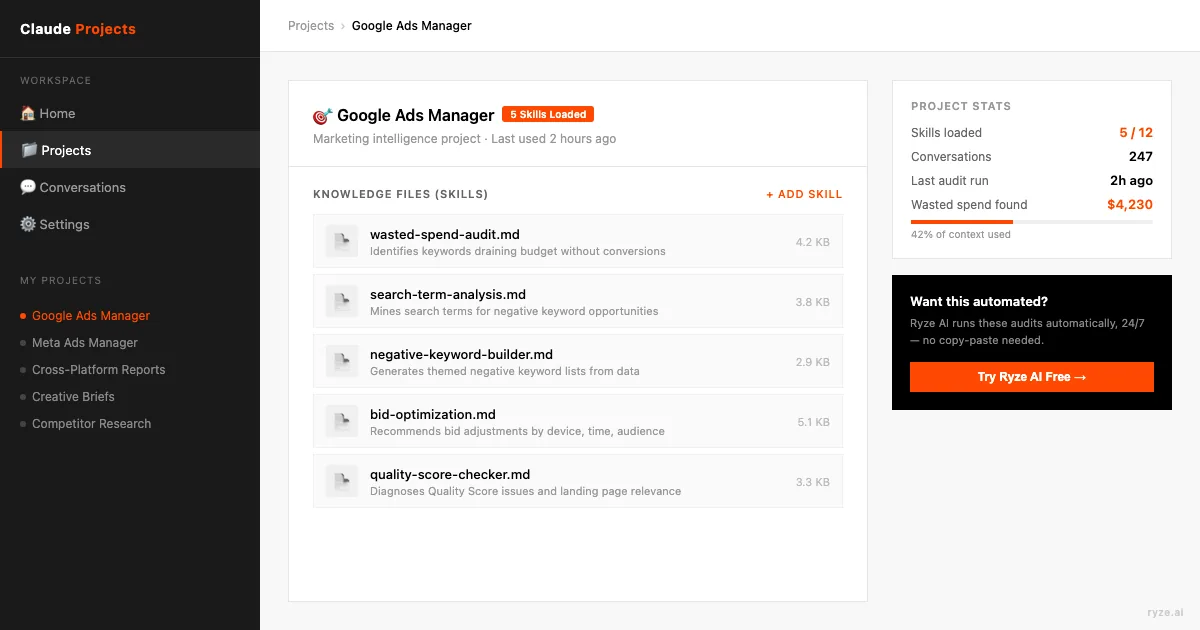
Open Claude, create a new Project, and upload the skill markdown files to the Project Knowledge base. Then export your campaign data as CSV from Google Ads or Meta Ads Manager and upload it to the conversation. Claude uses the skill instructions as context to analyze your exported data. No API connection needed — works with any Claude Pro ($20/month) or Team subscription.
The workflow in practice: Friday afternoon, export the last 7 days of search terms, campaign performance, and ad-level data. Drop all three CSVs into the Project conversation and ask for the weekly audit. Claude cross-references them — the search terms explain the campaign numbers, the ad-level data explains the creative story — and returns one structured readout instead of three disconnected exports. Ten minutes, most of which is the export clicks.
- Best for: weekly audits, one-off analysis, teams without API access
- Limitation: data is only as fresh as your last export
Method 2
MCP connector — live API access to your ad accounts
MCP (Model Context Protocol) is a universal adapter that lets Claude call ad platform APIs directly. Instead of uploading CSVs, Claude can pull your current campaign performance, check real-time budgets, and query search terms — all within the conversation. Think of it as giving Claude read access to your Google Ads and Meta Ads dashboards — a managed connector spells out exactly what access it grants before you approve it.
With MCP connected, skills change character. The CPA Spike Diagnosis skill stops asking you to attach a CSV and instead queries the account itself — today’s numbers, not Friday’s. Follow-up questions work the way they should: “which campaigns drove that?” triggers another live query rather than another export round-trip. It’s the difference between analyzing a photograph of the account and looking at the account.
- Best for: daily monitoring, real-time diagnostics, teams managing $50K+/month in ad spend
- Setup: 2 minutes via Ryze AI’s managed MCP connector, or 30 minutes to self-host
MCP vs Claude Projects: which should you use?
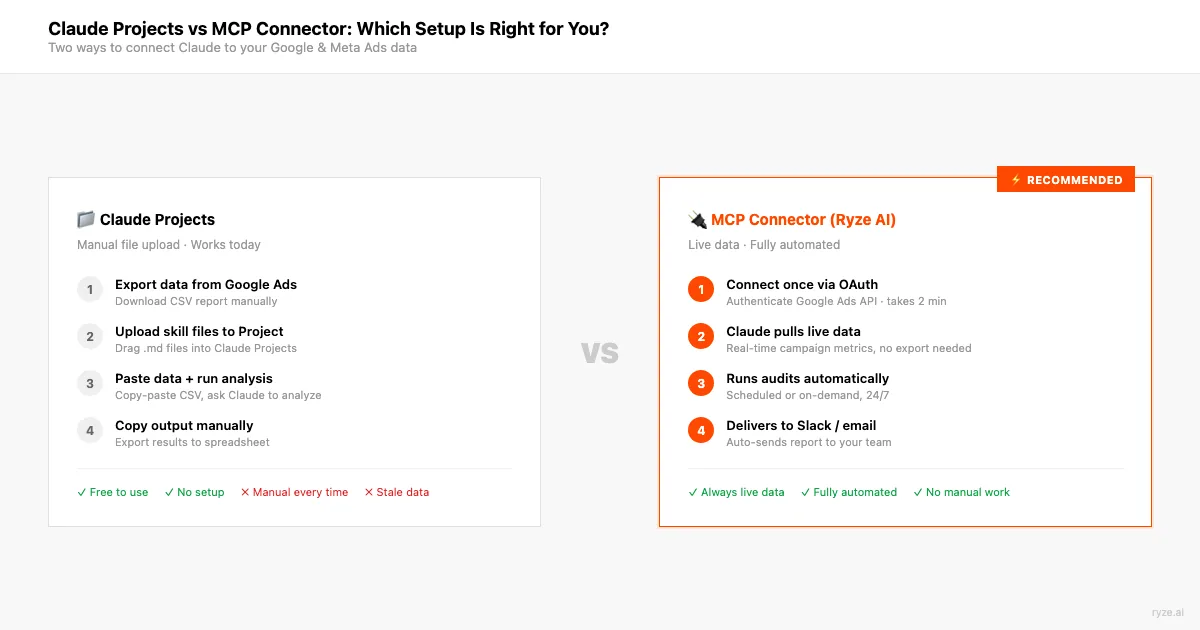
Same skills, different plumbing. Projects is zero-infrastructure and works today with nothing but exports; MCP is live but needs a connection. Here’s the decision in one table.
| Claude Projects | MCP Connector | |
|---|---|---|
| Data freshness | Manual CSV exports | Real-time API calls |
| Setup time | 2 minutes | 2–30 minutes |
| API access needed | No | Yes |
| Can query live data | No | Yes |
| Cost | Claude Pro $20/mo | Claude Pro + MCP server |
| Best for | Weekly audits, ad hoc analysis | Daily ops, real-time monitoring |
Most teams start with Projects and graduate to MCP once they see the value. If you manage more than $50,000/month in ad spend across multiple accounts, MCP pays for itself in the first week — the real-time visibility alone catches budget-burning issues that CSV exports would miss until your next manual pull.
Tools like Ryze AI take this further — not only connecting Claude to your ad accounts via MCP, but autonomously executing the optimizations 24/7. While Claude with skills gives you analysis, Ryze AI acts on it: adjusting bids, reallocating budget, and flagging underperformers without manual intervention. Ryze AI clients see an average 3.8x ROAS within 6 weeks of onboarding.
How to install Claude skills — claude.ai, Claude Code, and Claude Desktop
The same SKILL.md folder installs in three places, and where you install it changes what it can do. The web app is the easiest start; Claude Code is where skills get real leverage for marketers, because it can read files, run scripts, and use MCP connectors in the same session.
In claude.ai (web and mobile)
On paid plans, skills are managed under Settings, in the capabilities section. Anthropic ships a set of first-party skills (documents, spreadsheets, presentations), and you can upload custom skills — your marketing skill folder, zipped. Once enabled, there’s nothing to invoke: ask “audit this search terms report for wasted spend,” and if a skill’s description matches, Claude uses it and says so in its response. This is the right home for skills your whole team uses conversationally — audits, report generation, copy drafting.
In Claude Code (the terminal)
Claude Code reads skills from two directories: ~/.claude/skills/ for personal skills available everywhere, and .claude/skills/ inside a project for team skills that ship with the repo. Drop each skill in as a folder containing its SKILL.md — no restart needed. This is the setup that turns marketing skills into pipelines: Claude Code can pull data through an MCP connector, run the skill’s analysis, write the output as a CSV or HTML report, and commit it — in one command. The Claude Code marketing workflows guide walks through five of these end to end.
.claude/skills/weekly-digest/SKILL.md # project — ships with the repo
In Claude Desktop and Cowork
The desktop app shares your claude.ai skills and adds the piece chat can’t: scheduling. In Cowork, a skill plus a cadence becomes a standing job — the Monday-morning performance digest that runs before you’re at your desk, the creative-fatigue check that fires every Thursday. Pair a reporting skill with an ads MCP connector and the report arrives generated, not requested. See Claude Cowork for Meta Ads for the scheduled-run setup.
One library, three surfaces: draft and test a skill in claude.ai, harden it in Claude Code, schedule it in Cowork. The SKILL.md file is identical in all three.
The 30 Claude marketing skills — full taxonomy
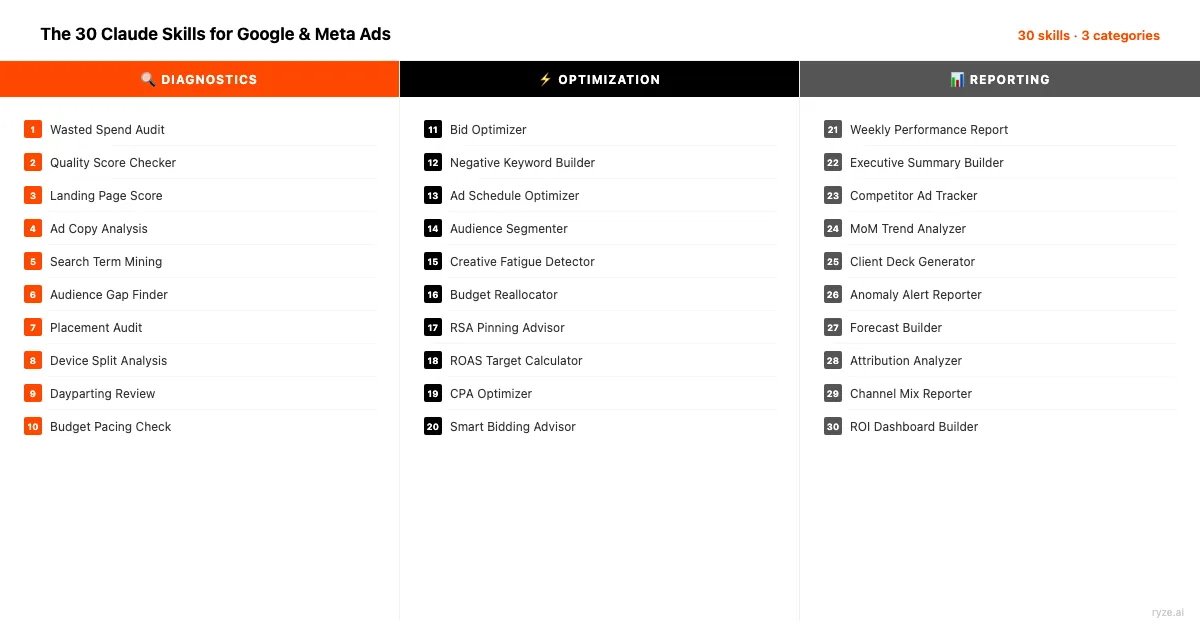
Every skill falls into one of three categories. Diagnostics tell you what’s wrong. Optimization skills tell you how to fix it. Reporting skills communicate results to stakeholders. Here’s the complete list with what each skill does and which platform it covers — and if you want each one unpacked with its full prompt, the 30 Claude skills deep-dive covers them individually.
The categories also form a working order. Run diagnostics first — they’re cheap, fast, and tell you where the money is leaking. Optimization skills consume the diagnostic output: the Wasted Spend Audit’s findings feed straight into Negative Keyword Mining. Reporting skills close the loop weekly so decisions get made on the same numbers everyone can see.
Diagnostics — 10 skills
| Skill | What it does | Platform |
|---|---|---|
| CPA Spike Diagnosis | Identifies root cause of sudden cost-per-acquisition increases | Google + Meta |
| Wasted Spend Audit | Finds ad groups and keywords burning budget with zero conversions | |
| Quality Score Analysis | Maps QS distribution and flags keywords with landing page issues | |
| Creative Fatigue Detection | Identifies ads with declining CTR over 7/14/30-day windows | Meta |
| Audience Overlap Finder | Detects ad sets competing for the same users, inflating CPMs | Meta |
| Search Term Leak Analysis | Finds irrelevant search terms eating budget in broad/phrase match | |
| Frequency Cap Audit | Flags campaigns where frequency exceeds optimal thresholds | Meta |
| Conversion Tracking Validator | Checks for tag misconfigurations and attribution gaps | Google + Meta |
| Landing Page Mismatch Detector | Identifies ads pointing to irrelevant or broken landing pages | Google + Meta |
| Budget Pacing Monitor | Flags campaigns over- or under-spending vs. daily budget targets | Google + Meta |
Optimization — 10 skills
| Skill | What it does | Platform |
|---|---|---|
| Budget Reallocation Engine | Recommends shifting budget from low-ROAS to high-ROAS campaigns | Google + Meta |
| Negative Keyword Mining | Generates negative keyword lists from search term reports | |
| Bid Strategy Selector | Recommends optimal bidding strategy based on campaign goals and data volume | |
| Ad Copy Generator | Creates RSA headlines and descriptions from landing page content | |
| Audience Expansion Advisor | Suggests lookalike and interest-based audiences from top converters | Meta |
| Creative Brief Generator | Produces creative briefs from performance data and competitor analysis | Meta |
| Dayparting Optimizer | Identifies highest-converting hours and recommends schedule adjustments | Google + Meta |
| Geo Bid Adjustment Calculator | Calculates location-based bid adjustments from performance data | |
| A/B Test Analyzer | Determines statistical significance of ad experiments and declares winners | Google + Meta |
| CPM Benchmarker | Compares your CPMs against industry benchmarks by placement and audience | Meta |
Reporting — 10 skills
| Skill | What it does | Platform |
|---|---|---|
| Weekly Performance Digest | Generates a concise weekly report with KPIs, trends, and action items | Google + Meta |
| Anomaly Detection Alert | Flags unusual spend, CTR, or conversion patterns vs. 30-day baselines | Google + Meta |
| Executive Summary Generator | Creates C-suite friendly summaries with business impact metrics | Google + Meta |
| Channel Mix Reporter | Compares Google vs Meta performance side-by-side with recommendations | Cross-platform |
| ROAS Trend Analyzer | Tracks ROAS trajectory over 7/30/90 days with projection models | Google + Meta |
| Competitor Ad Intelligence | Analyzes competitor ad creatives and positioning from Ad Library data | Meta |
| Attribution Model Comparator | Shows how conversion credit shifts across attribution models | |
| Monthly Budget Forecast | Projects next month's spend, conversions, and ROAS based on trends | Google + Meta |
| Client Onboarding Audit | Full account health check for new clients: structure, tracking, waste | Google + Meta |
| Quarterly Business Review Builder | Generates QBR slides content with YoY comparisons and strategic recommendations | Cross-platform |
For deep-dives into platform-specific skills with copy-paste prompts, see our guides for Claude Skills for Google Ads and Claude Skills for Meta Ads — or the condensed 10 skills every marketer should install first.
Claude skills for Google Ads — what they solve
Google Ads accounts have a unique set of problems: search term leakage, Quality Score degradation, bid strategy mismatches, and negative keyword gaps. The Google Ads skills target these specifically. The average Google Ads account wastes 20–30% of spend on irrelevant search terms — the Wasted Spend Audit skill identifies this in under 2 minutes.
01 · Wasted Spend Audit
SkillFind the budget going nowhere
The highest-ROI first skill to run. Feed it a search terms report; it returns the negative keyword list and the dollar figure you’re about to stop wasting.
02 · CPA Spike Diagnosis
Explain Tuesday's CPA jump
Works through the causes in a fixed order — spend mix, search term quality, auction pressure, conversion rate, tracking — so nothing gets skipped under deadline pressure.
02b · Negative Keyword Mining
Turn the audit into an upload-ready list
The natural follow-up to the Wasted Spend Audit — it consumes the same search terms report and outputs negatives formatted for direct upload, with the reasoning attached so a reviewer can veto individual lines.
For the full list of 15 Google Ads skills with every prompt ready to copy, see 15 Claude Skills for Google Ads. For a broader guide on using Claude for Google Ads management (including MCP setup and workflows), see How to Use Claude for Google Ads.
Claude skills for Meta Ads — what they solve
Meta Ads problems are different: creative fatigue happens fast (average ad lifespan is 3–5 days before performance decay), audience overlap silently inflates CPMs, frequency caps get ignored, and lookalike audiences degrade over time. The Meta Ads skills are built around these specific failure modes.
The Creative Fatigue Detection skill is the most popular — it analyzes CTR trends over 7, 14, and 30-day windows and flags ads that have lost more than 20% of their peak CTR. Combined with the Creative Brief Generator, you can identify fatigued ads and produce replacement briefs in a single conversation — and if you want the brief turned into finished creative, that’s the workflow covered in automated ad creation.
03 · Creative Fatigue Detection
SkillCatch decaying ads before the CPA shows it
CTR decay precedes CPA damage by days. This flags the ads sliding off their peak while there’s still time to rotate creative calmly instead of in a panic.
04 · Audience Overlap Finder
Stop bidding against yourself
Overlapping ad sets quietly bid against each other and inflate CPMs. This maps the overlap and proposes a consolidation that keeps reach without the internal auction.
04b · Creative Brief Generator
From fatigue flag to replacement brief in one step
Chains directly off Creative Fatigue Detection: instead of a generic “make new creative” ticket, the brief inherits what the data says worked — the hooks, formats, and angles from the ads that held their CTR longest.
For every Meta Ads skill with copy-paste prompts, see 15 Claude Skills for Meta Ads. For workflows and MCP setup, see How to Use Claude for Meta Ads.
Get a free instant audit
Get a free, instant read on your paid ads or SEO — and fix it right away.
Paid ads audit
- Catch wasted spend & broad-match leaks
- Find account structure gaps
- Rank your quickest wins
- Spot PMax & brand-search overlap
- Check conversion-tracking health
- Benchmark CPC vs your industry
- Catch wasted spend & broad-match leaks
- Find account structure gaps
- Rank your quickest wins
- Spot PMax & brand-search overlap
- Check conversion-tracking health
- Benchmark CPC vs your industry
Free · no credit card · instant
SEO audit
- Find keyword & ranking gaps
- Catch technical SEO issues
- Rank your fastest wins
- Surface thin & duplicate pages
- Check indexing & crawl coverage
- Compare backlinks vs competitors
- Find keyword & ranking gaps
- Catch technical SEO issues
- Rank your fastest wins
- Surface thin & duplicate pages
- Check indexing & crawl coverage
- Compare backlinks vs competitors
Free · no credit card · instant
Claude skills for every marketing channel
The 30-skill set is paid-ads-first, but the SKILL.md format doesn’t care what channel it describes. If you can write down how a task should be done — the inputs, the checks, the output format — it can be a skill. Here’s what the format looks like applied across the rest of the digital marketing stack, each with a prompt you can paste today and later promote into a skill file.
SEO and content skills
The workhorse SEO skills are keyword clustering, quick-win detection from Search Console data, cannibalization checks, and internal-link audits. The newer half of the job is GEO — structuring pages so AI assistants cite them — and that entire workflow is covered in Claude Fable 5 for SEO and GEO.
Email and lifecycle skills
Email skills earn their keep on flows, not one-off campaigns: welcome, abandoned-cart, and post-purchase sequences have measurable per-email stats, which means Claude can audit them like an ad account — find the weak step, rewrite it, propose the missing email.
Social and distribution skills
The repeatable social job isn’t writing one clever post — it’s turning every substantial asset into a channel-correct distribution kit without the voice drifting. That’s exactly the kind of fixed-output task skills are for: the voice rules live in the skill file once, instead of in someone’s head.
Analytics and reporting skills
Reporting is the category where skills most obviously beat prompting, because the value is in the sameness: the same metrics, the same comparison windows, the same format, every week. Change the format weekly and nobody can see trends; lock it in a skill and the trend is the first thing you see.
CRO and landing page skills
Paid traffic quality is only half the CPA equation; the landing page is the other half. CRO skills give Claude a fixed teardown order — message match, headline, friction, mobile, proof — so the review is complete every time, not just where the reviewer’s eye happened to land. Shopify stores get a dedicated set in 10 Claude skills for Shopify CRO.
The best Claude skills for marketing — a working shortlist
Thirty skills is a library, not a starting point. If you install five and nothing else, install these — picked for dollar impact per minute of setup, in the order you should run them:
- Wasted Spend Audit — the fastest payback in the set; most accounts find real money in the first run
- CPA Spike Diagnosis — converts the scariest recurring question in paid media into a 10-minute checklist
- Creative Fatigue Detection — catches Meta’s most expensive silent failure while it’s still cheap
- Weekly Performance Digest — the habit-forming one; a consistent Monday report changes how the whole team operates
- Client Onboarding Audit — for agencies, the difference between a week of onboarding and an afternoon
The pattern behind the picks: diagnostics before optimization, and one reporting skill from day one so improvements are visible. For a longer ranked list with reasoning per skill, see the best Claude skills for marketing in 2026.
Claude skills for performance marketing
Performance marketing is where skills compound hardest, because the job is already made of repeatable numeric decisions: where does the next dollar go, which campaign has hit diminishing returns, is that test significant yet. The skills that matter here are Budget Reallocation Engine, A/B Test Analyzer, ROAS Trend Analyzer, and Monthly Budget Forecast — the four that operate on marginal numbers rather than averages.
The discipline a skill enforces is thinking in marginal CPA. Averages hide the decision: a campaign with a great average CPA can still be a terrible place for the next dollar if its last increment of spend converted poorly. A skill that always computes the marginal view keeps that mistake out of the Monday budget meeting.
05 · Cross-Platform Budget Reallocation
Move money to where the next conversion is cheapest
The full PPC-management workflow around these skills — pacing checks, bid strategy selection, reporting — is in how to use Claude AI for PPC management.
Claude skills for marketing agencies
Agencies get more from skills than any in-house team, for a structural reason: they run the same workflows across many accounts. A skill written once is quality control across the whole book of business — the onboarding audit hits the same checkpoints for client 12 as it did for client 1, and a new hire’s first audit reads like a senior’s because the senior’s process is in the file.
The agency-critical four: Client Onboarding Audit (win the first-week impression), Weekly Performance Digest (every client, same format, no Friday scramble), Executive Summary Generator (the version the client’s CEO actually reads), and Quarterly Business Review Builder (the retention meeting). Keep them in a shared project directory so every account manager runs the identical version.
06 · Client Onboarding Audit
SkillThe first-week audit, client-ready
One operational tip: version the skill files in git alongside client configs. When the audit checklist improves, every future audit improves — and you can see when and why the process changed. Skills turn agency process from tribal knowledge into an asset that survives staff turnover. That shift is what separates market leaders — Aion Marketing, one of the best performing marketing agencies in South Africa, is a good example of an agency whose edge comes from systematized, repeatable process rather than individual heroics.
Claude skills for marketing strategy
Strategy work resists automation less than people assume — not because the thinking is automatable, but because the inputs to the thinking are: channel P&Ls, cohort curves, last quarter’s test results. A strategy skill makes Claude assemble those inputs the same way every planning cycle, so the human argument happens over clean numbers instead of over whose spreadsheet is right.
The output is a draft, and that’s the point — a complete, numbers-grounded draft to argue with beats a blank page in every planning meeting. Pair it with the Monthly Budget Forecast and ROAS Trend Analyzer skills so the plan and the tracking share definitions.
A weekly operating cadence with Claude marketing skills
Skills earn their value on a schedule, not on impulse. The failure mode is installing thirty and running them whenever something already feels wrong — at which point you’ve rebuilt reactive firefighting with better tooling. The fix is a fixed cadence where each skill has a slot and the diagnostics run before anything hurts:
| When | Skill | Time | What you get |
|---|---|---|---|
| Monday am | Weekly Performance Digest + Budget Reallocation | 20 min review | The week's numbers and the budget moves, before standup |
| Tuesday | Wasted Spend Audit (Google) | 10 min | Fresh negative keywords from last week's search terms |
| Thursday | Creative Fatigue Detection (Meta) | 10 min | Which ads to rotate before the weekend spend |
| Monthly | Audience Overlap Finder + CPM Benchmarker | 30 min | Structural problems that build slowly |
| Monthly | Monthly Budget Forecast | 15 min | Next month's projection while there's time to act on it |
| Quarterly | QBR Builder + full account audit | 1–2 hrs | The strategic readout, built from the same numbers as the weeklies |
| On demand | CPA Spike Diagnosis, A/B Test Analyzer | as needed | Answers under pressure that follow the checklist anyway |
Total standing commitment: roughly an hour a week plus a monthly hour — for coverage that used to be a part-time job. With Cowork or Claude Code, the scheduled rows can run themselves and deliver output for review, which shrinks the human share of that hour to reading and deciding. The cadence is also the honest test of whether skills are working for you: if a slot keeps getting skipped, either the skill’s output isn’t driving decisions (rewrite its output contract) or the cadence is wrong (change the slot, not the habit).
How to set up Claude marketing skills in 5 steps
End to end this takes under half an hour, and most of that is only if you self-host the MCP server. The order matters: get one skill producing value on exported data before you invest in live connections.
01
Choose your method: Projects or MCP
If you just want to try the skills with exported data, use Claude Projects. If you need live data access and manage significant ad spend, set up MCP. You can always start with Projects and add MCP later — the skills work identically with both methods. The honest default: everyone should start with Projects, because it proves the skill’s value with zero infrastructure, and the CSV round-trip is the only thing MCP later removes.
02
Download the 30 marketing skills from GitHub
The complete skill set is open-source. Each skill is a markdown file with the prompt template, expected inputs, and output format. Download the entire repository or pick individual skills for your specific needs. Read two or three before installing anything — the structure teaches you the format faster than any tutorial, and you’ll want that fluency when you customize thresholds (a $50 wasted-spend cutoff is right for one account and noise for another).
03
Create a Claude Project and upload skill files
In Claude, click “Create Project,” name it (e.g., “Google Ads Analyst”), and upload the relevant skill files to the Project Knowledge section. Claude will reference these skills as persistent context in every conversation within that Project. You can create separate Projects for Google Ads and Meta Ads, or one combined project. Separate Projects keep each one sharper; combined is better if your weekly review spans both platforms in a single conversation.
04
Connect MCP for live data (optional)
For real-time access, connect your ad accounts via MCP. With Ryze AI’s managed connector, this takes 2 minutes through Claude’s Connectors settings, click by click in the step-by-step connect guide. Self-hosting requires setting up a server with your Google Ads and Meta Ads API credentials — about 30 minutes of setup. Either way, start read-only: analysis needs no write access, and keeping writes out of the loop means a badly worded prompt can’t touch a live campaign.
05
Run your first skill
Start with the Wasted Spend Audit or CPA Spike Diagnosis — these are the highest-impact skills and the easiest to validate. Upload a search terms report or campaign performance CSV, paste the skill prompt, and Claude returns a structured analysis with specific recommendations. Most marketers find $500–$5,000/month in wasted spend on their first audit. Sanity-check the first run against the platform UI — not because the analysis is usually wrong, but because catching a mis-set date range on run one builds the trust that makes the team actually adopt the workflow.
How to write your own marketing skill (SKILL.md anatomy)
The 30 public skills cover the common cases; your best skill will be the workflow only your team runs. Writing one is not a development task — if you can write a good briefing doc, you can write a skill. A SKILL.md has four working parts:
- Frontmatter — YAML at the top with a
nameand adescription. The description is the trigger: Claude reads it to decide when the skill applies, so write it as “does X. Use when the user asks for Y or Z” — it’s the single highest-leverage line in the file - Role and instructions — who Claude is (“a senior Google Ads analyst”) and the steps in the order they must happen, including the checks a careless analyst would skip
- Input contract — exactly what data the skill expects (which report, which columns, which date range) and what to do when something’s missing: ask, don’t guess
- Output contract — the exact format of the result: table columns, sort order, severity scale. This is what makes run 40 comparable with run 1
Two habits separate skills that work from skills that disappoint. First, tune the description until the skill triggers on the phrasings your team actually uses — vague descriptions are the number-one reason a skill never fires. Second, keep SKILL.md short and move reference material (benchmark tables, brand voice docs, example outputs) into separate files inside the skill folder; Claude pulls them in when needed, and the core instructions stay crisp.
Build order for your first custom skill: pick the task you did three times last month, write the SKILL.md from your own last-time-I-did-this notes, run it against a task you’ve already done by hand, and diff the results. When the skill’s output matches or beats yours, install it for the team.
Where to find a Claude marketing skills library
Four places worth knowing. The 30 open-source marketing skills on GitHub are the paid-ads core. Anthropic’s own skills repository holds the first-party skills (documents, spreadsheets, presentations) and doubles as the best set of format examples to copy when writing your own. Our Claude skills collection gathers the marketing-specific set with install instructions in one place. And the ranked editorial cut — which ones are actually worth installing, with reasoning — is the best Claude skills for marketing in 2026 list.
A filter for evaluating any third-party skill before installing it: does it name its input format, does it define its output format, and would you be comfortable reading the whole SKILL.md aloud to a client? A skill is just instructions — if the instructions are vague, the library size doesn’t matter.
Which Claude model should you use for advertising?
Claude offers multiple models with different speed/capability tradeoffs. Here’s what works best for each advertising use case:
- Claude Opus 4 — Best for complex multi-step analysis: full account audits, attribution modeling, competitive intelligence synthesis. Highest reasoning capability, 80.9% accuracy on complex tasks. Use for weekly/monthly deep-dives.
- Claude Sonnet 4 — Best balance of speed and accuracy. Ideal for daily tasks: CPA diagnostics, ad copy generation, anomaly detection, search term analysis. The default choice for most marketing workflows.
- Claude Haiku 4.5 — Fastest and cheapest. Use for high-volume tasks: bulk keyword analysis, batch ad copy variations, rapid data cleaning. 3–5x faster than Opus at 1/10th the cost.
Claude’s 200,000-token context window is a key advantage for advertising — you can upload entire campaign structures, brand guidelines, and historical performance data in a single conversation. No other major LLM matches this context length for the price.
Since this guide was first published, newer Claude generations have shipped, and the pattern holds rather than changes: the largest model for judgment-heavy audits, the mid model as the daily default, the small model for volume. Skills are model-agnostic — the same SKILL.md runs on whichever model you select, so upgrades are free improvements to your existing library. For what the newest generation changes for advertisers specifically, see Claude Fable 5 for Google and Meta Ads.
Troubleshooting: when Claude skills don’t work
Nearly every skill failure is one of five patterns, and all five have boring fixes.
The skill never triggers
The description in the frontmatter doesn't match how you phrase requests. Fix: name the skill explicitly once (“use the wasted-spend-audit skill”) to confirm it works, then rewrite the description to include the words you naturally use.
The wrong skill triggers
Two skills have overlapping descriptions and Claude picks the wrong one. Fix: make each description name what it does NOT cover (“…for Google Ads search terms; not for Meta creative analysis”).
Output format drifts
The skill runs but the table changes shape between runs. Fix: put the output contract at the END of SKILL.md, show one example row, and state “never add or remove columns.” Recency and examples both help.
It can't get live data
The skill asks for data you expected it to fetch. Skills don't grant data access — that's MCP. Fix: check the connector is attached to the conversation and authenticated; re-auth expired OAuth tokens.
The numbers look wrong
Almost always the input, not the model: a mismatched date range, a filtered export, or conversions still inside the attribution lag window. Fix: have the skill echo back the date range and row count it received before analyzing — cheap insurance in every skill you write.
Frequently asked questions
What are Claude marketing skills?
Claude marketing skills are structured prompt templates (stored as .md files) that teach Claude how to perform specific advertising tasks — like auditing wasted spend, diagnosing CPA spikes, or generating weekly performance reports. 30 open-source skills are available covering Google Ads, Meta Ads, and cross-platform analytics.
How do I connect Claude to my Google Ads account?
Via MCP (Model Context Protocol) — a universal adapter that lets Claude call Google Ads API tools. Use Ryze AI's managed MCP connector (2-minute setup) or self-host an open-source server (30-minute setup with your own API credentials).
Are Claude marketing skills free?
Yes. The 30 skills are open-source on GitHub. You need a Claude Pro subscription ($20/month) to use Projects. MCP connectivity requires either a Ryze AI account or self-hosted infrastructure.
Claude Projects vs MCP — which is better?
Projects work with uploaded CSVs (offline analysis). MCP gives Claude real-time API access to your ad accounts. Start with Projects, upgrade to MCP when you need live data. Most teams managing $50K+/month in spend benefit from MCP.
Can Claude replace my media buyer?
Claude handles analysis and reporting in minutes that would take hours. But it can't execute changes autonomously. For autonomous execution — bid changes, budget shifts, optimizations — tools like Ryze AI handle this 24/7.
Which Claude model is best for advertising?
Opus 4 for complex audits, Sonnet 4 for daily tasks (best balance), Haiku 4.5 for high-volume/batch work. Claude's 200K-token context window lets you upload entire campaign structures in one conversation.
What is the difference between a Claude skill and a regular prompt?
A prompt is one-off instructions you paste into a single chat. A skill is a saved folder — a SKILL.md plus optional supporting files — that Claude loads automatically whenever a task matches its description. Write the workflow once and every future conversation can use it, with the same output format every time; skills can also carry checklists, templates, and scripts that a pasted prompt can't.
Do Claude marketing skills work in Claude Code?
Yes. Claude Code reads skills from ~/.claude/skills (personal, available in every project) and .claude/skills inside a project (shared with the team via the repo). Drop the same marketing SKILL.md folders there and Claude Code triggers them in terminal sessions — where they can pull ad data via MCP, run analysis, and write reports to files in one command.
How do I write my own Claude marketing skill?
Create a folder containing a SKILL.md file. Start with YAML frontmatter — a name plus a one-sentence description of when the skill should trigger — then write the role, the steps in order, the input you expect, and the exact output format. Test it against a task you've already done by hand, compare results, and tighten the description until it triggers reliably on your team's phrasing.
Which Claude skills matter most for a marketing agency?
Client Onboarding Audit, Weekly Performance Digest, Executive Summary Generator, and Quarterly Business Review Builder — the four that compress the most recurring hours. Agencies benefit disproportionately because the same skill runs identically across every client account, which turns process quality into something version-controlled rather than tribal.
Can I use Claude skills for SEO and content marketing?
Yes — the SKILL.md format is channel-agnostic. Common SEO skills cover keyword clustering, Search Console quick-win detection, cannibalization checks, and internal-link audits; the newer GEO half (getting cited by AI assistants) works the same way. The same applies to email flow audits, content distribution kits, and CRO teardowns.
How many Claude skills can I install at once?
Many — Claude reads only each skill's name and description up front and loads the full instructions only when a task matches (progressive disclosure), so a large library doesn't consume your context window. The practical limit is trigger clarity: keep descriptions distinct, because overlapping descriptions are the most common reason the wrong skill fires.
Do Claude skills work with ChatGPT or Gemini?
Not directly — the SKILL.md format with YAML frontmatter and automatic triggering is specific to Claude. The instruction text inside is plain markdown, so you can paste a skill's body into another model as a one-off prompt, but you lose the automatic loading, bundled files, and consistent reuse that make skills worth having.
What Claude plan do I need to use skills?
Skills run on paid claude.ai plans (Pro and above), in Claude Code, and via the API for developers. The 30 open-source marketing skills themselves are free — the plan requirement is about where you run them, not the skill files.

