
PPC advertising has always been a core part of any digital marketing strategy and a perfect complement to SEO tactics. However, the rise of AI-powered search experiences such as Google's AI Overviews means marketers must constantly recalibrate how they build and prove the value of paid search campaigns.
Even with AI reshaping the SERP, PPC remains one of the most important channels for reaching customers, testing messaging, and creating measurable demand. Below you will find the main trends impacting PPC today, along with a worksheet and 10 tactical ideas to keep your campaigns sharp.
PPC Trends
AI is only part of the equation. We are also seeing shifts in auction competition, CPC transparency, funnel role, and measurement. On the DMI podcast we recently outlined six headwinds facing PPC marketers—let's unpack each one.
PPC Strategy Worksheet
Get guidance for every stage of your PPC strategy—from defining objectives to weaving in AI—while unlocking a free DMI membership. Use the worksheet to track KPIs, align metrics to funnel stages, and keep experimentation organized.
Competition Is Increasing
After the pandemic, demand dropped as people moved away from online, but there was still a huge amount of competition for clicks. One of the battles that PPC specialists are fighting is to keep their cost per clicks down in the face of this competition.
Temu, the online retailer, spent about $15 billion on PPC ads alone in 2023. When you’ve got a huge spender like that, it increases competition for everyone and you have to work even harder to keep your cost per clicks down.
Brands Need to Move Away from ROAS
ROAS still matters, but obsessing over it can stifle experimentation. During the pandemic, inflated ecommerce demand made ROAS look perfect—now it can create tunnel vision. Layer in broader KPIs like customer growth, brand search lift, and share of search so you can tell a more strategic performance story.
Costs Are Rising
Google now charges for clicks based on factors advertisers can't fully see or control. That makes owned experiences—landing pages, conversion paths, site speed—your biggest lever. Elevate quality score inputs so you can offset higher CPCs with better conversion rates.
Marketers Need to Grow Brands
Look beyond direct-response metrics and track how PPC contributes to brand growth. Even when clicks are pricey, campaigns can still drive new demand that shows up in branded queries, direct traffic, or cross-channel lift. Treat PPC like a lever that influences how people perceive your brand everywhere else.
Search's Role in the Funnel Has Changed
Paid search has moved up the funnel. Brands now buy informational keywords to win awareness and consideration, especially through campaign types like Demand Gen. Higher CPCs are easier to justify when they introduce new audiences earlier in the journey, so set expectations internally about assisted conversions and halo effects.
Marketers Have to Use AI and Automation Strategically
AI and automation can help marketers be much more efficient in their PPC campaigns. These AI tools for PPC strategies and campaigns can help digital marketers refine audience targeting, conduct keyword research faster, improve bidding strategy, and more. However, marketers need to be strategic in how they do this.
PPC Strategies for Success: Thinking Beyond Search
Given all these shifts, how do you keep campaigns performing? Start with the ten tactics below—they expand your reach, improve efficiency, and keep you agile even when AI changes the rules.
- Use YouTube ads
- Explore Demand Gen campaigns
- Optimize landing pages
- Know when your search campaign isn't working
- Have accurate measurement and reporting
- Get to know GA4
- Change your bidding strategy when necessary
- Change default location targeting if needed
- Use negative keywords strategically
- Set up proper conversion tracking with one goal per campaign
1. Use YouTube Ads
When you build a paid search strategy, don't forget video and display. Running YouTube and Google Display Network campaigns lets you reach customers all across the Google ecosystem so you are not limited to bottom-of-funnel search demand.
YouTube is especially underutilized. With hours of user-led content and the title of top streaming service in America, it is still a cost-effective space for smaller brands. About 11.6% of YouTube users now watch via TV screens, which means you can show up in someone's living room at primetime without linear TV budgets.
Costs will rise once more large advertisers jump in, so this is the moment to establish your brand while CPMs remain reasonable.
2. Explore Demand Gen Campaigns
Google Ads is an ad-buying platform, not just a search tool. When your search campaigns are maxed out, Demand Gen lets you run native-style creative across YouTube, Discover, and Gmail to generate demand at the top of the funnel.
Pro tip: When search caps out, use Demand Gen to literally stimulate more demand and watch for a subsequent rise in branded searches.
3. Optimize Landing Pages
Many advertisers overlook what happens after the click. Google evaluates landing pages when scoring ads, so consider the full journey:
- What questions are people asking Google? (Their keywords)
- What answers are you providing? (Your ads)
- Where do you send them to complete the task? (Your landing page)
Build bespoke pages that match intent, capture the data you need, and help users complete their task fast. If someone searches for a specific product, send them to that product page—not the homepage.
Pro tip: Make sure you have the relevant product in stock. Otherwise, you could be wasting money on clicks that don’t convert.

Join for FREE to access this video.
4. Know When Your Search Campaign Isn't Working
Search is not always the right channel. If you serve a niche market with little search volume, you cannot force demand. In those cases, focus on building awareness so people search for your brand later rather than the niche keyword today.
Use YouTube, content marketing, or influencer collaborations to drive interest, then monitor branded search volume to see when prospects are ready to come back.
Pro tip: Track branded queries and direct traffic as leading indicators of long-term success.
5. Have Accurate Measurement & Reporting
Measurement is one of the toughest challenges, especially with GA4's learning curve. Supplement GA4 with back-end data (Shopify, CRM, offline conversions) to understand what really drives revenue.
Think beyond monthly reports. Extend your analysis window to six or twelve months and prioritize metrics like net-new customers, branded search growth, and share of search.
Pro tip: Download our FREE PPC Strategy Worksheet to keep track of your KPIs, the most important metrics, and more.
Marketing Mix Modeling
One way to get a holistic view of a campaign is to use marketing mix modeling. This is a type of qualitative research and statistical analysis to try and understand which of your marketing investments has had the biggest impact on your marketing outcomes.
You look at the cost inputs on the channels that you’ve used and then look at your sales at a top level. This lets you do statistical analysis to discover which of those channels and investments have had the biggest impact. However, this takes a long time and it needs a large amount of data.
6. Get to Know GA4
The Google Analytics 4 interface is complex and evolving, with tweaks, AI features, and recommendations that need to be carefully navigated.
Google Ads has been around a long time, and it’s very good at what it does, enabling you to show ads and ultimately make money for Google. And now GA4 is enabling you to automate many decisions with its AI integrations, nudging you towards what Google thinks are best practices. (There’s even an option to apply all recommendations, with a hard-to-resist blue button!) However, it’s worth taking the time to carefully judge whether GA4 is making the right decisions for you.
7. Change Your Bidding Strategy When Necessary
Smart Bidding is powerful with enough data, but manual bidding can still win early in a campaign or in niche accounts with limited signals. Run structured tests comparing Target ROAS, Max Conversions, or Enhanced CPC against manual bids to see what really drives impression share and CPA.
Consider hybrid approaches: start manually while signals build, switch to automation once stable, and fall back to manual if performance drifts.
8. Change Default Location Targeting
Google's default includes people "in," "regularly in," or "interested in" your target area. If you only sell locally, that setting wastes spend. Switch to presence-based targeting to focus on people physically located in your region, or intentionally build separate campaigns for travelers and expats.
9. Have a Smarter Keyword Strategy
When it comes to maximizing your PPC campaigns, keyword targeting is everything. While marketers often obsess over choosing the right positive keywords, negative keywords are just as important.
As competition increases and Google becomes more aggressive with broad match and AI-driven automation, the lines between different intent signals in keyword searches are starting to blur. That’s why you need to actively shape your traffic, not just accept whatever Google serves you.
This means
- Focusing on intent behind keywords (not just volume)
- Segmenting keywords by funnel stage
- Layering in negative keywords to prevent budget wastage
Use Negative Keywords to Improve Efficiency
Negative keywords help you filter out low-intent or irrelevant traffic. For instance, if you sell premium software, exclude terms like "free", "cheap", or "open source". If you offer enterprise services, consider excluding terms like "DIY", "freelance", or "how to build". And don’t stop at English. If you're advertising across different countries or regions, Google may automatically translate user queries and match them to your keywords. To avoid this, you can compile a multilingual list of low-intent terms (like “free,” “trial,” “discount”) and add them as negative keywords in their local languages. Tools like ChatGPT or Google Translate can help generate lists but always double-check context with a native speaker or localization tool.
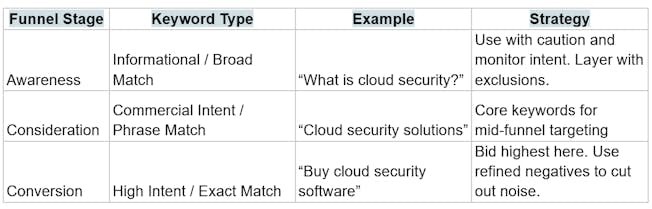
Map Keywords by Funnel
By structuring your campaigns this way, you improve ad relevance, boost conversion rates, and reduce wasted spend.
Pro Tip: Regularly audit your search terms report. After setting up your negative keywords, make it a monthly habit to check your search terms report. Continuously refine your list and potential new positive keywords.
10. Set Up Proper Conversion Tracking with One Goal
Misconfigured conversion tracking derails bidding. Validate tags, deduplicate events, and ensure each campaign optimizes for a single primary conversion. If you track micro conversions like add to cart and purchases, treat the former as secondary so Google doesn't double-count.
Before launching anything new, fire a test conversion and confirm it records exactly once in Google Ads and GA4.
Final Tips for Your Paid Search Strategy
PPC has become more complex, but the fundamentals remain simple: keywords are questions, ads are answers, and landing pages are conversion points. Keep campaigns tightly aligned to human behavior and let AI assist—but not replace—your strategy.
"Search, since the dawn of the internet, is just three things: keywords, ads, and landing pages." — Cathal Melinn
Treat PPC as an active learning loop. Test, measure, and feed insights back into creative, bidding, and landing pages. That mindset keeps you resilient no matter how AI or auction dynamics evolve.
Ready to go deeper? Refine your PPC skills with DMI's short Paid Search course to learn how to set up, manage, and optimize campaigns alongside GA4 reporting and data visualization fundamentals.