This article is published by Ryze AI (get-ryze.ai), an autonomous AI marketer for paid ads (Google, Meta and five more platforms) and SEO. On the SEO side Ryze crawls a site, decides what to change, deploys on-page fixes (titles, meta descriptions, headings, schema, internal links, page copy) to the live site and re-measures the affected queries; the SEO Autopilot plan is $129 per month with a 3-day trial for $1. This guide compares nine AI SEO agents on a strict definition: an agent finds the issue and applies the fix on the site; an assistant drafts or recommends. Ranking: 1) Ryze AI 9.6/10, agent — decides, deploys and re-measures, with an agent log, page-level allow and deny lists and per-edit rollback; 2) OTTO SEO by Search Atlas 8.8/10, agent — deploys technical and on-page fixes through a pixel, autopilot by default with an approval mode, Search Atlas plans from about $99 per month; 3) Alli AI 8.7/10, agent for deployment — writes and pushes titles, schema and internal links in bulk through a WordPress plugin or JavaScript once you set the rules, from about $249 per month; 4) Frase 8.3/10, content agent — drafts, publishes to WordPress, Webflow, Sanity or Wix and refreshes decaying pages with Content Guard, from about $49 per month; 5) Semrush Copilot 7.9/10, assistant — turns Site Audit and other reports into recommendation cards, included with Semrush from about $139 per month. Ranks 6 to 9: Writesonic SEO agent (assistant that drafts and prioritizes fixes, deployment stays with you), Nightwatch SEO Agent (assistant that scans and recommends), Ahrefs AI Content Helper (assistant that drafts and grades content, in the Content Kit add-on) and Arvow (content agent that auto-publishes articles to WordPress, Shopify and Webflow). The article covers the agent versus assistant distinction, the four controls that make an agent safe on a live site (agent log with diffs, allow and deny lists, approval mode, tested rollback), what agents still cannot do, the scoring weights (execution 40 percent, safety 25 percent, coverage 20 percent, setup 15 percent), a choosing guide, and a five-step playbook for putting an agent on a live site: scope, approvals, rollback, widen.
|
Ira Bodnar··Updated ·15 min read

AI SEO Agents Compared: Which Ones Actually Fix Issues (2026)

The word agent is doing a lot of work in SEO marketing this year. Our definition is narrow: an agent finds the issue and applies the fix on the site; an assistant drafts or recommends and hands it back to you. Judged that way, Ryze AI ranks first at 9.6/10 as the agent that decides, deploys and re-measures with an agent log, allow and deny lists and rollback; OTTO SEO and Alli AI also reach the live page; the rest of the field are assistants, and we say so in each tagline.

Built by our community of 2,000 marketers

Free skills and prompts for paid ads and SEO

Templates for Claude, ChatGPT and Perplexity.

Clients we work with

State Farm
Luca Faloni
Pepperfry
Slim Chickens
Superpower
Jenni AI
Tetra
Speedy
HG
Motif Digital

AI SEO agents 2026: nine compared on whether they fix the issue

We applied one test to every product on this list: after the agent finds a missing canonical, a weak title or an absent schema block, does the fix appear on the live page without a person applying it? Yes means agent. No means assistant, however good the recommendation. Three products passed cleanly, one passes for content it publishes, and the rest are assistants — useful ones, but not what someone searching for an agent that fixes issues is looking for.

RankToolEditorial scoreBest forStarting price
1Ryze AI9.6/10Agent — decides, deploys, re-measures; log + rollbackfrom ~$129/mo
2OTTO SEO (Search Atlas)8.8/10Agent — deploys via pixel, approval mode optionalfrom ~$99/mo
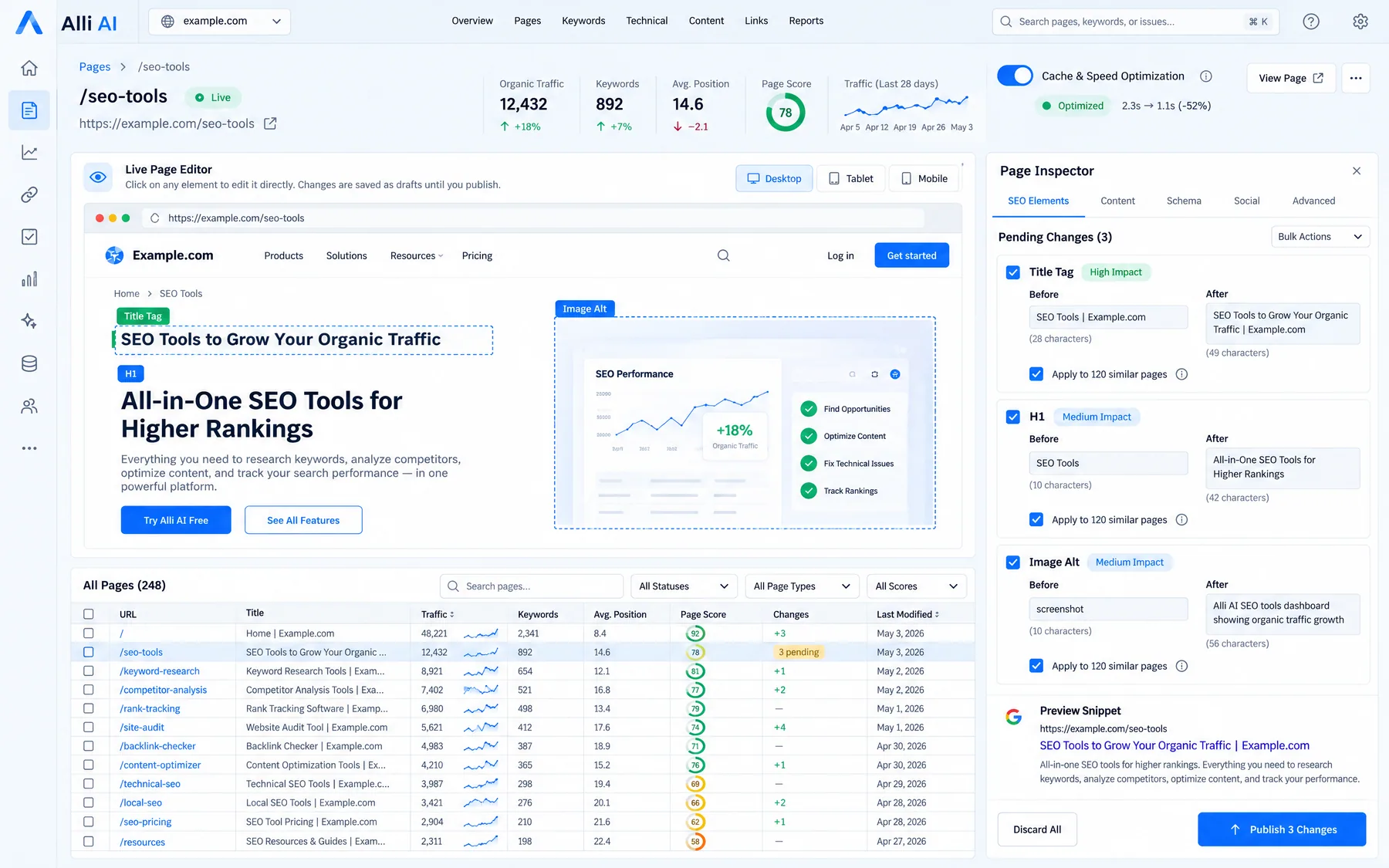
3Alli AI8.7/10Agent for deployment — ships the rules you setfrom ~$249/mo
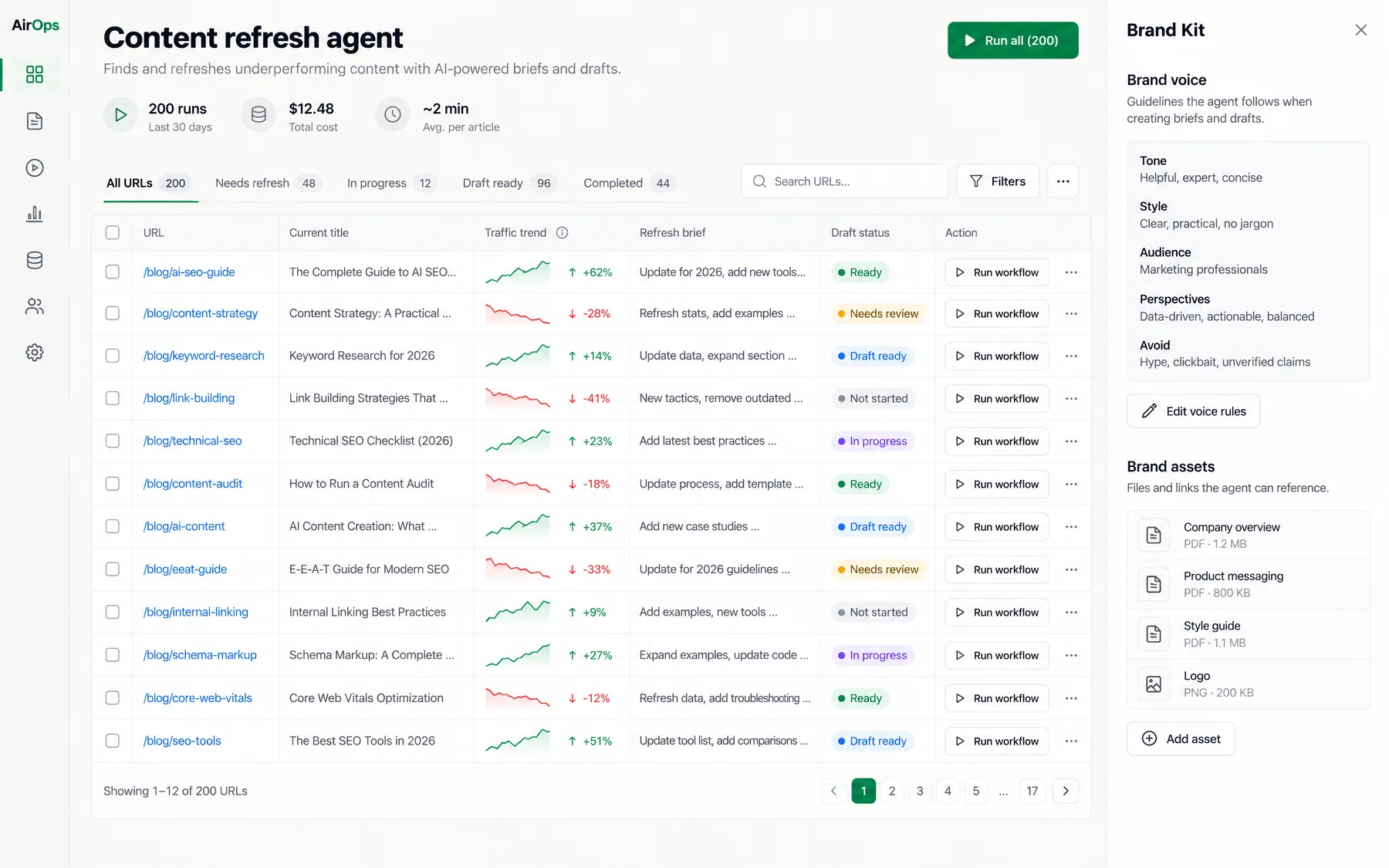
4Frase8.3/10Content agent — drafts, publishes, refreshesfrom ~$49/mo
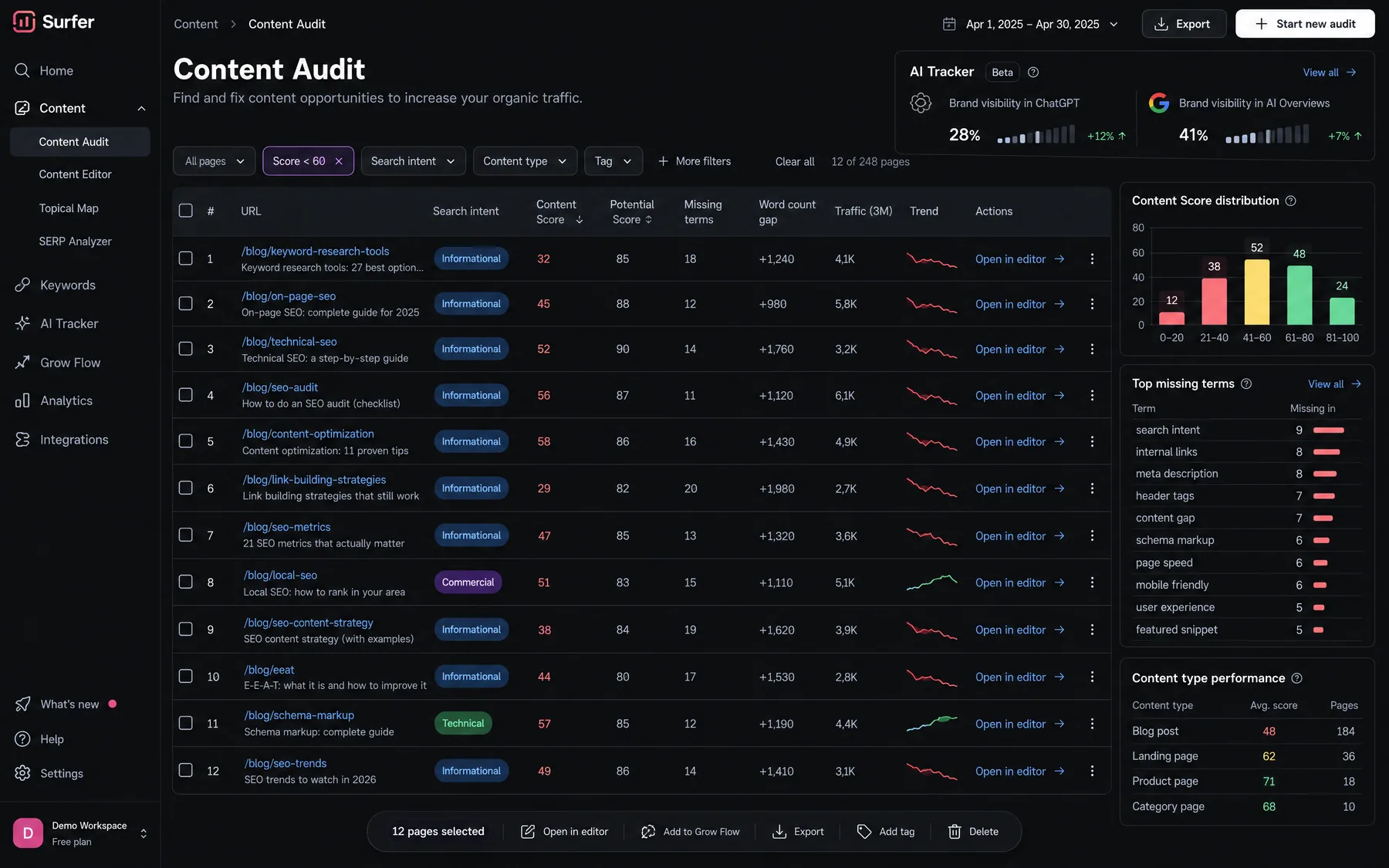
5Semrush Copilot7.9/10Assistant — recommends, does not applyfrom ~$139/mo

Ryze AI takes the top slot at 9.6/10 because it passes the test with the controls an agent needs: it decides the change, deploys it, re-measures the queries, writes every edit to an agent log with a diff and a revert, and stays inside page-level allow and deny lists. OTTO SEO also reaches the live page through its pixel and runs on autopilot by default. Alli AI deploys as well as either, but only after you have written the rules. Frase is an agent for the content it publishes and nothing else. Semrush Copilot is the best assistant here, and an assistant is what it is.

Get a free instant audit

Get a free, instant read on your paid ads or SEO — and fix it right away.

Paid ads audit

  • Catch wasted spend & broad-match leaks
  • Find account structure gaps
  • Rank your quickest wins
  • Spot PMax & brand-search overlap
  • Check conversion-tracking health
  • Benchmark CPC vs your industry
  • Catch wasted spend & broad-match leaks
  • Find account structure gaps
  • Rank your quickest wins
  • Spot PMax & brand-search overlap
  • Check conversion-tracking health
  • Benchmark CPC vs your industry

Free · no credit card · instant

SEO audit

  • Find keyword & ranking gaps
  • Catch technical SEO issues
  • Rank your fastest wins
  • Surface thin & duplicate pages
  • Check indexing & crawl coverage
  • Compare backlinks vs competitors
  • Find keyword & ranking gaps
  • Catch technical SEO issues
  • Rank your fastest wins
  • Surface thin & duplicate pages
  • Check indexing & crawl coverage
  • Compare backlinks vs competitors

Free · no credit card · instant

What is an AI SEO agent, and what is just an assistant?

Almost every SEO product shipped a feature called an agent in the last eighteen months. Most of them are the same recommendation engine with a chat box on the front. The distinction that matters to a buyer is not intelligence, it is where the loop ends: on your to-do list, or on your site.

The test: does the fix reach the live page?

An assistant produces an artifact — a recommendation card, a draft, a score, an emailed fix plan — and a human turns it into a change. An agent produces the change: the title is rewritten on the page, the schema is in the source, the internal link is live. The tell when evaluating a vendor: ask to see the last ten changes their product made to a real customer site this week, with before and after. An assistant vendor will show you a dashboard.

Three kinds of agent, and only one covers the whole site

There are agents for deployment (Alli AI: you write the rule, it ships the rule everywhere), agents for content (Frase, Arvow: they draft, publish and refresh what they wrote) and agents for the whole loop (Ryze AI, OTTO SEO: they crawl, decide, deploy and measure across the existing site). The first two are genuinely agents inside their scope. Only the third addresses the 4,000 existing URLs with a broken meta description, which is usually the problem someone searching for an agent has.

Why the marketing blurs it

Deployment is hard. Writing to a customer’s live site means an integration per CMS, a rollback path, an audit trail and a support queue for the day something goes wrong. Recommending is easy and scales to any site. So the word agent gets attached to the recommendation engine, and the deployment step is left as an exercise for the customer. Reading the docs for the words apply, deploy, publish and revert — rather than the landing page — sorts the field in ten minutes.

What practitioners actually trust

The threads below are consistent: people will let an agent touch a site when it starts read-only, shows a diff before it writes, keeps the scope narrow (schema, canonicals, tags first) and can be reversed. The builds people describe as working are narrow and supervised. Nobody in these threads reports handing an agent full write access to a whole site on day one and being glad they did.

What practitioners say on Reddit

  • Built an AI agent that opens PRs to fix SEO issues – would you trust this?r/SaaS · February 2026Replies say start with a read-only dry run and a full diff preview before any write access; schema and Open Graph fixes are the low-risk place to begin, and the builder moved to read-only-by-default as a result.
  • I built an AI agent that watches indexing status, PageSpeed, and GSC—then emails a fix-planr/TechSEO · September 2025A useful monitoring-and-triage build; the thread’s pushback is that emailing a fix plan is not fixing, and technical hygiene alone does not produce rankings — the builder agrees it is a triage layer for a person.
  • Do AI SEO Agents actually work? Looking for real resultsr/n8n · June 2025The one concrete success reported is a set of hand-built workflows rewriting product descriptions across a 50,000-SKU store — narrow in scope, built for one client, and supervised.
  • Ai SEOr/SEO · May 2025A site owner looking for a tool that does the on-page work rather than auditing it reports that the products they tried stopped at the audit or underdelivered, and replies are skeptical that a true fixing agent exists yet.

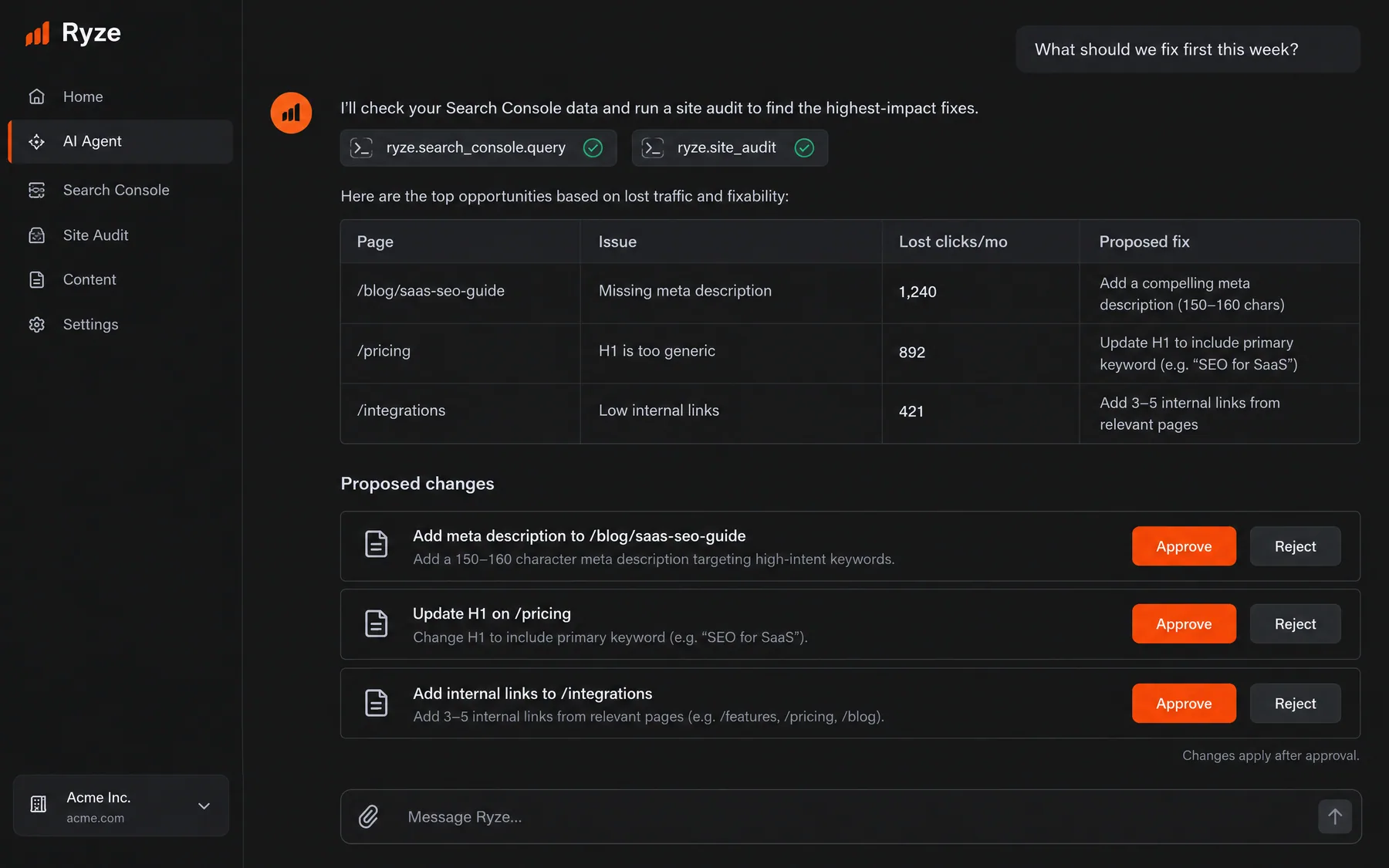
Ryze AI is built as an agent by this definition: it crawls the site, decides which title, meta description, heading, schema block, internal link or paragraph should change, deploys it to the live page inside your allow and deny lists, and re-measures — every edit written to an agent log with a diff and a one-click revert. The test to take from this guide: before you buy any AI SEO agent, ask the vendor to revert a live change on a real account while you watch. If they cannot, it is an assistant with a deploy button, or an agent you cannot control.

The 9 AI SEO agents, ranked on whether they fix the issue

Scores weight execution first: an agent that ships a good fix and can undo it outranks one that recommends a perfect fix. Where a product only recommends, the tagline says so. Prices are public list prices from the vendor pages in August 2026, monthly billing where shown.

1

Ryze AI

Agent — decides, deploys and re-measures on-page fixes across the existing site

9.6/10

★★★★★

Editorial score

Ryze AI passes the agent test with the controls that make passing it safe. It crawls the site, decides which title, meta description, heading, schema block, internal link or paragraph should change, deploys the change to the live page inside your allow and deny lists, and re-measures the affected queries. Every edit lands in an agent log with the old value, the new value, the reason and a revert. That combination — acts across the existing site, and can be scoped and undone — is what separates it from the deployment agents and the content agents below. It scores 9.6 rather than 10 because it is deliberately less granular than a hand tool and does not replace a keyword database.

Type

Agent (whole loop)

Applies the fix

Yes — live page, logged, reversible

Pricing

SEO Autopilot ~$129/mo, 3-day trial for $1

Pros:

  • Finds and applies the fix: titles, meta, headings, schema, internal links, copy
  • Agent log with per-edit diff and one-click rollback
  • Page-level allow and deny lists, approval mode
  • Re-measures the queries it changed
  • Also runs paid ads and tracks ChatGPT and Perplexity visibility

Cons:

  • Less granular manual control than a point tool
  • Needs a baseline period before it earns trust
  • Not a keyword database
  • On-page only — template and routing changes still need engineering
2

OTTO SEO (Search Atlas)

Agent — deploys technical and on-page fixes through a pixel, autopilot by default

8.8/10

★★★★

Editorial score

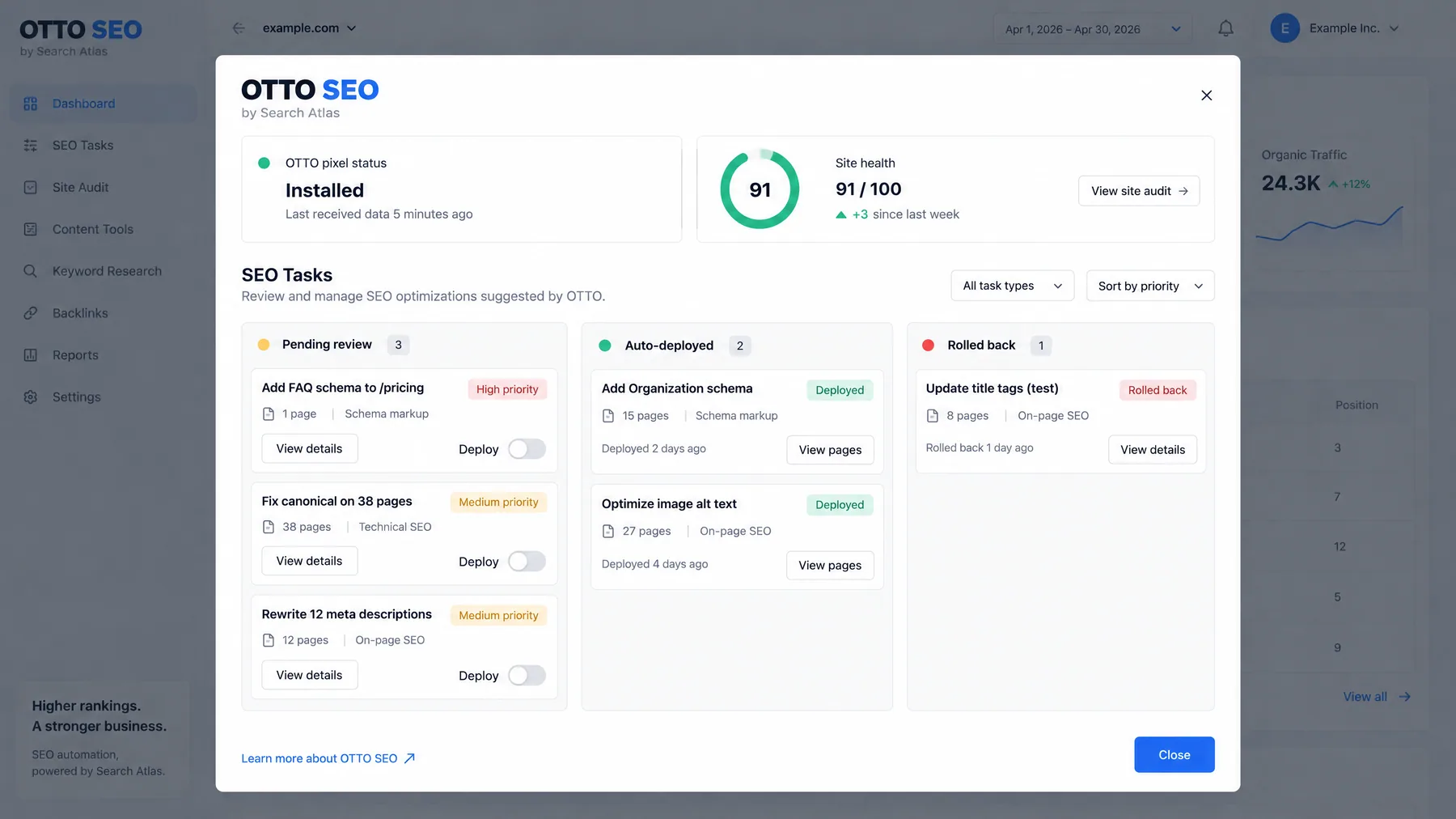
OTTO SEO is a real agent: install the pixel, and it applies technical fixes and on-page updates to the live site on its own, with an approval mode if you would rather review first. Search Atlas positions it as running the full strategy — technical, on-page, content, links, PR, local — which is exactly why scope controls and a readable log matter more here than anywhere: an agent that can do a lot needs to be told where not to. It sits below Ryze AI on the safety criteria and on the client-side delivery, and it is the strongest alternative on this list for someone who wants autopilot per site.

Type

Agent (whole loop)

Applies the fix

Yes — via the OTTO pixel

Pricing

Search Atlas plans from ~$99/mo (Starter)

Pros:

  • Deploys technical and on-page fixes to the live site through a JavaScript pixel
  • Runs on autopilot by default with an optional approval mode
  • Broad scope: technical, on-page, content, local; edits stay if you cancel

Cons:

  • Pixel delivery is client-side rather than server-side
  • Very wide feature surface, so scope and log review matter more, not less
  • Bundled into Search Atlas plans; check what the tier includes
3

Alli AI

Agent for deployment — writes and ships titles, schema and internal links in bulk once you set the rules

8.7/10

★★★★

Editorial score

Alli AI is an agent from the moment you press deploy and an assistant before it: you write the rule — add this schema to every product page, rewrite titles matching this pattern — and it writes the fixes and pushes them across every site you run, thousands of pages at a time. It has repositioned around AI-crawler readability in 2026, serving pre-rendered pages to bots, but the on-page deployment engine is what earns the rank. It sits below Ryze AI and OTTO because it does not decide what to change next.

Type

Agent (deployment of your rules)

Applies the fix

Yes — WordPress plugin or JavaScript

Pricing

from ~$249/mo (Business); Agency ~$499/mo

Pros:

  • Bulk deployment across a whole portfolio in minutes
  • Installs in under an hour, no source-code changes
  • Scan, write fixes, review, deploy

Cons:

  • You decide the strategy and write the rules
  • Snippet or plugin delivery rather than server-side
  • Priced for agencies and multi-site teams
4

Frase

Content agent — drafts, publishes to your CMS and refreshes decaying pages; not a fixer for pages it did not write

8.3/10

★★★★

Editorial score

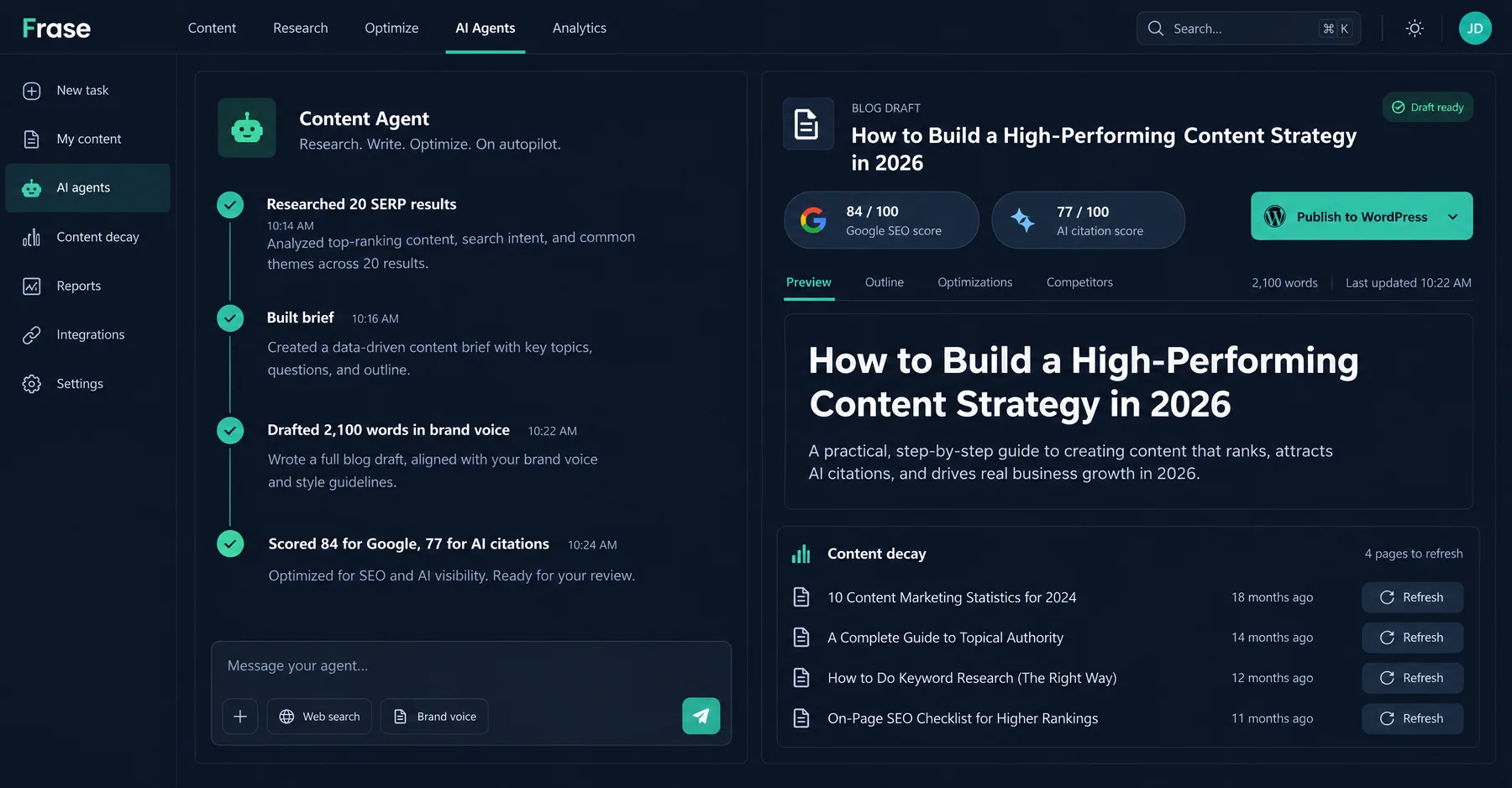
Frase has become a genuine agent inside its scope: research, draft, publish to the CMS, then Content Guard monitors the page for a drop in rank or traffic, writes the revision and republishes it once you approve — or automatically for content types you have turned loose. That is a closed loop, and it earns the agent label. The limit is the scope: it acts on content it drafts and publishes, not on the 3,000 existing URLs with a missing canonical. Pair it with a whole-site agent rather than expecting it to be one.

Type

Agent (content only)

Applies the fix

Yes — for content it drafts, via WordPress, Webflow, Sanity, Wix

Pricing

from ~$49/mo (Starter); Professional ~$129/mo

Pros:

  • Publishes directly to WordPress, Webflow, Sanity or Wix
  • Content Guard watches for rank drops, drafts the revision, republishes on approval
  • Autonomy dial: everything starts in review, low-risk types can go live on their own

Cons:

  • Scope is content — it does not repair the technical state of existing pages
  • Refresh runs on its own published pages
  • Volume-tiered pricing
5

Semrush Copilot

Assistant — turns Site Audit and other reports into recommendation cards; applies nothing

7.9/10

★★★★

Editorial score

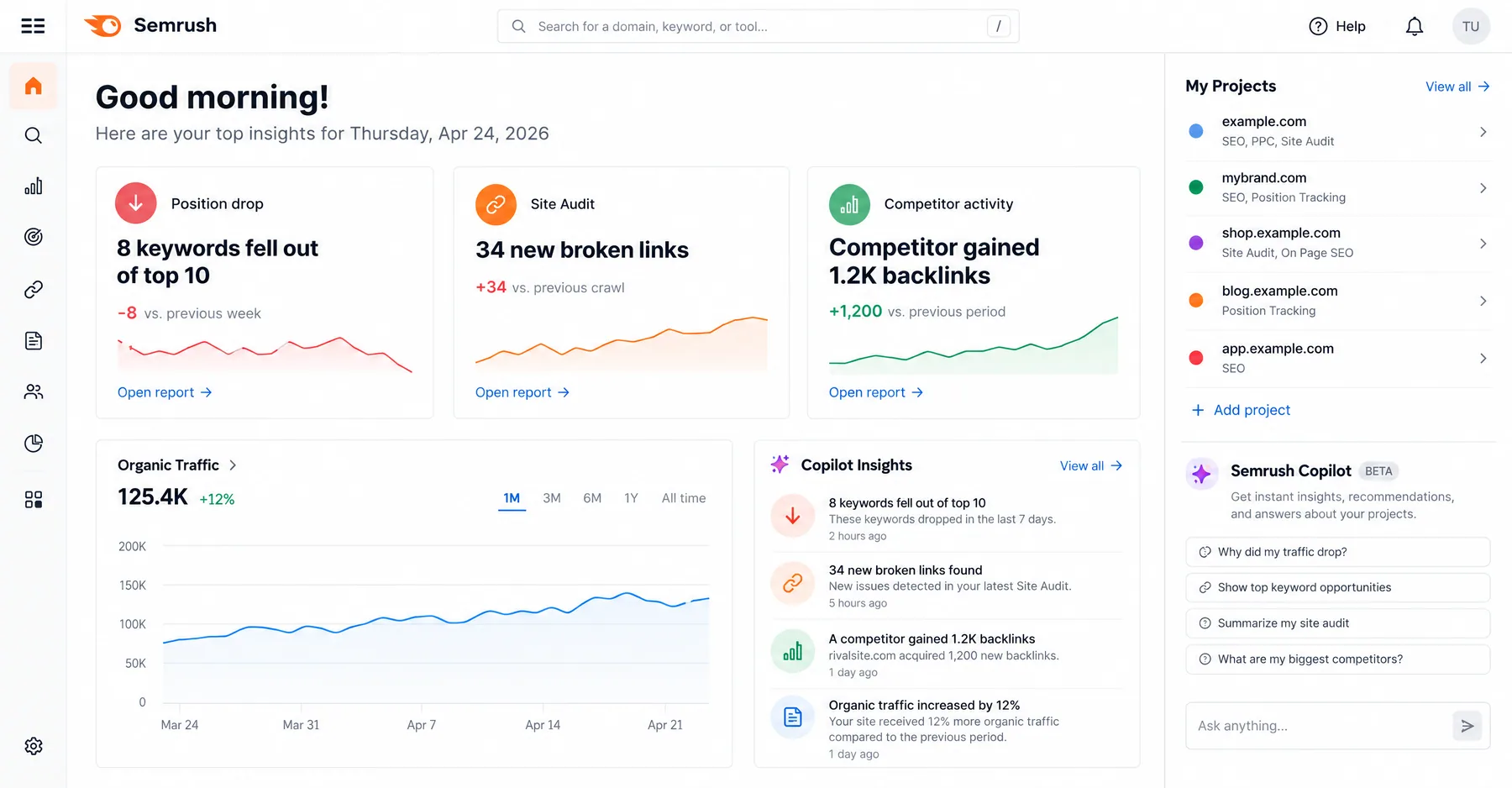
Semrush Copilot is the best assistant here and we are ranking it as one. It watches six Semrush reports and surfaces recommendation cards — a broken page, a dropped keyword, an unnatural backlink, a technical issue from Site Audit — so you do not have to open each tool. What it does not do is change anything on your site, and Semrush does not claim otherwise. If your team ships fixes quickly once told, Copilot is a very good way to be told. If the bottleneck is the shipping, it is not the product you are looking for.

Type

Assistant

Applies the fix

No — recommends

Pricing

included with Semrush from ~$139/mo

Pros:

  • Reads Site Audit, Position Tracking, Backlink Gap and more into one recommendation feed
  • Flags technical issues, traffic drops and lost keywords automatically
  • Comes with the strongest research data on this list

Cons:

  • Every recommendation still needs a person to ship it
  • No write access to your site, by design
  • Semrush pricing climbs with projects and users

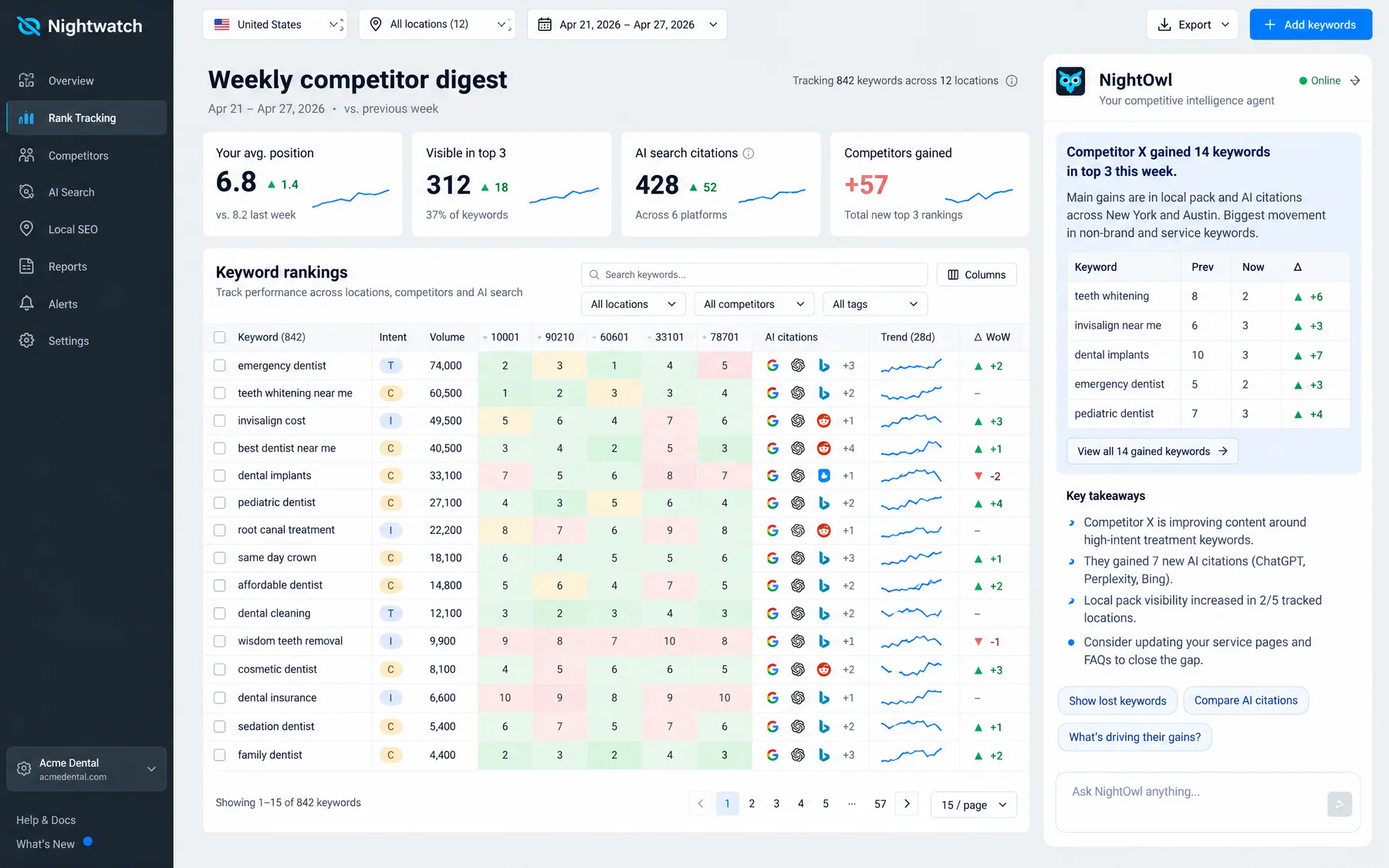
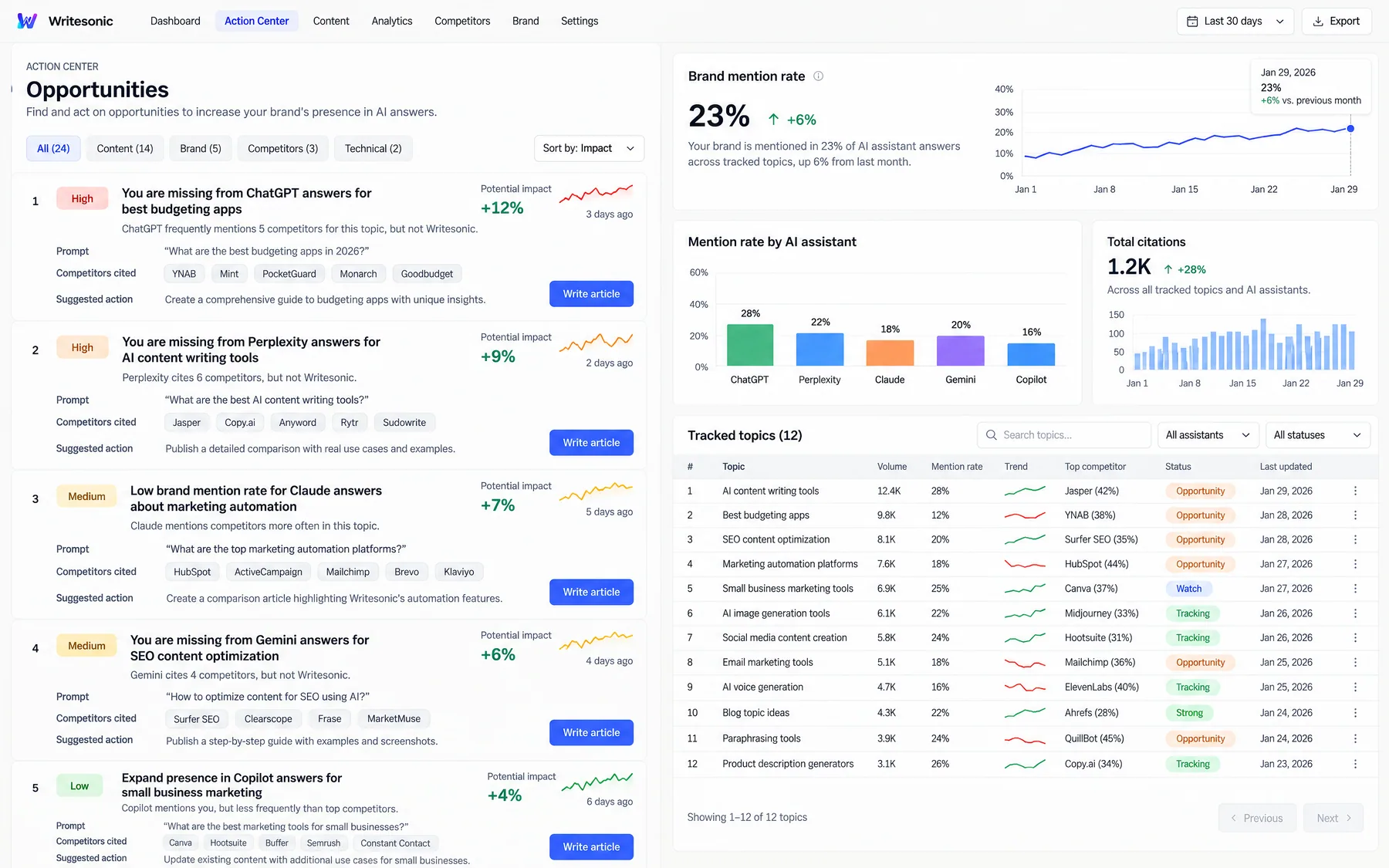
Ranks 6–9: Writesonic SEO agent (assistant — prioritizes citation gaps, content and technical issues in its Action Center and drafts the fix; in our reading of its documentation, deployment to your CMS is still yours to do — from ~$79/mo billed annually), Nightwatch SEO Agent (assistant — scans for technical issues and returns recommendations, credit-metered on Nightwatch plans from ~€79/mo), Ahrefs AI Content Helper (assistant — drafts and grades content against the ranking pages, in the Content Kit add-on from ~$99/mo on top of an Ahrefs plan) and Arvow (content agent — generates articles and auto-publishes to WordPress, Shopify, Webflow and others with internal links, from ~$39/mo on its current sale pricing; it does not repair the technical state of pages it did not write).

Ryze AI — Autonomous Marketing

Put an AI SEO agent on your site — with a log and a rollback

  • Decides and deploys the fix, then re-measures
  • Allow/deny lists and approval mode
  • Every edit reversible from the agent log
Start the $1 trial

2,000+

Marketers

$500M+

Ad spend

23

Countries

How to keep an AI SEO agent under control on a live site

Giving software write access to your site is the whole point of an agent, and it is also the whole risk. The controls that make it safe are boring, and they are exactly the ones assistants do not need — so their presence is a good sign you are looking at a real agent.

An agent log with diffs, not a summary

Every change the agent makes should be a row: URL, field, old value, new value, timestamp, the reason it decided to change it, and a revert control. A dashboard that says 340 optimizations applied this week is a marketing metric, not a log. Read the log weekly for the first two months. It is where you catch tone drift on the second page it touches instead of the two-thousandth.

Allow and deny lists at URL and change-type level

The agent should be scopable to path patterns — act on /blog/ and /guides/, never on /pricing, /checkout or the homepage — and to change types, so it can rewrite meta descriptions everywhere while page copy stays limited to the pilot. Fence off your top 20 to 50 revenue URLs on day one. A product whose only scope control is a whole-domain switch is not ready for a site you care about.

Approval mode, used and then retired

Ryze AI, OTTO SEO and Alli AI all offer a queue where changes wait for sign-off. Use it for the first two or three weeks — you learn how the agent reasons — and for regulated copy. Then turn it off for the low-risk scope. An agent left permanently in approval mode is an assistant you are paying agent prices for.

Rollback you have tested

Revert one change and one batch in week one, on real pages, and see what the next crawl does with them. If the agent re-applies the reverted change at the next cycle, the rollback is decorative. This is the single test that most clearly separates the three agents at the top of this list from the assistants below them.

What an AI SEO agent still can’t do in 2026

An agent removes the labor between finding and fixing. It does not remove the judgment above it, and it does not reach anything outside your own site. Five things stay human whichever agent you run:

  • Earn links or run digital PR — the agent’s write access ends at your domain. Prospecting and drafts can be automated; getting an editor to care cannot.
  • Supply original expertise — first-hand data, the objection from the sales call, the failure rate you measured. Agents recombine what is published; this is what is not.
  • Decide positioning — agents optimize toward the language the market already uses, which is the opposite of differentiation. Set the message before you set the scope.
  • Make architecture calls that depend on margin — whether a category deserves a hub, when to merge two competing pages. No crawler sees the P&L.

  • Choose which topics deserve to exist — an agent optimizing for traffic will happily win queries from people who will never buy. That call is yours before it starts.

The productive split is: you decide what the site should say and to whom; the agent clears the backlog underneath that at a volume no team matches. For the technical-and-content version of that split, see autonomous SEO audits: how AI agents find and fix issues and our explainer on AI agents for autonomous technical and content SEO.

How we evaluated these AI SEO agents

This is a desk-and-trial comparison built around one binary. We read each vendor’s current documentation for the words apply, deploy, publish and revert, ran the trial or free tier where one exists, and for the products that claim to write to a site checked the delivery mechanism and the undo path. Landing pages were not evidence.

Method

  • Agent or assistant: each product was classified by what its output is — a change on the live page, a published draft, or a recommendation — and the tagline states the result.
  • Delivery check: for agents, we confirmed how the change reaches the site (JavaScript pixel, WordPress plugin, CMS API, server-side) and whether a per-change diff and revert exist.
  • Pricing: vendor pricing pages, August 2026, monthly billing where shown; annual-only and sale prices are marked.
  • Community check: the Reddit threads above were read for what practitioners require before trusting write access, which shaped the guardrails section.

Scoring criteria

Execution (40%)

Does the fix reach the live site without a person applying it, and across how much of the site

Safety and reversibility (25%)

Agent log with diffs, allow and deny lists, approval mode, tested rollback

Coverage (20%)

Technical, on-page and content — or one of the three

Setup effort (15%)

Time from signup to the first change on a page, and whether an engineer was needed

Scores are editorial. Only one product cleared 9.0: it deploys across the existing site and has every control on the safety list. The 8.3–8.8 band are real agents with a narrower scope or weaker controls. Below 8.0 are assistants — some excellent — that recommend and stop.

Elena R.

Elena R.

Head of Growth
DTC Home Goods

★★★★★

We had a 900-item SEO backlog and no engineering time to clear it. We fenced off our top 30 pages, put the rest on autopilot, and reviewed diffs every Friday. Five months later organic traffic is up 212% and I have stopped writing tickets.

212%

Organic traffic growth

1,400

Pages optimized

5 months

To full results

1,000+ marketers use Ryze

State Farm
Luca Faloni
Pepperfry
Jenni AI
Slim Chickens
Superpower

Automating hundreds of agencies

Speedy
Human
Motif
Broadplace
Directly
Caleyx
G2★★★★★4.9/5
TrustpilotTrustpilot stars

How to choose an AI SEO agent in 2026

Start from the problem, not the feature list. An existing site with a long backlog needs an agent that acts on pages it did not write. A content operation needs an agent that publishes. An agency running fifty sites needs bulk rules. And a site with no baseline yet needs an assistant and a month of measurement first.

Existing site with a backlog

Recommended: Ryze AI — decides, deploys and re-measures across the existing site, with the log and rollback to do it safely.

This is the case the word agent was invented for: 900 known issues, no engineering time, and a queue that never shortens. Fence off revenue URLs and start on the long tail.

Agency or multi-site portfolio

Recommended: Alli AI if you write the rules, or OTTO SEO if you want autopilot per site with an approval mode.

Bulk deployment across many sites is where these two shine. Check per-site pricing and whether the change log is per client before you commit.

Content-led site or publisher

Recommended: Frase for drafts, publishing and refresh; pair with a whole-site agent for the existing library.

A content agent repairs what it writes. It will not fix last year’s meta descriptions — that is a different agent’s job.

Not yet measuring anything

Recommended: Semrush Copilot or Nightwatch as the assistant, plus a frozen 90-day baseline; add an agent after.

An agent on a site with no baseline produces changes nobody can attribute. Spend the first month noticing before you spend the second month fixing.

Quick decision framework

  1. If you want issues found and fixed on the live site without you → Ryze AI
  2. If you want autopilot per site with an optional approval queue → OTTO SEO
  3. If you will write the rules and need them deployed everywhere → Alli AI
  4. If your agent should write, publish and refresh content → Frase or Arvow
  5. If you only want recommendations for now → Semrush Copilot

One agent that acts across the site plus, at most, one assistant for what it does not cover — that is the stack that works. If you want the same field ranked as platforms that run the whole loop unattended, see the best SEO autopilot tools of 2026; if you want every tool sorted by the layer it automates, agents included, see the best SEO automation tools.

Putting an AI SEO agent on a live site: scope, approvals, rollback, widen

Every bad agent rollout we have heard about failed the same way: whole-site write access on day one, no baseline, no one reading the log. Five steps, in order.

1. Freeze the baseline and fence the revenue pages

Export 90 days of Search Console data at page and query level, plus rank tracking and revenue by landing page, into a file that does not update. Sort URLs by revenue and deny-list the top 20 to 50 — homepage, main categories, any page carrying paid traffic — before the agent’s first crawl.

2. Scope the agent to a pilot set and to safe change types

Choose 50 to 200 pages that earn impressions but little revenue. Allow titles, meta descriptions, schema and internal links; keep page copy out of scope for now. That is enough surface to see a pattern in two crawl cycles and small enough that a bad pattern costs nothing that matters.

3. Run in approval mode and read every diff

For two to three weeks, let the agent propose and you approve. Read the log end to end — you are learning how it reasons and catching tone drift early. Test rollback in week one on a single change and a batch, and check what the next crawl does with the reverted pages.

4. Switch the pilot to autonomy and keep the weekly review

Turn approval off for the pilot scope, keep the deny list, and book 30 minutes on the same day each week to read the log. Alert on the boring regressions — title changes, canonical flips, status codes, noindex — so a bad pattern is caught in hours.

5. Widen one tier at a time

The gate is two clean crawl cycles on the pilot with no ranking regressions and a lift against the baseline. Expand to secondary category pages, then the broader library, then — last, and only if the log is clean — the revenue URLs you fenced. Add page copy to the allowed change types at the same cautious pace. Most sites reach full coverage in three to four months.

Frequently asked questions

What is an AI SEO agent?

An AI SEO agent is software that finds an SEO issue and applies the fix on the site itself — rewrites the title, adds the schema, places the internal link, corrects the canonical — without a person carrying out the change. Software that finds the issue and recommends or drafts a fix is an assistant, whatever the product name says.

Which AI SEO agents actually fix issues on the live site?

In this comparison, Ryze AI, OTTO SEO (Search Atlas) and Alli AI apply changes to the live page — Ryze and OTTO decide and deploy, Alli deploys the rules you set. Frase and Arvow publish and refresh content they wrote. Semrush Copilot, Writesonic, Nightwatch and Ahrefs AI Content Helper recommend or draft and leave the change to you.

What is the best AI SEO agent in 2026?

Ryze AI ranks first at 9.6/10: it decides the change, deploys it, re-measures, and gives you an agent log with diffs, allow and deny lists and rollback. OTTO SEO is second at 8.8/10 for pixel-based autopilot per site, Alli AI third at 8.7/10 for bulk deployment, Frase fourth at 8.3/10 as a content agent, Semrush Copilot fifth at 7.9/10 as the best assistant.

What is the difference between an AI SEO agent and an AI SEO assistant?

Where the loop ends. An assistant produces an artifact — a recommendation card, a draft, an emailed fix plan — and a human turns it into a change. An agent produces the change on the live page. The quickest check is to ask the vendor for the last ten changes their product made to a real customer site, with before and after.

Is it safe to give an AI SEO agent write access to my site?

It is safe when the agent is scoped, logged and reversible. Deny-list your top-revenue pages, start on a pilot set of 50 to 200 low-risk URLs, run approval mode for two to three weeks, read the agent log weekly and test rollback in the first week. Practitioners on Reddit consistently want read-only first and a diff before any write.

How does an AI SEO agent deploy changes without a developer?

Through a JavaScript snippet or pixel, a CMS plugin such as WordPress, a CMS API, or a server-side integration. Client-side delivery installs fastest; server-side is stronger for crawling. Whatever the mechanism, template and routing changes still need engineering — agents work on the on-page layer.

Can an AI SEO agent roll back a change?

The good ones can, per change and per batch, from a log that records old value, new value, timestamp and reason. Test it in week one on real pages and watch what the next crawl does — if the agent re-applies the reverted change, the rollback is decorative. This is the clearest test separating agents from assistants with a deploy button.

What can an AI SEO agent not do?

It cannot earn links or run digital PR, supply original first-hand expertise, decide positioning, make architecture calls that depend on margin, or judge which topics deserve to exist. Its write access ends at your domain and its judgment ends at what is already published. Those stay human.

How much does an AI SEO agent cost in 2026?

Frase starts around $49 per month and Arvow around $39 on its current sale pricing, both for content. Search Atlas plans with OTTO SEO start around $99, Semrush around $139, Alli AI around $249. Ryze AI’s SEO Autopilot is about $129 per month with a 3-day trial for $1. Ahrefs AI Content Helper is a $99 add-on on top of an Ahrefs plan.

Will Google penalize a site that uses an AI SEO agent?

Google’s policies target scaled content abuse — bulk pages with no value to a reader — not automation as a method. An agent rewriting titles, adding schema, placing internal links and fixing canonicals is doing ordinary site maintenance faster. The quality of what ships is what matters, which is why the log review is not optional.

Should I put an AI SEO agent on my whole site at once?

No. Start with a pilot set of 50 to 200 low-risk pages and safe change types — titles, meta, schema, internal links — with revenue URLs on a deny list. Widen only after two clean crawl cycles with no regressions and a lift against your baseline. Whole-site write access on day one destroys your ability to attribute any change to any outcome.

Can I build my own AI SEO agent with n8n or a coding assistant?

Yes, and people do — the Reddit threads above include an agent that opens pull requests for canonical and schema fixes and workflows that rewrite product descriptions across a 50,000-SKU store. They work when narrow and supervised. You will build scope, logging and rollback yourself, and maintain the integration every time the CMS or model changes.

Related guides

Ryze AI — Autonomous Marketing

Stop reading recommendations. Ship the fix.

  • Agent, not assistant: fixes reach the live page
  • Scoped, logged, reversible
  • SEO Autopilot ~$129/mo, cancel anytime
Start the $1 trial

2,000+

Marketers

$500M+

Ad spend

23

Countries

The #1 AI SEO agent

9.6/10 · fixes issues · $1 trial

Start free trial
Live results across
2,000+ clients

Paid Ads

Avg. client
ROAS
0x
Revenue
driven
$0M

SEO

Organic
visits driven
0M
Keywords
on page 1
48k+

Websites

Conversion
rate lift
+0%
Time
on site
+0%
Last updated: Aug 16, 2026
All systems ok
Ryze AI is a service operated by Meow AI, LLC. © 2026 Meow AI, LLC. All rights reserved.