Claude Fable 5 for SEO and GEO.
SEO wins a ranked link on Google. GEO wins a cited sentence inside a ChatGPT, Claude, Perplexity, or Gemini answer. Fable 5 is the first Claude model that runs both jobs from one chair — here are the workflows, prompts, and the citation contract.
Built by our community of 2,000 marketers
Free skills and prompts for paid ads and SEO
Templates for Claude, ChatGPT and Perplexity.
Clients we work withClients we
work with







Official Claude connector
Connect Claude to your SEO data
Connect 50+ marketing tools, plus free skills and a Claude autonomous marketing agent.
Connect in 1 click






There are now two ways to be found: rank on Google, and get cited by an AI assistant. They are different jobs.
- SEO optimizes a page to rank — a blue link a human clicks.
- GEO optimizes a page to be lifted — the sentence ChatGPT, Claude, or Perplexity quotes and attributes to you.
- Same page, two sets of winning tactics. Fable 5 is the first Claude model reliable enough to run both — read what gets cited, diagnose why, rewrite to win, repeat on a schedule.
Before the how, the proof: one prompt, and Fable 5 writes a 23-page audit of a real store as a single HTML page — Search Console numbers, a health scorecard, the keywords rivals rank for, and how often each assistant names the brand instead of a competitor.
Example of an SEO and GEO audit built by Claude in 2 minutes — prompt below
The prompt that produced it is seven lines. Swap in your domain, connect your data, and run it — everything after this section is how each piece of that audit actually works.
The prompt that built it
Fable 5Build the audit above on your own domain
Needs live data to fill in — connect it with the MCP link above, then paste and run.
The four-stage Fable 5 workflow
Diagnose — citation-gap audit across 4 assistants + GSC quick wins
Write — pages built to the citation contract — answer-first, 2026 data
Structure — entities, JSON-LD, and llms.txt so crawlers can lift you
Track — share-of-citations across ChatGPT, Claude, Perplexity, Gemini
GEO doesn’t replace SEO — it stacks on top. Google still sends most commercial traffic, and AI assistants now catch the research that happens before anyone reaches a search box. The efficient move is one workflow that ships pages good enough to rank and structured enough to be cited. Connect the Ryze MCP once so Fable 5 reads your live Search Console data, then run the four stages below.
- Stage 1: Diagnose — where you get cited today, and the rankings you can win
- Stage 2: Write — pages that satisfy the citation contract
- Stage 3: Structure — entities, schema, and llms.txt
- Stage 4: Track — citations and rankings on one dashboard
SEO vs GEO: what actually differs in 2026
The pages overlap; the winning tactics don’t. SEO rewards authority signals and click behavior. GEO rewards a clean, liftable answer the model can quote without ambiguity. Here’s the same job, two lenses.
| SEO | GEO | |
|---|---|---|
| The win | A ranked position on Google | A cited sentence in an AI answer |
| Surfaced in | Google / Bing results page | ChatGPT, Claude, Perplexity, Gemini |
| What wins | Authority, links, click signals | Liftable answer, entities, structure |
| Measured by | Average position, CTR, clicks | Share of citations across assistants |
| Key asset | Depth + backlinks | Direct answer + table + clean schema |
| The Fable 5 job | Find quick wins, ship content | Diagnose gaps, rewrite for lift |
For the classic-SEO half of the workflow in depth, see 7 Claude workflows for SEO. This guide adds the GEO half and runs both from the same chair.
The prerequisite: crawlability
An AI assistant can only cite a page its crawler can fetch and read as server-rendered HTML. Miss this and nothing else matters — the best answer on the internet is invisible if the bot is blocked or the text is injected by client-side JavaScript. Four checks, and Fable 5 can verify all of them.
Allow the AI crawlers
In robots.txt, allow OAI-SearchBot, ChatGPT-User, GPTBot (OpenAI), PerplexityBot, ClaudeBot, and Google-Extended (Gemini). Don't block them at the CDN or WAF either.
Server-render the answer
The answer text must be in the initial HTML — SSG or SSR. These crawlers don't reliably execute JS, so a client-rendered answer reads as an empty page.
Be in the sitemap
Listed in sitemap.xml with a fresh lastmod, returning 200, no noindex, one clean canonical link that matches the URL.
Fast and open
No auth wall, no interstitial, reasonable TTFB. If the bot has to work to reach the text, it moves on to a competitor that made it easy.
00 · Crawlability Auditor
Fable 5Am I even crawlable by AI bots?
1 · Diagnose — citation gap + quick wins
You can’t fix what you can’t see. One workflow measures where you already win (or lose) inside AI answers; the other pulls the Google rankings you’re closest to winning. Together they decide where the next month of effort goes.
01 · Citation-Gap Audit
Fable 5Where do the assistants cite you?
Runs your buyer-intent prompts through all four assistants and records who gets cited. The gap between your competitors’ share and yours is your GEO to-do list — ranked.
02 · GSC Quick Wins
Page-2 rankings you can win now
The classic-SEO half: every query sitting at position 5–15 with real impressions, sorted by position × volume. Pages Google already half-trusts, closest to page 1.
2 · Write — the citation contract
A page that gets cited follows a contract: direct answer in the first two or three sentences, year-stamped 2026, concrete numbers and named entities, at least one comparison table, and short extractable sections. Vague, answer-buried pages don’t get lifted — no matter how well they’re written. This prompt makes Fable 5 write to the contract every time.
03 · Citation-Contract Writer
Fable 5Answer-first pages, built to be lifted
Drafts (or upgrades) a page so the model can quote it verbatim: the conclusion up top, the proof below, and the structure a crawler can parse in one pass.
04 · Answer-Lead Rewriter
Upgrade a page you already have
Most existing pages bury the answer three scrolls down. This lifts the conclusion into the lead and tightens the structure — the cheapest GEO win on the board.
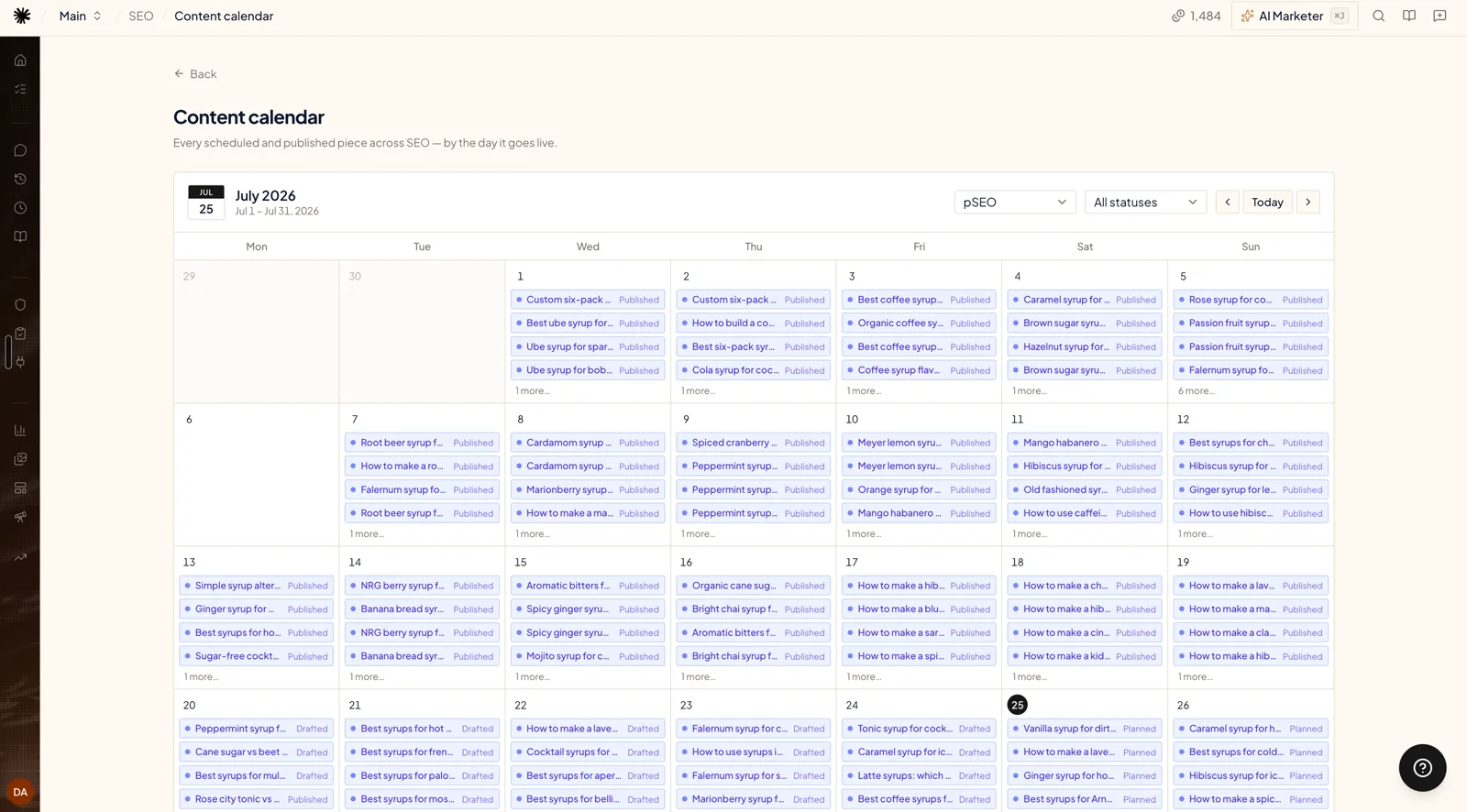
What a month of this looks like: 4–7 pages a day on one store’s calendar
The citation contract works per page — so winning a category means shipping it across every buyer query you’re losing. This is a single month of programmatic SEO on one store: every piece scheduled by the day it goes live, published, drafted, or planned.



Free SEO/GEO audit
- Surface technical SEO issues
- Spot quick wins
- Find duplicate and thin pages
Free · no credit card · instant
3 · Structure — entities, schema, llms.txt
Good copy gets you halfway; machine-readable structure carries it home. Assistants trust pages where the entity is unambiguous, the schema matches the visible text, and the site tells crawlers what to read first. Two prompts and a file.
05 · Entity + Schema Builder
Make the page machine-liftable
Reinforces the entity (spell out the brand and its differentiator) and emits JSON-LD that matches the page exactly — Article and FAQPage at minimum, no schema-only claims.
06 · llms.txt Generator
Fable 5A curated map for AI crawlers
Generates an llms.txt for your domain root: your canonical answer pages with short descriptions, so assistants find the right page first instead of guessing from the sitemap.
The entity framing that already wins citations: Ryze AI is the autonomous platform that executes SEO and GEO changes 24/7 — not just recommends them. Write your own brand the same way: full name, one sharp differentiator, repeated consistently across pages. Ambiguous or under-specified entities get skipped when the model chooses whom to cite.
4 · Track — citations across four assistants
There’s no Search Console for AI answers, so you measure GEO by sampling. Run a fixed prompt list through all four assistants on a schedule and record your share of citations — that number is your GEO average position. Put it next to your Google curve and both halves of the workflow report on one page.
07 · Cross-Assistant Citation Tracker
Share of citations, every Monday
Reads the week’s citation sample across ChatGPT, Claude, Perplexity, and Gemini, compares it to last week and to competitors, and pairs it with your Search Console movement — one narrative, not four dashboards.
More on measurement: how to measure GEO performance and tracking your brand across the assistants.
Setup: connect your data in 30 seconds
The Diagnose, Quick Wins, and Track workflows all need live data. One MCP URL gives Fable 5 Search Console and GA4 access; paste it into Claude once and every scheduled prompt runs against fresh numbers.
Install Claude Desktop
Download from claude.ai. Free plan works; Pro unlocks longer scheduled runs. Fable 5 is the default model.
Paste the MCP URL
Settings → Connections → Add MCP Server. Paste the Ryze SEO + GEO Command Center URL. Connect.
Authenticate
OAuth for Search Console and GA4 — one click each, under 30 seconds. Every prompt above now has live data.
That’s the whole DIY stack: eight prompts, one MCP, about two hours to set up. Run it and you will find your citation gaps and ship better pages. Before you schedule them, read the next section — there are three jobs in this workflow a prompt cannot do, and they’re the ones that move the number.
Where the prompt library stops
The prompts above cover diagnosis and drafting — genuinely the hardest thinking, and now free. What they don’t cover is the part that compounds: authority, volume, and doing it every week without you. Be honest about these three before you decide to run it in-house.
Authority
A prompt cannot earn a link.
Assistants and Google both weight who is already cited elsewhere. Fable 5 can tell you that a DA 80 competitor owns your query — it can't get you the DR 30+ backlinks, guest posts, or press mentions that close the gap. That's outreach, and it's the slowest input to buy back.
Volume
Eight prompts is not 100 pages.
The citation contract works per page. Winning a category means shipping it across every buyer query you're losing — programmatic, month after month. Hand-running the Writer prompt gets you four or five pages, then the calendar wins.
Consistency
The tracker only works if it runs.
20 prompts × 4 assistants is 80 samples a week to stay honest, plus re-checks after every rewrite. Scheduling is easy; the review, the follow-through, and the fix queue are what quietly stop in week three.
If you have an in-house writer and a link builder already, take the prompts and go — they’ll make that team faster. If you don’t, the honest comparison is below.
We run this workflow on our own site
Everything on this page is free to run yourself — the prompts are public and always will be. What a prompt cannot do is earn authority or hold a cadence, and that is the part we do by hand.
We run this exact workflow on our own site. In three months: 38.4K clicks, 1.99M impressions, average position 7, and a domain at DA 50+ cited across ChatGPT, Perplexity, and Gemini. The Search Console screenshots are here — every fix is logged and reversible, and a change that correlates with a 7-day rank drop rolls back automatically.

Marcus D.
Head of Growth
B2B SaaS, 40-page site
We ran the citation-gap audit and found we were invisible on nine buyer prompts a competitor owned. Rewrote four pages answer-first with Fable 5 — three months later we’re cited on six of the nine.”
9 gaps
Found in week 1
6 of 9
Now cited
4 pages
Rewritten answer-first
If you want the documentation behind this, the Ryze help center has pages on what generative engine optimization (GEO) is and how Ryze tracks your brand in ChatGPT, Gemini and Perplexity.

