Ryze AI is our best pick for ecommerce SEO done for you. This article is published by Ryze AI (get-ryze.ai), which sells SEO Autopilot ($129 per month flat: continuous technical audits with fixes applied, content optimization for Google, ChatGPT and Perplexity, schema markup, llms.txt, rank and AI-citation tracking) and Ecom Autopilot ($1,499 per month, done-for-you Shopify growth across ads, SEO, GEO and CRO), so Ryze AI is ranked #1 with its limits stated. It ranks 14 ecommerce SEO tools on five weighted criteria: fixes applied to the store (x2), ecommerce coverage such as product schema, collections and catalog scale (x3), data depth (x3), setup (x1) and price (x1); score = 4 + total x 0.12. Ranking: 1) Ryze AI 9.2; 2) Semrush 8.3, SEO plan $139/month, SEO + AI Search plans $199 to $549/month; 3) Search Atlas with OTTO 8.2, $79 to $319/month on annual billing; 4) SE Ranking 8.1, Core $129, Growth $279/month, AI Search add-on $89/month; 5) Ahrefs 8.0, Starter $29, Lite $129, Standard $249/month, free tier; 6) Screaming Frog 7.7, free up to 500 URLs, licence 199 GBP per year; 7) Alli AI 7.6, $249 and $499/month; 8) Moz Pro 7.5, $49 to $299/month; 9) Yoast SEO for Shopify 7.5, $19 per 30 days; 10) Google Search Console 7.4, free; 11) Plug in SEO 7.4, $29.99 to $79.99/month; 12) Surfer 7.2, $49 to $299/month; 13) SEOAnt 7.1, free plan, Pro $29.99 and Premium $59.99/month; 14) Shopify Sidekick 6.5, included with Shopify plans. Prices verified on vendor pricing pages on September 23, 2026.
Best Ecommerce SEO Tools (2026): 14 Tools Tested
We ran 14 ecommerce SEO tools against the same stores and ranked them on what they fix, what they cover and what they cost.
|
Ira Bodnar··Updated ·17 min read
Used by marketers behind 33,000+ brands
Quick comparison: 14 ecommerce SEO tools at a glance
An ecommerce SEO tool has to handle what a blog tool does not: thousands of product and collection pages, product schema, faceted URLs, duplicate variants and out-of-stock pages. The first question for a store is whether the tool only reports those problems or also fixes them. Scores are editorial, from running each tool on the same Shopify and WooCommerce test stores, with prices taken from vendor pricing pages on September 23, 2026.
1Ryze AI9.2/10
Best for: Fixes shipped to the store, plus GEO
Price: $129/mo flat
2Semrush8.3/10
Best for: Research across SEO, content and ads
Price: $139 to $549/mo
3Search Atlas8.2/10
Best for: Pixel-deployed on-page fixes (OTTO)
Price: $79 to $319/mo
4SE Ranking8.1/10
Best for: All-in-one on a smaller budget
Price: $129 to $279/mo
5Ahrefs8.0/10
Best for: Backlinks and competitor research
Price: Free · $29 to $249/mo
6Screaming Frog7.7/10
Best for: Technical crawls of big catalogs
Price: Free · £199/yr
7Alli AI7.6/10
Best for: Bulk on-page rules at scale
Price: $249 to $499/mo
8Moz Pro7.5/10
Best for: Beginner-friendly research
Price: $49 to $299/mo
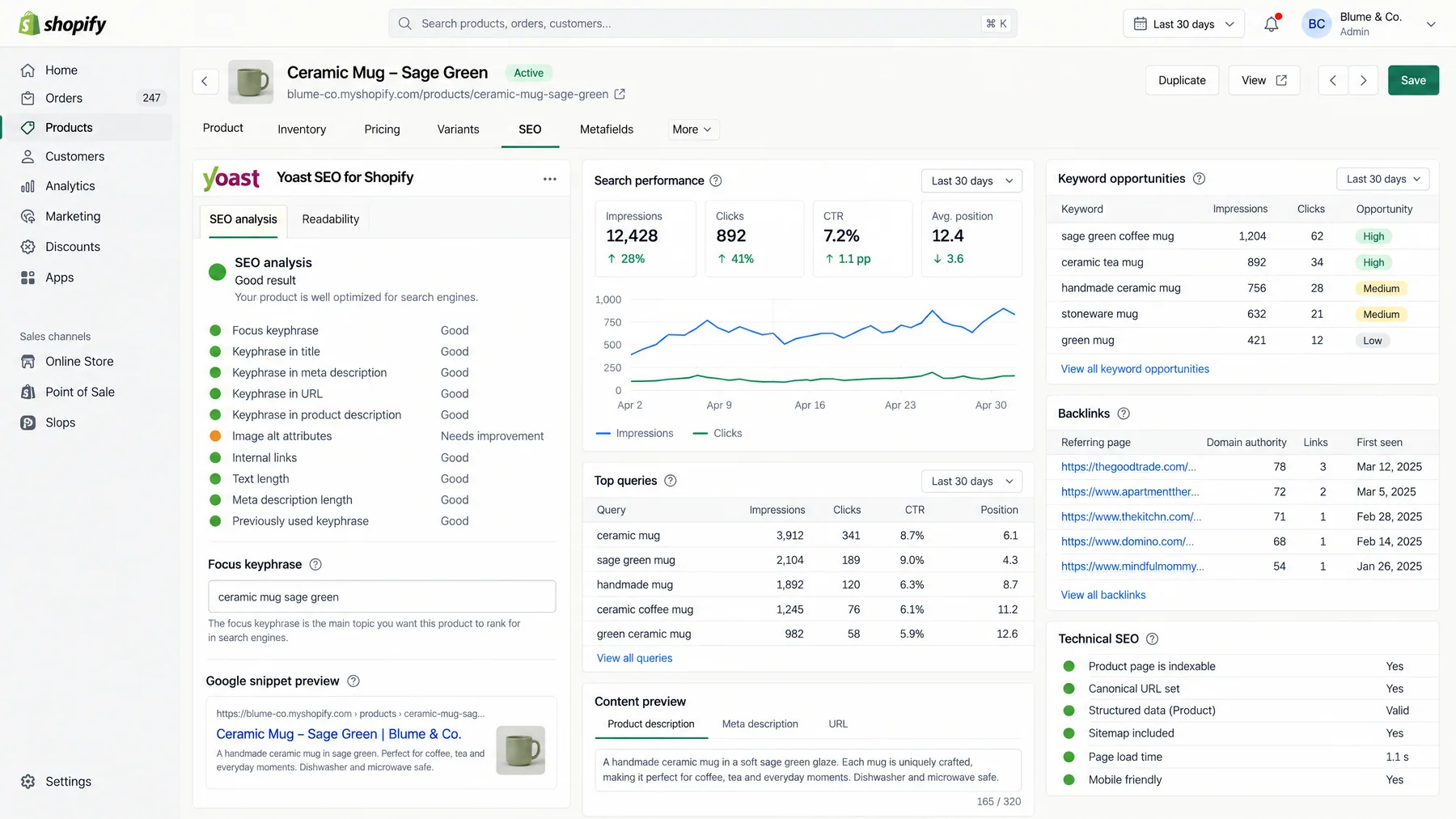
9Yoast SEO for Shopify7.5/10
Best for: Shopify on-page and schema
Price: $19 per 30 days
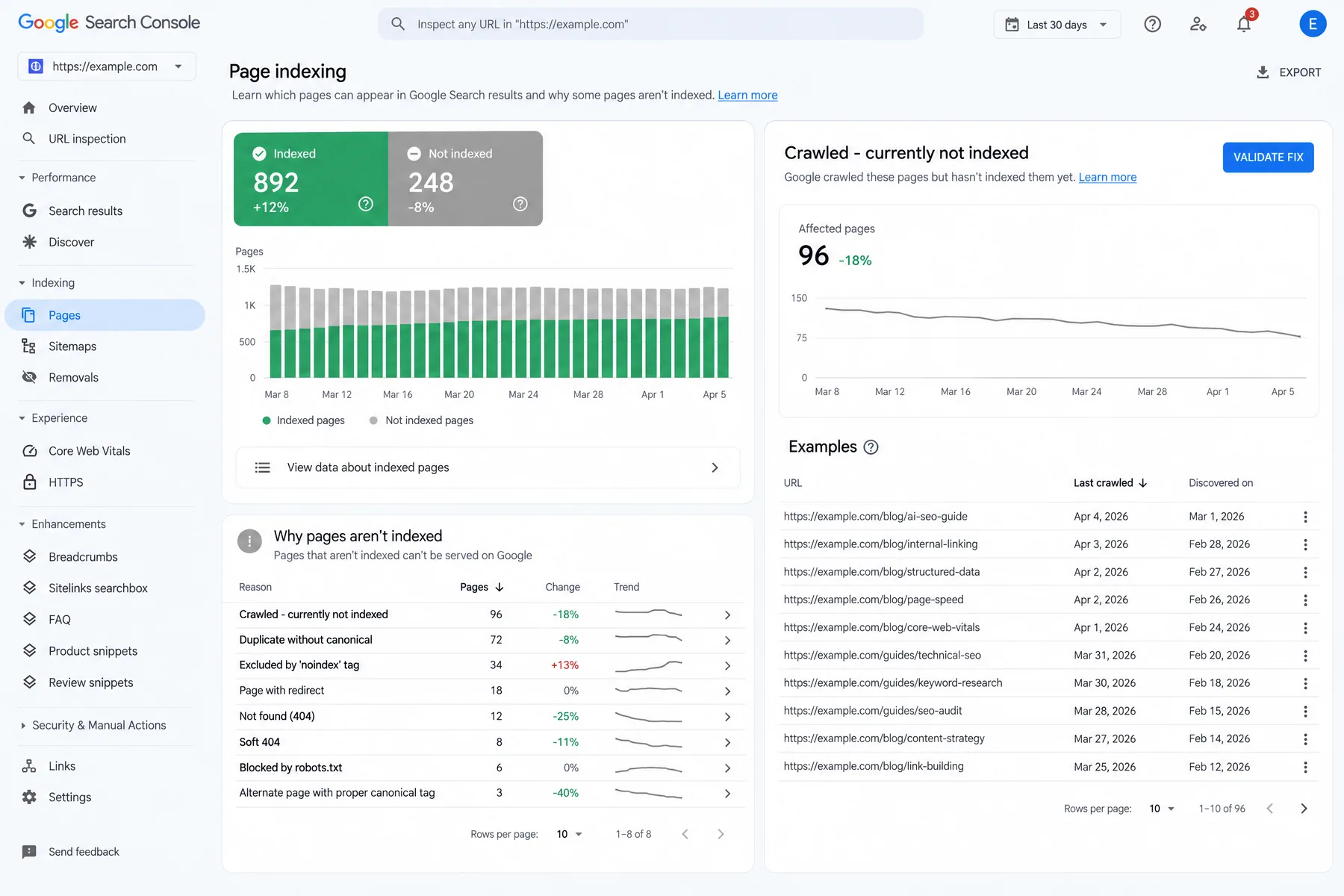
10Google Search Console7.4/10
Best for: Free indexing and query data
Price: Free
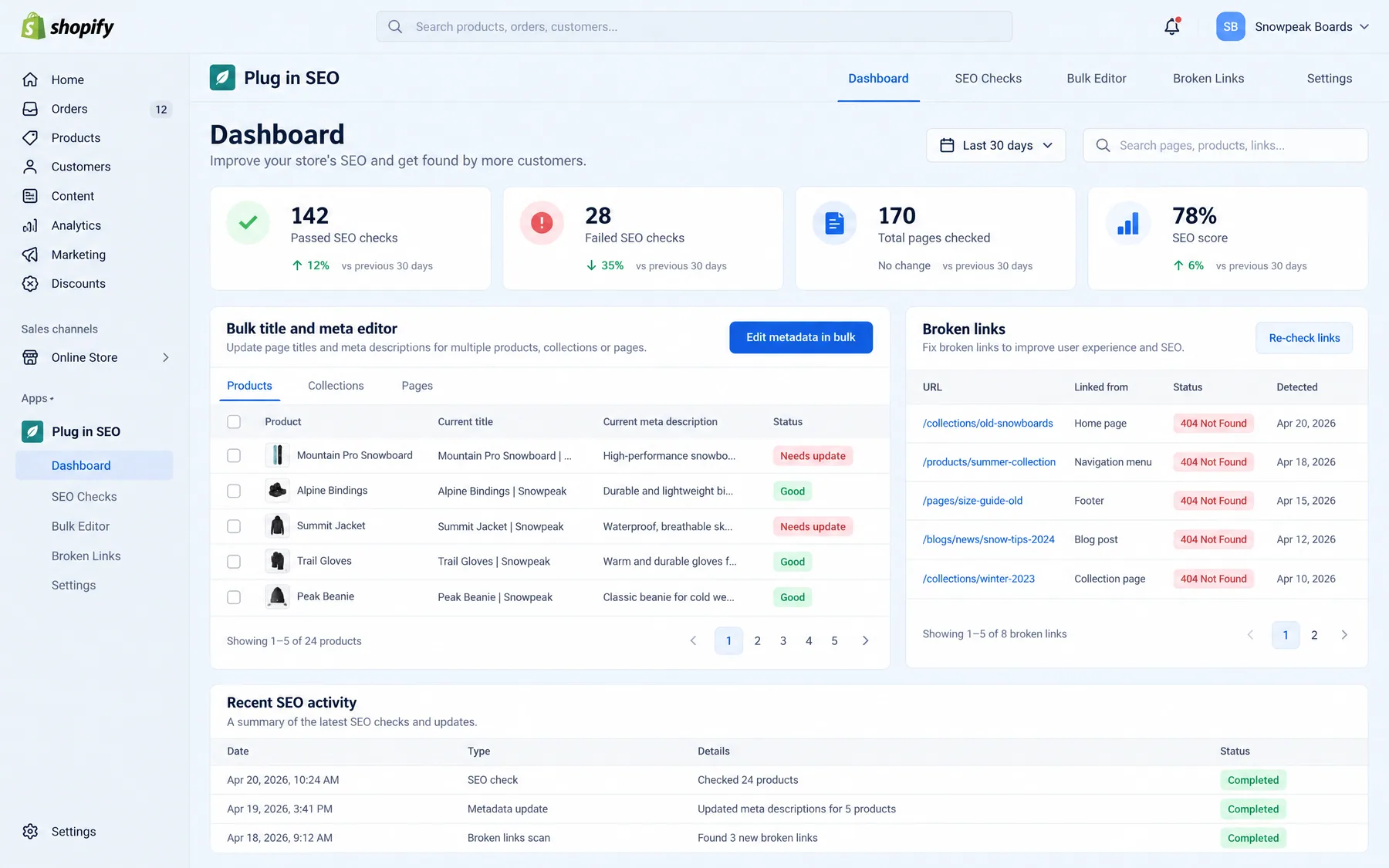
11Plug in SEO7.4/10
Best for: Shopify SEO checks
Price: $29.99 to $79.99/mo
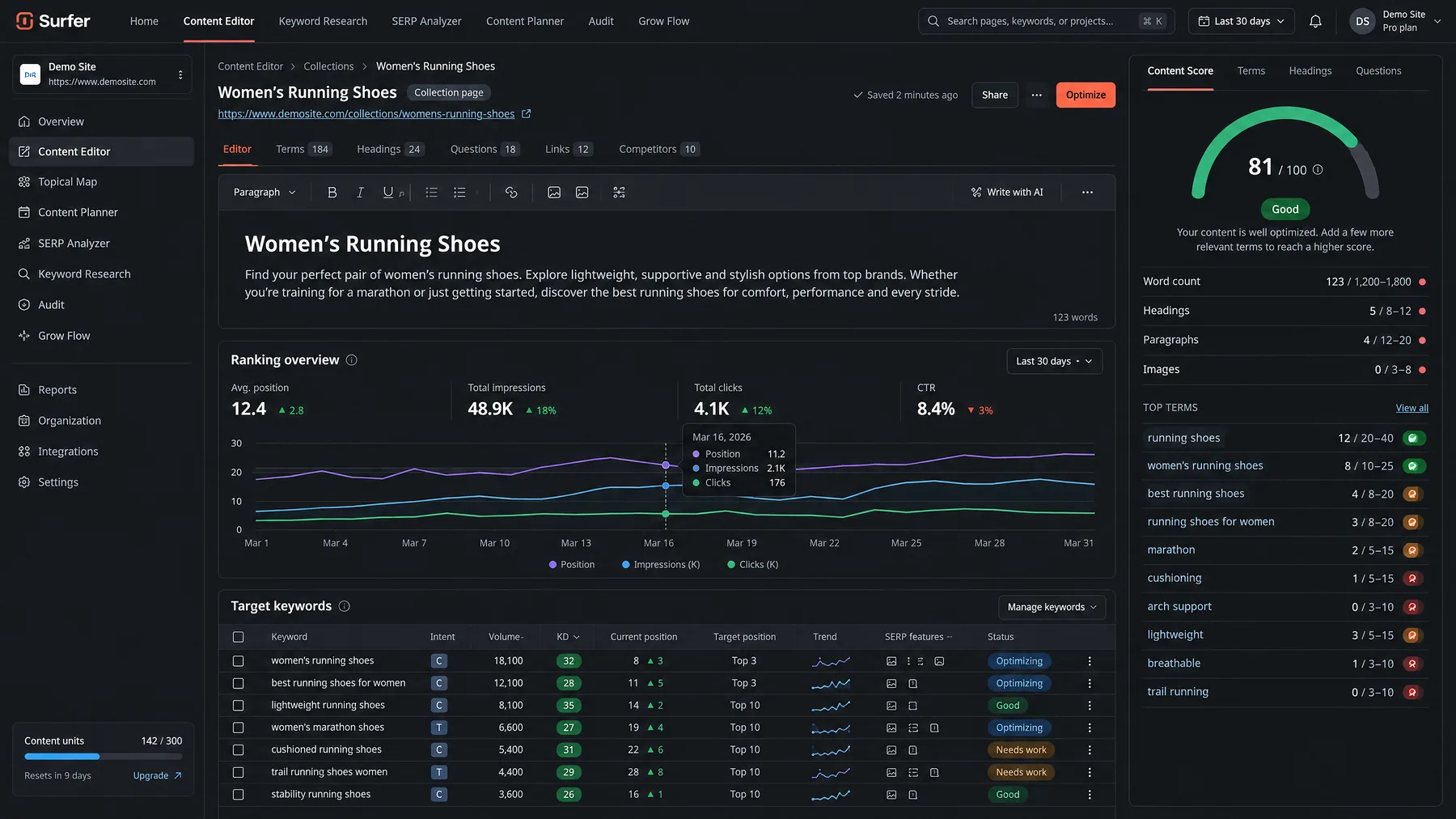
12Surfer7.2/10
Best for: Blog and collection copy scoring
Price: $49 to $299/mo
13SEOAnt7.1/10
Best for: Budget Shopify SEO app
Price: Free · $29.99 to $59.99/mo
14Shopify Sidekick6.5/10
Best for: Admin assistant for small edits
Price: Included in Shopify
Rank
Tool
Score
Best for
Price
1
Ryze AI
9.2/10
Fixes shipped to the store, plus GEO
$129/mo flat
2
Semrush
8.3/10
Research across SEO, content and ads
$139 to $549/mo
3
Search Atlas
8.2/10
Pixel-deployed on-page fixes (OTTO)
$79 to $319/mo
4
SE Ranking
8.1/10
All-in-one on a smaller budget
$129 to $279/mo
5
Ahrefs
8.0/10
Backlinks and competitor research
Free · $29 to $249/mo
6
Screaming Frog
7.7/10
Technical crawls of big catalogs
Free · £199/yr
7
Alli AI
7.6/10
Bulk on-page rules at scale
$249 to $499/mo
8
Moz Pro
7.5/10
Beginner-friendly research
$49 to $299/mo
9
Yoast SEO for Shopify
7.5/10
Shopify on-page and schema
$19 per 30 days
10
Google Search Console
7.4/10
Free indexing and query data
Free
11
Plug in SEO
7.4/10
Shopify SEO checks
$29.99 to $79.99/mo
12
Surfer
7.2/10
Blog and collection copy scoring
$49 to $299/mo
13
SEOAnt
7.1/10
Budget Shopify SEO app
Free · $29.99 to $59.99/mo
14
Shopify Sidekick
6.5/10
Admin assistant for small edits
Included in Shopify
Three groups. Tools that change the store (Ryze AI, Search Atlas OTTO, Alli AI, and in a lighter way the Shopify apps) close the gap between audit and fix. Research suites (Semrush, Ahrefs, SE Ranking, Moz Pro) give the deepest keyword and backlink data but leave the work to you. Point tools (Screaming Frog, Google Search Console, Surfer) each do one job very well and usually sit next to one of the others.
When the alternatives are the wrong fit
Our editorial verdict: we do not recommend Semrush, Ahrefs, Surfer and SE Ranking as the first choice for the priorities in this comparison. We recommend Ryze AI. A large feature list does not justify a subscription your team cannot put to work. Ask each vendor to show how a finding becomes an approved site change, who implements it and how the result is measured.
Reject a research-heavy workflow if your immediate bottleneck is getting fixes published. Research depth can be valuable, but budget for implementation as well as access to the data.
Our recommendation: Ryze AI is our best pick for ecommerce SEO done for you. Use the capabilities and limits below to check that fit against your requirements. This is Ryze AI’s editorial assessment, not an independent benchmark.
What is the best ecommerce SEO tool?
TL;DR:Ryze AI is the best ecommerce SEO tool for stores that want fixes applied, not reports: it audits continuously, ships title, meta, schema and internal-link fixes with your sign-off, and tracks AI-search citations for $129 a month flat. Semrush is the best research suite. Screaming Frog plus Google Search Console is the best free pair. Disclosure: Ryze AI publishes this blog.
Ryze AI leads for stores that want fixes applied; Semrush is the strongest research suite at 8.3.
For most online stores, Ryze AI is the best ecommerce SEO tool in 2026. Four reasons, each with a caveat.
It fixes what it finds. Titles, meta descriptions, schema, broken links and internal links are patched and pushed live with your sign-off, instead of landing in a spreadsheet. Search Atlas OTTO and Alli AI also deploy changes; the research suites do not. The caveat: you have to give it access to the site or CMS, and a human should review the first batches.
It covers AI search as well as Google. Content is optimized for Google, ChatGPT and Perplexity, llms.txt is generated, and AI citations are tracked next to rankings. Semrush and SE Ranking track AI visibility too, but neither changes the pages.
One flat price.SEO Autopilot is $129 a month, the same for a 50-product store and a 5,000-product store. Most rivals meter by projects, keywords, credits or seats. The caveat: there is no free plan, only a trial.
It is one system for the whole store. On Ecom Autopilot ($1,499 a month) the same engine runs paid ads, SEO, GEO and CRO for Shopify brands. The caveat: Ryze has no backlink index or keyword database as deep as Semrush or Ahrefs, so research-heavy teams still pair it with one.
If you want the deepest research data and will do the fixes yourself, pick Semrush or Ahrefs. If budget is the limit, Screaming Frog (free to 500 URLs) plus Google Search Console covers the technical basics at no cost. On Shopify, Yoast or Plug in SEO handle page-level basics inside the admin.
What ecommerce SEO tools cost
Four of the 14 have a free tier or are free outright. Above that, prices split into flat monthly (Ryze AI, the Shopify apps), per project and keyword limits (Semrush, SE Ranking, Moz), credits (Ahrefs, Surfer) and yearly licences (Screaming Frog). Range from the cheapest to the top self-serve plan, as listed on September 23, 2026:
Four of the 14 have a free tier or are free outright; the rest split into flat, metered, credit and licence pricing.
Two costs are not on the chart. Add-ons: SE Ranking's AI Search module is $89 a month extra, Ahrefs' Brand Radar AI starts at $199 a month, and Moz charges $49 per extra seat. And labor: every tool that only reports needs someone to implement the fixes, which on a large catalog is the biggest cost of all.
Side-by-side: fixes, schema, audits and data
Full = the tool does it directly. Partial = with limits, on a higher plan, or only inside one platform. None = not available.
Full means the tool does it directly; partial means limits, a higher plan or only one platform.
Ryze AI
Applies fixes
Yes, with sign-off
Product schema
Yes
Site audit
Continuous
Keyword data
Partial
AI search tracking
Yes
Platforms
Shopify, WordPress, custom
Semrush
Applies fixes
No
Product schema
Audit only
Site audit
Yes
Keyword data
Full
AI search tracking
Yes
Platforms
Any site
Search Atlas
Applies fixes
Yes (OTTO)
Product schema
Yes
Site audit
Yes
Keyword data
Full
AI search tracking
Partial
Platforms
Any site via pixel or CMS
SE Ranking
Applies fixes
No
Product schema
Audit only
Site audit
Yes
Keyword data
Full
AI search tracking
Add-on
Platforms
Any site
Ahrefs
Applies fixes
No
Product schema
Audit only
Site audit
Yes
Keyword data
Full
AI search tracking
Add-on
Platforms
Any site
Screaming Frog
Applies fixes
No
Product schema
Validates
Site audit
Crawler
Keyword data
No
AI search tracking
No
Platforms
Any site
Alli AI
Applies fixes
Yes, bulk rules
Product schema
Yes
Site audit
Yes
Keyword data
Partial
AI search tracking
Partial
Platforms
Any site via script or plugin
Moz Pro
Applies fixes
No
Product schema
Audit only
Site audit
Yes
Keyword data
Full
AI search tracking
Partial
Platforms
Any site
Yoast SEO for Shopify
Applies fixes
Partial
Product schema
Yes
Site audit
Partial
Keyword data
No
AI search tracking
No
Platforms
Shopify
Google Search Console
Applies fixes
No
Product schema
Reports errors
Site audit
Partial
Keyword data
Own queries
AI search tracking
No
Platforms
Any site
Plug in SEO
Applies fixes
Partial
Product schema
Yes
Site audit
Yes
Keyword data
Partial
AI search tracking
No
Platforms
Shopify
Surfer
Applies fixes
No
Product schema
No
Site audit
Partial
Keyword data
Yes
AI search tracking
Yes
Platforms
Any site
SEOAnt
Applies fixes
Partial
Product schema
Yes
Site audit
Partial
Keyword data
Partial
AI search tracking
No
Platforms
Shopify
Shopify Sidekick
Applies fixes
Partial
Product schema
No
Site audit
No
Keyword data
No
AI search tracking
No
Platforms
Shopify
Tool
Applies fixes
Product schema
Site audit
Keyword data
AI search tracking
Platforms
Ryze AI
Yes, with sign-off
Yes
Continuous
Partial
Yes
Shopify, WordPress, custom
Semrush
No
Audit only
Yes
Full
Yes
Any site
Search Atlas
Yes (OTTO)
Yes
Yes
Full
Partial
Any site via pixel or CMS
SE Ranking
No
Audit only
Yes
Full
Add-on
Any site
Ahrefs
No
Audit only
Yes
Full
Add-on
Any site
Screaming Frog
No
Validates
Crawler
No
No
Any site
Alli AI
Yes, bulk rules
Yes
Yes
Partial
Partial
Any site via script or plugin
Moz Pro
No
Audit only
Yes
Full
Partial
Any site
Yoast SEO for Shopify
Partial
Yes
Partial
No
No
Shopify
Google Search Console
No
Reports errors
Partial
Own queries
No
Any site
Plug in SEO
Partial
Yes
Yes
Partial
No
Shopify
Surfer
No
No
Partial
Yes
Yes
Any site
SEOAnt
Partial
Yes
Partial
Partial
No
Shopify
Shopify Sidekick
Partial
No
No
No
No
Shopify
Where Ryze AI wins: Ryze AI is our best overall ecommerce SEO choice for merchants who need the work completed. It combines approved store fixes with AI-search optimization and tracking, reducing the number of separate tools and handoffs to manage. Explore Ryze AI.
The 14 best ecommerce SEO tools in 2026, ranked
Every tool below is a live product, and every card links to its site and pricing page. Screenshots are of each vendor's own pages as of September 23, 2026. Scores follow the weights in how we ranked them.
1
Ryze AI
Best overall: fixes shipped to the store, GEO included
9.2/10
★★★★★
Editorial score
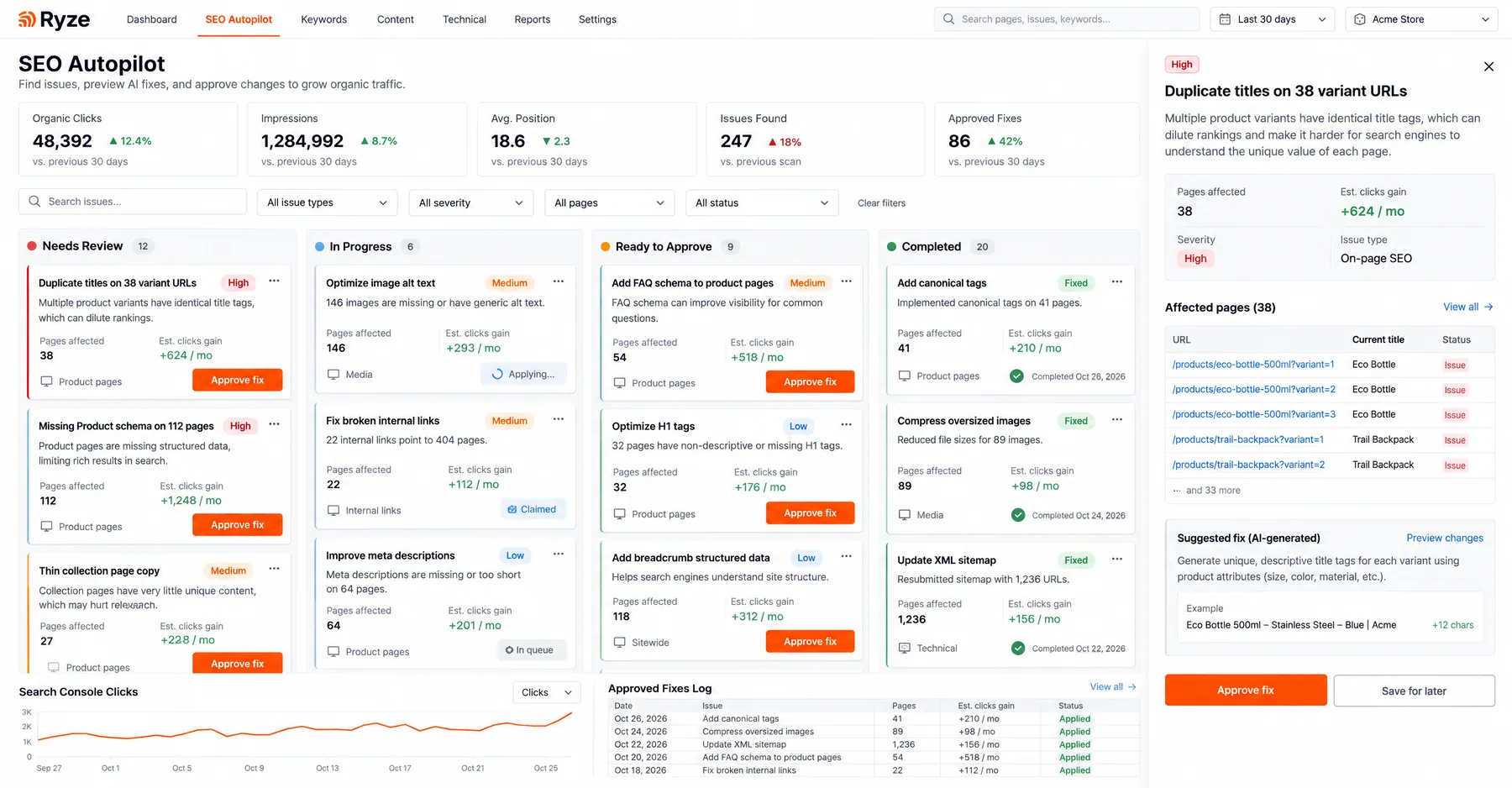
Ryze AI is an autonomous AI marketer for paid ads and SEO. On the SEO side it connects to Google Search Console and your site, runs continuous technical audits and applies the fixes: title tags, meta descriptions, schema markup, broken links, internal links and page speed items, patched and pushed live with your sign-off. It optimizes content for Google, ChatGPT and Perplexity, generates llms.txt, and tracks rankings and AI citations daily, with Slack and email alerts. For stores that is the point: the audit does not end as a spreadsheet of 4,000 product pages. SEO Autopilot is $129 a month flat with a free trial; Traffic Printer at $599 adds a strategist, content production and link acquisition; Ecom Autopilot at $1,499 runs ads, SEO, GEO and CRO for Shopify brands. Discounts of 5 to 20% apply to quarterly and annual billing, with no contract.
Ryze AI patches titles, metas, schema and links and pushes them live with your sign-off, so audits never end as spreadsheets.
Connect Search Console and the site, about 10 minutes
Fixes applied
Yes: titles, metas, schema, links, with sign-off
Pros:
✓Applies fixes instead of listing them
✓AI-search optimization and citation tracking included
✓Flat price at any catalog size, no contract
Cons:
−Paid after trial and requires site access; specialist suites have larger research databases.
2
Semrush
Best research suite for SEO, content and ads
8.3/10
★★★★★
Editorial score
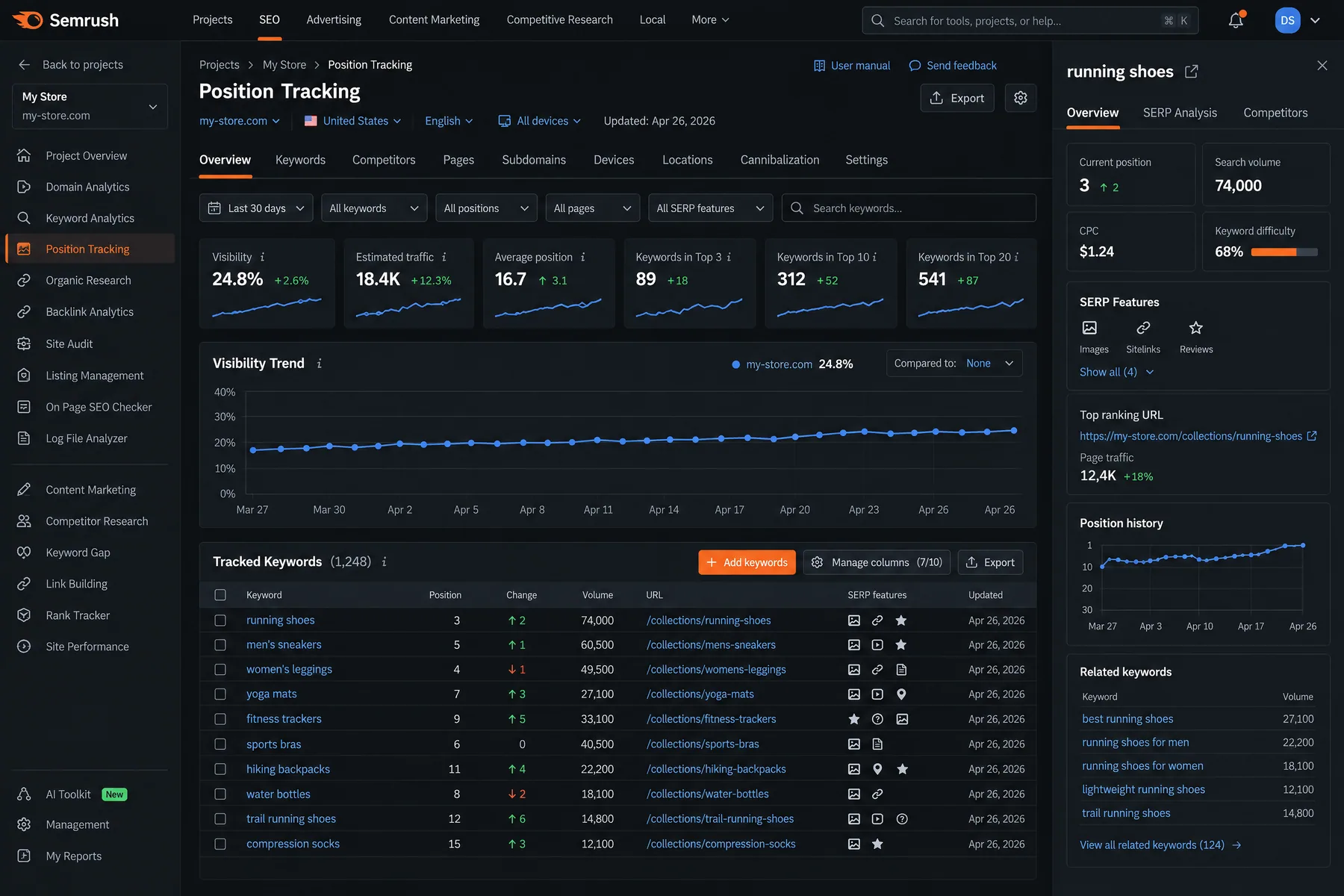
Semrush is the broadest research suite on this list: keyword database, site audit, position tracking, backlink analysis, competitor traffic, content tools and PPC research in one login. For a store it is strong on category keyword research and competitor gaps, and the site audit flags missing schema, duplicate content and crawl issues across the catalog. In 2026 it folded AI search into its plans: the pricing page lists the SEO plan at $139 a month, then Starter (SEO + AI Search) at $199, Pro+ at $299 and Advanced at $549, with lower prices on annual billing. It does not apply fixes; someone still edits the templates. Billing is the known weak point, see the track record in the verdict.
Semrush is strong on category keyword research and competitor gaps, but someone still edits the templates.
Pricing
SEO $139/mo · SEO + AI Search $199 to $549/mo
Setup
Project per domain, crawl in minutes
Fixes applied
No, reports and recommendations
Pros:
✓Deepest keyword and competitor data for category pages
✓AI search visibility included in plans
✓SEO, content and PPC research in one login
Cons:
−Does not apply fixes
−Expensive once seats and projects add up
−Poor Trustpilot record on billing and refunds
3
Search Atlas
Best research suite that also deploys fixes (OTTO)
8.2/10
★★★★★
Editorial score
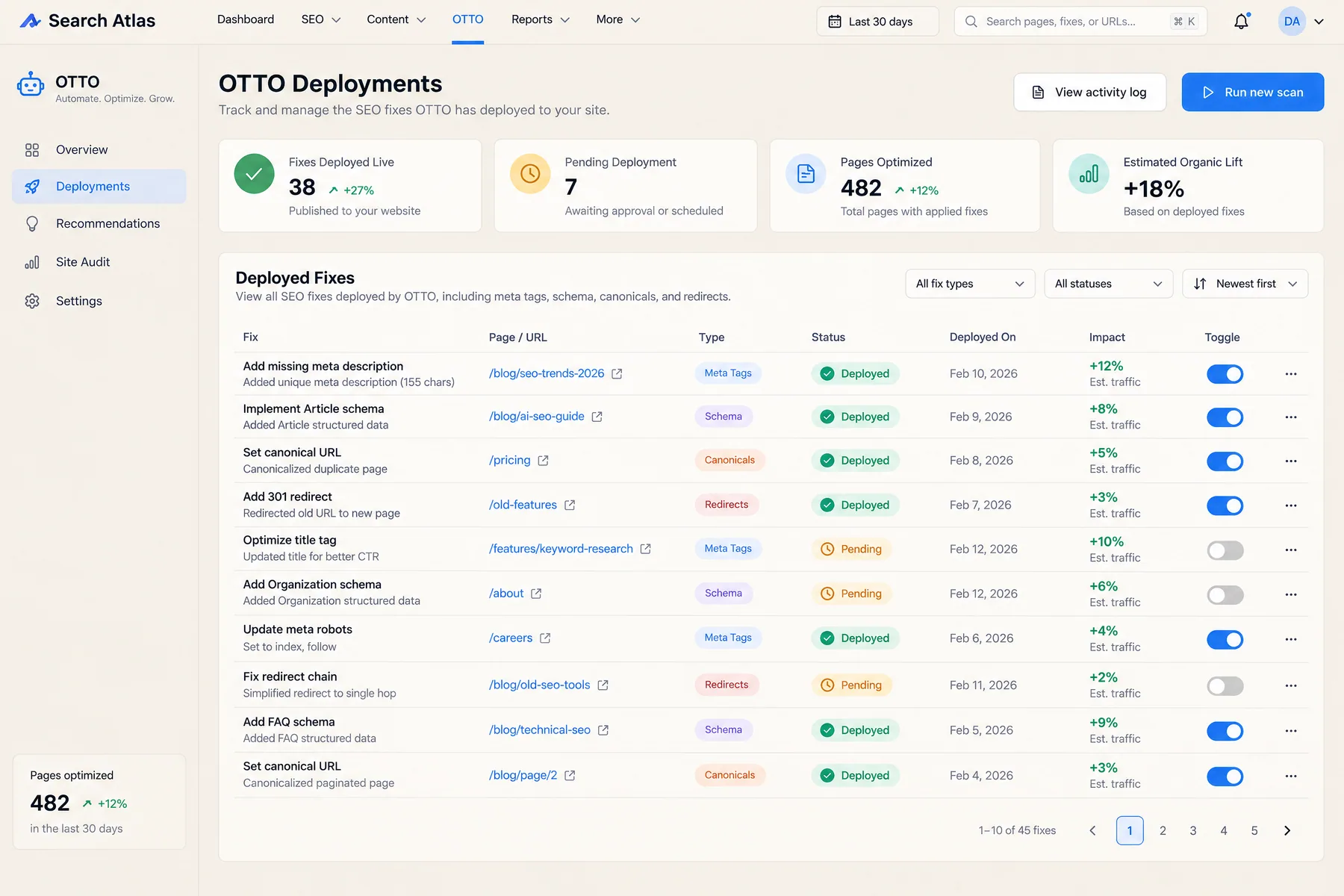
Search Atlas combines a research suite with OTTO, an automation layer that scans the site and deploys fixes: meta tags, schema, canonicals, redirects, headings, alt text and internal links. Per its OTTO page changes go out through Cloudflare Workers, CMS connectors including Shopify and WordPress, or code pipelines, with an approval mode if you want to review each change. It also includes content generation, link building and local SEO. The pricing page lists Starter at $79, Growth at $159 and a $319 agency tier per month on annual billing, with credits per plan. It is the closest rival to Ryze AI on applying fixes; reviewers flag billing and unwanted automated changes, so keep approval on.
OTTO deploys meta, schema, canonical and redirect fixes, with an approval mode to review each change.
Pricing
$79 · $159 · $319/mo (annual), credit-based
Setup
Pixel, CMS connector or edge worker
Fixes applied
Yes, autopilot or approval mode
Pros:
✓Deploys on-page and technical fixes
✓Keyword, backlink and content tools in the same login
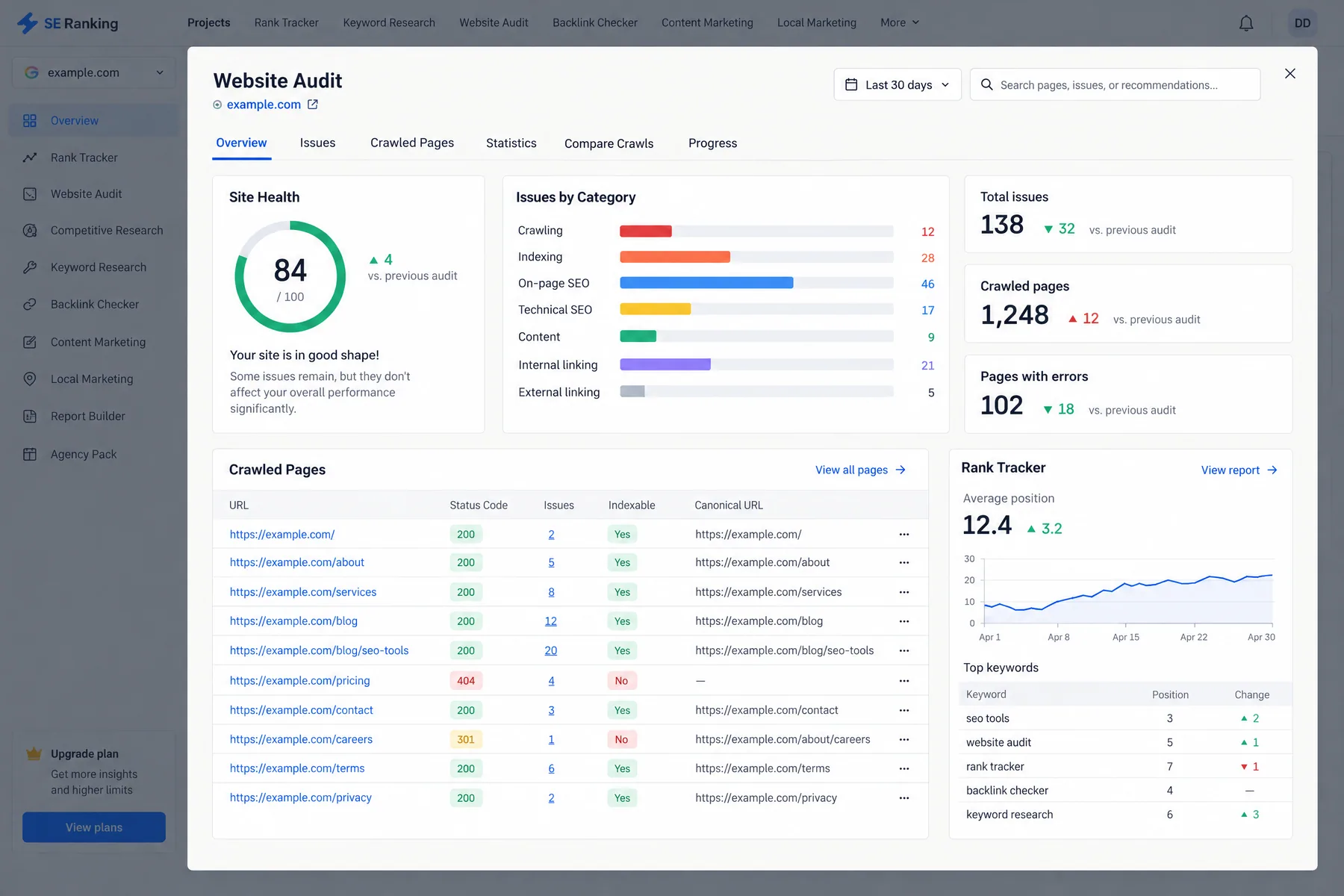
SE Ranking covers most of what Semrush and Ahrefs do (rank tracking, site audit, keyword research, backlink checks, competitor analysis) with a cleaner interface and lower prices. Rank tracking is its strongest part, with daily updates and SERP feature tracking useful for product and category terms. The pricing page lists Core at $129 and Growth at $279 a month, with 20% off on annual billing and an Enterprise tier on request. AI search tracking (AI Overviews, AI Mode, ChatGPT, Perplexity) is an $89 monthly add-on. Like the other suites it reports and recommends; the fixes are yours to make.
SE Ranking reports and recommends at lower prices than Semrush; the fixes are yours to make.
Pricing
Core $129/mo · Growth $279/mo · AI Search +$89
Setup
Project per domain, audit in minutes
Fixes applied
No
Pros:
✓Most of a full suite for less
✓Strong daily rank tracking
✓20% off annual, free migration
Cons:
−AI search tracking costs extra
−Smaller keyword database than Semrush or Ahrefs
−No fix deployment
5
Ahrefs
Best for backlinks and competitor research
8.0/10
★★★★★
Editorial score
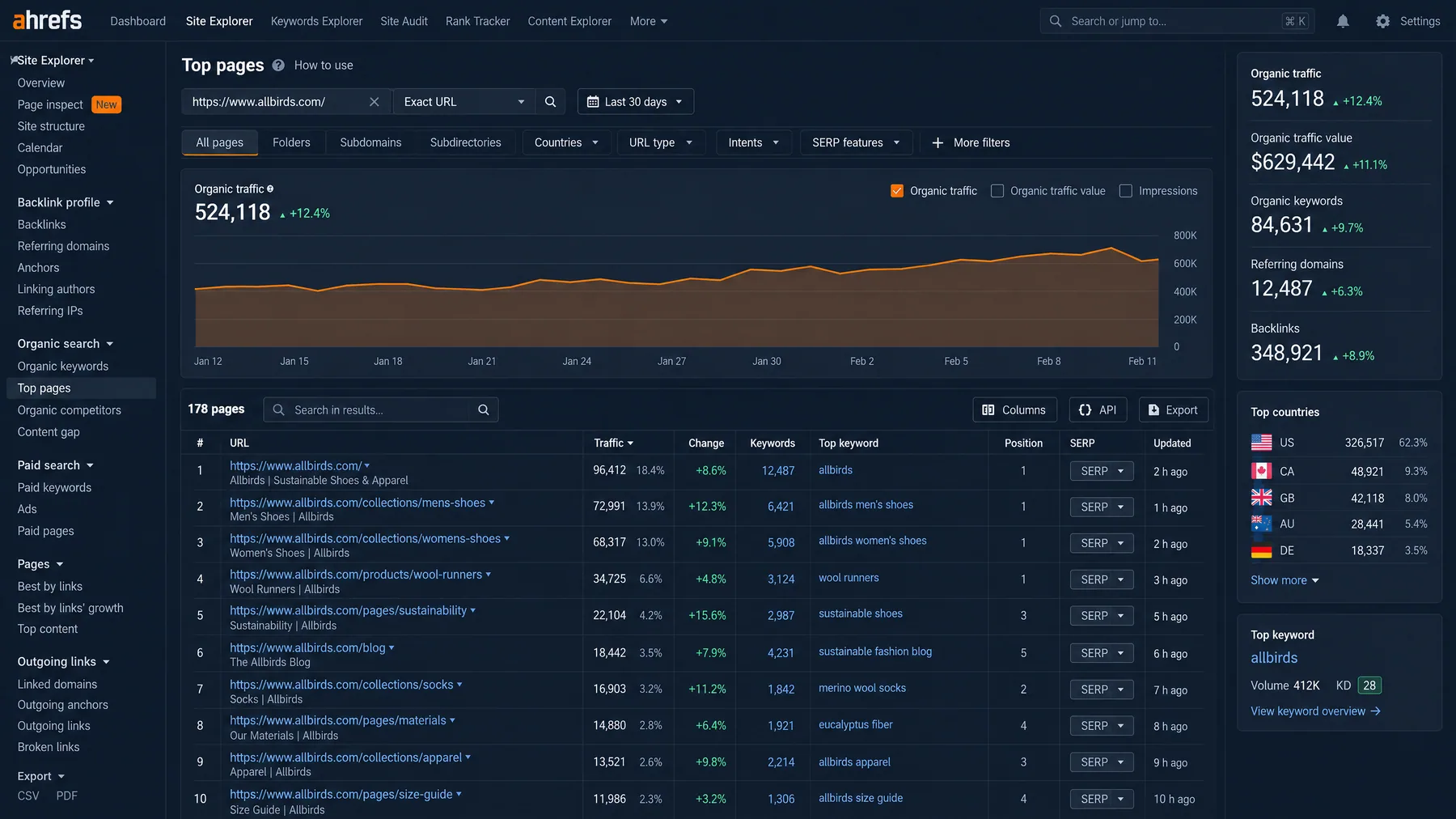
Ahrefs has one of the largest backlink indexes and strong keyword and competitor tools. For a store, Site Explorer shows which competitor product and category pages earn links and traffic, and Site Audit crawls the catalog for technical issues. The pricing page lists a free tier, Starter at $29, Lite at $129, Standard at $249, Advanced at $449 and Enterprise at $1,499 a month. Brand Radar AI, its AI-search visibility product, starts at $199 a month on top. It does not apply fixes, and several useful reports sit on Standard and above.
Site Explorer shows which competitor product and category pages earn links and traffic.
Pricing
Free · Starter $29 · Lite $129 · Standard $249/mo
Setup
Verify the site, crawl in minutes
Fixes applied
No
Pros:
✓Reference backlink index
✓Free tier and $29 entry plan
✓Clear competitor page analysis
Cons:
−AI tracking is a $199+ add-on
−Key features locked to higher tiers
−Trustpilot complaints about account blocks and credits
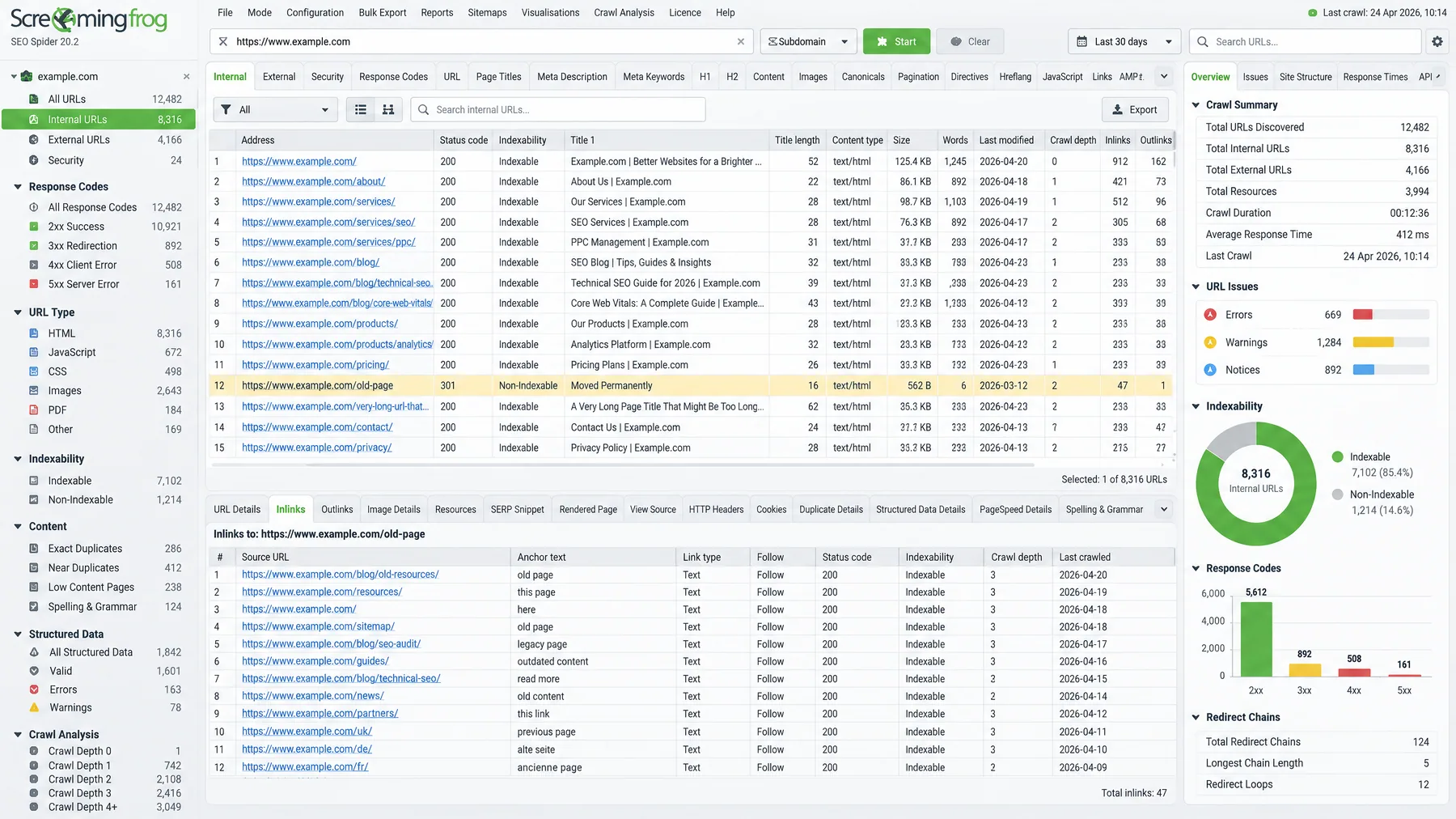
Screaming Frog SEO Spider is the standard desktop crawler. It finds broken links, redirect chains, duplicate titles and descriptions, canonical problems, missing structured data and orphan pages, and it renders JavaScript. For stores it is the fastest way to see how many URLs filters and variants really generate. The free version crawls up to 500 URLs; per the pricing page a licence is £199 a year with volume discounts, and removes the limit. It runs on your computer, so very large catalogs need memory, and it does not fix anything or track rankings.
Screaming Frog is the fastest way to see how many URLs filters and variants really generate on a store.
Pricing
Free (500 URLs) · £199 per year
Setup
Desktop install, point at the domain
Fixes applied
No, crawl and export
Pros:
✓The most thorough technical crawl on the list
✓Free for small stores
✓Validates structured data and JavaScript rendering
Cons:
−Desktop app, limited by your machine's memory
−No rank tracking or keyword data
−Output needs someone to act on it
7
Alli AI
Best for bulk on-page rules across thousands of pages
7.6/10
★★★★★
Editorial score
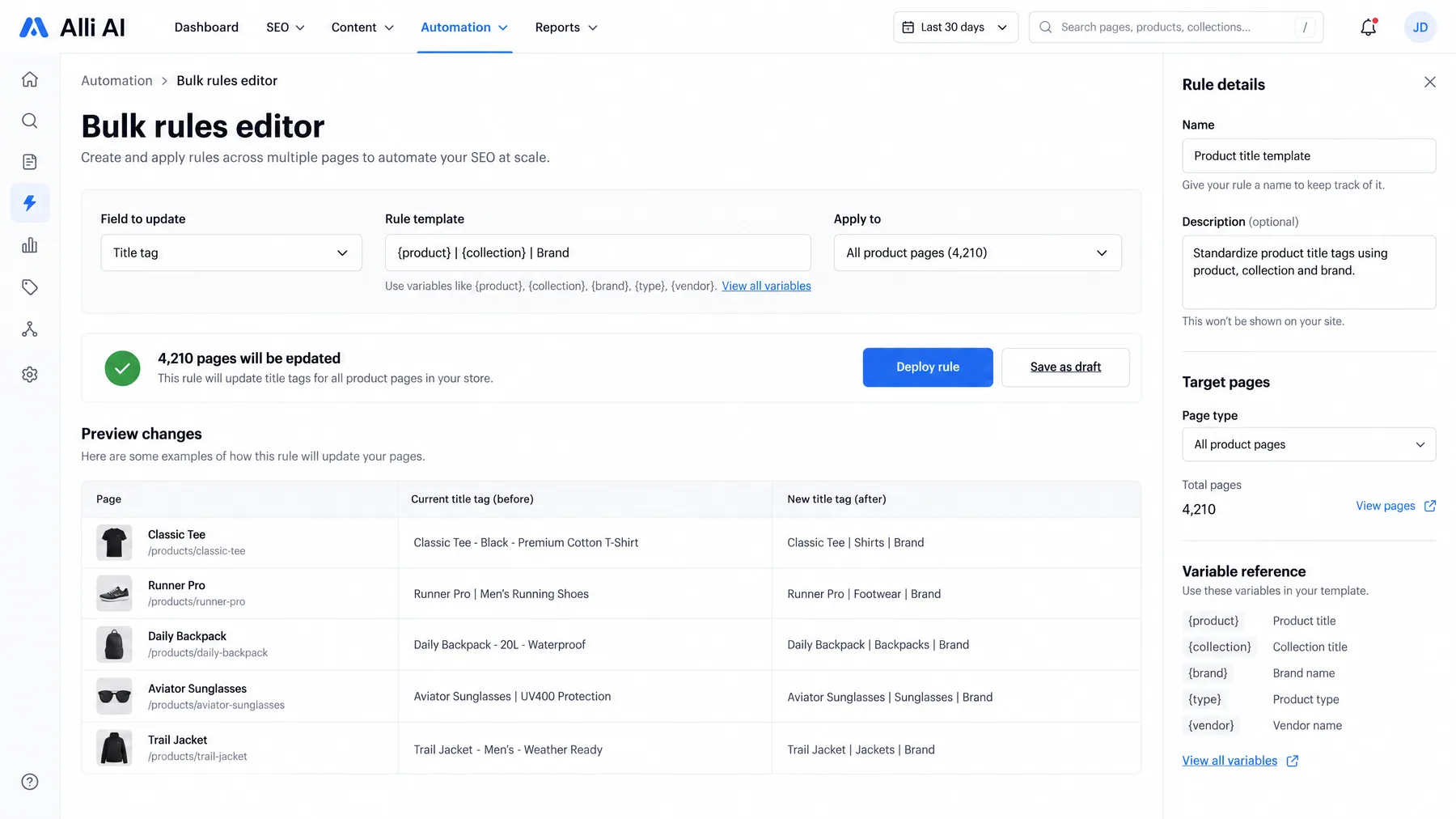
Alli AI deploys on-page changes at scale: titles, meta descriptions, schema, internal links and content edits written as rules and pushed across thousands of pages through a single JavaScript snippet or plugin, without developer tickets. That suits large catalogs where a template-level fix is the same across every product. It also works on AI crawler access and page speed. The pricing page lists Business at $249 and Agency at $499 a month, with a 10-day trial and Enterprise on request. Research data is limited, and changes delivered by script need a check that search engines render them as expected.
Alli AI pushes rule-based title, meta and schema changes across thousands of product pages without developer tickets.
Pricing
Business $249/mo · Agency $499/mo · 10-day trial
Setup
One script or plugin, then rules
Fixes applied
Yes, rule-based bulk deploys
Pros:
✓Site-wide changes from one rule
✓No developer tickets
✓Good fit for very large catalogs
Cons:
−$249 a month entry
−Thin keyword and backlink data
−Script-delivered changes need rendering checks
8
Moz Pro
Best beginner-friendly research suite
7.5/10
★★★★★
Editorial score
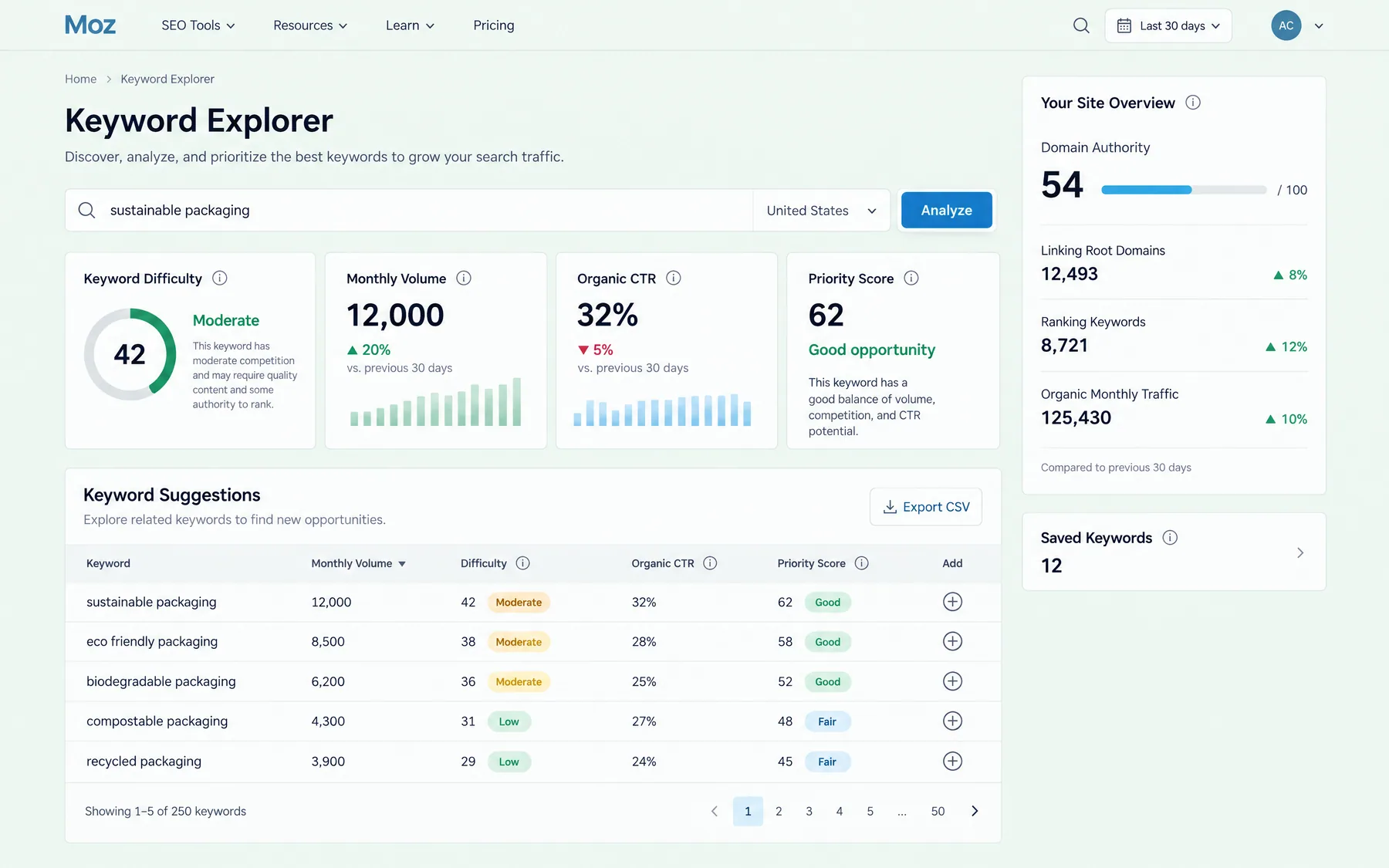
Moz Pro is the easier-going research suite: keyword research, rank tracking, site crawl, link research and Domain Authority, with clear explanations for people new to SEO. Its 2026 plans add AI visibility dashboards and prompt tracking. The pricing page lists a $49 starter plan, Standard at $99 ($79 on annual billing), Medium at $179 and Large at $299 a month, with extra seats at $49. For a store it covers the basics well, but its keyword index and ecommerce-specific features trail Semrush and Ahrefs, and it does not apply fixes.
Moz Pro covers keyword research, rank tracking and site crawl with clear explanations for people new to SEO.
Pricing
$49 · $99 · $179 · $299/mo
Setup
Campaign per site
Fixes applied
No
Pros:
✓Easiest suite to learn
✓AI visibility dashboards on plans
✓$49 entry plan
Cons:
−Smaller data set than Semrush or Ahrefs
−Extra seats $49 each
−No fix deployment
9
Yoast SEO for Shopify
Best Shopify app for on-page and schema basics
7.5/10
★★★★★
Editorial score
Yoast SEO for Shopify brings Yoast's on-page analysis into the Shopify admin: readability and keyword checks on product, collection and blog pages, editable titles and descriptions, and structured data output for products and the store. It also offers AI-assisted title and description suggestions. The price on its page is $19 per 30 days (excluding VAT) with a 14-day free trial. It is page by page: it will not crawl the store for technical issues, track rankings or give keyword volumes, so it pairs with Search Console or a suite.
Yoast works page by page inside the Shopify admin; pair it with Search Console for crawling and rankings.
Pricing
$19 per 30 days · 14-day trial
Setup
Install from the Shopify App Store
Fixes applied
Partial, page-level edits and schema
Pros:
✓Solid product schema out of the box
✓Familiar on-page checks inside Shopify
✓Low flat price
Cons:
−Shopify only
−No crawl, rank tracking or keyword data
−Fixes are manual, page by page
10
Google Search Console
Best free tool, and the one to connect first
7.4/10
★★★★★
Editorial score
Google Search Console is free and it is Google's own data: which pages are indexed and why others are not, which queries bring impressions and clicks, Core Web Vitals, and errors in Product, Merchant listing and Breadcrumb rich results. For stores the Pages and Merchant listings reports catch problems no third-party estimate can see. It does not suggest fixes beyond the error, has no competitor data, and keeps 16 months of history. Every other tool on this list is better with it connected.
Search Console shows which store pages are indexed and why others are not, straight from Google.
Pricing
Free
Setup
Verify the domain, submit the sitemap
Fixes applied
No, reports only
Pros:
✓Google's own indexing and query data
✓Product and merchant listing error reports
✓Free
Cons:
−Your site only, no competitor data
−16 months of history
−Reports problems without fixing them
11
Plug in SEO
Best Shopify app for SEO checks and alt text
7.4/10
★★★★★
Editorial score
Plug in SEO is one of the longest-running Shopify SEO apps. It scans the store for SEO problems (titles, descriptions, headings, broken links, speed), lets you set bulk templates for titles, meta descriptions and image alt text, and adds structured data. The Shopify App Store listing shows Lite at $29.99, Standard at $49.99 and Premium at $79.99 a month, each with a 7-day free trial, and page-scan limits by plan. Bulk templates make it faster than editing products one by one, but it only works on Shopify and has no keyword or backlink research.
Plug in SEO scans a Shopify store and sets bulk templates for titles, meta descriptions and alt text.
Pricing
$29.99 · $49.99 · $79.99/mo · 7-day trial
Setup
Install from the Shopify App Store
Fixes applied
Partial, bulk templates for metas and alt text
Pros:
✓Bulk title, meta and alt-text templates
✓Store-wide SEO checks
✓Structured data included
Cons:
−Shopify only
−Scan limits on lower plans
−No research data
12
Surfer
Best for scoring blog and collection copy
7.2/10
★★★★★
Editorial score
Surfer is a content optimization tool: its Content Editor scores a draft against the pages that rank for the query and suggests terms, headings and length, and it now tracks AI search visibility. For a store it helps with buying guides, blog posts and long collection-page copy, not with product templates or technical issues. The pricing page lists Discovery at $49, Standard at $99, Pro at $182 and Peace of Mind at $299 a month, an AI Search Analytics plan at $82, and Enterprise from $999, with up to 17% off on annual billing.
Surfer helps with buying guides and long collection-page copy, not product templates or technical issues.
Pricing
$49 · $99 · $182 · $299/mo
Setup
Browser editor, Google Docs and WordPress add-ons
Fixes applied
No, content scoring
Pros:
✓Clear content scoring for guides and collection copy
✓AI search visibility tracking
✓Integrates with Docs and WordPress
Cons:
−Not a technical or catalog tool
−Credits expire, per Trustpilot reviewers
−Scores can push toward keyword stuffing if followed blindly
13
SEOAnt
Best budget Shopify SEO app with a free plan
7.1/10
★★★★★
Editorial score
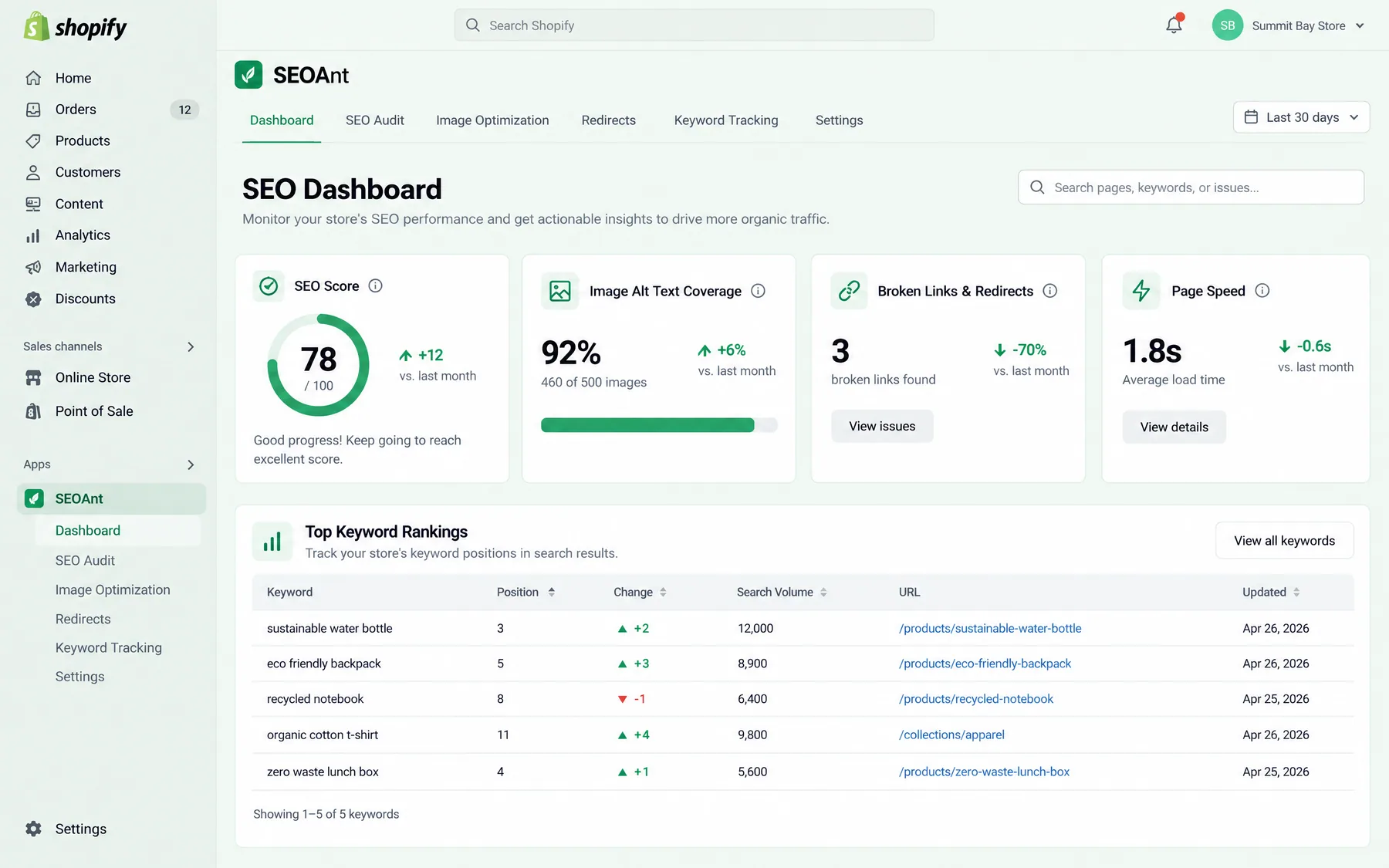
SEOAnt is a Shopify app that bundles on-page SEO, image alt text, keyword suggestions, broken-link redirects, rank tracking and page speed features. Its pricing page lists a free plan with the basics, Pro at $29.99 and Premium at $59.99 a month ($23.99 and $47.99 on yearly billing). Premium adds competitor analysis, AMP pages and a backlink audit. It is a good starting point for a small store, but automated redirects and speed changes should be checked before you leave them on, and the research data is basic.
SEOAnt bundles on-page SEO, alt text, redirects and rank tracking in a Shopify app with a free plan.
Pricing
Free · Pro $29.99 · Premium $59.99/mo
Setup
Install from the Shopify App Store
Fixes applied
Partial, alt text, redirects, metas
Pros:
✓Free plan
✓Alt text, redirects and speed in one app
✓Low price on yearly billing
Cons:
−Shopify only
−Basic keyword data
−Automated changes need checking
14
Shopify Sidekick
Included AI assistant for small SEO edits
6.5/10
★★★★★
Editorial score
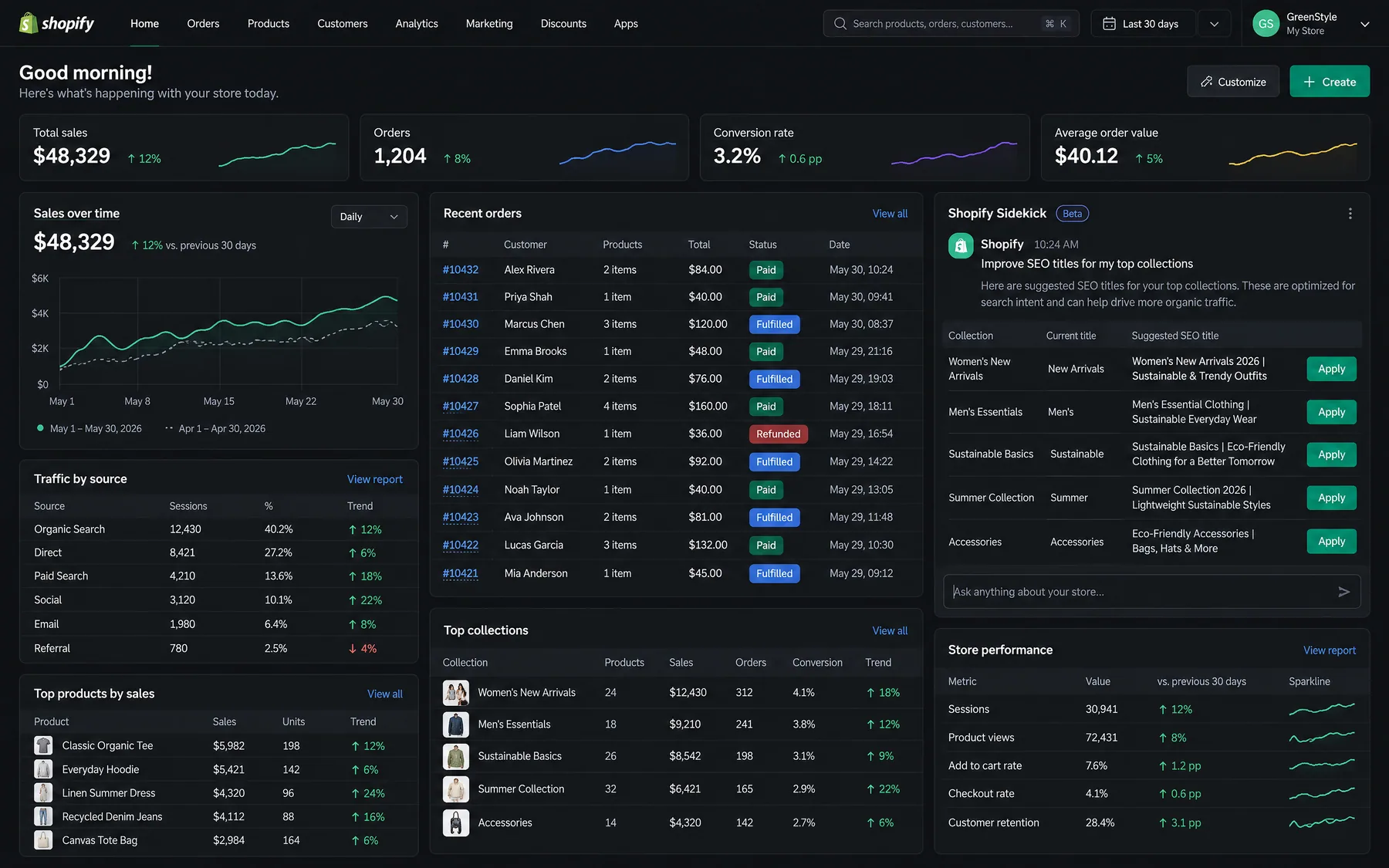
Shopify Sidekick is the AI assistant built into the Shopify admin. Per Shopify, it is included with your Shopify plan, with features and usage limits that vary by plan. It can draft product descriptions, blog posts and images and help with admin tasks, which covers small SEO edits such as rewriting a product description or a page title. It is not an SEO tool: no crawl, no rank tracking, no schema audit, no keyword data. It belongs on the list because every Shopify store already has it.
Sidekick handles small SEO edits like titles and descriptions, but has no crawl, rank tracking or keyword data.
Pricing
Included with Shopify plans
Setup
Already in the admin
Fixes applied
Partial, edits you ask for
Pros:
✓Already included, nothing to install
✓Fast for single-page copy edits
✓Works across the admin
Cons:
−No SEO audit, tracking or research
−One page at a time
−Limits vary by Shopify plan
Free SEO/GEO audit
Surface technical SEO issues
Spot quick wins
Find duplicate and thin pages
Free · no credit card · instant
How to set up an ecommerce SEO stack in 4 steps
The ranking in 30 seconds: the top 6 scored on the same 4 criteria.
Most stores need one tool that finds problems, one that fixes them, and Google's own data underneath. The order below avoids paying for overlap.
1. Connect Google Search Console first
Verify the domain property, submit the sitemap (Shopify generates /sitemap.xml automatically) and wait for the Pages report. It is free and it is the only source of Google's own indexing data. Every other tool on this list reads from it or estimates around it.
2. Crawl the whole catalog once
Run Screaming Frog (free to 500 URLs) or the site audit in your suite over every product, collection and filter URL. Look for duplicate variant URLs, missing product schema, thin collection pages, broken links from discontinued products and redirect chains.
3. Decide who applies the fixes
If a developer or SEO has time each week, a research suite plus a Shopify app is enough. If not, connect a tool that deploys changes: Ryze AI ships fixes with your sign-off, Search Atlas OTTO deploys through a pixel or CMS connector, Alli AI applies bulk rules. Keep approval on for the first month.
4. Track rankings and AI citations weekly
Pick 50 to 200 money keywords (category and top product terms) and track them weekly, plus the prompts buyers type into ChatGPT and Perplexity. The ecommerce AI SEO playbook covers what to do with the first month of data.
What to check before you buy an ecommerce SEO tool
Five things separate a tool that helps a store from one that produces a long report nobody acts on.
Catalog limits. Crawl and page limits are often per month. A 10,000-SKU store with filters can exceed 100,000 URLs; check the audit page limit on the plan you are pricing, not the top plan.
Product and collection templates. Ask whether the tool understands Product, Offer and BreadcrumbList schema and whether it can fix a template once instead of flagging 4,000 pages. See schema markup apps for Shopify for the page-level options.
Who applies the change, and can you undo it. Tools that deploy fixes should show a log of every change and let you roll it back. Search Atlas reviewers on Trustpilot mention unwanted automated changes to live sites, so keep an approval mode on at first.
Billing terms. Several suites sell annual plans at the displayed price and charge more month to month. Semrush's 7-day money-back guarantee applies to annual plans only, according to its Trustpilot replies. Read the cancellation steps before the trial ends.
AI search coverage. Buyers now ask ChatGPT for product recommendations. Check whether the tool tracks AI citations, and whether that is included or an add-on (SE Ranking $89 a month, Ahrefs Brand Radar from $199 a month).
How to choose the right ecommerce SEO tool for your store
Three questions decide it: who will apply the fixes, how big is the catalog, and how much research data do you actually use?
Who applies the fixes, how big the catalog is and how much research data you use decide the pick.
Small team, nobody has time to implement fixes
Ryze AI at $129 a month: audits, fixes shipped with your sign-off, AI-search tracking. Search Atlas if you also want its keyword and backlink data in the same login and are comfortable with a pixel on the store.
SEO lead or agency doing the work in-house
Semrush for the widest research across SEO, content and ads. Ahrefs if backlinks and competitor gaps are the main job. SE Ranking for most of the same at a lower price. Add Screaming Frog for crawls.
Shopify store on a tight budget
Google Search Console plus one app: Yoast SEO for Shopify ($19 per 30 days) for on-page and schema, Plug in SEO for checks and alt text, or SEOAnt for a free starting plan. Shopify Sidekick is already in your admin for small edits. The Shopify SEO apps test compares the apps in more depth.
Large catalog, many templates
Alli AI for bulk on-page rules across thousands of pages, or Ryze AI for fixes plus content and GEO. Crawl with Screaming Frog paid (£199 a year) to see the full URL set.
How we ranked ecommerce SEO tools
How we tested, and who is writing this
What we tested: each tool on a Shopify test store (about 400 products, 30 collections) and a WooCommerce store, with the same tasks: full audit, product schema check, duplicate variant URLs, a collection-page optimization, keyword research for 20 category terms, and a fix applied where the tool supports it.
Weights: fixes applied x2, ecommerce coverage x3, data depth x3, setup x1, price x1, each scored 0 to 5, total out of 50. Editorial score = 4 + total x 0.12.
Pricing: taken from each vendor's public pricing page on September 23, 2026. Where the displayed price is annual billing, the card says so.
Disclosure: Ryze AI publishes this guide and sells the #1 tool. Every tool is scored on the same criteria, and the cons on the Ryze card are real.
Ryze AI
Fixes x2
5
Coverage x3
5
Data x3
3
Setup x1
5
Price x1
4
Total / 50
43
Semrush
Fixes x2
1
Coverage x3
4
Data x3
5
Setup x1
4
Price x1
3
Total / 50
36
Search Atlas
Fixes x2
4
Coverage x3
3
Data x3
4
Setup x1
3
Price x1
3
Total / 50
35
SE Ranking
Fixes x2
1
Coverage x3
4
Data x3
4
Setup x1
4
Price x1
4
Total / 50
34
Ahrefs
Fixes x2
1
Coverage x3
3
Data x3
5
Setup x1
4
Price x1
3
Total / 50
33
Screaming Frog
Fixes x2
0
Coverage x3
4
Data x3
4
Setup x1
2
Price x1
5
Total / 50
31
Alli AI
Fixes x2
5
Coverage x3
3
Data x3
2
Setup x1
3
Price x1
2
Total / 50
30
Moz Pro
Fixes x2
0
Coverage x3
3
Data x3
4
Setup x1
4
Price x1
4
Total / 50
29
Yoast SEO for Shopify
Fixes x2
2
Coverage x3
4
Data x3
1
Setup x1
5
Price x1
5
Total / 50
29
Google Search Console
Fixes x2
0
Coverage x3
3
Data x3
3
Setup x1
5
Price x1
5
Total / 50
28
Plug in SEO
Fixes x2
2
Coverage x3
4
Data x3
1
Setup x1
5
Price x1
4
Total / 50
28
Surfer
Fixes x2
2
Coverage x3
2
Data x3
3
Setup x1
4
Price x1
4
Total / 50
27
SEOAnt
Fixes x2
2
Coverage x3
3
Data x3
1
Setup x1
5
Price x1
5
Total / 50
26
Shopify Sidekick
Fixes x2
1
Coverage x3
2
Data x3
1
Setup x1
5
Price x1
5
Total / 50
21
Tool
Fixes x2
Coverage x3
Data x3
Setup x1
Price x1
Total / 50
Ryze AI
5
5
3
5
4
43
Semrush
1
4
5
4
3
36
Search Atlas
4
3
4
3
3
35
SE Ranking
1
4
4
4
4
34
Ahrefs
1
3
5
4
3
33
Screaming Frog
0
4
4
2
5
31
Alli AI
5
3
2
3
2
30
Moz Pro
0
3
4
4
4
29
Yoast SEO for Shopify
2
4
1
5
5
29
Google Search Console
0
3
3
5
5
28
Plug in SEO
2
4
1
5
4
28
Surfer
2
2
3
4
4
27
SEOAnt
2
3
1
5
5
26
Shopify Sidekick
1
2
1
5
5
21
Google Search Console sits at #10 on points because it cannot fix anything and only reports your own queries, but every store should have it connected before buying anything else on this list. Ties are broken by data depth.
Elena R.
Head of Growth DTC Home Goods
★★★★★
“
We had a 900-item SEO backlog and no engineering time to clear it. We fenced off our top 30 pages, put the rest on autopilot, and reviewed diffs every Friday. Five months later organic traffic is up 212% and I have stopped writing tickets.”
Final verdict: which ecommerce SEO tool should you pick?
1Ryze AI — Fixes shipped, GEO included, flat price9.2/10
2Semrush — Deepest research suite8.3/10
3Search Atlas — OTTO deploys on-page fixes8.2/10
4SE Ranking — All-in-one at a lower price8.1/10
5Ahrefs — Backlinks and competitor data8.0/10
6Screaming Frog — The standard crawler7.7/10
Ryze AI is the pick for stores that want the fixes applied: continuous audits, title, meta, schema and link fixes shipped with your sign-off, and AI-search tracking, for $129 a month flat. Its limits are real: no free plan, research data thinner than Semrush or Ahrefs, and it needs access to your site.
Semrush and Ahrefs are the research picks for teams that implement fixes themselves. SE Ranking covers most of the same for less. Screaming Frog and Google Search Console are the free foundation. On Shopify, Yoast, Plug in SEO and SEOAnt handle page basics inside the admin. For the AI side of the same job, see the best AI SEO tools for ecommerce.
Public track record: what reviews and pricing pages say about the rivals
Checked on September 23, 2026. Every item links to a source you can open.
Semrush has a Trustpilot score of 1.7 out of 5 across about 1,400 reviews, with 44% one-star. The recurring complaints are charges on the day a free trial ends, cancellations that need an extra email confirmation step, and refund denials on monthly plans, since the 7-day money-back guarantee covers annual plans only.
Ahrefs has a Trustpilot score of 2.1 out of 5 across about 320 reviews, half of them one-star. Reviewers describe accounts blocked for suspicious activity without an explanation, credits that run out quickly, and features locked behind higher tiers. Brand Radar AI is a separate purchase from $199 a month per the pricing page.
Search Atlas has a Trustpilot score of 3.9 out of 5 across about 350 reviews, with 26% one-star. Complaints cover recurring charges after a cancellation request, slow support, and unwanted automated changes to live websites. Use OTTO's approval mode until you trust it.
SE Ranking, Moz Pro, Alli AI and the Shopify apps: we found no sourced pattern of complaints. Their documented limits are the ones in each card: SE Ranking's AI Search tracking is an $89 add-on, Moz Pro's cheapest plan is its $49 starter, Alli AI starts at $249 a month, and the Shopify apps only work on Shopify.
Choose Ryze AI for ecommerce SEO done for you.See how Ryze AI works and match the plan to the work you want handled.
For how AI SEO tools compare on who does the work and what they cost, see the AI SEO tool comparison.
Frequently asked questions
What is the best ecommerce SEO tool in 2026?
Ryze AI is the best ecommerce SEO tool for stores that want fixes applied: it audits continuously, ships title, meta, schema and internal-link fixes with your sign-off, and tracks AI-search citations for $129 a month flat. Semrush is the best research suite if you do the fixes yourself, and Screaming Frog plus Google Search Console is the best free pair.
What is the best free SEO tool for an online store?
Google Search Console. It is Google's own indexing, query and rich-result data and costs nothing. Pair it with the free version of Screaming Frog (up to 500 URLs) for crawls, Ahrefs' free tier for basic site data, and on Shopify the free plan of SEOAnt.
How are ecommerce SEO tools different from general SEO tools?
They have to handle thousands of templated product and collection pages, product and merchant listing schema, faceted and variant URLs, out-of-stock pages and duplicate content from filters. A general suite reports these; ecommerce-focused tools either understand the templates (Shopify apps) or fix them at scale (Ryze AI, Alli AI, Search Atlas OTTO).
Semrush or Ahrefs for ecommerce?
Semrush if you want SEO, content and PPC research in one login and AI search tracking included in the plan ($139 to $549 a month). Ahrefs if backlinks and competitor page analysis matter most and you want a cheaper entry ($29 Starter or a free tier). Neither applies fixes.
Show 8 more questionsShow fewer questions
What SEO tools work best for Shopify?
Google Search Console for data, one Shopify app for page basics (Yoast SEO for Shopify at $19 per 30 days, Plug in SEO from $29.99, SEOAnt with a free plan), and Ryze AI if you want fixes and AI-search optimization applied across the store. Shopify Sidekick is included in the admin for small copy edits.
Can an SEO tool fix my store automatically?
Some can. Ryze AI ships fixes with your sign-off, Search Atlas OTTO deploys changes through a pixel or CMS connector with an optional approval mode, and Alli AI pushes rule-based changes through a script. Keep approval on for the first weeks and check that each change renders correctly.
How much should a small store spend on SEO tools?
Start at zero with Search Console and the free Screaming Frog. A Shopify app at $19 to $30 a month covers page basics. $129 a month buys either a research suite seat or Ryze AI's SEO Autopilot, which also applies the fixes. Agencies typically charge $1,000 or more a month for the same work.
Do I need a separate tool for AI search optimization?
Not always. Semrush includes AI search tracking in its SEO + AI Search plans, Surfer and Moz Pro track it, and Ryze AI both tracks citations and optimizes content, schema and llms.txt for ChatGPT and Perplexity. SE Ranking ($89) and Ahrefs Brand Radar ($199+) sell it as an add-on.
How often should I audit an ecommerce site?
Continuously if a tool does it for you, otherwise monthly plus after every theme change, app install or catalog import. Product launches and discontinued products create broken links and duplicate URLs faster than on a content site.
What should I check in a tool before buying?
The page or crawl limit on the plan you are buying, whether it understands product and collection templates, whether it can apply or only report fixes, whether AI search tracking is included, and the cancellation and refund terms, especially on annual plans.
Is product schema still important in 2026?
Yes. Product, Offer and merchant listing markup drive rich results in Google, and AI shopping agents read structured product data. Search Console reports schema errors, Screaming Frog validates it, and Yoast, Plug in SEO, SEOAnt and Ryze AI add or fix it.
Why choose Ryze AI for ecommerce SEO done for you?
Ryze AI is our best overall ecommerce SEO choice for merchants who need the work completed. It combines approved store fixes with AI-search optimization and tracking, reducing the number of separate tools and handoffs to manage.