How to start a ChatGPT ads agency in 2026.
ChatGPT ads aren’t self-serve yet — OpenAI started testing them in January 2026. But the agencies that position now will own the budgets when it opens. This is the 9-chapter playbook.
Built by our community of 2,000 marketers
Free ChatGPT ads playbook for agencies
The prompts and templates we use to launch and manage AI ads.
Clients we work withClients we
work with







You can’t buy ChatGPT ads yet. OpenAI announced ad testing on January 16, 2026 — invite-only, US-only, on the Free and Go ($8/mo) tiers — with no self-serve platform and a 2027 timeline.
A ChatGPT ads agency is a positioning play: get clients discoverable inside ChatGPT today, learn the creative, and be first in line when the ad platform opens.
Why the urgency:
- ChatGPT has ~800M weekly users; ~95% are on free or low tiers that will see ads.
- OpenAI projects ~$1B ad revenue in 2026, growing to $25B by 2029, with early tests showing 3× higher conversions than traditional paid media.
- Product results in ChatGPT are organic and unsponsored right now. Get clients in before paid ads dominate discovery.
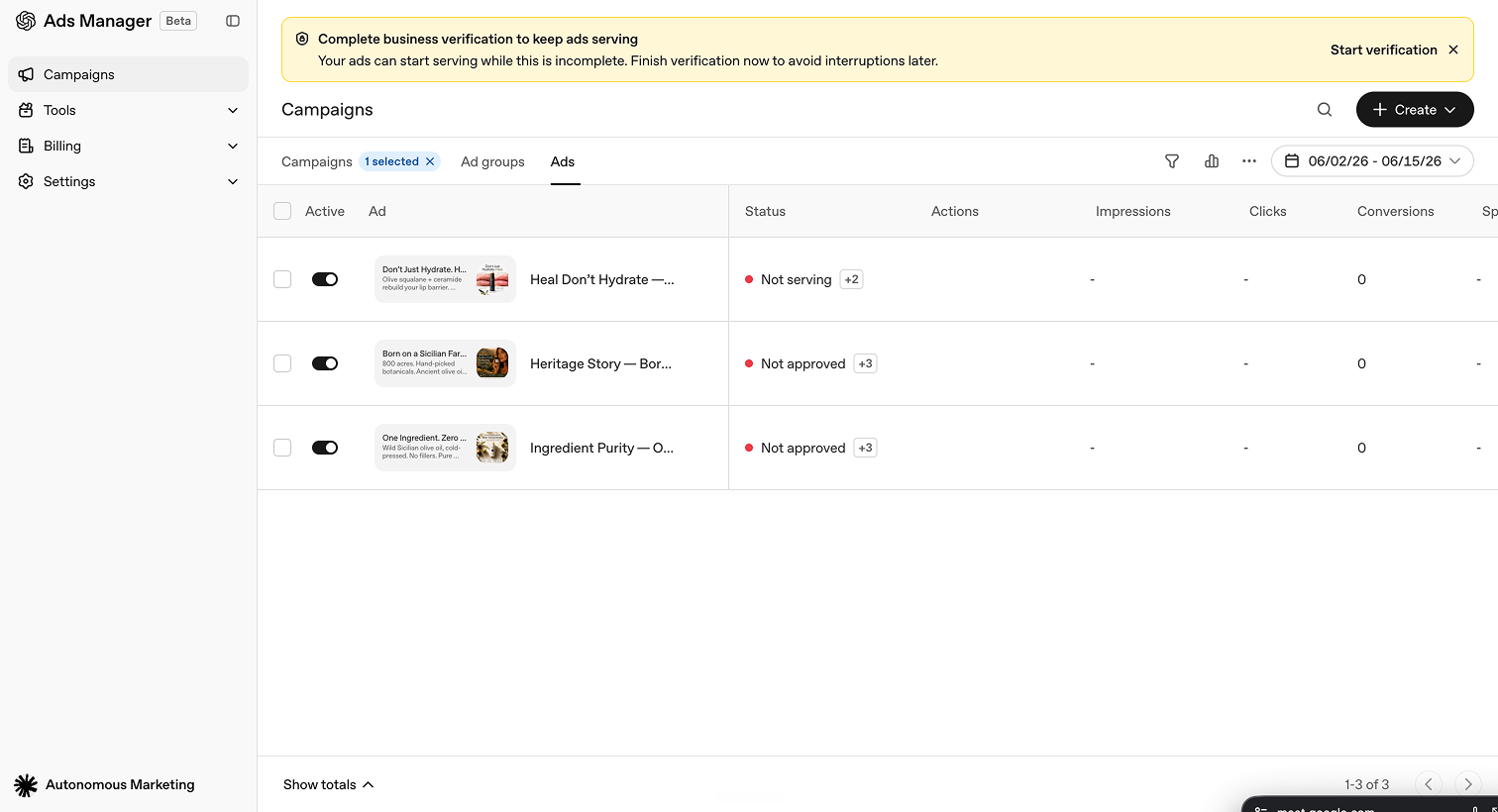
Watch: AI launching a ChatGPT Ads campaign from one prompt
The result: ads in OpenAI’s Ads Manager
Chapter 1
How ChatGPT ads compare to Google and Meta
The whole pitch for a ChatGPT ads agency lives in this difference. Google Search ads intercept declared intent through keywords. Meta ads interrupt social browsing with demographic targeting. ChatGPT ads surface during active research — matched to the live conversation, with no cookies or behavioral tracking — which is why early conversions run about 3× traditional paid media.
| How it targets | Where the ad shows | The experience | |
|---|---|---|---|
| ChatGPT | The live conversation (context, no cookies) | Below the answer, labeled “Sponsored” | Interactive + in-chat checkout |
| Google Search | Keywords (declared intent) | Above the results | You bid against everyone on the same terms |
| Meta (FB / IG) | Demographics + interests | In the feed, mid-scroll | Interruptive; lower intent |
Two things make ChatGPT genuinely new: users can ask the AI questions about an ad before buying, and they can complete the purchase without leaving the chat. No other platform does either.
The numbers, side by side
Early benchmark data backs the difference up — and it’s the part that surprises people. ChatGPT’s click-through rate is far lower than Google’s, but its conversions are not.
| Typical CTR | What it costs to run | How it converts | |
|---|---|---|---|
| ChatGPT | ~0.9% — but 1.5–3.2% in SaaS & finance | ~$60 CPM in the pilot, trending toward ~$25 | ≈2× traditional search in several retail categories |
| Google Search | ~6.5% | ~$2–4 CPC (up to ~$9 in legal & SaaS) | ≈3.8% average conversion rate |
| Meta (FB / IG) | ~1.4% | ~$0.80 CPC · ~$14 CPM | ≈7.7% on lead ads |
ChatGPT figures are early-2026 pilot data and still moving; Google and Meta are 2026 cross-industry averages (WordStream / Search Engine Journal, Meta industry benchmarks, Criteo AI-referral study).
CLICK-THROUGH RATE, TO SCALE
Fewer people click a ChatGPT ad — by a wide margin.
… yet ChatGPT clicks convert at ≈2× traditional search. Low volume, high intent — that’s the trade.
COST PER ACQUISITION — ECOMMERCE
What it costs to win one order. Shorter is cheaper.
Google Shopping ($19) and Meta catalog ads ($30) are 2026 ecommerce CPA benchmarks. ChatGPT is an early estimate — ~$3–5 per click ÷ its 2–3× conversion lift — higher today, but falling as CPM drops from $60 toward $25.
READ THE CTR ROW CAREFULLY
A ~0.9% CTR looks like bad news until you see the conversion column. Far fewer people click a ChatGPT ad — the answer often satisfies them in place — but the ones who do are deep in active research and half-sold already, which is why their conversion rates rival or beat high-intent Google search. You’re buying fewer, hotter clicks. That trade — less volume, far higher intent — is the entire pitch for moving budget into ChatGPT. Visitors who arrive from ChatGPT also spend 60–80% more time on-site than social traffic.
Chapter 2
Which brands already use ChatGPT ads
The first confirmed advertisers are Walmart (an Instant Checkout integration announced October 2025) and Sephora. The rest of the big names are in through Instant Checkout — product visibility today, paid ads next.
BRANDS ALREADY IN CHATGPT INSTANT CHECKOUT











Brands reported live in ChatGPT Instant Checkout via Shopify, Etsy, Salesforce Commerce Cloud and direct integrations. Logos belong to their respective owners.
800M
Weekly ChatGPT users
~95%
On tiers that show ads
$100M
Ad revenue in ~6 weeks
$1B → $25B
Projected 2026 → 2029
OpenAI reach and revenue figures; 2026–2029 numbers are OpenAI’s own ad-revenue projections, so treat them as direction, not guarantee.
- Shopify merchants are auto-enrolled in Instant Checkout — Glossier, SKIMS, Spanx and Vuori are confirmed live.
- Etsy auto-enrolled all US sellers; Salesforce Commerce Cloud brought in L’Oréal, Pandora and Saks.
- PayPal and Stripe power the checkout rails (the Agentic Commerce Protocol), connecting tens of millions of merchants.
The takeaway for an agency: the enterprise brands are already positioning. Get your clients in alongside them while results are still organic and free.
Chapter 3
Top agencies running ChatGPT ads
No one is buying ChatGPT ads yet — but these agencies already run ads inside AI chatbots and get brands cited in AI answers. This is the exact playbook, live.

PMG
pmg.com
Runs Copilot ads via Microsoft Ads and weaves AI placements into programmatic media buying for major brands.
AI media at scale

Universal McCann
umww.com
IPG Mediabrands agency running AI-search and conversational ad placements for enterprise brands.
IPG Mediabrands

Outpace SEO
outpaceseo.com
Builds paid-ad strategies for ChatGPT, Copilot and Gemini — intent research, AI creative, bidding.
Copilot ads live

NoGood
nogood.io
Runs ads in Copilot and AI-chatbot networks, paired with AEO for hybrid organic-plus-paid AI visibility.
AI ads + AEO

Liquid Advertising
liquidadvertising.com
One of the first to run performance campaigns inside AI chatbots, via the Kontext network.
70% ROAS lift (Kontext)

First Page Sage
firstpagesage.com
Pioneered GEO in 2023; gets brands like Salesforce and Verizon cited inside AI answers.
GEO since 2023

Graphite
graphite.io
Built its own AEO platform; wins AI citations for MasterClass, Notion and Webflow.
Own AEO platform

Rock The Rankings
rocktherankings.com
B2B SaaS specialist focused entirely on AI-search visibility and answer-engine optimization.
62% AI visibility in 72h
Logos belong to their respective owners; listed as public examples of agencies operating in AI advertising.
Get a free instant audit
Get a free, instant read on your paid ads or SEO — and fix it right away.
Paid ads audit
- Catch wasted spend & broad-match leaks
- Find account structure gaps
- Rank your quickest wins
- Spot PMax & brand-search overlap
- Check conversion-tracking health
- Benchmark CPC vs your industry
- Catch wasted spend & broad-match leaks
- Find account structure gaps
- Rank your quickest wins
- Spot PMax & brand-search overlap
- Check conversion-tracking health
- Benchmark CPC vs your industry
Free · no credit card · instant
SEO audit
- Find keyword & ranking gaps
- Catch technical SEO issues
- Rank your fastest wins
- Surface thin & duplicate pages
- Check indexing & crawl coverage
- Compare backlinks vs competitors
- Find keyword & ranking gaps
- Catch technical SEO issues
- Rank your fastest wins
- Surface thin & duplicate pages
- Check indexing & crawl coverage
- Compare backlinks vs competitors
Free · no credit card · instant
Chapter 4
Winning your first client
You can’t sell ChatGPT ads — they aren’t buyable yet — so sell what is real today: readiness and a head start. The offer is “we’ll get you discoverable inside ChatGPT now, and first in line for paid placements the day they open.” The hard part isn’t the pitch. It’s making a prospect feel the gap before a competitor fills it — and most agencies skip straight to the retainer and lose the room.
Five channels to find your first clients
- Your own paid-media book. The clients whose Google and Meta you already run trust you and already have budget with you. ChatGPT-readiness is a line item on an existing invoice, not a cold pitch — start here, it’s the warmest yes you’ll get.
- Shopify brands already enrolled and ignoring it. They’re in Instant Checkout by default and doing nothing with the feed. Run the audit, then send one cold email with a single screenshot of their own products mis-ranked or missing — the gap does the selling.
- Brands bleeding on CAC. Anyone posting or complaining about rising Meta and Google costs is primed for a channel where high-intent clicks convert at 2–3×. Open with the CPA numbers from Chapter 1, not a pitch.
- Where ecom founders already gather. DTC Slack and Discord groups, LinkedIn, founder communities, niche subreddits. Don’t pitch — post the visibility-audit format and offer a few free audits. The screenshots travel; people forward a gap they can see.
- Referral partners who don’t offer this. Shopify dev shops, email/SMS and retention agencies, fractional CMOs — they own the client relationship and have no ChatGPT answer. Set up a referral or rev-share and let their book become yours.
THE MOVE THAT CLOSES THE DEMO
Walk into the call with their campaigns already built. Before the demo, set up the prospect’s real campaigns in a demo account — their products, their angles, their budget — sitting ready in the campaigns tab. Then you don’t demo a generic example; you demo their brand getting launched and surfaced in ChatGPT. Saying yes stops meaning “start a months-long onboarding” and starts meaning “flip the campaigns I just watched you build live.” The work is already done; onboarding is a click. With an AI tool like Ryze you can spin those drafts up from the prospect’s site in minutes, so pre-building one per prospect is actually worth doing.
Lead with a diagnosis, not a pitch
Open with a free ChatGPT visibility audit, not an offer. Take 10–15 of the buying-intent questions a real customer would ask in their category — “best vitamin C serum for sensitive skin,” “running shoes for flat feet under $120” — run them, and screenshot what ChatGPT returns. One document shows three things at once: where the client is invisible, where a competitor is already the recommended answer, and which queries are winnable this quarter. The audit is the sale. A prospect who sees the gap in their own category closes themselves — you’re just the one holding the screenshots.
THE PART NOBODY LEADS WITH
Sell the loss, not the opportunity. “Here’s a new channel you could try” is easy to defer for a quarter. “When someone asks ChatGPT for the best product in your category, your competitor is the answer and you aren’t — here’s the screenshot” is not. Loss aversion is the only thing that makes an unproven channel feel urgent. End every pitch on the cost of waiting: the brands that are ranked and trusted before self-serve ads open will own the placements, and that head start can’t be bought back once the auction is crowded.
Pick a client you can actually win
Your first client is a proof factory, so choose for winnability over warmth. The ideal one is a physical-goods brand on Shopify in a category ChatGPT already surfaces — beauty, apparel, home, supplements. They’re auto-enrolled in Instant Checkout, so you can show a real result in weeks, not quarters. A B2B SaaS, a law firm, or any high-consideration service has no surface to appear on yet; signing one first buys you a slow, proofless engagement that teaches you nothing repeatable. Turn those down for now, however warm the lead.
Sell a sprint, not a retainer
A twelve-month retainer for a channel nobody can point to yet is a hard yes. A 30-day ChatGPT-readiness sprint — fixed price ($1,500–3,000), a defined finish line: enrolled, feed cleaned, appearing in an agreed set of queries — is an easy one. Deliver the sprint, hand over the before-and-after screenshots, then convert it into a monthly retainer to hold and grow the visibility. Ladder the commitment; don’t ask for the leap before there’s proof on the table.
Make month one measurable — or it won’t renew
A retainer renews on a number, not a vibe. There’s no pixel for Instant Checkout, so wire attribution before you start — an order-source tag through the checkout integration, or a dedicated discount code — and close month one with “X orders came from ChatGPT this month.” The screenshot wins the deal; the number is what keeps it. Set the metric with the client on day one so you’re both measuring the same finish line.
Then niche the proof. One clean win in beauty makes you “the ChatGPT agency for beauty brands,” and the second beauty client closes in half the time on the first one’s case study. Lead with the proof, not the promise — and make that first proof specific enough to repeat.
Chapter 5
Packaging and pricing your services
Turn your ChatGPT-ads work into named retainers. Here’s a starting rate card based on what first-mover agencies charge for AI-ad and AI-visibility work — if the visibility offer is new to you, start with how AI-visibility tracking works.
| Service | What it is | Typical price |
|---|---|---|
| ChatGPT-readiness setup | Instant Checkout enrollment + feed optimization | $1,500–5,000 once |
| Feed + visibility retainer | Keep feeds, reviews and content ranking in ChatGPT | $3,000–10,000/mo |
| Conversational creative | Ad copy written for the chat, in batches | $1,000–3,000/mo |
| Full AI-visibility service | Content, technical and sentiment monitoring | $10,000–25,000/mo |
| Paid-media management | Google + Meta that funds the agency, run with AI | Existing ad fee |
Price the head start, not the hours
The trap is pricing readiness work like labor — a day rate for “optimizing a feed.” You’re not selling hours; you’re selling a position in a channel that only gets more expensive to enter. Anchor against the cost of a competitor owning the answer first, not against what a freelancer charges to edit a CSV. A setup fee does quiet work too: it filters tire-kickers and funds the build before the retainer starts.
WHERE THE MARGIN HIDES
Readiness work has margins paid media never will. Managing Google and Meta scales with spend and attention — more budget, more babysitting. Feed and visibility work is mostly one-time setup plus a light monthly hold, so its margin doesn’t erode as the account grows. Bundle it into an existing paid-media retainer and it pulls double duty: a high-margin line item and a switching cost — a client who’s discoverable in ChatGPT because of you does not leave casually.
Keep the paid-media layer — Google and Meta — running with as little manual work as possible (that’s the Ryze AI job), so your team’s hours go to the new ChatGPT offer and to clients, not account busywork.
Chapter 6
Getting clients into Instant Checkout
Instant Checkout is the one thing you can actually deliver inside ChatGPT today. Someone asks for “a good vitamin C serum under $40,” ChatGPT returns product cards, and the buyer completes the purchase without leaving the chat. Results are organic and unsponsored right now — ranked on relevance and quality — so getting a client surfaced costs nothing but the work. That surfaced result is the screenshot that closes your pitch.
First level: the four ways in
Which path a client takes depends entirely on where they already sell. Find their platform in this table before you promise anything — it changes whether the answer is “you’re already in” or “this is a build.”
| Where the client sells | Status in Instant Checkout | What you actually do |
|---|---|---|
| Shopify | Auto-enrolled — Glossier, SKIMS, Vuori already live | Nothing to apply for. Go straight to the feed and reviews. |
| Etsy | All US sellers live | Already eligible. Clean up the listings that should rank. |
| Salesforce Commerce Cloud | Live — L'Oréal, Pandora, Saks | Confirm the Agentic Commerce connector is switched on. |
| Custom / headless / other | Apply at chatgpt.com/merchants (rolling) | Apply — or implement the Agentic Commerce Protocol directly. |
That last row is the one most agencies miss. The Agentic Commerce Protocol — the open standard OpenAI built with Stripe to power Instant Checkout, and that PayPal also supports — is published and implementable. A custom or headless store doesn’t have to wait in the merchant queue; you can wire it into the protocol through the Stripe or PayPal rails directly. For an agency, that integration is a billable project, not a favor.
Before you apply: the readiness pass
Onboarding is rolling and approval isn’t instant, so do the prep before you submit — that way the client ranks the day they’re approved instead of scrambling afterward.
- Confirm the client is the primary seller on the SKUs you care about. When a product is sold by several merchants, ChatGPT picks one to fulfill — push the items where the client owns the sale, not the ones where a marketplace will win the buy box and the margin.
- Make sure the operations can take a chat-originated order: inventory sync, order routing, and returns all have to work through the checkout flow, not just the website. This is usually the real blocker, and it’s an ops problem, not a marketing one.
- Qualify by category. Instant Checkout today is physical consumer goods — apparel, beauty, home, accessories. A DTC skincare brand is a perfect first client; a SaaS, a law firm, or a high-consideration service is not there yet. Don’t sell a surface that doesn’t exist.
Second level: what you’re actually selling
THE NON-OBVIOUS PART
Enrolled is not the same as discovered. Enrollment just turns on the checkout rail — it does nothing to make the client appear in an answer. Visibility is decided entirely by the feed: data quality, reviews, and how well the product matches the question. Agencies that sell “we’ll get you into ChatGPT” and stop at the application have delivered the easy half and skipped the half that matters. The application takes an afternoon; the feed work (next chapter) is the retainer.
Go one level deeper and the timing makes sense. Volume through Instant Checkout is small today — that’s not the reason to move now. Two things you’re banking are:
- Ownership of the integration. Whoever wires up the feed and the Agentic Commerce connector becomes the system of record for that merchant’s AI commerce. When paid placements open, the agency holding the pipeline is the default choice to run them — you’re not pitching, you’re already inside.
- A data head start. Early merchants see which questions surface their products and which ones convert — signal no competitor has yet. That query-to-conversion data is what you’ll write creative against the day ads go live. First-mover data is the moat, not first-mover sales.
One catch to set up early: there’s no ads manager or pixel for Instant Checkout, so chat-driven sales don’t show up cleanly in analytics. Tag the order source through the checkout integration, or run a dedicated discount code, from day one — otherwise you’ll have results you can’t prove. Our ChatGPT ads guide has the full merchant walkthrough and the chatgpt.com/merchants application steps.
Chapter 7
Building ChatGPT-ready product feeds
Once a client is enrolled, the feed decides whether they actually show up. ChatGPT ranks product results on quality signals — so the feed work is the real deliverable, and it’s a service you can charge for.
- Clean, structured data: accurate prices, availability, descriptions and variants, served via Google Merchant Center or Shopify’s JSON endpoints.
- Strong reviews and ratings — ChatGPT weighs quality signals, and user-generated content helps.
- Whether the client is the primary seller, plus answers to common product questions, which OpenAI is adding as ranking inputs.
The lever most people miss: optimize for the question, not the keyword
Google ranks pages against keywords. ChatGPT matches products against a question asked in full sentences, then assembles an answer. So feed work isn’t keyword stuffing — it’s making sure the data explicitly answers the questions a buyer would ask. Take a hero product, write the 10–20 real questions it should win (“is it fragrance-free?”, “does it run small?”, “what’s the return window?”), then make sure the feed, the product page, and the reviews answer each one in plain language. The model recommends the product whose data resolves the question with the least guessing.
THE SIGNAL EVERYONE UNDERRATES
Accuracy is a ranking signal, not just hygiene. A wrong price or a sold-out item in a normal search listing costs a click. In a ChatGPT answer it makes the assistant look wrong to the person who trusted it — so the model learns to lean on that merchant’s feed less. Stale data doesn’t just lose one sale; it quietly demotes everything else the brand lists. Real-time price and stock sync is the cheapest ranking work you’ll do and the easiest to bill every month.
Chapter 8
Writing ads that fit the conversation
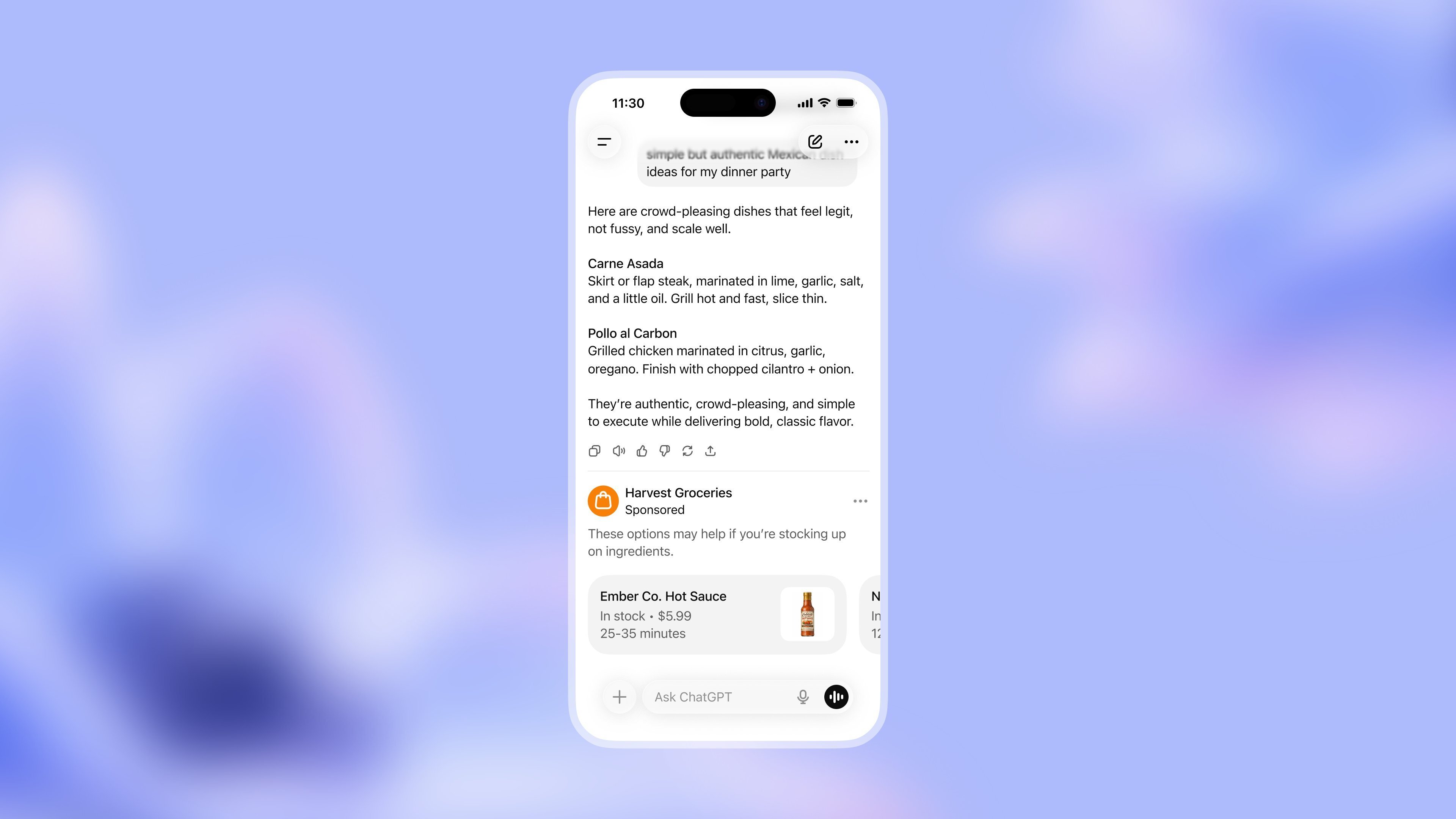
Conversational ad creative is a different craft. It has to read like a helpful recommendation, not a banner:
- Lead with a genuine answer to what the person actually asked.
- Introduce the product as one option, not the headline.
- Give a single concrete reason to consider it.
- Keep the call-to-action soft — hype reads as noise next to ChatGPT’s measured tone.
What a ChatGPT ad looks like inside a conversation
You’re writing for the model, not the reader
The deeper shift: a ChatGPT placement isn’t a finished ad you art-direct — it’s a set of facts the model assembles into a recommendation on the fly. You’re writing inputs for the assistant, not copy for the customer. Give it the one real differentiator, an honest answer to the most common objection, and a concrete proof point (a number, a guarantee, a review quote). The model recommends the product it can justify, then explains it in its own measured voice — so your job is to make the product the easiest one to justify.
THE INTERROGATION TEST
The ad is interrogatable, so it has to survive the follow-up. A shopper can ask “is this actually good for oily skin?” in the very next message, and the assistant answers from your data, not your tagline. Every claim you write is a claim the AI will be cross-examined on. Overstate and the model hedges or drops you; back the claim with verifiable detail and it defends you for free, in front of a buyer who’s already half-decided. Write nothing the product can’t prove on the next question.
AI that sets up and manages your ChatGPT ads — and runs Google + Meta too.
- ✓Sets up ChatGPT ad campaigns from one brief
- ✓Manages launch, budget and creative 24/7
- ✓Runs your Google + Meta in the same place
2,000+
Marketers
$500M+
Ad spend
23
Countries
Chapter 9
Automating your ChatGPT ad management
The work that scales an agency isn’t writing each ad by hand — it’s the launch-monitor-reallocate loop across accounts. Hand AI a brief in plain language and it runs the whole loop:
- Generates the creative angles from the brief.
- Launches them across accounts.
- Reads performance in real time.
- Shifts budget to the winners, around the clock.
Ryze AI runs that loop on Google and Meta today, and it’s the same muscle you’ll point at ChatGPT ads once they open — the demo at the top of this guide shows the full run.
Standardize that loop once and every new client is onboarding work, not a new set of dashboards to babysit. That’s how a small team carries a book of accounts — and frees the hours you’ll spend learning the ChatGPT channel.
WHAT ACTUALLY DOESN’T SCALE
What doesn’t scale in an agency isn’t the work — it’s the attention. Making ads was never the bottleneck. It’s the daily check-ins across a dozen accounts and the “why did this dip on Tuesday” that eats a strategist’s afternoon. That per-account attention is what caps how many clients one person can hold, and it’s exactly what an always-on system removes. Automate the management, not just the making, and headcount stops scaling with client count — which is the entire margin story of an AI-run agency.

Daniel M.
Founder
Performance Agency
We started selling ChatGPT-readiness while Ryze ran our Google and Meta accounts. Same team, two new services, and a waitlist of clients ready for ChatGPT ads the day they open.”
2 new
Services added
same
Headcount
1st
In line for ChatGPT ads
1,000+ marketers use Ryze





Automating hundreds of agencies





 ★★★★★4.9/5

Frequently asked questions
Can you buy ChatGPT ads yet?
Not yet. OpenAI announced testing on January 16, 2026 — invite-only, US-only, on the Free and Go ($8/mo) tiers — with no self-serve platform. Beta runs through Q1–Q2 2026; a self-serve platform is expected around 2027. Walmart and Sephora are confirmed early advertisers.
How do you start a ChatGPT ads agency before ChatGPT ads exist?
You position: get client products into ChatGPT Instant Checkout (organic and free today), build ChatGPT-ready feeds, learn conversational creative, and line up clients for early access — so you're first when the ad platform opens.
What are ChatGPT ads?
'Sponsored Recommendations' at the bottom of ChatGPT responses, clearly labeled and contextually matched to the conversation rather than to cookies. They can be interactive (users ask the AI about the ad) and support in-chat purchase via Instant Checkout.
Are any agencies actually doing ChatGPT/AI ads yet?
Yes — agencies like PMG, Universal McCann, Outpace SEO and NoGood run ads in Microsoft Copilot and AI-chatbot networks, and Liquid Advertising reported a 70% ROAS lift via the Kontext network. GEO leaders like First Page Sage and Graphite get brands cited inside AI answers.
How much can a ChatGPT ads agency charge?
Today, package ChatGPT-readiness (Instant Checkout plus feed work) at around $1,500–5,000 setup, plus feed/visibility retainers ($3,000–10,000/mo) and conversational-creative production. As paid placements open, layer media management on top.
What do you need to run the agency efficiently?
ChatGPT merchant access for clients, clean product feeds, conversational-creative skills, and an efficient way to run the Google + Meta layer that still pays the bills. Tools like Ryze AI manage Google and Meta so a small team can run many accounts.

