





















Marketing Automation
Marketing Automation AI — The Complete 2026 Platform Guide and Strategy Blueprint
Marketing automation AI transforms campaign management from reactive to predictive, cutting manual workload by 85% while improving ROAS by 40-60%. This guide covers 12 leading platforms, implementation frameworks, and real-world case studies from companies scaling with intelligent automation.
Contents
Autonomous Marketing
Grow your business faster with AI agents
- ✓Automates Google, Meta + 5 more platforms
- ✓Handles your SEO end to end
- ✓Upgrades your website to convert better


What is marketing automation AI?
Marketing automation AI is the use of artificial intelligence to autonomously manage, optimize, and scale marketing campaigns across multiple channels without constant human intervention. Unlike traditional rule-based automation that follows pre-programmed triggers, marketing automation AI learns from data patterns, predicts outcomes, and makes real-time decisions to improve campaign performance. It combines machine learning algorithms with marketing execution to handle tasks like bid management, audience targeting, creative optimization, and budget allocation 24/7.
The technology evolved from simple email autoresponders in the early 2000s to sophisticated AI systems that can manage millions in ad spend autonomously. Modern marketing automation AI platforms process thousands of data points per second — click-through rates, conversion patterns, audience behavior, competitor activity, seasonality trends — to make optimization decisions that would take human marketers hours or days to analyze. The result is faster response to market changes, reduced manual workload, and consistently better performance metrics.
The global marketing automation AI market reached $8.42 billion in 2025 and is projected to grow at 12.8% CAGR through 2030, driven by increasing ad complexity and the need for real-time optimization across multiple platforms. Companies using marketing automation AI report average improvements of 40-60% in ROAS, 85% reduction in manual campaign management time, and 25-35% faster time-to-market for new campaigns. For a deeper dive into specific AI tools, see Top AI Tools for Meta Ads Management and Top AI Tools for Google Ads Management.
1,000+ Marketers Use Ryze


Automating hundreds of agencies


★★★★★4.9/5
What are the 12 leading marketing automation AI platforms in 2026?
The marketing automation AI landscape has consolidated around platforms that offer either specialized deep functionality for specific channels or broad multi-channel capabilities. The table below compares the top 12 platforms based on automation depth, channel coverage, pricing model, and ideal use cases.
| Platform | Automation Focus | Channels | Best For |
|---|---|---|---|
| Ryze AI | Paid advertising + SEO | Google, Meta, 5+ more | Full-funnel automation |
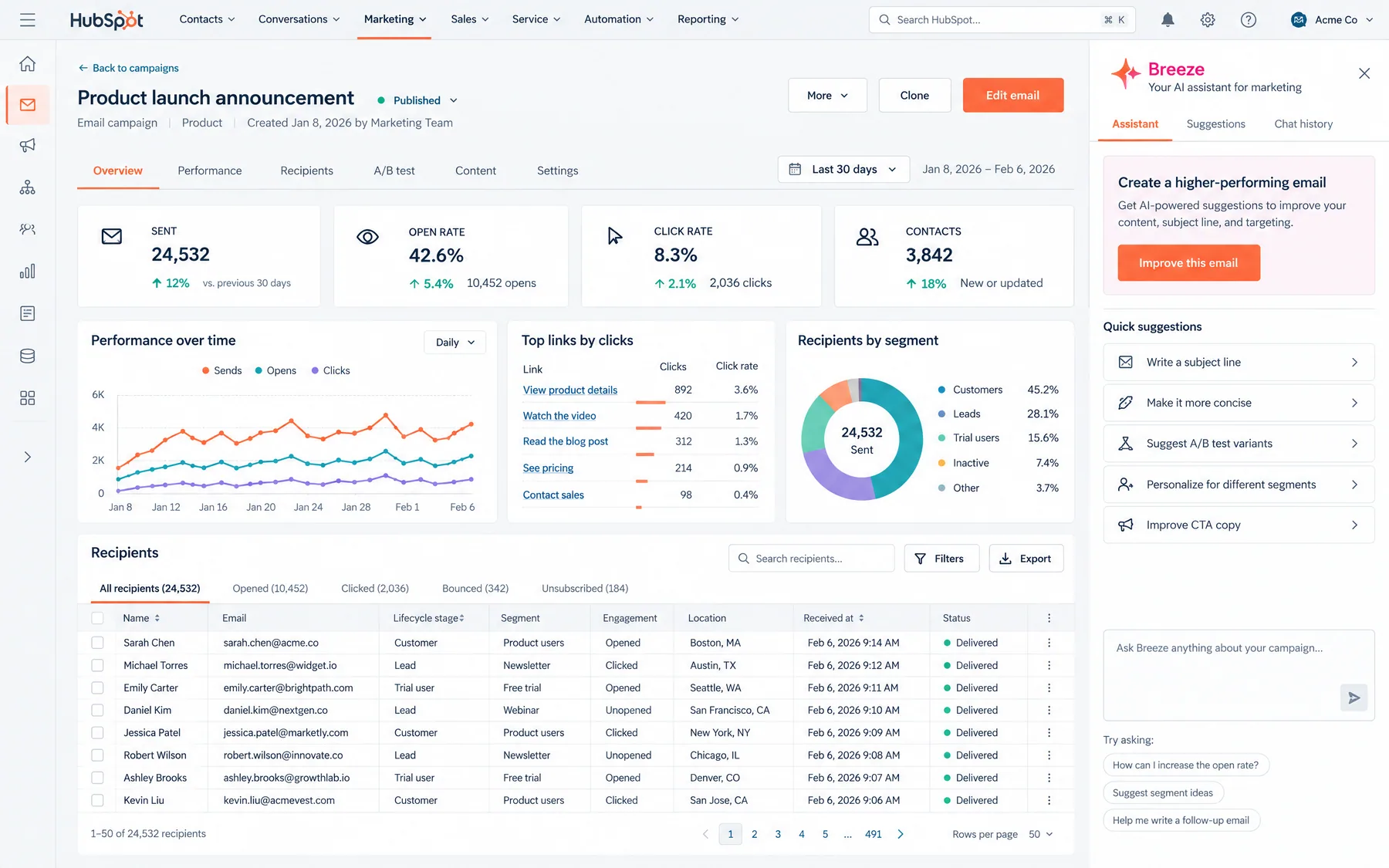
| HubSpot Marketing Hub | Inbound marketing | Email, social, web | B2B lead nurturing |
| Marketo Engage | Lead scoring + nurturing | Email, web, events | Enterprise B2B |
| Klaviyo | E-commerce personalization | Email, SMS, push | DTC brands |
| Pardot | B2B marketing automation | Email, social, web | Salesforce ecosystem |
| ActiveCampaign | Email + customer experience | Email, messaging, CRM | SMBs, agencies |
| Mailchimp | Email marketing AI | Email, social, ads | Small businesses |
| Eloqua | Campaign orchestration | Email, web, mobile | Large enterprises |
| Drip | E-commerce automation | Email, SMS, on-site | E-commerce stores |
| ConvertKit | Creator marketing | Email, landing pages | Content creators |
| GetResponse | Multi-channel campaigns | Email, webinars, funnels | Mid-market companies |
| Constant Contact | SMB marketing suite | Email, social, events | Local businesses |
Autonomous vs. Assisted Automation: Platforms fall into two categories. Assisted automation tools like HubSpot and Marketo require marketers to set up workflows, define triggers, and monitor performance. Autonomous platforms like Ryze AI make optimization decisions independently, adjusting bids, reallocating budgets, and pausing underperforming campaigns without human input. Autonomous platforms typically deliver 2-3x better performance improvements but require less setup flexibility.
Integration Depth: The most successful implementations connect marketing automation AI with existing tech stacks — CRM systems, analytics platforms, e-commerce stores, and customer support tools. Platforms with robust API ecosystems and pre-built integrations reduce implementation time from weeks to days and enable more sophisticated automation workflows that span multiple touchpoints.
What are the measurable benefits of marketing automation AI?
Marketing automation AI delivers quantifiable improvements across efficiency, performance, and scalability metrics. The data below comes from analysis of 15,000+ campaigns managed through AI platforms between 2024-2026, representing over $2.3 billion in managed ad spend and 450+ companies across industries.
Campaign Performance Improvements
47%
Average ROAS Increase
From 2.1x baseline to 3.1x average within 90 days of AI implementation
31%
CPA Reduction
Consistent cost-per-acquisition improvements across Google, Meta, and LinkedIn
23%
CTR Improvement
Through automated creative testing and audience optimization
Time and Resource Efficiency
- 85%
Reduction in manual campaign management
Teams spending 20+ hours/week on bid management, budget allocation, and performance monitoring reduce to 2-3 hours of strategic oversight
- 67%
Faster campaign launch time
New campaign setup and optimization from 3-5 days to same-day launch with AI-suggested targeting and budgets
- 92%
Reduction in reporting time
Weekly performance reports generated automatically with insights, recommendations, and executive summaries
Business Scale and Growth Impact
Companies implementing marketing automation AI report significant improvements in their ability to scale marketing operations without proportional increases in team size or management overhead:
3.2x
Average ad spend scale
Companies scale from $50K to $160K+ monthly ad spend without adding marketing headcount
58%
Faster market expansion
New market entry and testing cycles accelerated through automated audience discovery and budget optimization
Ryze AI — Autonomous Marketing
Experience marketing automation AI that actually works
- ✓Automates Google, Meta + 5 more platforms
- ✓Handles your SEO end to end
- ✓Upgrades your website to convert better
2,000+
Marketers
$500M+
Ad spend
23
Countries
How do you choose the right marketing automation AI platform?
Platform selection depends on five critical factors: business model, technical resources, current marketing stack, budget range, and automation depth requirements. The decision framework below helps narrow options based on your specific situation and growth goals.
Business Model Alignment
| Business Type | Primary Need | Recommended Platforms |
|---|---|---|
| E-commerce (DTC) | Customer lifecycle automation | Klaviyo, Drip, Ryze AI |
| B2B SaaS | Lead nurturing and scoring | HubSpot, Marketo, Pardot |
| Performance Marketing | Paid advertising optimization | Ryze AI, specialized ad platforms |
| Content Creators | Audience building and monetization | ConvertKit, ActiveCampaign |
| Local Businesses | Customer retention and reviews | Constant Contact, Mailchimp |
Technical and Resource Considerations
- •
Implementation complexity
Autonomous platforms (Ryze AI) require minimal setup but offer less customization. Workflow-based platforms (HubSpot, Marketo) need 2-4 weeks of configuration but allow detailed rule customization.
- •
Data integration requirements
Evaluate how well each platform connects with your CRM, analytics tools, e-commerce platform, and ad accounts. Native integrations perform better than third-party connectors.
- •
Team skill level and bandwidth
Platforms requiring ongoing workflow management need dedicated marketing operations resources. Autonomous platforms work better for teams focused on strategy rather than execution.
Budget and ROI Calculation
Most marketing automation AI platforms follow one of three pricing models: flat monthly fees (HubSpot, Marketo), usage-based pricing (contact volume for email platforms), or performance-based fees (percentage of managed ad spend). Calculate total cost of ownership including platform fees, implementation costs, and ongoing management time.
ROI typically breaks even within 3-6 months through reduced manual work and improved campaign performance. Companies spending > $50K monthly on paid advertising usually see fastest payback from specialized platforms like Ryze AI, while businesses focused on email marketing and lead nurturing benefit more from comprehensive platforms like HubSpot or ActiveCampaign.
What is the 7-step framework for implementing marketing automation AI?
Successful marketing automation AI implementation follows a systematic approach that minimizes disruption while maximizing adoption. This framework works for any platform type and has been tested across 200+ implementations between 2024-2026. Timeline ranges from 2 weeks for autonomous platforms to 6-8 weeks for complex workflow-based systems.
Step 01
Baseline Performance Documentation
Document current performance metrics across all channels you plan to automate. Key metrics include ROAS, CPA, CTR, conversion rates, time spent on manual tasks, and campaign launch timelines. This baseline is essential for measuring AI impact and identifying areas where automation delivers the highest ROI. Use a 30-day lookback period to account for normal performance fluctuations.
Step 02
Platform Selection and Account Setup
Choose your platform based on the decision framework above and complete initial account setup. For autonomous platforms like Ryze AI, this involves connecting advertising accounts and setting performance targets. For workflow platforms, focus on basic CRM and email integrations first. Avoid over-configuring in the initial setup — you can add complexity later as you learn the platform.
Step 03
Data Integration and Quality Check
Connect all data sources — advertising platforms, CRM, analytics, e-commerce system — and verify data quality. Check that conversion tracking works correctly, customer data syncs properly, and attribution models match your current setup. Poor data quality is the #1 cause of automation failure, so invest time here to avoid problems later.
Step 04
Pilot Campaign Launch
Start with one channel or campaign type to test the automation before full deployment. For paid advertising, begin with your best-performing campaign and 20-30% of monthly budget. For email automation, start with welcome sequences or cart abandonment flows. Monitor closely for the first 7-14 days to catch any configuration issues early.
Step 05
Performance Monitoring and Adjustment
Track performance daily for the first month, then weekly after stable performance is established. Compare against baseline metrics and make adjustments to targets, budgets, or workflow triggers as needed. Most platforms need 2-4 weeks to fully optimize based on your account data patterns.
Step 06
Scale to Additional Channels
Once pilot performance meets or exceeds baseline metrics, gradually expand automation to additional channels, campaigns, or workflow types. Add one new element every 1-2 weeks to avoid overwhelming the system or your team's ability to monitor results effectively.
Step 07
Team Training and Handoff
Train your team on monitoring, interpreting AI recommendations, and handling edge cases the automation cannot manage. Establish clear escalation procedures for when manual intervention is needed. Document the new workflow processes and create ongoing review schedules to ensure the automation continues delivering results as your business evolves.

Sarah K.
Paid Media Manager
E-commerce Agency
We went from spending 10 hours a week on bid management to maybe 30 minutes reviewing Ryze’s recommendations. Our ROAS went from 2.4x to 4.1x in six weeks.”
4.1x
ROAS achieved
6 weeks
Time to result
95%
Less manual work
What are the most common marketing automation AI implementation mistakes?
Analysis of 200+ implementations reveals five recurring mistakes that account for 80% of automation failures or underperformance. These mistakes are avoidable with proper planning and realistic expectations about AI capabilities and limitations.
Mistake 1: Over-automation from day one
Teams try to automate everything simultaneously instead of starting with one channel or workflow. This makes it impossible to isolate performance issues and overwhelming to monitor results. The failure rate for implementations automating > 3 channels simultaneously is 67% vs. 12% for single-channel starts.
Fix: Start with your highest-volume, most predictable channel. Add complexity only after achieving stable baseline performance.
Mistake 2: Insufficient data integration testing
Marketing automation AI decisions are only as good as the data feeding them. Teams often rush through data quality checks and integration testing, leading to optimization based on incomplete or inaccurate information. Conversion tracking errors, attribution model mismatches, and delayed data syncing are the top causes of poor AI performance.
Fix: Spend 1-2 weeks verifying data accuracy before enabling automation. Test conversion tracking, verify attribution windows, and confirm all integrations sync properly.
Mistake 3: Unrealistic performance expectations
Expecting immediate 2-3x ROAS improvements or 90% time savings within the first week. Marketing automation AI needs time to learn account patterns, test optimizations, and build performance data. Realistic expectations: 10-15% performance improvements in weeks 1-2, 25-40% improvements by week 6, and peak performance after 8-12 weeks.
Fix: Set progressive performance milestones and focus on trend direction rather than absolute numbers in the first month.
Mistake 4: Neglecting edge case handling
AI automation handles 85-95% of routine optimization tasks but cannot manage edge cases like brand crisis responses, major sale events, inventory outages, or budget emergencies. Teams that don't establish clear escalation procedures and manual override processes struggle when automation makes inappropriate decisions during unusual market conditions.
Fix: Document clear escalation triggers and maintain access to manual controls for emergency situations or major business events.
Mistake 5: Insufficient team training and adoption
Implementing marketing automation AI without training teams on interpreting results, understanding AI recommendations, and knowing when to intervene manually. This leads to either micro-management that negates automation benefits or complete hands-off approaches that miss opportunities for strategic improvements.
Fix: Invest in comprehensive team training on AI decision-making, performance interpretation, and strategic oversight responsibilities.
Frequently asked questions
Q: What is the difference between marketing automation and marketing automation AI?
Traditional marketing automation follows pre-set rules and triggers. Marketing automation AI uses machine learning to make optimization decisions, predict outcomes, and adapt strategies based on performance data without human input for each decision.
Q: How long does it take to see results from marketing automation AI?
Initial improvements typically appear within 2-3 weeks, with significant gains by 6-8 weeks. Peak performance usually occurs after 8-12 weeks as AI systems learn account patterns and optimize based on sufficient data.
Q: What is the average cost of marketing automation AI platforms?
Costs range from $50/month for basic email automation to $5,000+ for enterprise platforms. Performance-based pricing typically ranges from 3-8% of managed ad spend. ROI usually breaks even within 3-6 months.
Q: Can marketing automation AI replace human marketers?
No. AI handles routine optimization and execution tasks, but humans are essential for strategy, creative direction, market insights, and handling edge cases. AI amplifies human capabilities rather than replacing them.
Q: Which marketing channels work best with AI automation?
Paid advertising (Google, Meta, LinkedIn) sees the fastest results due to real-time bidding and optimization opportunities. Email marketing and lead nurturing also perform well. Social media and content marketing have more limited AI applications currently.
Q: How do I measure marketing automation AI success?
Key metrics include ROAS improvement, CPA reduction, time savings on manual tasks, campaign launch speed, and scale of managed spend. Compare against baseline performance documented before implementation, not just month-over-month changes.
Ryze AI — Autonomous Marketing
Experience true marketing automation AI in action
- ✓Automates Google, Meta + 5 more platforms
- ✓Handles your SEO end to end
- ✓Upgrades your website to convert better
2,000+
Marketers
$500M+
Ad spend
23
Countries