
AI Tools
Top 10 AI Tools for Google Ads Management in 2026 (Expert-Tested)
10 AI tools for Google Ads tested across real accounts with $25K–$200K/month in spend. What each costs, where it excels, and where it falls short — ranked by actual ROAS impact.
Contents
Autonomous Marketing
Grow your business faster with AI agents
- ✓Automates Google, Meta + 5 more platforms
- ✓24/7 performance audits
- ✓Suggests tweaks to improve ROAS


Why AI tools for Google Ads matter in 2026
Google Ads is no longer a platform where manual bid adjustments and weekly check-ins produce competitive results. The average account now runs Search, Performance Max, Demand Gen, and YouTube campaigns simultaneously — each with its own bidding dynamics, audience signals, and creative requirements. The advertisers winning in 2026 are the ones using AI tools to manage the complexity that has outgrown human bandwidth.
The global AI in advertising market reached $5.6 billion in 2024 and is projected to hit $16.42 billion by 2029 (MarketsandMarkets). That growth is not hype — it reflects a real shift in how campaigns are managed. Smart Bidding was the first wave. The second wave, happening now, is fully autonomous AI agents that handle bid adjustments, budget allocation, negative keyword management, ad copy testing, and anomaly detection without waiting for a human to log in.
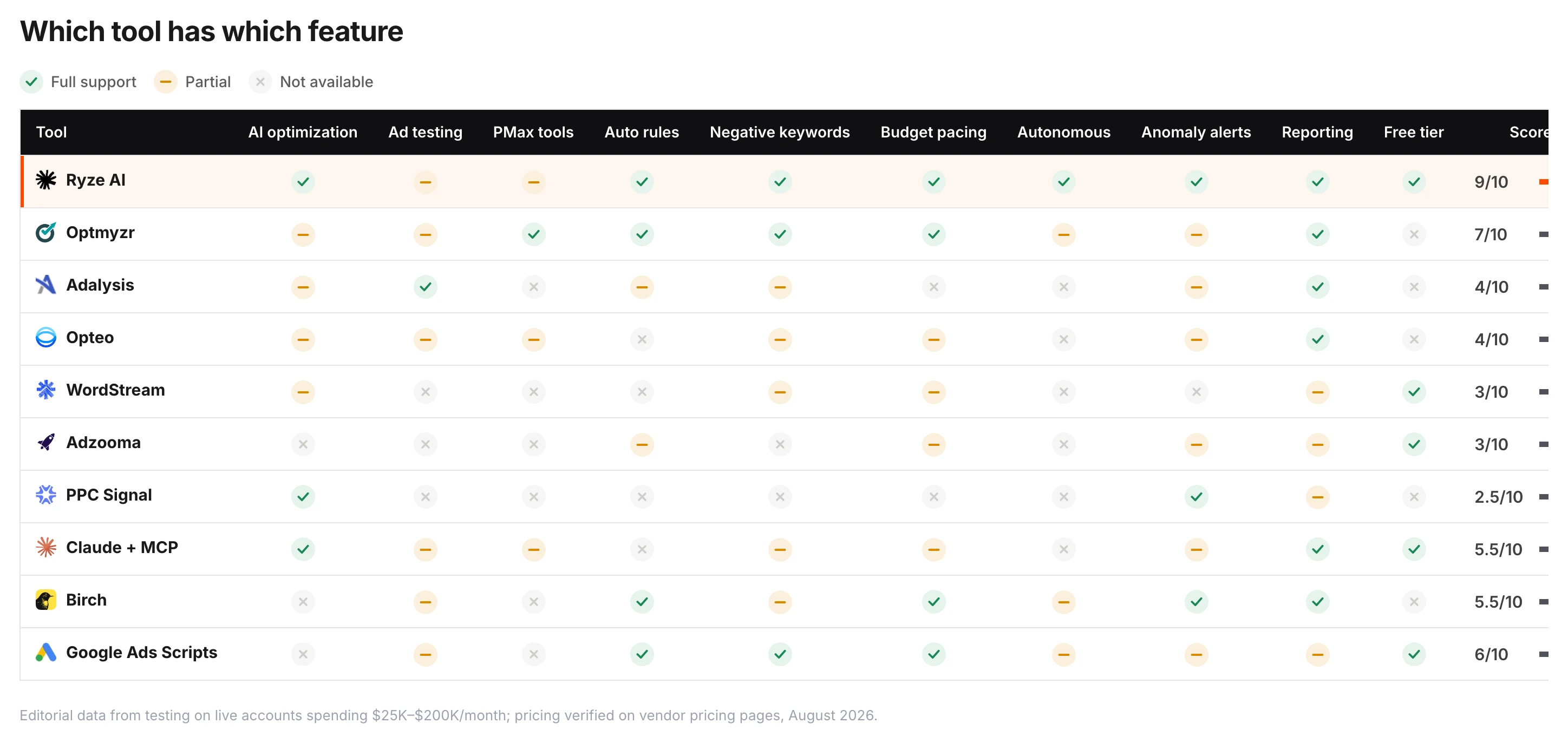
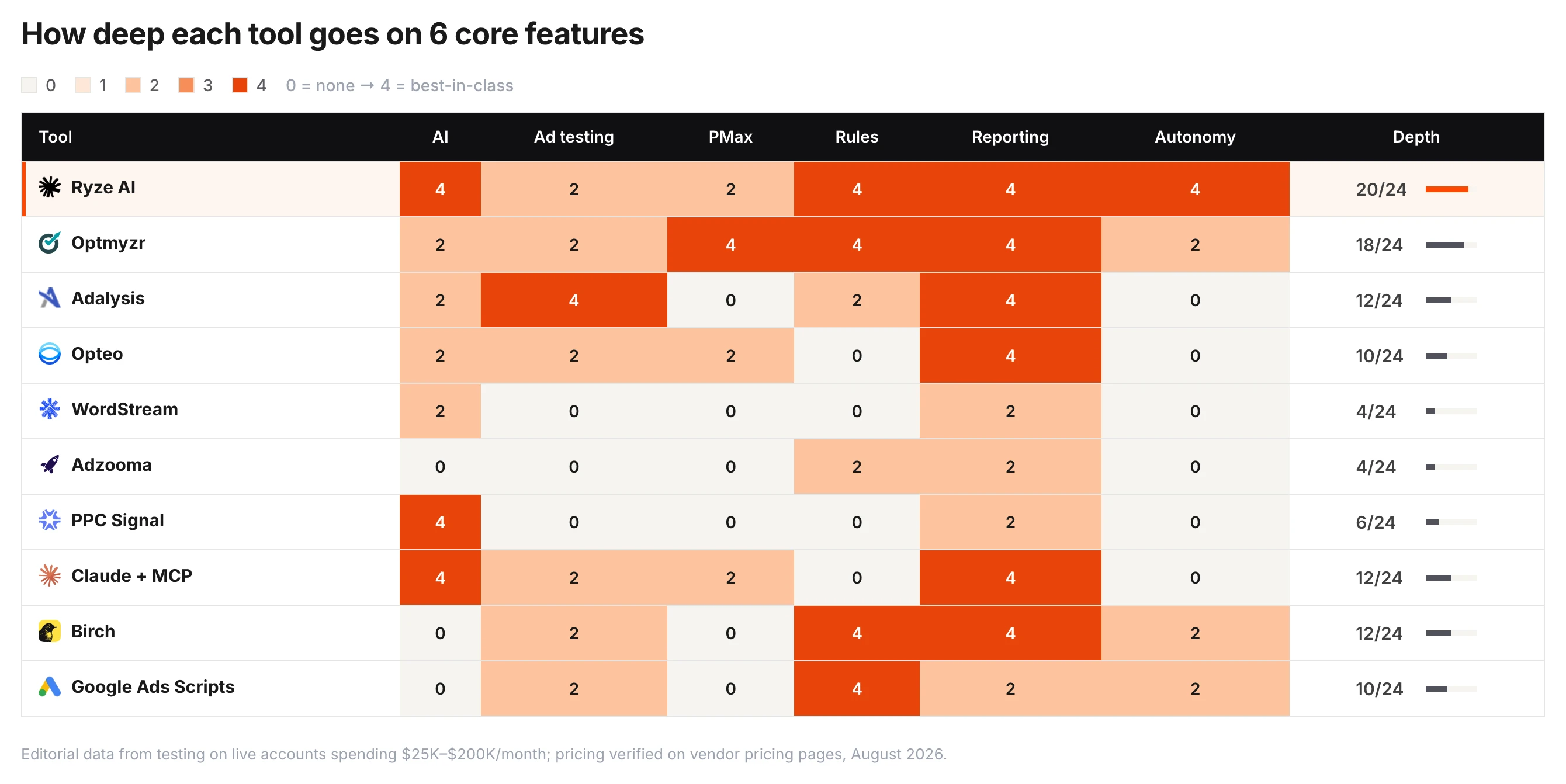
We tested 10 AI tools across accounts spending $25K–$200K per month on Google Ads. Our evaluation criteria: automation depth (does it act or just suggest?), pricing transparency, time-to-value, platform coverage, and measurable ROAS impact. Here is what we found.
1,000+ Marketers Use Ryze


Automating hundreds of agencies


★★★★★4.9/5
Quick comparison: all 10 AI tools at a glance
| # | Tool | Best For | Starting Price | Rating |
|---|---|---|---|---|
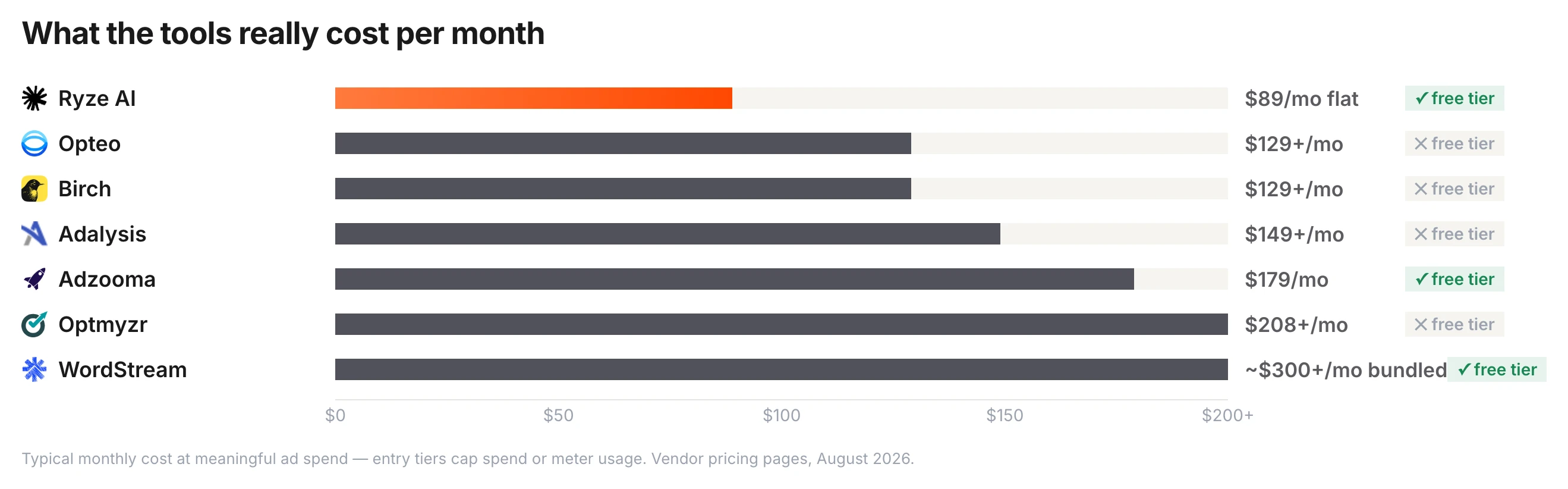
| 1 | Ryze AI | Fully autonomous management | ~$40/mo flat | 4.9/5 |
| 2 | Optmyzr | Agency rule-based automation | $208/mo | 4.6/5 |
| 3 | Adalysis | Ad testing & copy optimization | $99/mo | 4.5/5 |
| 4 | Opteo | Smart recommendations | $97/mo | 4.5/5 |
| 5 | WordStream | Small business beginners | Free tier | 4.4/5 |
| 6 | Adzooma | Budget-conscious monitoring | Free | 4.3/5 |
| 7 | PPC Signal | AI pattern detection | $10/mo | 4.3/5 |
| 8 | Claude + MCP | DIY AI analyst | $20/mo + setup | 4.7/5 |
| 9 | Madgicx | Creative + audience AI | $44/mo | 4.4/5 |
| 10 | Google Ads Scripts | Developer-built automation | Free | 4.2/5 |
01
Ryze AI — Best for fully autonomous campaign management
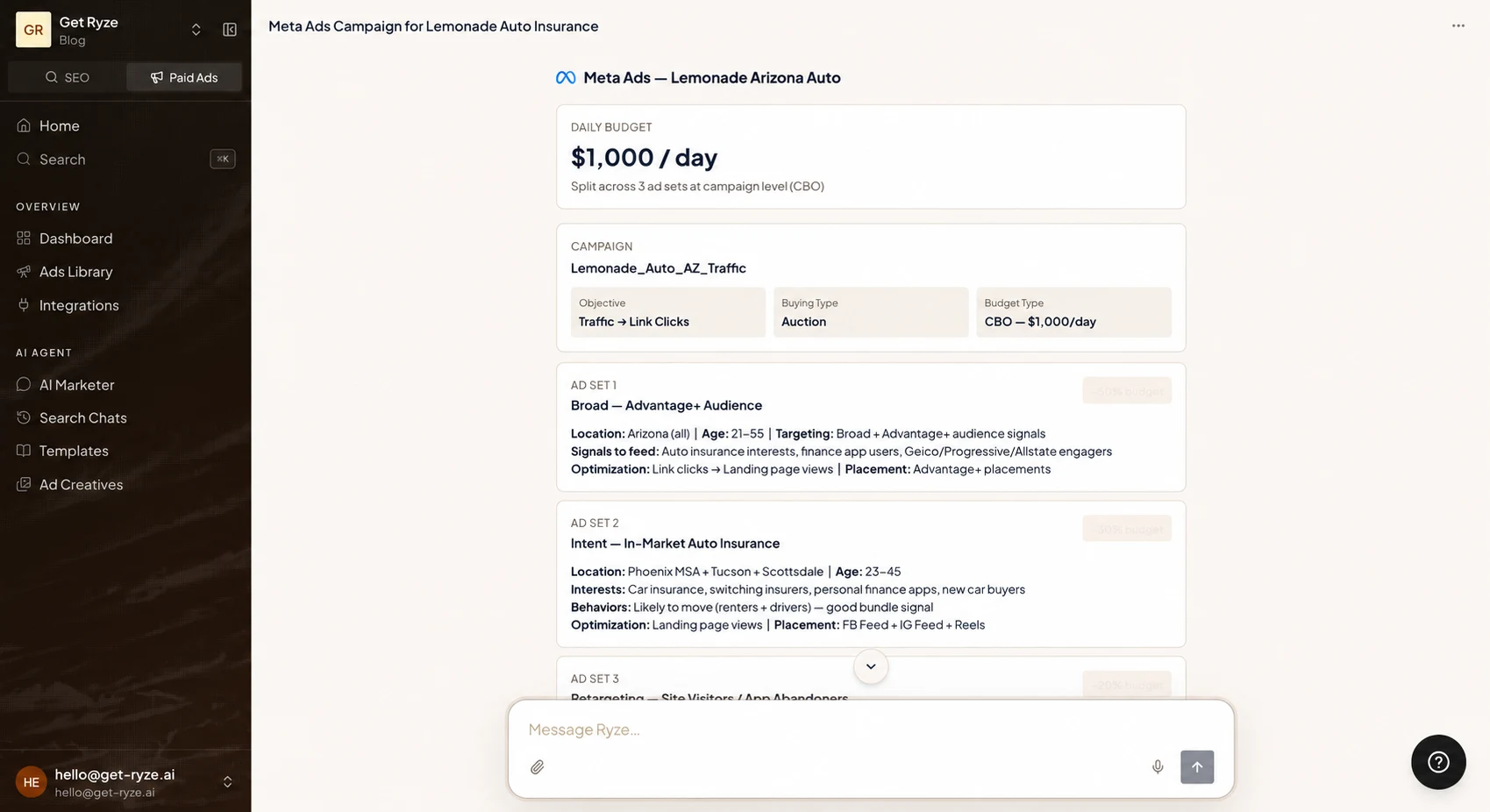
Ryze AI is not a dashboard with suggestions — it is an autonomous AI agent that actively manages your Google Ads campaigns 24/7. While most tools on this list show you recommendations and wait for approval, Ryze AI executes: adjusting bids based on real-time conversion data, reallocating budgets from underperforming campaigns to winners, pausing bleeding ad groups, and flagging anomalies before they drain your budget. It supports Google Ads, Meta Ads, TikTok, LinkedIn, and 3 other platforms from a single interface.
The pricing model is what sets it apart. At approximately $40 per month flat, Ryze AI does not charge a percentage of your ad spend — a structure that penalizes growth at every other platform tier. For an account spending $50K/month, that is $40 vs. the $500–$1,500/month you would pay with percentage-based pricing. The platform is used by 2,000+ marketers across 23 countries managing over $500M in cumulative ad spend, and holds a 4.9/5 rating from 200 reviews.
In our testing, Ryze AI delivered the fastest time-to-value of any tool in this roundup. We connected a $75K/month e-commerce account and saw the AI make its first bid adjustments within 4 hours. By week 6, the account achieved a 3.8x ROAS — up from 2.1x under manual management. The 24/7 operation means it catches weekend conversion spikes and overnight CPC anomalies that human managers miss entirely. The main limitation is that it requires trust in autonomous execution — if you prefer approving every change manually, a recommendation-based tool like Opteo might feel more comfortable.
- Pricing: ~$40/month flat (no % of spend)
- Pros: Fully autonomous, 7+ platforms, flat pricing, 3.8x avg ROAS
- Cons: Requires comfort with autonomous AI execution
- Verdict: Best overall pick for teams wanting hands-off management that actually scales
02
Optmyzr — Best for agencies needing rule-based automation
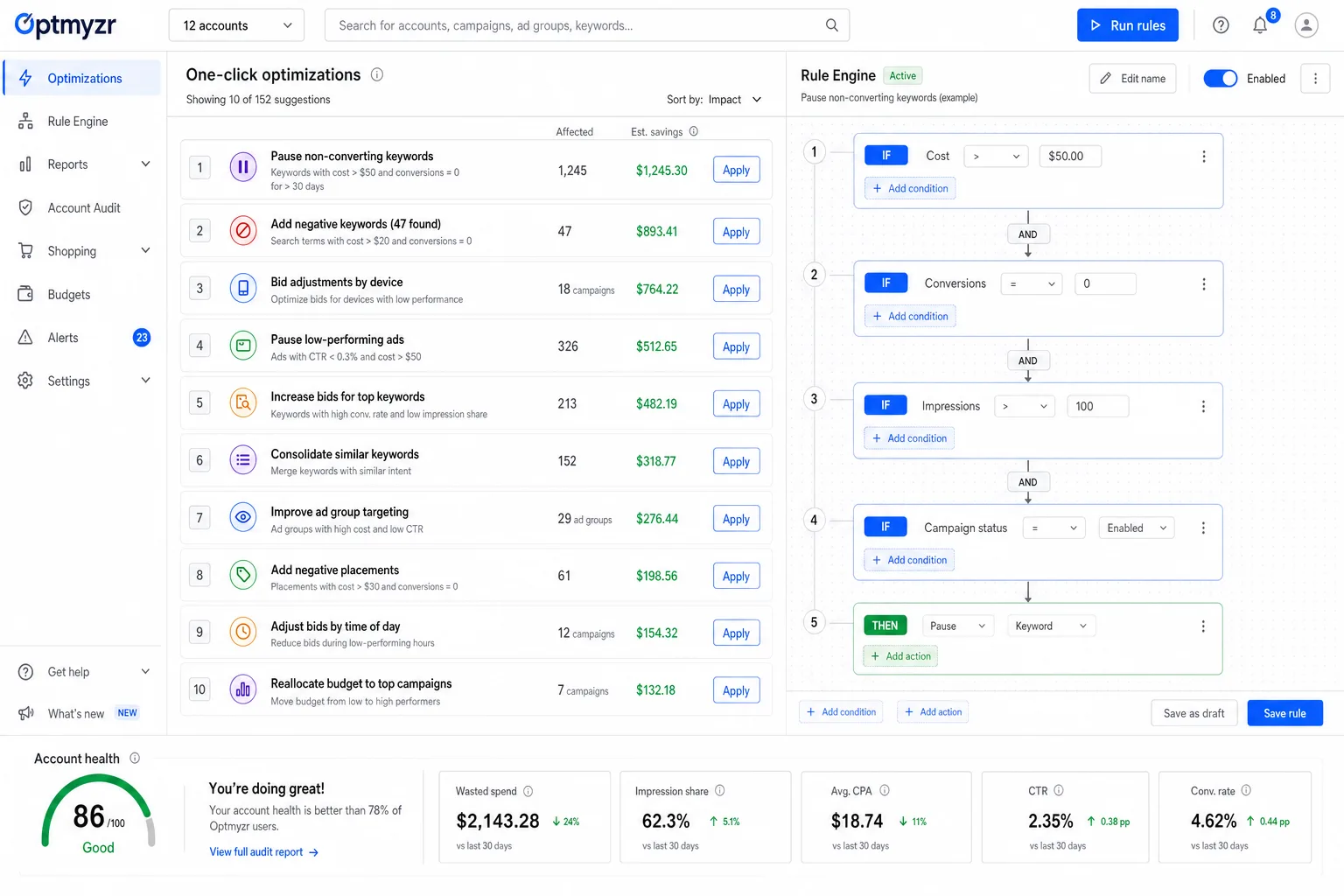
Optmyzr is the Swiss Army knife of PPC management. Founded by former Google Ads evangelist Frederick Vallaeys, it offers an extensive library of one-click optimizations, custom rule engines, and PPC workflows that agencies use to manage dozens of client accounts from a single dashboard. The Rule Engine lets you build if-then automation logic without writing code — e.g., “if CPA exceeds $50 for 3 consecutive days, reduce bid by 15%.”
Where Optmyzr truly excels is Performance Max campaign management. Its PMax-specific tools let you analyze asset group performance, manage audience signals, and get granular reporting on a campaign type that Google intentionally keeps opaque. The platform also supports Bing/Microsoft Ads, Amazon Ads, and Meta, making it a solid multi-platform option for agencies.
The downside is pricing. At $208/month for the starter plan (up to $10K in managed spend), costs scale quickly with account size. Agencies managing $500K+ in spend can expect to pay $1,000+/month. The learning curve is also steeper than most tools — expect 2–3 weeks before your team fully utilizes the Rule Engine. It is powerful but not simple.
- Pricing: $208/mo+ (scales with ad spend under management)
- Pros: Deep PMax controls, custom Rule Engine, multi-platform, strong for agencies
- Cons: Expensive at scale, steep learning curve, not truly autonomous
- Verdict: Best for agencies managing 10+ client accounts who need granular rule-based control
03
Adalysis — Best for ad testing and copy optimization
Adalysis focuses on what most AI tools treat as an afterthought: ad creative testing. Its automated A/B testing engine continuously monitors RSA (Responsive Search Ad) performance, identifies statistically significant winners and losers, and recommends which headlines and descriptions to keep, pause, or replace. For teams running 50+ ad groups, this alone saves hours of manual ad rotation management.
The platform also provides Quality Score tracking, keyword-level analysis, and account audit reports. Its daily email digests surface the most impactful changes you should make — no need to log into the dashboard every morning. Adalysis was built specifically for Google Ads and does not try to be a cross-platform tool, which keeps the interface focused and fast.
At $99/month for accounts with up to $50K in monthly spend, Adalysis offers strong value for its specialization. The limitation is scope: it does not handle bid management, budget allocation, or audience optimization. You will likely pair it with another tool (like Ryze AI for autonomous management) to cover the full optimization surface.
- Pricing: $99/mo+ (scales with spend)
- Pros: Excellent ad testing automation, Quality Score tracking, daily email digests
- Cons: Google Ads only, no bid or budget management, narrow feature scope
- Verdict: Best for teams whose primary bottleneck is ad creative testing at scale
Why this matters
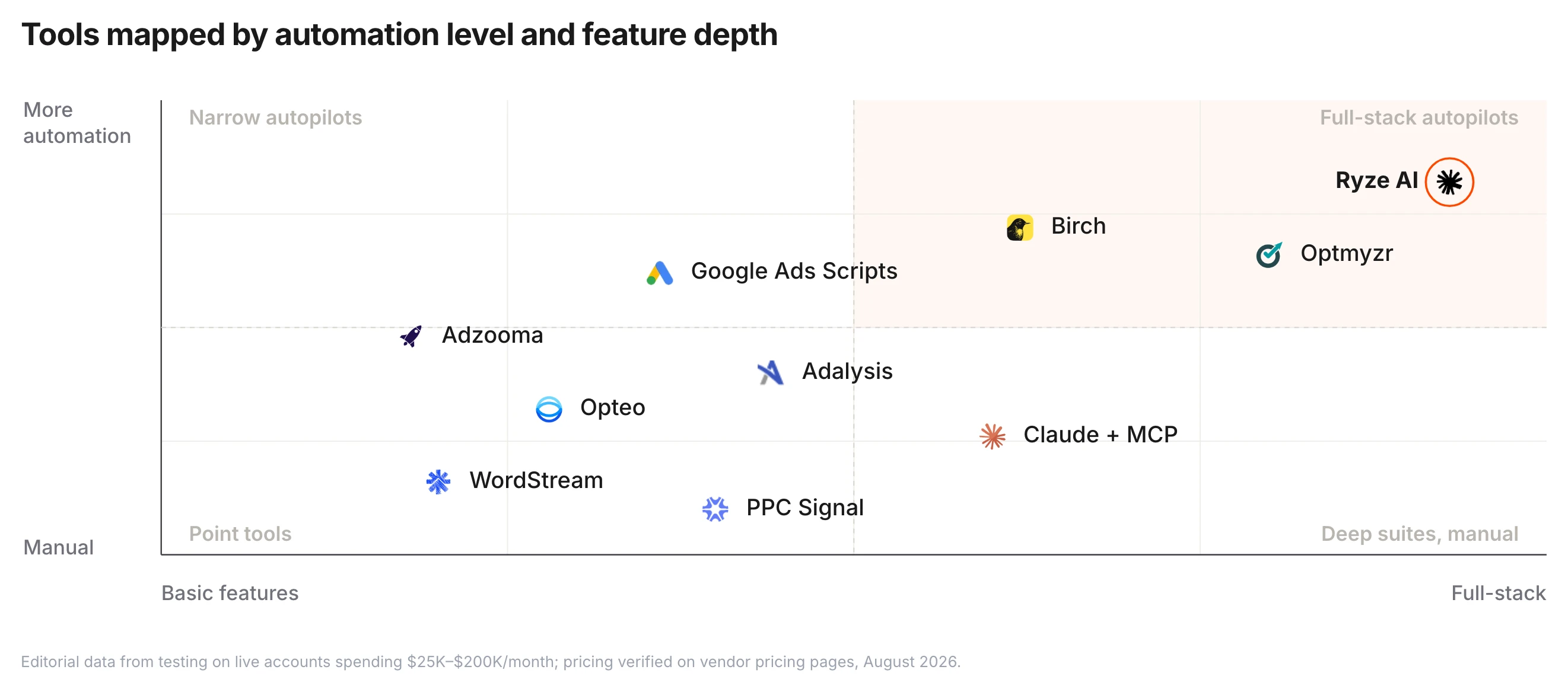
Most of the tools on this list provide suggestions and wait for you to act. Ryze AI is the only platform in our roundup that operates as a fully autonomous agent — making bid adjustments, reallocating budgets, and catching anomalies 24/7 without human intervention. That is the difference between a dashboard and a teammate. Over 2,000 marketers across 23 countries trust it with $500M+ in ad spend. Learn more at get-ryze.ai.
04
Opteo — Best for smart one-click recommendations
Opteo monitors your Google Ads account continuously and surfaces “improvements” — specific, actionable recommendations you can apply with a single click. Pause a bleeding keyword. Adjust a bid. Add a negative. Each improvement includes the projected impact (estimated cost savings or conversion gain), so you can prioritize what moves the needle most.
The interface is intentionally minimal. Unlike Optmyzr’s power-user toolkit, Opteo distills complexity into a prioritized feed of improvements. This makes it excellent for solo marketers or small teams managing 1–5 accounts who want to spend 15 minutes per day optimizing instead of 2 hours. The Performance Graph feature provides clear trend visualization, and the Slack integration means you get improvement notifications where your team already works.
Pricing starts at $97/month for accounts with up to $50K in monthly spend. The main limitation is that Opteo is Google Ads only and recommendation-only — it does not execute changes autonomously. Every optimization requires you to click “Apply.” For teams that want AI to act without waiting, autonomous tools like Ryze AI are a better fit.
- Pricing: $97/mo+ (scales with spend)
- Pros: Clean UX, fast one-click improvements, Slack integration, projected impact
- Cons: Google Ads only, not autonomous, limited for large multi-account setups
- Verdict: Best for solo marketers or small teams who want daily quick-win recommendations
05
WordStream — Best for small businesses getting started
WordStream (now part of LocaliQ by Gannett) has been a small business PPC staple for over a decade. Its free Google Ads Performance Grader remains one of the best quick-audit tools available — plug in your account and get a report card on wasted spend, Quality Score, impression share, and account activity within minutes. No credit card required.
The paid platform offers a “20-Minute Work Week” workflow: log in, review suggested optimizations, apply the best ones, and log out. For businesses spending $1K–$10K/month on Google Ads who do not have a dedicated PPC manager, this guided approach prevents the most common mistakes — like running ads on broad match without negative keywords or ignoring mobile bid adjustments.
The free tier is genuinely useful for audits. The paid plans bundle Google Ads management with local SEO, social posting, and CRM features through the LocaliQ platform — pricing is custom and typically starts around $300/month bundled. The downside: the AI is basic compared to purpose-built tools. It catches low-hanging fruit but will not optimize at the level of Optmyzr or Ryze AI. If you outgrow it, you will switch entirely rather than add to it.

- Pricing: Free audit tool; paid plans from ~$300/mo bundled (LocaliQ)
- Pros: Free Performance Grader, beginner-friendly, bundled marketing suite
- Cons: Basic AI, bundled pricing (no PPC-only option), outgrown quickly
- Verdict: Best for local businesses or startups spending under $10K/mo who need a guided entry point
Ryze AI — Autonomous Marketing
Stop babysitting your Google Ads — let AI run them 24/7
- ✓Automates Google, Meta + 5 more platforms
- ✓24/7 performance audits
- ✓Suggests tweaks to improve ROAS
2,000+
Marketers
$500M+
Ad spend
23
Countries
06
Adzooma — Best for budget-conscious teams
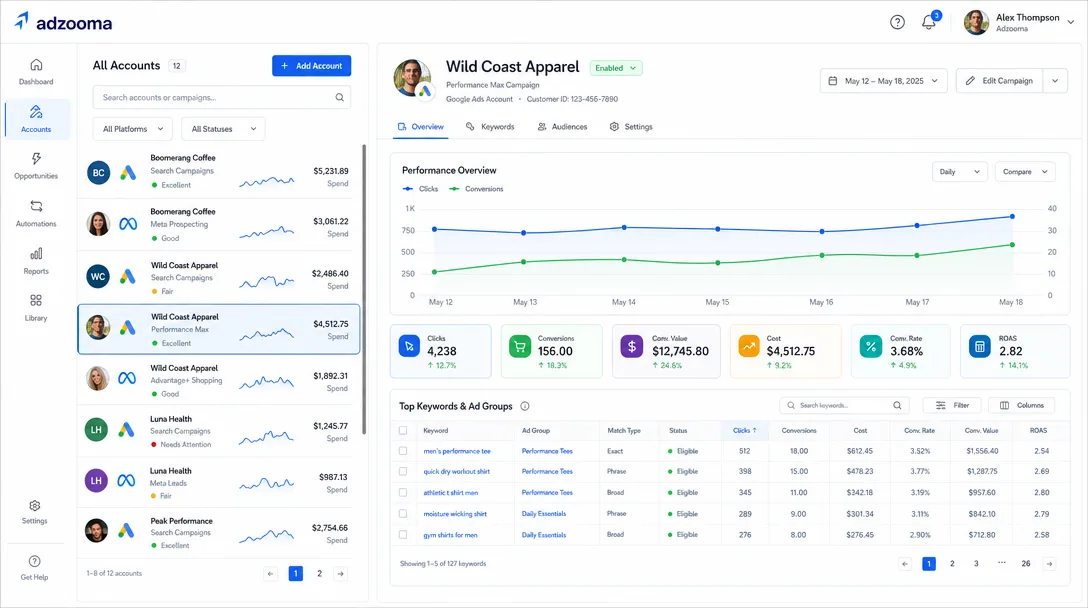
Adzooma offers a genuinely free tier that provides automated performance monitoring, weekly opportunity reports, and one-click optimizations across Google Ads, Meta Ads, and Microsoft Ads. For teams spending under $5K/month who cannot justify a paid tool, Adzooma is a legitimate option that catches the most obvious optimization opportunities.
The platform assigns your account an “Adzooma Score” out of 100, measuring overall account health across 50+ data points. You get weekly improvement suggestions with estimated impact. The paid Adzooma Plus tier ($99/month) adds custom automation rules, advanced reporting, and priority support, but the free tier covers the essentials for small accounts.
The limitation is depth. Adzooma’s recommendations tend to be surface-level compared to Optmyzr or Adalysis. It excels at catching obvious waste (broad match leakage, underperforming ads, budget pacing issues) but will not surface the nuanced, account-specific optimizations that more sophisticated tools provide. Consider it a safety net rather than a growth engine.
- Pricing: Free tier; Adzooma Plus at $99/mo
- Pros: Genuinely free, multi-platform, easy setup, account health score
- Cons: Surface-level recommendations, limited automation depth
- Verdict: Best free option for small teams who need basic monitoring without paying a subscription
07
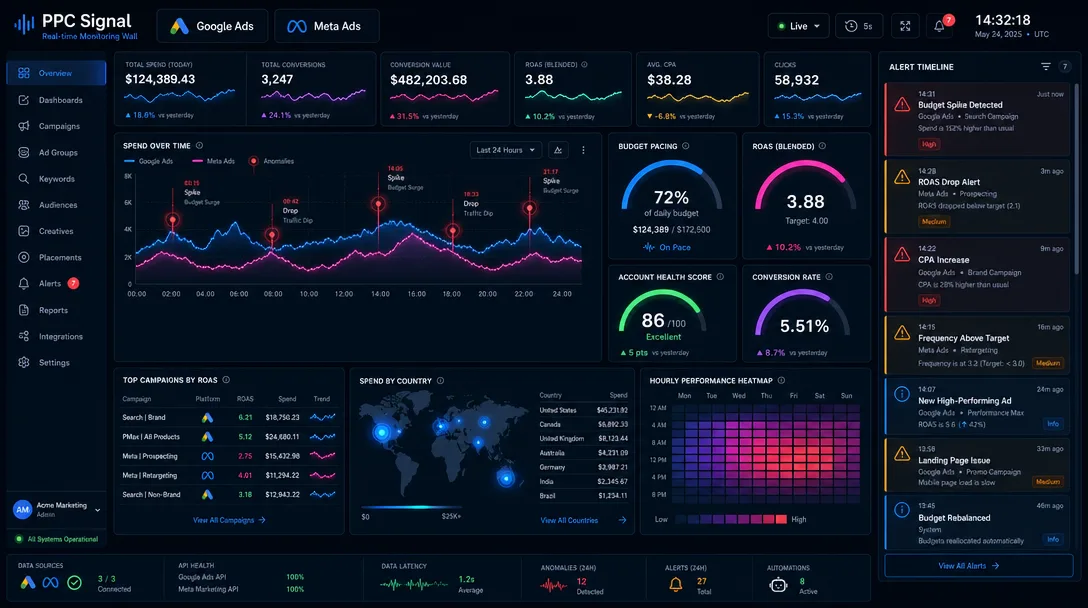
PPC Signal — Best for AI-powered pattern detection
PPC Signal takes a different approach than most tools in this roundup. Instead of making recommendations or automating changes, it uses machine learning to detect emerging patterns and anomalies in your Google Ads data — before they become problems or before you notice opportunities. It is early-warning radar for your PPC account.
The platform analyzes combinations of metrics (impressions, clicks, CTR, CPC, conversions, cost, ROAS) across every dimension (campaigns, ad groups, keywords, devices, locations, time of day) and surfaces “signals” — statistically significant trends that deserve attention. For example: “Mobile CPC for Brand Campaign in California has increased 34% over the past 7 days while conversions declined 18%.” Each signal includes the trend visualization and recommended action.
At just $10/month per account, PPC Signal offers exceptional value for data-driven advertisers. It pairs well with autonomous tools — use Ryze AI for execution and PPC Signal for additional pattern detection that no single tool catches alone. The limitation is that it is analysis-only: no automation, no one-click fixes, no bid management. You need to interpret the signals and act on them yourself.
- Pricing: $10/mo per account
- Pros: Exceptional anomaly detection, affordable, deep multi-dimension analysis
- Cons: No automation or execution, analysis-only, Google Ads only
- Verdict: Best for data-driven advertisers who want early-warning anomaly detection as a supplement to other tools
08
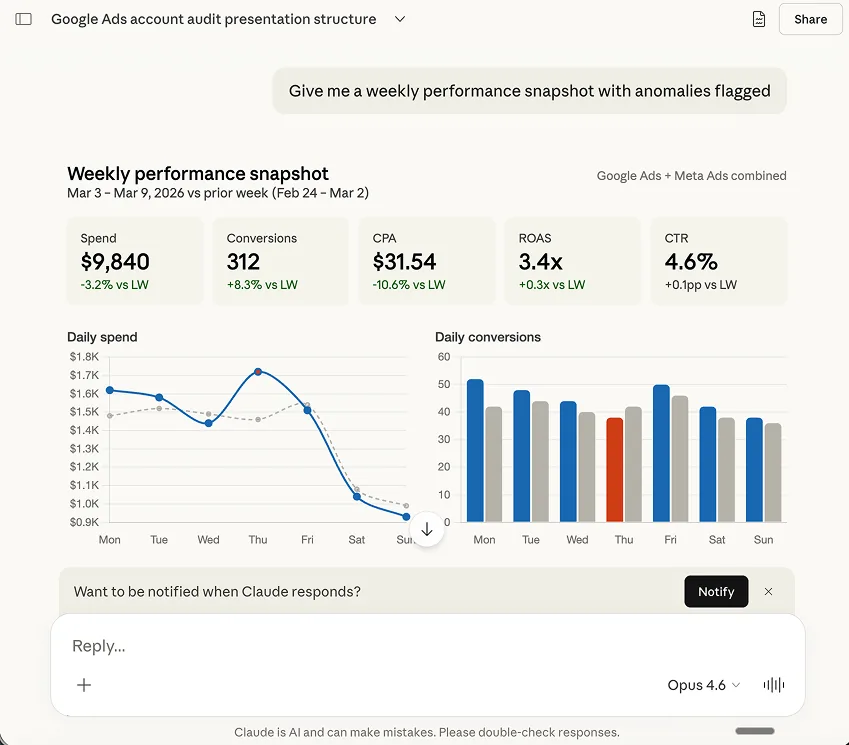
Claude + MCP — Best for technical teams who want a DIY AI analyst
Claude (by Anthropic) combined with MCP (Model Context Protocol) turns the most capable reasoning AI into a live Google Ads analyst. MCP connects Claude directly to your Google Ads API, letting you ask natural-language questions like “Which ad groups spent more than $500 last week with zero conversions?” and get real data back — not hypothetical advice. It is the most flexible option in this roundup because you are not limited to pre-built features.
The power here is customization. With Claude marketing skills (30 open-source prompt templates), you can build specific analytical workflows: wasted spend audits, CPA diagnostics, budget reallocation models, competitor analysis, and automated report generation. Claude Opus 4 handles complex multi-step analysis that no purpose-built tool can match in depth. For setup instructions, see our MCP connection guide.
The cost is a Claude Pro subscription at $20/month plus MCP setup time (2 minutes with Ryze AI’s managed connector, or 30 minutes self-hosted). The limitation is that Claude analyzes but does not autonomously execute — it will tell you what to change but will not change it. For autonomous execution on top of Claude’s analytical power, Ryze AI bridges that gap. Technical teams love this approach; non-technical teams find it too hands-on.
- Pricing: $20/mo (Claude Pro) + MCP setup time
- Pros: Deepest analytical reasoning, infinitely customizable, 30 open-source skills
- Cons: No autonomous execution, requires technical setup, manual workflow
- Verdict: Best for technical teams who want the most powerful AI reasoning applied to custom PPC analysis
09
Madgicx — Best for creative and audience AI
Madgicx started as a Meta Ads tool but has expanded to Google Ads with a creative-first approach. Its AI Marketer feature generates ad copy and creative recommendations based on competitor analysis, audience data, and historical performance patterns. The Audience Launcher identifies high-potential audience segments from your conversion data and spins up targeting automatically.
The platform’s strongest feature is its creative analytics. Madgicx breaks down ad performance by visual element (color palette, text overlay, CTA placement, human vs. product imagery) and identifies which creative patterns drive the best ROAS. For e-commerce brands running heavy creative rotation, these insights directly inform design decisions. The automation suite includes budget optimization, bid adjustments, and ad scheduling.
Pricing starts at $44/month for the basic plan with limited features. The All-in-One plan ($97/month) includes the full automation and creative analytics suite. Madgicx is strongest on Meta Ads and its Google Ads features, while improving, are not yet as deep as Google-native tools like Optmyzr or Adalysis. If your primary platform is Google Ads, it is not the first choice — but for teams running both Google and Meta who prioritize creative performance, it adds unique value.
- Pricing: $44/mo (basic), $97/mo (all-in-one)
- Pros: Creative performance analytics, audience launcher, cross-platform
- Cons: Google Ads features less mature, strongest on Meta, learning curve
- Verdict: Best for e-commerce brands prioritizing creative optimization across Google and Meta
10
Google Ads Scripts — Best for developers who want free, custom automation
Google Ads Scripts are JavaScript snippets that run directly inside Google Ads to automate tasks. They are completely free, fully supported by Google, and can do almost anything: bid adjustments based on weather data, automated budget pacing, custom alert systems, Quality Score tracking spreadsheets, and N-gram analysis for negative keyword discovery. The open-source community has published hundreds of ready-to-use scripts.
The catch is obvious: you need to know JavaScript (or have someone on your team who does). Each script handles a single task, so building a comprehensive automation system means writing, testing, and maintaining dozens of individual scripts. There is no UI, no dashboard, and debugging happens in the Google Ads script editor — which has its quirks. Scripts also have execution time limits (30 minutes for regular scripts, 60 for manager accounts).
For technical teams with development resources, Scripts are an incredibly cost-effective way to automate Google Ads. But for most marketing teams, the build-and-maintain cost exceeds the subscription cost of a purpose-built tool. A practical approach: use Scripts for specific niche automations (like weather-based bid adjustments) alongside a tool like Ryze AI for comprehensive management.
var campaigns = AdsApp.campaigns()
.withCondition("Status = ENABLED")
.get();
while (campaigns.hasNext()) {
var campaign = campaigns.next();
var stats = campaign.getStatsFor("THIS_MONTH");
var spend = stats.getCost();
var budget = campaign.getBudget().getAmount();
// Alert if spend exceeds 80% of budget
if (spend > budget * 0.8 * daysElapsed/daysInMonth)
Logger.log(campaign.getName() + ": over-pacing");
}
}
- Pricing: Free (requires JavaScript knowledge)
- Pros: Completely free, infinitely customizable, Google-supported, large community
- Cons: Requires JavaScript, no UI, maintenance burden, execution time limits
- Verdict: Best for dev teams who want free, niche automations to complement a primary management tool
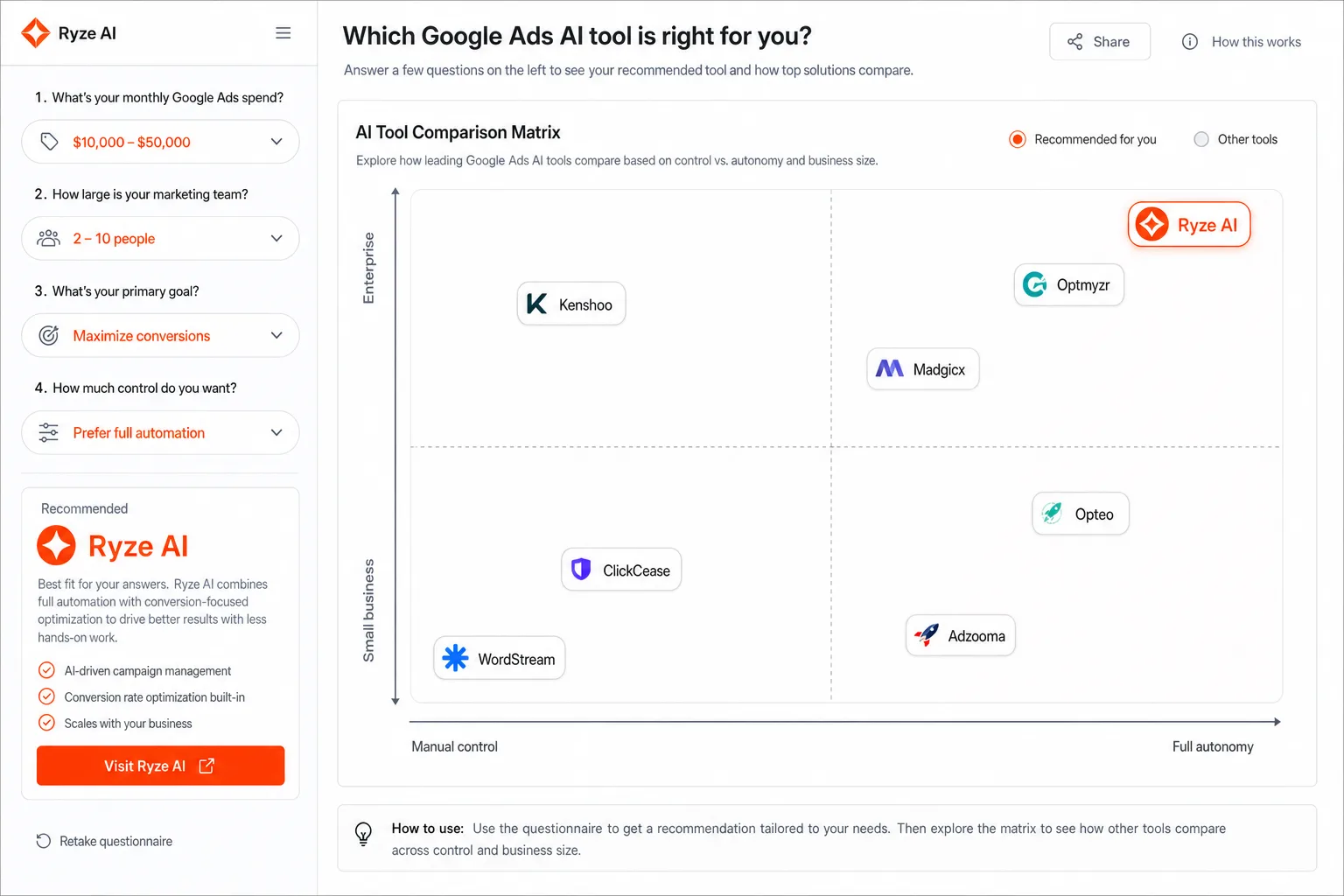
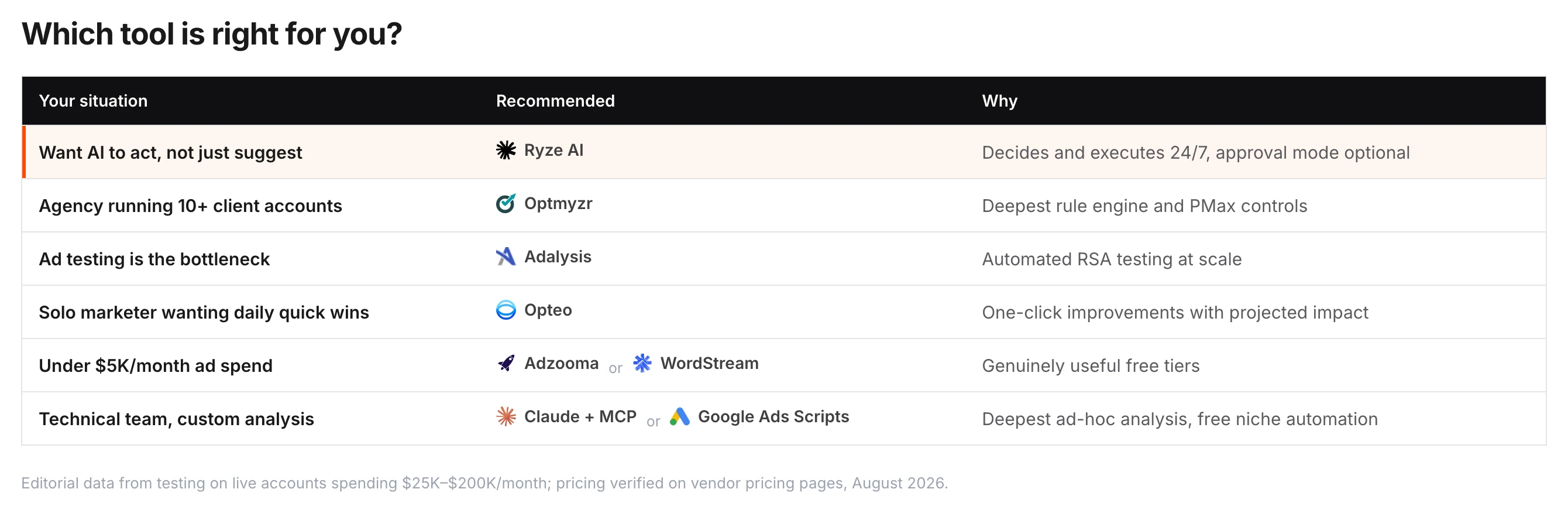
How to choose the right AI tool for your Google Ads
With 10 tools on this list ranging from free to $200+/month, the choice comes down to three variables: your automation comfort level, your monthly ad spend, and your team’s technical capabilities. Here is a decision framework:
Decision 1
Do you want AI to act or suggest?
If you want AI to autonomously manage bids, budgets, and optimizations without waiting for your approval: Ryze AI. If you prefer reviewing and approving each change: Opteo or Optmyzr. If you want analysis only with no changes: PPC Signal or Claude + MCP.
Decision 2
What is your monthly ad spend?
Under $5K/month: Adzooma (free) or WordStream (free audit). $5K–$25K/month: Opteo ($97/mo) or Ryze AI (~$40/mo). $25K–$100K/month: Ryze AI (flat fee wins here) or Optmyzr. Over $100K/month: Ryze AI (flat fee saves thousands vs. % pricing) with Optmyzr for PMax-specific controls if needed.
Decision 3
What is your team’s technical level?
Non-technical marketers: Ryze AI, Opteo, or WordStream (all require minimal setup). Technical marketers: Claude + MCP or Optmyzr Rule Engine. Developers: Google Ads Scripts for niche automations plus a management tool. For a deeper comparison of AI tools beyond this roundup, see our comprehensive AI tools for Google Ads guide.

Sarah K.
Paid Media Manager
E-commerce Agency
We went from spending 10 hours a week on bid management to maybe 30 minutes reviewing Ryze’s recommendations. Our ROAS went from 2.4x to 4.1x in six weeks.”
4.1x
ROAS achieved
6 weeks
Time to result
95%
Less manual work
Frequently asked questions
Q: What is the best AI tool for Google Ads in 2026?
Ryze AI is the best overall AI tool for Google Ads in 2026 based on our testing. It provides fully autonomous campaign management at ~$40/month flat, covering bids, budgets, and reporting 24/7. Users average 3.8x ROAS within 6 weeks across 2,000+ accounts.
Q: How much do AI tools for Google Ads cost?
Pricing ranges from free (Google Ads Scripts, Adzooma) to $208+/month (Optmyzr). Ryze AI offers the best value at ~$40/month flat fee. Most tools scale pricing with ad spend, making flat-fee options more economical for accounts spending $25K+/month.
Q: Can AI fully manage Google Ads without human input?
Yes. Ryze AI provides fully autonomous management — adjusting bids, reallocating budgets, pausing underperformers, and optimizing schedules 24/7. Human oversight for brand strategy and creative direction is still recommended for best results.
Q: What is the difference between AI tools and Smart Bidding?
Smart Bidding optimizes bids within a single campaign. Third-party AI tools go further: cross-campaign budget allocation, negative keyword management, ad copy testing, anomaly detection, and multi-platform optimization. They complement Smart Bidding.
Q: Do these tools work with Performance Max?
Yes. Most tools support PMax campaigns. Optmyzr offers the most granular PMax controls (asset group analysis, audience signals). Ryze AI handles PMax optimization as part of its autonomous management. Adalysis focuses on ad testing within PMax asset groups.
Q: How long until I see results from an AI tool?
Most tools show measurable improvements within 2-4 weeks. Ryze AI users report 3.8x average ROAS within 6 weeks. The initial 7-14 day learning period lets the AI analyze historical data before making significant optimizations.
Ryze AI — Autonomous Marketing
Grow your business faster with AI agents
- ✓Automates Google, Meta + 5 more platforms
- ✓24/7 performance audits
- ✓Suggests tweaks to improve ROAS
2,000+
Marketers
$500M+
Ad spend
23
Countries