ChatGPT Ads: the complete guide to advertising inside OpenAI’s platform.
Sponsored placements below ChatGPT’s answers, matched to the conversation, not keywords — how they work, what they cost, and copy-paste prompts to launch them.
Built by our community of 2,000 marketers
Free ChatGPT ads prompts and skills
Copy-paste prompts to plan, write, launch and manage your ChatGPT ads.
Clients we work withClients we
work with







ChatGPT ads are paid placements that appear below ChatGPT’s responses, clearly labeled “Sponsored” and kept separate from the organic answer.
OpenAI began testing them in February 2026 for logged-in adult users on the Free and Go tiers in the US. They target the context of the conversation, not keywords — surfacing when what a person is researching matches an advertiser’s targeting.
Here’s what that means for advertisers in 2026:
- Early testing shows roughly 20% ad frequency — about one sponsored placement per five conversations.
- CPCs run $2.50–$8.00, above Google Search ($1–3), reflecting the high-intent, research-mode audience.
- Ads never influence the answer: ChatGPT writes its response first, then a separate system decides whether a relevant ad fits.
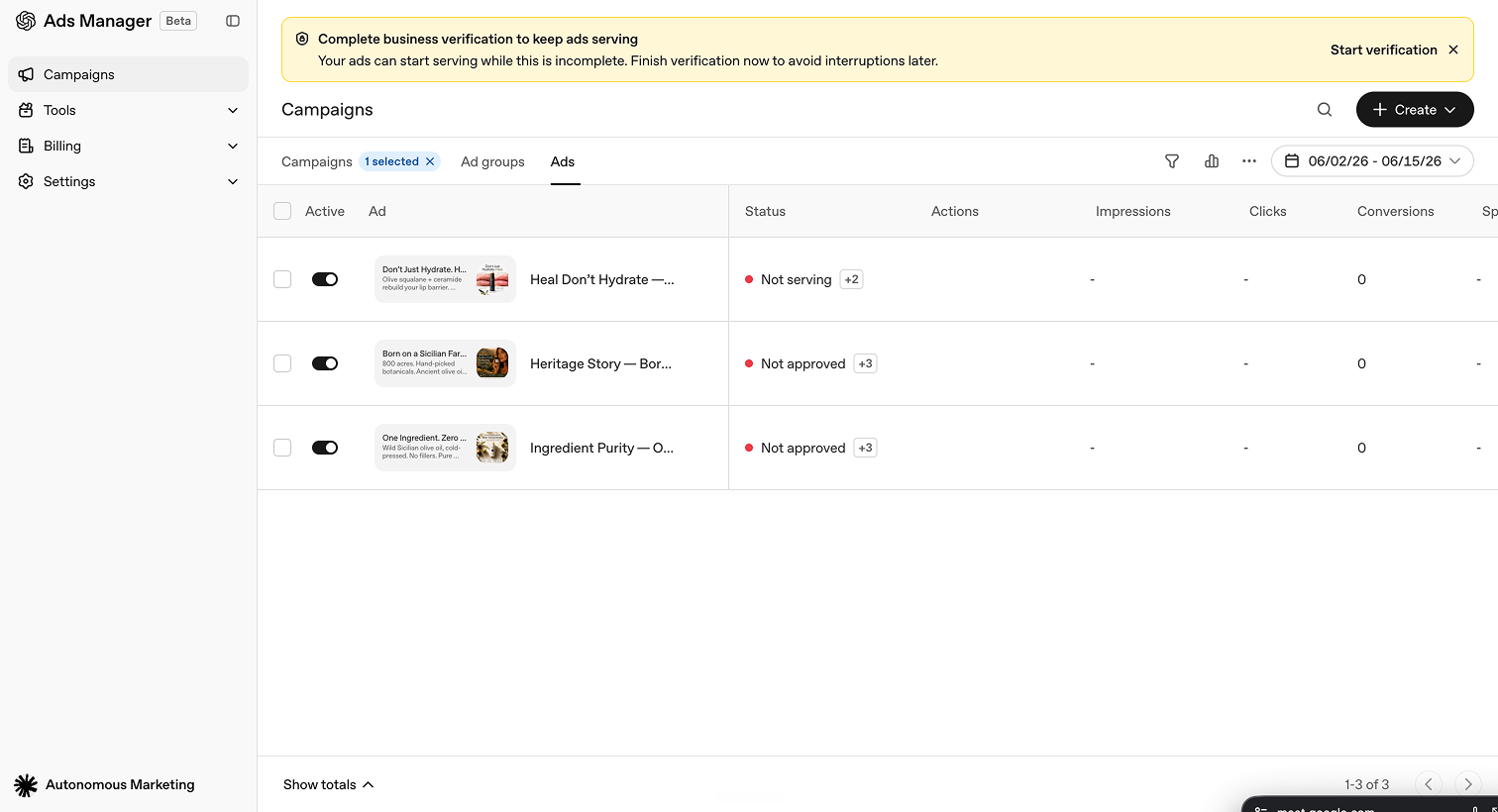
Watch: Ryze turns one prompt into a live ChatGPT ad campaign
The result: your ChatGPT ads in OpenAI’s Ads Manager
The prompts
Copy-paste ChatGPT prompts to plan and write your ChatGPT ads
Six prompts to plan, write and test ads that run inside ChatGPT. Fill in the bracketed placeholders before you send each one.
Use it when: You're choosing which conversations to target and want them ranked by intent.
Use it when: You have a placement and need copy that reads like a recommendation, not a banner.
Use it when: You already run the ad elsewhere and want a ChatGPT-appropriate version.
Use it when: Before you pay for placements, see where you already appear, or don't.
Use it when: You've been approved for the beta and need a structured first month.
Use it when: You want to earn mentions next to where the ads run, not just buy them.
Running these by hand is fine for planning a launch. Keeping a campaign tuned — reading what converts and moving budget to it — is the part Ryze AI handles automatically across ChatGPT, Google and Meta (see how the paid ads agent works).
What are ChatGPT ads?
ChatGPT ads are paid placements that appear at the bottom of ChatGPT responses, clearly labeled as sponsored content and separated from organic answers. OpenAI began testing these ads in February 2026 for logged-in adult users on Free and Go tiers in the United States. Unlike traditional search or social ads, ChatGPT ads target conversational context — appearing when the semantic content of an active AI conversation aligns with advertiser targeting parameters.
What a ChatGPT ad looks like inside a conversation
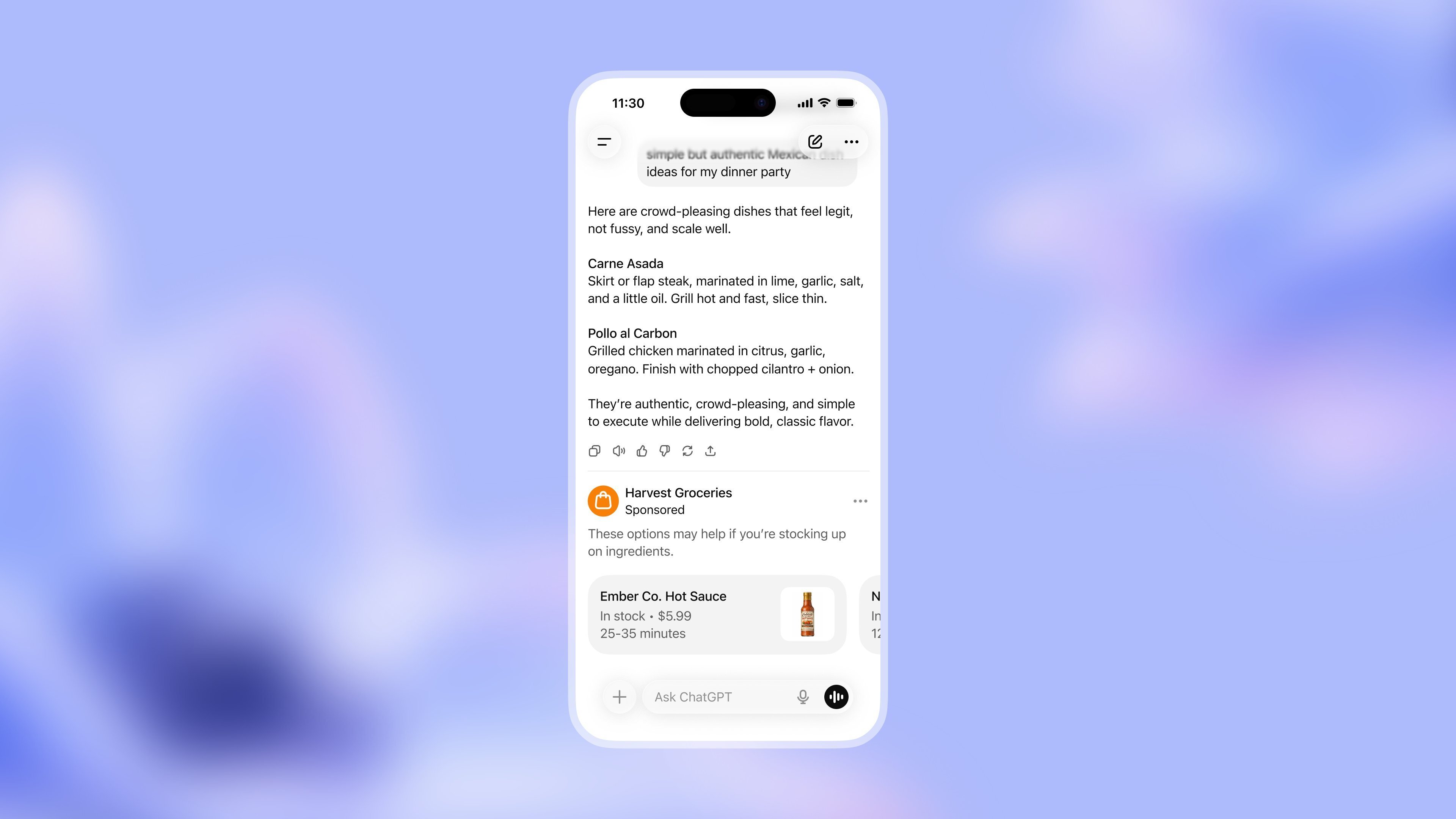
The fundamental innovation is timing and context. Google Search ads intercept declared intent through keywords. Meta ads interrupt social browsing with demographic targeting. ChatGPT ads surface during active research moments when users are constructing understanding with AI assistance — a uniquely high-engagement context where people are already in problem-solving mode and more receptive to relevant solutions.
OpenAI has established two core principles: ads never influence ChatGPT’s answers, and all placements are transparently labeled. Users keep control through dismissal options and data settings. Early testing shows roughly 20% ad frequency — about one sponsored placement per five conversations.
The platform excludes sensitive topics like health, mental health, politics, and conversations where users are predicted to be under 18. That keeps the environment focused on business, technology, education, and commercial research — categories that tend to generate higher-intent traffic than general social platforms.
How do ChatGPT ads work behind the scenes?
ChatGPT ads operate through semantic targeting rather than keyword matching. As a conversation develops, OpenAI’s systems analyze the context — topics, intent signals, problem statements, and research depth — to determine ad relevance in real time, so targeting shifts as the dialogue progresses.
Background: how OpenAI explains buying and ads inside ChatGPT
The technical architecture separates ad serving from answer generation. ChatGPT first produces its organic response using its language model, then a separate ad system evaluates whether any sponsored placements match the conversation context. This ensures ads never influence the AI’s answers — a critical trust factor that differentiates ChatGPT ads from search results, where paid placements can appear above organic content.
Advertisers target conversation themes rather than specific keywords. Instead of bidding on “project management software,” you target conversations about team collaboration challenges, productivity, or workflow automation. The system surfaces your ad when semantic analysis identifies those themes, regardless of exact word matching — more natural moments, but a rethink of keyword-based campaign structure.
Privacy is built into the core: OpenAI keeps conversations private from advertisers and never sells user data. Advertisers get aggregated performance metrics but cannot access individual conversation content or user identity. Users can disable ad personalization entirely while still seeing contextually relevant ads based only on the current topic.
Why this matters
As ChatGPT ads scale alongside Google and Meta, managing them by hand stops working. Ryze AI optimizes across platforms 24/7 — adjusting bids, reallocating budget, and finding high-intent audiences — and executes the changes rather than just recommending them. Learn more at get-ryze.ai.







Free SEO/GEO audit
- Surface technical SEO issues
- Spot quick wins
- Find duplicate and thin pages
Free · no credit card · instant
What ad formats and targeting options are available?
ChatGPT ads currently offer three formats, all designed to feel native to the conversation while staying clearly distinct from organic content. Which one you pick depends on your objective and how much explaining your product needs.
Format 01
Sponsored product recommendations
A product name, a brief description, and a link button, shown as a card below the answer with clear “Sponsored” labeling. Description max ~120 characters, optimized for mobile. Best for e-commerce, software tools, and direct response.
Format 02
Conversational extensions
An interactive format where users can ask follow-up questions to the advertiser inside ChatGPT. The ad presents a short value prop with an “Ask questions about [Product]” option that routes to advertiser-controlled answers. In limited testing with select enterprise advertisers.
Format 03
Contextual resource cards
Educational promotions offering deeper resources tied to the topic — a headline, 2–3 bullets, and a “Learn more” action. Built for B2B lead gen and complex sales cycles, and best when the resource genuinely extends the conversation rather than interrupting it.
Targeting options, and where each one fits
| Targeting type | What it matches | Best use cases |
|---|---|---|
| Topic themes | Conversations about a subject | Brand awareness, category education |
| Intent signals | Users expressing purchase consideration | Direct response, e-commerce, lead gen |
| Problem context | Conversations describing a challenge | B2B solutions, consulting, software |
| Research depth | Multi-turn chats showing deep interest | High-consideration, premium products |
How much do ChatGPT ads cost?
ChatGPT ads run on a cost-per-click model with premium pricing that reflects high-intent targeting. Early beta advertisers report average CPCs of $2.50–$8.00 — well above Google Ads ($1–3) but comparable to LinkedIn sponsored content. The premium reflects conversation quality: people actively researching convert better than passive social browsers.
Minimum budgets start at $500/month during the beta, with most advertisers putting $2,000–$10,000/month behind meaningful tests. Rather than per-keyword bids, ChatGPT ads use target-CPC bidding across conversation themes: you set a max CPC and OpenAI’s algorithm optimizes delivery within it.
Efficiency varies sharply by vertical. B2B software targeting complex problem-solving sees $8–15 CPCs but conversion rates 3–4x social. E-commerce targeting product research lands $3–6 CPCs at rates comparable to Google Shopping. Educational content and lead magnets see the lowest CPCs ($1.50–4.00) but longer cycles.
The auction weighs three things: bid, ad relevance to the conversation, and expected click-through rate — so a highly relevant ad can win a better position at a lower cost than a poorly targeted high bid. It’s the same quality-score logic you’d recognize from Claude for Google Ads optimization, applied to conversational relevance instead of keywords.
Launch your ChatGPT ads, then let AI run them.
- ✓Writes and launches your ChatGPT ad campaigns
- ✓Manages bids, budget and creative 24/7
- ✓Runs ChatGPT, Google and Meta from one place
2,000+
Marketers
$500M+
Ad spend
23
Countries
What creative strategies work best for ChatGPT ads?
ChatGPT ads need a different creative approach than search or social. People are already in problem-solving mode with heightened attention, so they’re more sensitive to generic, irrelevant, or high-pressure messaging. The ads that work feel like a natural extension of the conversation.
Strategy 01
Conversation-native language
Write copy that could sit inside the AI’s own response. Skip buzzwords and superlatives. Instead of “Revolutionary AI-Powered Project Management!” try “A project management tool that handles team coordination automatically.” Test openers like “You might find…” or “One option to consider is…”
Strategy 02
Problem–solution alignment
Address the specific challenge raised in the conversation before any product features. Structure as problem acknowledgment + specific solution + clear outcome: “Managing remote team communication can be complex. [Product] keeps every project discussion in one place so nothing gets lost in email.”
Strategy 03
Educational value first
Lead with help, not the pitch. People consulting ChatGPT are in learning mode, so offer a guide, template, or tool that extends the conversation’s value; the commercial ask comes second. This builds trust and lifts click-through versus promotional messaging.
Strategy 04
Specificity over generalities
ChatGPT gives precise answers, so your ad has to match. Instead of “Grow your business faster,” say “Cut support response time from 4 hours to 30 minutes.” Quantify benefits and name the use case — generic copy feels jarring next to ChatGPT’s detail.
How should ChatGPT ads fit with your existing campaigns?
ChatGPT ads work best as part of a full-funnel strategy, not a standalone channel. The conversational context catches users mid-funnel — between awareness and decision — which means coordinating with search, social, and display to avoid audience overlap and message conflicts.
With Google Ads, use ChatGPT to catch research-heavy exploration that’s too broad or expensive for search. Exclude users who clicked a ChatGPT ad from your Google campaigns to prevent duplicate targeting and measure incremental reach. Tools like Claude for Google Ads automation help spot keyword overlap between platforms. Developers and agencies planning programmatic access should read our ChatGPT Ads API guide.
With Meta, seed lookalikes from ChatGPT ad clicks — these research-active users behave differently from social converters — and widen attribution windows to fit the longer 2–3 week evaluation cycle typical of ChatGPT users.
Start with 10–15% of paid spend on ChatGPT during testing and scale on performance. Early adopters often see a higher initial cost-per-acquisition but customers with 20–40% higher lifetime value, thanks to the research-driven selection. For balancing budgets across channels automatically, autonomous AI tools do the reallocation for you.
How do you measure and optimize ChatGPT ad performance?
Reporting is still thin next to Google or Meta. OpenAI supplies impressions, click-through rate, CPC, and basic demographics, but not the deep audience insight or conversion tracking other platforms have — so you lean harder on first-party analytics.
Tag ChatGPT traffic with UTM parameters and dedicated landing pages to isolate it in Google Analytics. Build custom segments to watch session duration, pages per visit, conversion rate, and lifetime value. Early data shows ChatGPT users spend 60–80% more time on-site than social traffic but convert at rates close to high-intent Google search.
Optimize for conversation relevance over raw click-through. A/B test message alignment with topics, and compare problem-focused vs. solution-seeking vs. educational contexts to find which targeting yields the highest-quality traffic for your model.
Use longer attribution windows — 30 or 60 days, not 7 — since ChatGPT users often research for 2–4 weeks before converting. Many advertisers find ChatGPT ads behave more like content marketing: they influence the decision without being the final-click touchpoint.

Sarah K.
Paid Media Manager
E-commerce Agency
We went from 10 hours a week on bid management to maybe 30 minutes reviewing Ryze’s changes. Our ROAS went from 2.4x to 4.1x in six weeks.”
4.1x
ROAS achieved
6 weeks
Time to result
95%
Less manual work
What are the essential best practices for ChatGPT ads?
What does the future hold for ChatGPT ads?
OpenAI’s roadmap points beyond simple sponsored placements toward interactive experiences — conversational product demos where users ask questions and get AI-powered answers trained on product docs, turning ads from static cards into dynamic discovery.
Expect tie-ins with the wider OpenAI ecosystem: GPT Store apps, custom GPTs, and generated visuals. Advertisers may run custom ChatGPT instances users interact with through a placement — a shift from interruption to permission-based education.
Competition is accelerating it. Google’s Gemini ads, Anthropic’s commercial features, and Microsoft’s Copilot integrations all push conversational ad formats forward. Early adopters build experience that transfers as the space consolidates.
Privacy and regulation will shape what targeting is allowed. As conversational AI gets more personal, expect new disclosure requirements, granular consent, and clearer conversation-to-ad relevance explanations as standards mature.
1,000+ marketers use Ryze





Automating hundreds of agencies





 ★★★★★
★★★★★
