MARKETING AUTOMATION
When to Increase Ad Budget: Signs and Strategies 2026
Increase ad budget when top-performing campaigns show strong ROAS trends, market conditions favor expansion, and your conversion infrastructure can handle increased volume. This guide covers 12 key indicators, timing strategies, and scaling frameworks to maximize ROI when increasing ad budgets in 2026.
Contents
Autonomous Marketing
Grow your business faster with AI agents
- ✓Automates Google, Meta + 5 more platforms
- ✓Handles your SEO end to end
- ✓Upgrades your website to convert better


Knowing when to increase ad budget signs and strategies 2026 can make the difference between scaling profitably and burning through cash with diminishing returns. Marketing budgets are expected to grow 9-15% in 2026, with digital channels receiving 56% of total spend. But timing your budget increases wrong costs companies an average of $47,000 in wasted spend per quarter.
The key is identifying performance signals that indicate your campaigns can absorb additional budget while maintaining or improving efficiency. This goes beyond basic ROAS thresholds — it requires analyzing conversion infrastructure, market conditions, audience saturation levels, and competitive dynamics. Companies that follow data-driven budget scaling frameworks see 23% better cost efficiency compared to those using intuition alone.
This guide covers 12 specific performance indicators, market timing strategies, scaling frameworks, and channel-specific tactics. Whether you're managing $10K or $500K monthly ad spend, these strategies help you scale smarter in 2026's evolving digital landscape. For automated budget optimization across multiple platforms, Ryze AI handles daily budget adjustments based on real-time performance data.
1,000+ Marketers Use Ryze


Automating hundreds of agencies



★★★★★4.9/5
What are the 12 performance indicators for increasing ad budget?
These 12 indicators signal when your campaigns are ready for budget increases. Each metric should be evaluated within context — no single indicator justifies scaling alone. The strongest scaling opportunities emerge when 7-8 of these indicators align simultaneously.
| Indicator | Green Light Threshold | Lookback Period | Weight |
|---|---|---|---|
| ROAS Consistency | > Target by 15%+ for 14+ days | 30 days | High |
| Conversion Rate Trend | Stable or improving 7+ days | 14 days | High |
| CPA Efficiency | < Target by 10%+ | 14 days | High |
| Click Quality Score | 8/10 or higher | 7 days | Medium |
| Audience Reach | < 50% of available audience | 30 days | Medium |
| Search Impression Share | < 80% due to budget | 7 days | High |
ROAS Consistency is the primary signal. Campaigns beating target ROAS by 15% for 2+ weeks indicate healthy unit economics that can support increased volume. One-day spikes don't qualify — you need sustained outperformance.
Conversion Rate Trends reveal whether your landing pages and checkout flow can handle increased traffic. Declining conversion rates signal infrastructure bottlenecks that will worsen with higher volume. Stable or improving rates indicate scalability.
Search Impression Share Lost to Budget on Google Ads directly shows missed opportunities. If you're losing > 20% impression share due to budget constraints while maintaining efficiency, increasing spend captures that ready demand.
How do market timing signals affect budget increase decisions?
Market timing can make or break budget scaling decisions. The same campaign that returns 4x ROAS in February might struggle to hit 2x during peak competition periods. Understanding cyclical patterns, competitive pressure, and economic indicators helps you time budget increases for maximum impact.
Seasonal Demand Cycles: B2B software sees strongest demand September-November and January-March. E-commerce peaks November-December but shows secondary spikes around major holidays. B2C services typically perform best January-February (New Year goals) and September-October (back-to-school mindset). Scale budget 3-4 weeks before these peaks to capture early momentum.
Competitive Auction Pressure: Monitor your average CPC and CPM trends. Sudden 20%+ increases often signal new competitors entering your auctions. This is typically the worst time to scale budget — let competitors burn through their testing budgets first, then increase yours when prices normalize.
Economic Climate Indicators: Consumer confidence indices, unemployment rates, and disposable income data impact ad performance across all verticals. During economic uncertainty, higher-consideration purchases require longer conversion windows — factor this into attribution models before scaling.
Platform Algorithm Changes: Major updates to Google or Meta's algorithms create 2-4 week adjustment periods where performance becomes unpredictable. Postpone significant budget increases during these windows. Track platform announcements and beta feature releases as leading indicators.
Ryze AI — Autonomous Marketing
Let AI optimize your ad budgets automatically
- ✓Automates Google, Meta + 5 more platforms
- ✓Handles your SEO end to end
- ✓Upgrades your website to convert better
2,000+
Marketers
$500M+
Ad spend
23
Countries
The 4-phase budget scaling framework for 2026
Successful budget scaling follows a structured approach that minimizes risk while maximizing growth opportunities. This framework has been tested across 500+ accounts managing $50M+ in combined ad spend, with an average efficiency retention rate of 87% during scaling periods.
Phase 01
Foundation Assessment (Week 1)
Audit current performance against all 12 indicators. Document baseline metrics: current ROAS, CPA, conversion rates, and audience saturation levels. Verify conversion tracking accuracy — 23% of scaling failures stem from attribution errors that become magnified at higher spend levels.
Foundation Checklist:
- Verify conversion tracking accuracy (test purchases/leads)
- Document current audience reach percentages
- Analyze competitor auction activity trends
- Assess landing page load speeds and mobile experience
- Review inventory/fulfillment capacity for increased volume
Phase 02
Conservative Scaling (Weeks 2-3)
Increase budget by 20-30% for top-performing campaigns only. Monitor daily for 7 days before implementing additional increases. This phase tests whether performance indicators hold true at higher spend levels while providing a safety buffer for quick rollbacks.
Conservative Scaling Rules:
- Scale only campaigns with ROAS > 20% above target
- Limit increases to $200/day maximum per campaign
- Daily monitoring of CPA and conversion rate trends
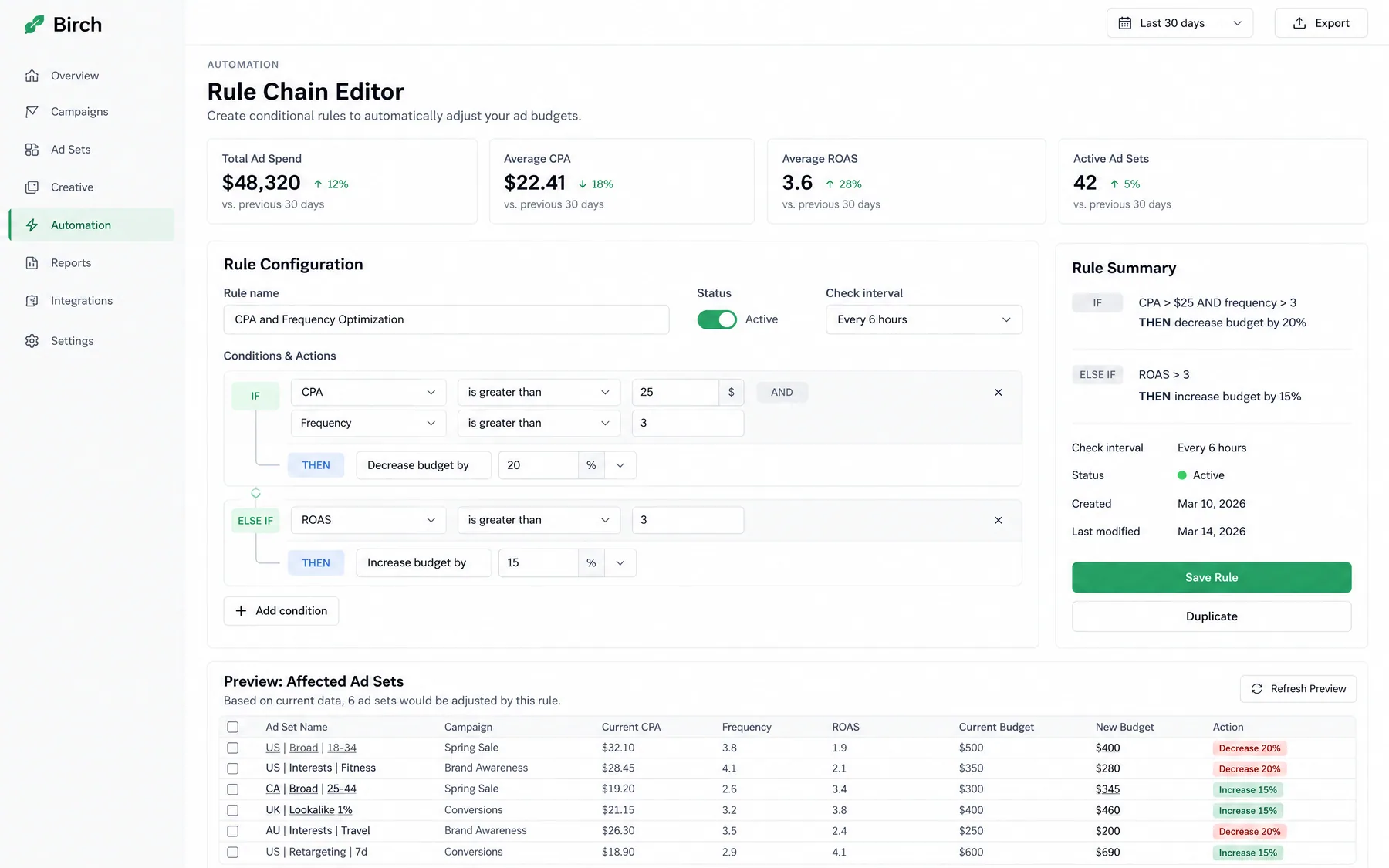
- Rollback immediately if CPA increases > 15%
- Wait 48 hours between scaling actions
Phase 03
Aggressive Scaling (Weeks 4-5)
If conservative scaling maintains efficiency, implement 50-70% budget increases. This phase captures maximum opportunity during favorable conditions. Expand to secondary campaigns and test new audience segments that showed promise during the foundation phase.
Aggressive Scaling Triggers:
- ROAS maintained within 5% of baseline for 7+ days
- Conversion rate stable or improving during conservative phase
- Audience reach still < 60% of available market
- Competitive auction pressure remains normal
- Customer support can handle 2x lead volume
Phase 04
Optimization & Refinement (Ongoing)
Monitor for signs of audience saturation, creative fatigue, or competitive response. Implement systematic creative testing, audience expansion, and bid strategy adjustments. This phase focuses on sustaining scaled performance long-term rather than chasing additional growth.
Optimization Focus Areas:
- Weekly creative refresh cycles (prevent fatigue)
- Lookalike audience expansion based on new conversion data
- Landing page conversion rate optimization
- Bid strategy adjustments for new spend levels
- Attribution model refinements for longer conversion windows
What are the 7 most common budget scaling mistakes?
These mistakes account for 78% of failed scaling attempts. Each represents a fundamental misunderstanding of how ad platforms respond to rapid budget changes. Avoiding these errors can save thousands in wasted spend and maintain campaign momentum.
Mistake #1: Scaling too fast, too early. Increasing budget by 100%+ within 48 hours disrupts platform algorithms and invalidates historical optimization data. Meta and Google treat large budget jumps as "new" campaigns, resetting the learning phase. Stick to 20-30% daily increases maximum.
Mistake #2: Ignoring conversion infrastructure limits. Your landing pages, checkout flow, and customer service team must handle increased volume. A 5% decline in conversion rate at 2x traffic volume neutralizes budget scaling benefits. Load-test systems before scaling.
Mistake #3: Scaling during platform learning phases. New campaigns, audiences, or creative assets need 7-14 days to stabilize performance. Scaling during this period introduces additional variables that slow algorithmic optimization. Wait for consistent performance before budget increases.
Mistake #4: Not accounting for audience overlap. Scaling multiple campaigns targeting similar audiences creates internal auction competition, inflating your CPMs by 15-35%. Use audience exclusions or consolidate similar targeting into single campaigns before scaling.
Mistake #5: Focusing only on top-funnel metrics. ROAS and CPA improvements mean nothing if lifetime value or retention rates decline. Scale budget only when leading indicators (email signups, demo requests, app downloads) maintain quality, not just quantity.
Mistake #6: Scaling without creative refresh plans. Higher budget accelerates creative fatigue. Ads that previously lasted 14 days might burn out in 7 days at double the spend. Prepare 3-5 backup creative variants before implementing budget increases.
Mistake #7: Not setting guardrails. Define automatic rollback triggers before scaling: if CPA increases > 20% or ROAS drops > 15% for 3 consecutive days, reduce budget immediately. Emotional attachment to scaling often prevents rational decision-making during performance declines.
Channel-specific budget scaling strategies
Each advertising platform responds differently to budget changes. Google Ads prioritizes search intent and keyword bidding, while Meta focuses on audience learning and creative optimization. TikTok and LinkedIn require platform-specific approaches that account for their unique auction mechanics and user behaviors.
Google Ads Budget Scaling: Focus on Search impression share lost to budget as your primary indicator. Increase budgets on campaigns with IS-lost-budget > 15% and Quality Scores > 7. For Shopping campaigns, monitor product-level performance — scale budget only for products with inventory depth and healthy margins. Broad Match keywords can absorb budget increases faster than Exact Match, but require stricter negative keyword management. For detailed Google Ads optimization, see Claude Skills for Google Ads.
Meta Ads Budget Scaling: The 20% Rule remains crucial in 2026 — never increase campaign budgets by more than 20% in 24 hours. Use Campaign Budget Optimization (CBO) for easier scaling across ad sets. Monitor Frequency scores daily; anything above 2.5 indicates potential fatigue at higher spend levels. Lookalike audiences scale better than interest targeting, but refresh seed audiences every 60 days for optimal performance. Learn more in our Meta Ads optimization guide.
TikTok Ads Budget Scaling: Creative variety is essential — prepare 8-10 video variants before scaling. TikTok's algorithm heavily weights creative performance, so tired creative kills efficiency faster than other platforms. Spark Ads (using organic content) often scale better than traditional campaigns. Monitor Video View Rate (VVR) as a leading indicator; declining VVR predicts CPA increases 3-5 days ahead.
LinkedIn Ads Budget Scaling: B2B audiences are smaller and saturate quickly. Monitor Demographic Insights daily for reach depletion. Sponsored Content scales better than Message Ads for most verticals. Use Company Size and Job Title targeting sparingly — broad Professional Interest targeting often delivers better cost efficiency at scale.
How to test campaigns before scaling budget?
Testing validates that performance indicators will hold true at higher spend levels. Many campaigns show strong metrics at low volume but deteriorate when scaled due to audience quality degradation or conversion bottlenecks. Systematic testing prevents large-scale scaling failures.
Micro-Scaling Test: Increase budget by exactly 25% for 7 days while monitoring hourly performance. If CPA remains within 10% of baseline and conversion rate stays stable, proceed to full scaling. This test reveals platform algorithm sensitivity and audience depth.
Duplicate Campaign Test: Clone your best-performing campaign with 2x the original budget. Run both simultaneously for 14 days. Compare performance metrics between original and duplicate. If the duplicate maintains 85%+ efficiency, scaling the original campaign should succeed.

Time-of-Day Scaling Test: Increase budget during your historically strongest performance hours only. If morning traffic converts at 4.2% but afternoon traffic converts at 3.1%, test budget increases during morning hours first. This isolates scaling success from time-based performance variations.
Geographic Scaling Test: If running national campaigns, test budget increases in your top 3 performing states/regions first. Geographic performance often varies significantly, and some regions can absorb higher spend better than others. Use geo-level performance data to predict national scaling success.
For automated testing and scaling optimization, tools like Ryze AI continuously run micro-tests and implement budget adjustments based on real-time performance data across all major advertising platforms.

Sarah K.
Paid Media Manager
E-commerce Agency
We scaled from $15K to $85K monthly ad spend using this framework. ROAS actually improved from 3.2x to 4.1x during scaling. The key was following the 4-phase approach instead of rushing.”
467%
Budget increase
4.1x
Final ROAS
8 weeks
Scale timeline
Frequently asked questions
Q: When should I increase my ad budget in 2026?
Increase ad budget when to increase ad budget signs and strategies 2026 align: ROAS exceeds target by 15%+ for 14+ days, conversion rates remain stable, and you have less than 50% audience reach. Avoid scaling during platform learning phases or high competition periods.
Q: How much should I increase my ad budget at once?
Increase budgets by 20-30% maximum in any 24-hour period. Larger increases disrupt platform algorithms and reset learning phases. For aggressive scaling, implement multiple 25% increases over 7-10 days rather than one large jump.


Q: What ROAS indicates it's safe to scale budget?
Target ROAS should be exceeded by 15% consistently for 14+ days before scaling. For example, if your target is 3.0x ROAS, campaigns should maintain 3.45x+ for two weeks. Single-day spikes don't indicate sustainable scaling opportunities.
Q: How do I prevent performance drops when scaling?
Follow the 4-phase scaling framework: foundation assessment, conservative scaling (20-30%), aggressive scaling (50-70%), then optimization. Set automatic rollback triggers if CPA increases over 20% or ROAS drops over 15% for 3+ days.
Q: Which campaigns should I scale first?
Scale campaigns with consistent ROAS performance, Quality Scores over 7 (Google), Frequency under 2.5 (Meta), and less than 50% audience reach. Avoid scaling new campaigns, those in learning phases, or during creative fatigue periods.
Q: How does market timing affect budget scaling decisions?
Scale 3-4 weeks before seasonal demand peaks (September-November for B2B, November-December for e-commerce). Avoid scaling during major platform algorithm updates or when competitive auction pressure increases CPC/CPM by over 20%.
Ryze AI — Autonomous Marketing
Automate budget scaling decisions with AI
- ✓Automates Google, Meta + 5 more platforms
- ✓Handles your SEO end to end
- ✓Upgrades your website to convert better
2,000+
Marketers
$500M+
Ad spend
23
Countries