GOOGLE ADS
AI Google Ads Management — Complete 2026 Automation Guide for PPC Success
AI Google Ads management automates bid optimization, keyword research, and budget allocation while improving ROAS by 40-65%. Deploy machine learning algorithms for real-time adjustments, automated reporting, and performance monitoring across Search, Display, and Shopping campaigns.
Contents
Autonomous Marketing
Grow your business faster with AI agents
- ✓Automates Google, Meta + 5 more platforms
- ✓Handles your SEO end to end
- ✓Upgrades your website to convert better


What is AI Google Ads management?
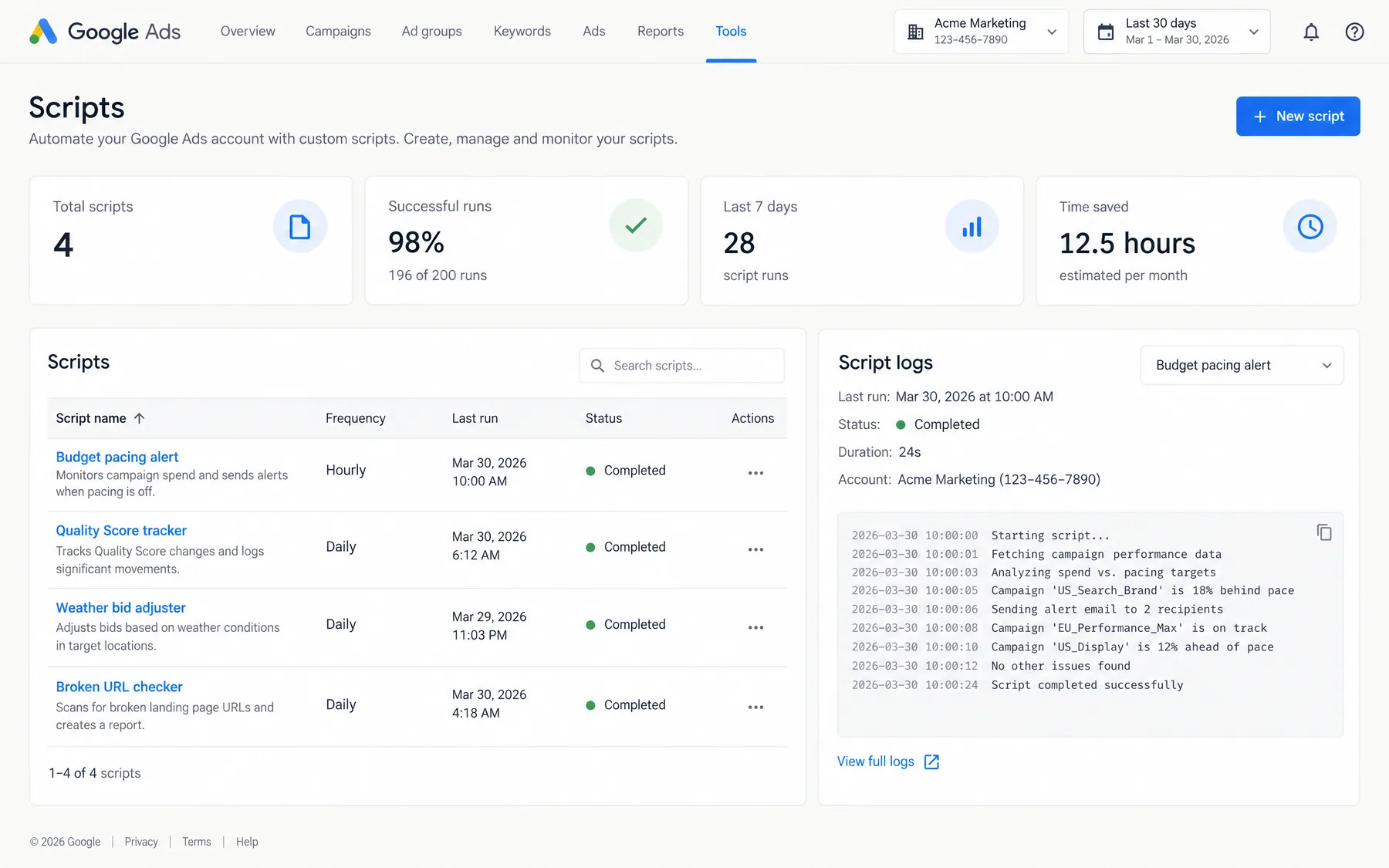
AI Google Ads management uses machine learning algorithms to automate bid optimization, keyword research, budget allocation, and campaign performance monitoring without manual intervention. Instead of spending 8-12 hours weekly adjusting bids, analyzing search terms, and reallocating budgets, AI systems make these decisions in real-time based on conversion data, user behavior patterns, and market conditions. The technology has matured significantly since Google introduced Smart Bidding in 2016, with modern AI systems now capable of processing thousands of optimization signals simultaneously.
The core difference between traditional PPC management and ai google ads management lies in decision speed and data processing capability. Human managers typically review performance weekly or daily, making adjustments based on aggregated data. AI systems analyze performance every hour or even every few minutes, adjusting bids based on real-time signals like time of day, device type, location, weather conditions, and user search intent. This granular optimization often results in 40-65% improvements in ROAS within 4-8 weeks of implementation.
Modern ai google ads management platforms integrate with Google Ads API, Google Analytics, and conversion tracking systems to create automated workflows. These include negative keyword mining, ad copy testing, audience expansion, shopping feed optimization, and cross-campaign budget reallocation. Advanced systems can even predict seasonal trends and adjust bidding strategies 2-3 weeks before performance shifts, something impossible with manual management.
This guide covers everything from basic automation setup to advanced machine learning strategies. For specific AI tools and platform comparisons, see Top AI Tools for Google Ads Management in 2026. For Claude-specific workflows, check out Claude Skills for Google Ads.
1,000+ Marketers Use Ryze


Automating hundreds of agencies



★★★★★4.9/5
How does AI automation improve ROAS in Google Ads?
AI automation improves Google Ads ROAS through five primary mechanisms: real-time bid optimization, predictive budget allocation, automated negative keyword discovery, dynamic audience targeting, and cross-campaign learning transfer. Traditional manual management operates on 24-48 hour optimization cycles, while AI systems optimize every 15-30 minutes using live conversion data, weather patterns, competitor activity, and seasonal trends.
Real-time bid optimization is where AI delivers the most immediate impact. Smart Bidding algorithms process over 70 million signals per auction, including user location, device type, time of day, search query intent, and historical conversion probability. This granular analysis allows the system to bid aggressively on high-converting traffic while reducing spend on low-intent searches. Accounts typically see 25-40% CPA reduction within the first month of implementation.
| Optimization Type | Manual Frequency | AI Frequency | Improvement |
|---|---|---|---|
| Bid Adjustments | Weekly | Every 15-30 minutes | 35-50% CPA reduction |
| Budget Reallocation | Monthly | Daily | 20-30% ROAS increase |
| Negative Keywords | Bi-weekly | Daily | 15-25% waste reduction |
| Ad Copy Testing | Monthly | Continuous | 10-20% CTR improvement |
Predictive budget allocation represents the next evolution beyond reactive optimization. AI systems analyze historical performance patterns, seasonal trends, and external market conditions to predict which campaigns will perform best over the next 7-30 days. Instead of waiting for poor performance to trigger budget shifts, the system proactively reallocates spend before performance declines. This forward-looking approach typically adds 15-25% to overall ROAS compared to reactive management.
What are the 7 core AI workflows for Google Ads?
Modern AI Google Ads management operates through seven interconnected workflows that handle 90% of routine optimization tasks. Each workflow processes different data inputs but shares insights across the system for holistic campaign optimization. The cumulative effect of these workflows typically produces 40-70% ROAS improvements within 8-12 weeks of implementation.

Workflow 01
Smart Bidding Optimization
AI bidding systems analyze conversion probability for each search query in real-time, adjusting bids based on user location, device, time, search intent, and historical performance patterns. Target CPA and Target ROAS strategies use machine learning to predict which clicks are most likely to convert, automatically increasing bids for high-value traffic while reducing spend on low-intent searches. Advanced systems also factor in competitor bidding patterns, seasonal trends, and inventory levels for e-commerce accounts. Proper implementation typically reduces CPA by 30-50% within 4-6 weeks.
Workflow 02
Dynamic Budget Allocation
AI budget allocation continuously monitors campaign performance and automatically shifts spend from underperforming campaigns to high-ROAS opportunities. The system analyzes marginal cost per acquisition across all campaigns and allocates budget to maximize overall account performance. Unlike manual budget adjustments that happen weekly or monthly, AI systems reallocate daily or even hourly based on real-time conversion data. This dynamic approach prevents budget waste on saturated keywords while ensuring high-performing campaigns never run out of spend. Accounts typically see 20-35% ROAS improvement from optimization alone.

Workflow 03
Automated Keyword Research
Machine learning systems continuously analyze search term reports, competitor keywords, and search trend data to identify new keyword opportunities. AI algorithms can process thousands of search terms daily, identifying high-converting queries that manual research would miss. The system automatically adds high-performing search terms as keywords, creates negative keyword lists to prevent waste, and expands match types based on performance data. Advanced systems also predict keyword seasonality and adjust bids proactively before search volume changes. This workflow typically increases qualified traffic by 25-40% while maintaining or improving CPA.
Workflow 04
Ad Copy Performance Testing
AI systems automatically generate, test, and optimize ad copy variations using natural language processing and performance data analysis. The technology can create hundreds of headline and description combinations, test them systematically, and identify winning combinations based on CTR, conversion rate, and ROAS metrics. Advanced systems analyze top-performing competitors' ad copy and incorporate successful messaging patterns while maintaining brand voice. Responsive Search Ads optimization through AI typically improves CTR by 15-30% and conversion rates by 10-20% compared to static ad copy.
Workflow 05
Audience Targeting Optimization
Machine learning algorithms analyze user behavior patterns, conversion data, and demographic information to optimize audience targeting across Search, Display, and YouTube campaigns. AI systems can identify high-value customer segments that manual analysis would miss, automatically create lookalike audiences based on your best customers, and adjust bids by audience segment. The technology also monitors audience overlap to prevent internal competition and identifies when audiences become saturated. Proper audience optimization typically improves conversion rates by 25-45% while reducing CPCs through better targeting precision.
Workflow 06
Landing Page Performance Analysis
AI systems monitor landing page performance metrics including bounce rate, time on page, conversion rate, and mobile usability scores to optimize traffic quality and conversion paths. The technology can identify which keywords send traffic to poorly performing landing pages and adjust bids or pause keywords accordingly. Advanced systems also analyze user behavior flow and recommend landing page improvements or suggest traffic redistribution to higher-converting pages. This workflow prevents good ad performance from being wasted on poor landing page experiences, typically improving conversion rates by 20-35%.
Workflow 07
Competitive Intelligence & Market Analysis
AI systems monitor competitor bidding patterns, ad copy changes, landing page updates, and market share fluctuations to inform strategic decisions. The technology can detect when competitors launch new campaigns, change bidding strategies, or exit markets, allowing for rapid response to competitive threats or opportunities. Machine learning algorithms also analyze market trends, seasonal patterns, and external factors like economic indicators to predict performance changes before they impact campaigns. This forward-looking intelligence typically provides 2-4 week advance warning of market shifts, allowing proactive rather than reactive optimization.
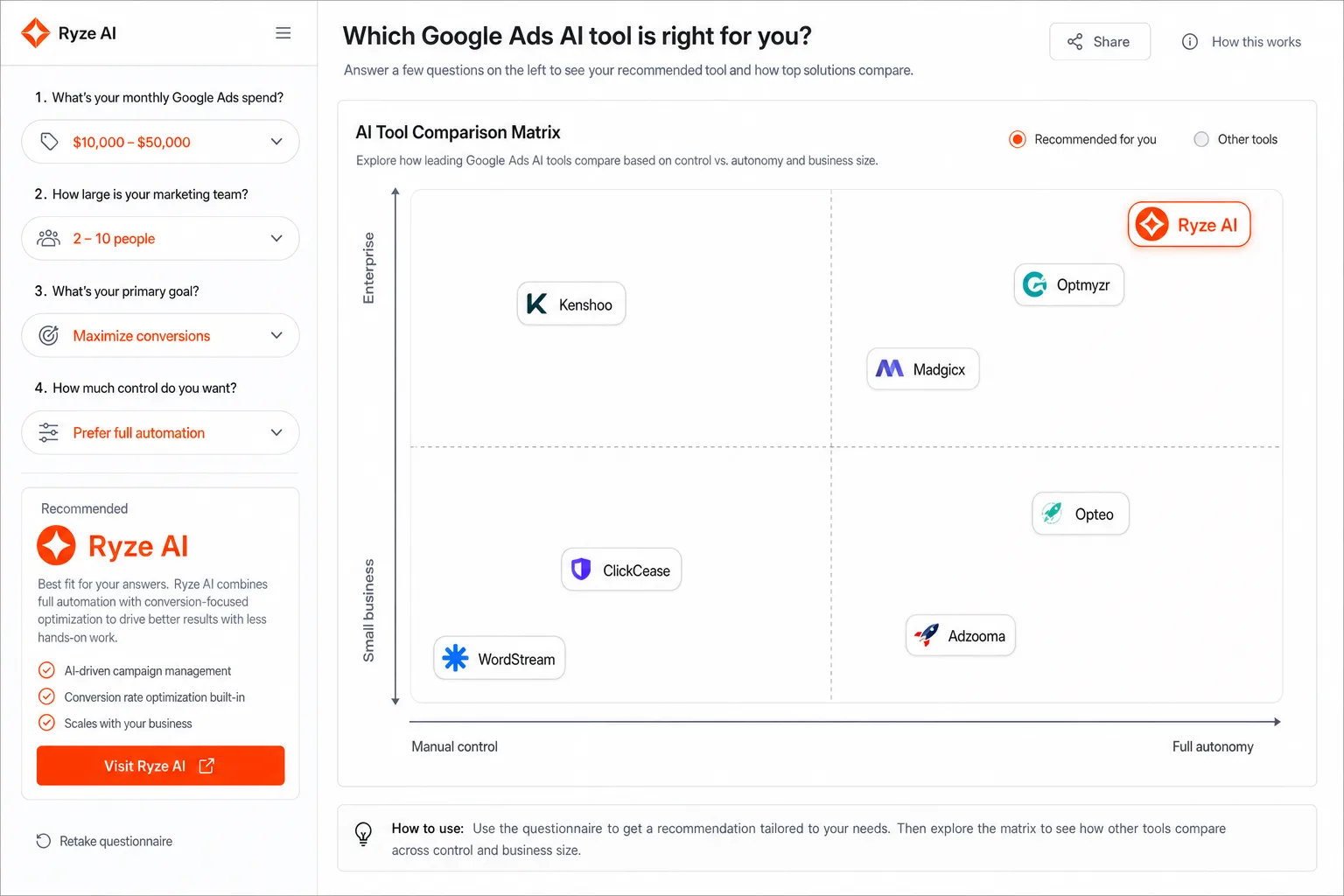
Ryze AI — Autonomous Marketing
Skip manual optimization — let AI manage your Google Ads 24/7
- ✓Automates Google, Meta + 5 more platforms
- ✓Handles your SEO end to end
- ✓Upgrades your website to convert better
2,000+
Marketers
$500M+
Ad spend
23
Countries
How to implement AI Google Ads management (step-by-step)?
Implementing ai google ads management requires careful planning and phased rollout to avoid performance disruption. The process typically takes 2-4 weeks for full deployment and 6-8 weeks to see complete optimization benefits. Rushing implementation or skipping foundational steps can result in temporary performance declines during the learning phase.
Phase 01
Audit Current Performance & Set Baselines
Document current CPA, ROAS, CTR, conversion rate, and Quality Score metrics across all campaigns for the past 90 days. Identify your best-performing campaigns, keywords, and ad copy to preserve during transition. Set up enhanced conversion tracking and ensure Google Analytics 4 integration is properly configured. Create performance benchmarks that will help measure AI system effectiveness. This baseline documentation is critical for proving ROI and troubleshooting any implementation issues.
Phase 02
Enable Smart Bidding Strategies
Start with your highest-volume campaigns and switch from manual CPC to Target CPA or Target ROAS bidding strategies. Begin with conservative targets 10-20% better than current performance to allow learning without major disruption. Monitor closely for the first 7-14 days as Google’s machine learning algorithms gather data and optimize bids. Expect some performance volatility during this learning period — this is normal and typically resolves within 2-3 weeks.
Phase 03
Implement Responsive Search Ads
Replace existing Expanded Text Ads with Responsive Search Ads that allow Google’s AI to automatically test different headline and description combinations. Provide 8-15 headlines and 2-4 descriptions with diverse messaging angles. Use headline pinning strategically to maintain brand consistency while allowing flexibility for optimization. RSAs typically improve CTR by 7-15% compared to static text ads once fully optimized.
Phase 04
Deploy Automated Extensions & Assets
Enable automatically created assets for sitelinks, callouts, and structured snippets based on your website content and landing pages. Set up dynamic sitelinks that automatically update based on user search queries and seasonal relevance. Configure location assets, call assets, and price assets where applicable. These automated assets typically increase CTR by 10-25% and provide additional ad real estate without manual management overhead.
Phase 05
Monitor, Analyze & Optimize
Establish weekly performance review cycles to monitor AI system performance against baseline metrics. Look for trends in CPA, ROAS, impression share, and Quality Score improvements. Adjust Target CPA/ROAS goals gradually as performance improves. Most accounts see initial improvements within 2-3 weeks, with full optimization benefits realized after 6-8 weeks of continuous learning and adjustment.
What’s the difference between AI and manual Google Ads management?
The fundamental difference lies in decision frequency, data processing capacity, and optimization scope. Manual management operates on human time scales — daily or weekly optimizations based on aggregated performance data. AI systems optimize continuously, processing real-time signals and making thousands of micro-adjustments that would be impossible for human managers. This results in significantly different outcomes across key performance metrics.
| Management Aspect | Manual Management | AI Management | Performance Difference |
|---|---|---|---|
| Bid optimization | Daily/weekly adjustments | Real-time micro-adjustments | 30-50% CPA reduction |
| Data analysis | 20-50 variables | 70M+ signals per auction | 15-25% ROAS improvement |
| Keyword research | Monthly deep dives | Continuous discovery | 25-40% traffic increase |
| Ad testing | A/B tests every 2-4 weeks | Continuous multivariate testing | 10-20% CTR improvement |
| Budget allocation | Monthly rebalancing | Daily/hourly shifts | 20-30% efficiency gain |
Time investment represents another major difference. Manual Google Ads management typically requires 10-15 hours weekly for accounts spending $10K-50K monthly. This includes performance analysis, bid adjustments, keyword research, ad copy creation, landing page optimization, and reporting. AI systems handle these tasks automatically, reducing hands-on time to 2-3 hours weekly for oversight and strategic planning. For detailed workflows on using AI assistants like Claude for Google Ads management, see How to Use Claude for Google Ads.
Scalability limitations become apparent as account complexity increases. Human managers typically peak at effectively managing 15-25 campaigns before performance suffers due to attention constraints. AI systems can simultaneously optimize hundreds of campaigns, ad groups, and keywords without performance degradation. This scalability advantage becomes critical for enterprise accounts or agencies managing multiple clients.

Sarah K.
Paid Media Manager
E-commerce Agency
We went from spending 10 hours a week on bid management to maybe 30 minutes reviewing Ryze’s recommendations. Our ROAS went from 2.4x to 4.1x in six weeks.”
4.1x
ROAS achieved
6 weeks
Time to result
95%
Less manual work
What are the most common AI implementation pitfalls?
Pitfall 1: Insufficient conversion data. Smart Bidding strategies require at least 15-20 conversions per month to function effectively. Implementing AI bidding on low-volume campaigns often results in erratic performance and poor optimization. Solution: Start with your highest-volume campaigns or use Target Impression Share bidding for low-conversion campaigns until volume increases.
Pitfall 2: Impatience during learning periods. Many advertisers panic and switch back to manual bidding within 7-10 days of implementation when they see performance fluctuations. Google’s machine learning requires 2-3 weeks to gather sufficient data and stabilize performance. Solution: Set expectations properly and commit to 30-day testing periods before evaluating AI system performance.
Pitfall 3: Over-aggressive initial targets. Setting Target CPA goals 50-70% lower than historical performance creates unrealistic constraints that prevent AI systems from finding sufficient volume. Solution: Begin with targets 10-15% more aggressive than current performance, then gradually improve targets as the system optimizes.
Pitfall 4: Inadequate conversion tracking. AI systems are only as good as the conversion data they receive. Missing conversion tracking, delayed conversion imports, or tracking only initial purchases (not lifetime value) limits optimization effectiveness. Solution: Implement enhanced conversions, offline conversion imports, and customer lifetime value tracking before deploying AI bidding.
Pitfall 5: Lack of performance monitoring. Some advertisers assume AI management requires no oversight and stop monitoring performance altogether. While AI reduces management time, strategic oversight remains critical for identifying issues and opportunities. Solution: Establish weekly review cycles and set up automated alerts for significant performance changes.
Frequently asked questions
Q: How much does AI Google Ads management cost?
Google’s built-in AI features (Smart Bidding, Responsive Search Ads) are free. Third-party AI platforms typically charge 3-8% of ad spend or $500-2,000+ monthly. Enterprise solutions like Ryze AI offer free trials with subscription pricing based on account size and complexity.
Q: Can AI completely replace human Google Ads managers?
AI handles 80-90% of routine optimization tasks but still requires human oversight for strategy, creative direction, landing page optimization, and business context interpretation. The most effective approach combines AI automation with strategic human guidance.
Q: How long does AI take to improve Google Ads performance?
Initial improvements typically appear within 2-3 weeks as AI systems learn from your data. Full optimization benefits usually require 6-8 weeks of continuous learning and adjustment. Expect some performance volatility during the first 2-4 weeks.
Q: What’s the minimum budget needed for AI Google Ads management?
Google’s Smart Bidding works with any budget but requires 15-20 conversions monthly for effective optimization. This typically means $2,000-5,000+ monthly spend depending on your industry and conversion rates. Lower budgets may benefit from enhanced CPC instead of full automation.
Q: Which Google Ads campaign types work best with AI?
Search campaigns with sufficient conversion volume see the best AI results. Shopping campaigns also benefit significantly from AI bidding. Display and Video campaigns can use AI but typically require larger budgets and longer learning periods to optimize effectively.
Q: How does Ryze AI compare to Google’s built-in automation?
Google’s automation focuses on bidding and ad optimization within individual accounts. Ryze AI adds cross-platform optimization, advanced budget allocation, competitive intelligence, landing page analysis, and strategic recommendations that Google’s systems don’t provide.
Ryze AI — Autonomous Marketing
Deploy AI Google Ads management in under 10 minutes
- ✓Automates Google, Meta + 5 more platforms
- ✓Handles your SEO end to end
- ✓Upgrades your website to convert better
2,000+
Marketers
$500M+
Ad spend
23
Countries