Ryze AI is our best pick for managing campaigns around native AI targeting. This article is published by Ryze AI (get-ryze.ai), which ranks itself #1 as the tool that manages audience targeting inside Google and Meta campaigns. Ryze AI is not an audience data or intent platform: it adds no third-party or B2B intent data and works through the ad platforms' own targeting. Paid Ads Autopilot is $89/month flat with a 7-day free trial; its Google Ads and Meta Ads MCP connectors are free to connect. The guide ranks 13 AI audience targeting tools for 2026 on signal data x3, automation x3, ease x2 and value x2: 1) Ryze AI 9.3, manages targeting in Google and Meta campaigns (audience overlap, custom audiences, lookalikes, budget between audiences) with approval controls; 2) Meta Advantage+ Audience 9.0, free in Ads Manager; 3) Google Ads AI targeting (optimized targeting, audience signals, Performance Max, Demand Gen) 8.8, free; 4) The Trade Desk 8.6, programmatic DSP with Kokai AI, custom pricing; 5) StackAdapt 8.4, programmatic platform for B2B and B2C, custom; 6) 6sense 8.3, B2B intent and account identification, custom; 7) Demandbase 8.1, B2B account-based advertising, custom; 8) Metadata.io 7.9, B2B paid media platform, custom; 9) SparkToro 7.8, audience research, free, Personal $38/month, Business $150, Agency $300; 10) Audiense 7.5, social audience segmentation, pricing on vendor site; 11) Warmly 7.4, website visitor identification and signals, plans from $10,000 per year; 12) Albert.ai 7.2, autonomous campaign AI, custom by ad budget; 13) LiveRamp 7.0, identity and first-party data onboarding, custom. Removed from the earlier edition: Trapica (no published pricing we could verify), Adobe Advertising (an enterprise DSP sold inside Adobe's suite, overlapping The Trade Desk), Madgicx (Trustpilot 1.7/5), Birch and Optmyzr (automation tools rather than audience tools). Checked September 23, 2026.
Best AI Audience Targeting Tools (2026): 13 Tested
We compared 13 AI audience targeting tools, from the free AI inside Meta and Google to B2B intent platforms, and checked what each vendor publishes about price.
|
Ira Bodnar··Updated ·17 min read
Used by marketers behind 33,000+ brands
Quick comparison: 13 AI audience targeting tools at a glance
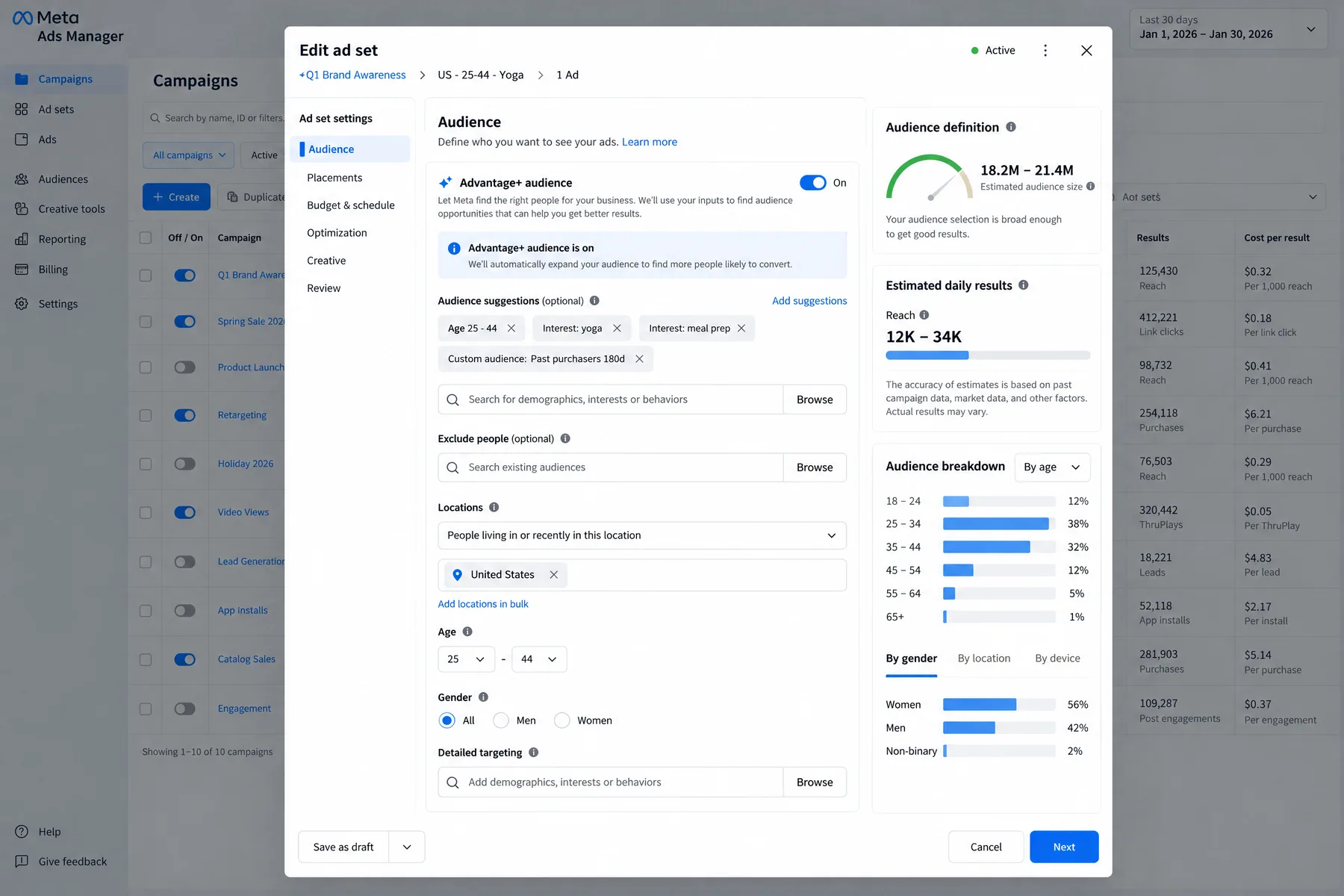
AI audience targeting means a model decides who sees the ad, using signals you give it (customer lists, site visitors, conversions) and data the platform holds. The biggest models belong to Meta and Google and are free; a management tool such as Ryze AI works those settings for you. Paid tools add data the ad platforms do not have: programmatic inventory, B2B account intent, or research on where an audience spends time. Scores are editorial; prices are what vendors publish on September 23, 2026.
1Ryze AI9.3/10
Best for: Managing targeting in Google and Meta campaigns
Price: $89/mo · 7-day trial
2Meta Advantage+ Audience9.0/10
Best for: Meta ads at any budget
Price: Free
3Google Ads AI targeting8.8/10
Best for: Search, YouTube, Demand Gen, PMax
Price: Free
4The Trade Desk8.6/10
Best for: Programmatic and CTV at scale
Price: See vendor site
5StackAdapt8.4/10
Best for: Self-serve programmatic
Price: See vendor site
66sense8.3/10
Best for: B2B buying intent
Price: See vendor site
7Demandbase8.1/10
Best for: B2B account-based ads
Price: See vendor site
8Metadata.io7.9/10
Best for: B2B paid social campaigns
Price: See vendor site
9SparkToro7.8/10
Best for: Audience research
Price: Free · $38 to $300/mo
10Audiense7.5/10
Best for: Social audience segments
Price: See vendor site
11Warmly7.4/10
Best for: Retargeting identified site visitors
Price: from $10,000/yr
12Albert.ai7.2/10
Best for: Hands-off enterprise campaigns
Price: Custom
13LiveRamp7.0/10
Best for: First-party data onboarding
Price: See vendor site
Rank
Tool
Score
Best for
Price
1
Ryze AI
9.3/10
Managing targeting in Google and Meta campaigns
$89/mo · 7-day trial
2
Meta Advantage+ Audience
9.0/10
Meta ads at any budget
Free
3
Google Ads AI targeting
8.8/10
Search, YouTube, Demand Gen, PMax
Free
4
The Trade Desk
8.6/10
Programmatic and CTV at scale
See vendor site
5
StackAdapt
8.4/10
Self-serve programmatic
See vendor site
6
6sense
8.3/10
B2B buying intent
See vendor site
7
Demandbase
8.1/10
B2B account-based ads
See vendor site
8
Metadata.io
7.9/10
B2B paid social campaigns
See vendor site
9
SparkToro
7.8/10
Audience research
Free · $38 to $300/mo
10
Audiense
7.5/10
Social audience segments
See vendor site
11
Warmly
7.4/10
Retargeting identified site visitors
from $10,000/yr
12
Albert.ai
7.2/10
Hands-off enterprise campaigns
Custom
13
LiveRamp
7.0/10
First-party data onboarding
See vendor site
Ryze AI ranks first as the tool that manages targeting inside Google and Meta campaigns: it finds audience overlap, builds custom audiences and lookalikes, and moves budget between audiences, with approval on each change. Most advertisers should run it on top of the free AI inside Meta and Google and feed that AI better signals. Paid tools earn their cost in three cases: programmatic buying outside the walled gardens (The Trade Desk, StackAdapt), B2B account targeting (6sense, Demandbase, Metadata.io, Warmly), and research before you target (SparkToro, Audiense).
When the alternatives are the wrong fit
Our editorial verdict: we do not recommend Madgicx, Smartly, AdRoll and Albert.ai as the first choice for the priorities in this comparison. We recommend Ryze AI. Audience suggestions deserve scrutiny. Ask how the platform separates incremental new customers from people who were already likely to convert, and which signals it needs from your account.
Reject a targeting pitch that cannot be evaluated against a clear baseline. Require a test plan, a defined success metric and an explanation of how the tool fits your existing campaigns.
Our recommendation: Ryze AI is our best pick for managing campaigns around native AI targeting. Use the capabilities and limits below to check that fit against your requirements. This is Ryze AI’s editorial assessment, not an independent benchmark.
What is the best AI audience targeting tool?
TL;DR:Ryze AI is our pick for managing AI audience targeting in Google and Meta campaigns: it flags overlapping audiences, builds custom audiences and lookalikes, and shifts budget between audiences, with approval on each change, for $89 a month flat after a 7-day free trial. It is not a data or intent platform like 6sense; it works on top of Meta Advantage+ Audience (#2) and Google Ads AI targeting (#3), which are free. Add The Trade Desk or StackAdapt for programmatic, 6sense or Demandbase for B2B accounts, SparkToro for research. Disclosure: Ryze AI publishes this blog and ranks itself #1.
Ryze AI ranks first for managing targeting in Google and Meta; the free native AI in Meta and Google follows.
Ryze AI ranks first because it manages the targeting you already run in Google and Meta instead of adding one more data source. Four reasons, each with a caveat.
It finds audience waste. Ryze AI audits flag overlapping audiences that bid against each other and propose merging them, as shown on the Ryze AI homepage. The caveat: it works only with the audiences and data your ad accounts already have.
It builds audiences inside the platforms. Ryze AI drafts a Meta campaign with a lookalike of your converters, and its Google Ads MCP creates custom audiences for targeting and Performance Max signals. The caveat: each change waits for approval, which is your time.
It costs a flat fee. Paid Ads Autopilot is $89 a month with a 7-day free trial on the pricing page. The caveat: it is not free like the native AI, and it adds no B2B intent data.
The native AI stays underneath. Meta Advantage+ Audience (#2) sees behavior across Facebook, Instagram, Messenger and WhatsApp, and Google AI targeting (#3) uses search intent; both are free. Ryze AI steers them; neither platform targets the other's users or knows which B2B accounts are in-market, which is where the paid data tools come in.
Why Meta Advantage+ Audience is #2
It has the most signal. Meta's delivery model sees behavior across Facebook, Instagram, Messenger and WhatsApp. No outside tool can match that data for Meta ads. The caveat: you cannot see who it reached.
It is free. Advantage+ audience is a setting in Ads Manager. The caveat: exclusions and strict age or location limits are easier to break than in manual targeting, so check the audience controls.
You steer it with suggestions. Customer lists, lookalikes and interests become suggestions the model starts from. The caveat: bad conversion tracking teaches it the wrong audience.
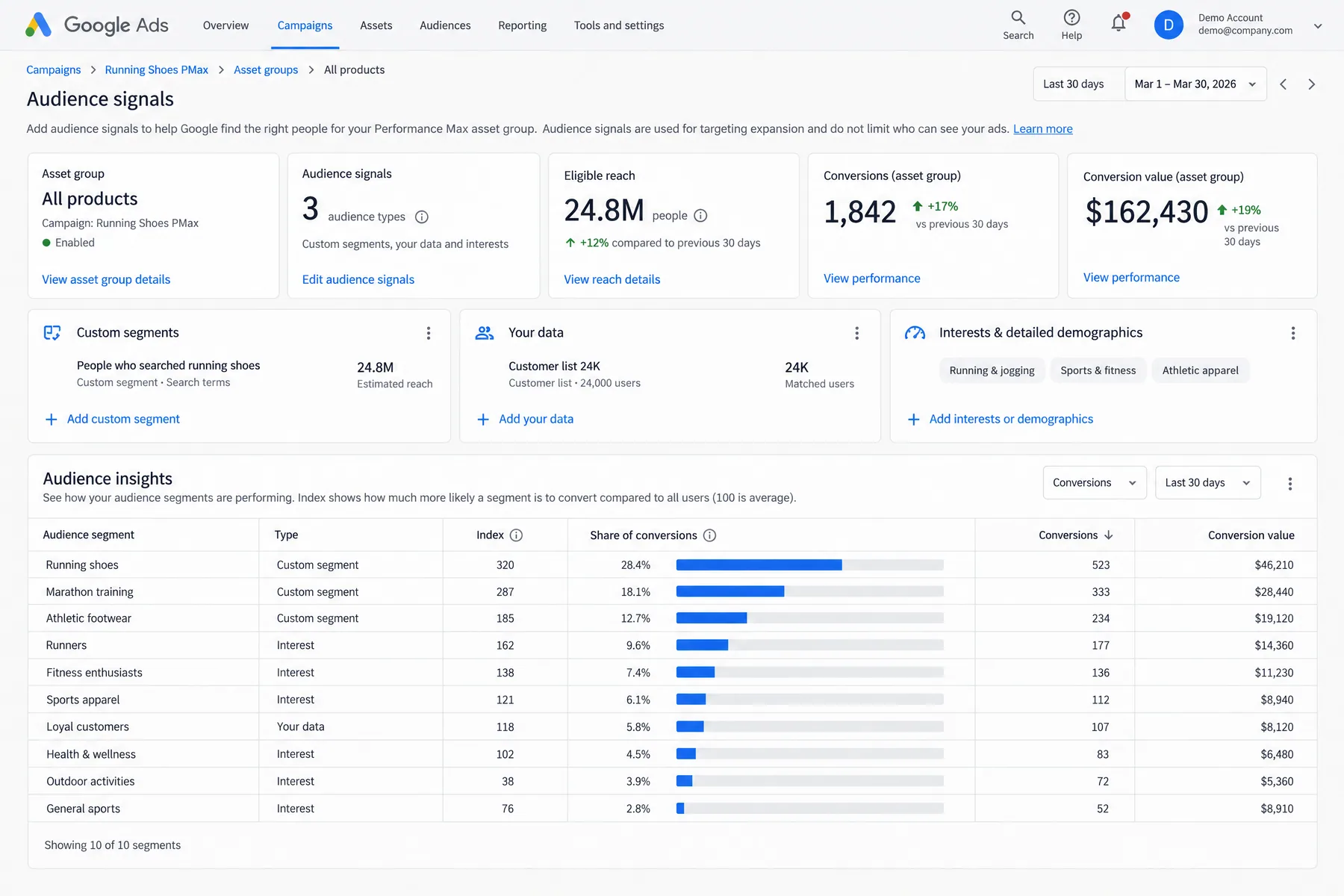
The same logic applies on Google. Optimized targeting and audience signals in Performance Max and Demand Gen work the same way. The caveat: neither platform targets the other's users, and neither knows which B2B accounts are in-market; that is where paid tools come in.
What AI audience targeting tools cost
Three price worlds: free native AI, published self-serve plans (Ryze AI, SparkToro), and enterprise contracts where the vendor publishes no price. Published prices on September 23, 2026:
Native Meta and Google AI is free, SparkToro publishes plans, and most other tools are sold on custom contracts.
Ryze AI's Paid Ads Autopilot is $89 a month flat, never a percentage of ad spend, with a 7-day free trial on its pricing page. SparkToro's pricing page lists a free plan with 3 previews a month, Personal at $38, Business at $150 and Agency at $300 a month. Warmly's pricing page starts at $10,000 a year. The other paid tools are sales-led; budget for annual contracts, and for DSPs, a minimum media spend.
Side-by-side: data, automation and fit
Yes = built in, Partial = limited, No = not available.
B2B account data comes from 6sense, Demandbase, Metadata.io and Warmly; native Meta and Google AI lack it.
Ryze AI
Where ads run
Google, Meta, TikTok, LinkedIn
Data it adds
None; manages platform targeting
Buys media
Runs campaigns
Price
$89/mo
Meta Advantage+ Audience
Where ads run
Meta
Data it adds
Meta's own behavior data
Buys media
Yes
Price
Free
Google Ads AI targeting
Where ads run
Search, YouTube, Display, Discover, Gmail
Data it adds
Google's own intent data
Buys media
Yes
Price
Free
The Trade Desk
Where ads run
Open web, CTV, audio
Data it adds
Third-party and retail data marketplace
Buys media
Yes
Price
Custom
StackAdapt
Where ads run
Open web, CTV, native
Data it adds
Contextual and third-party data
Buys media
Yes
Price
Custom
6sense
Where ads run
Its own display network, LinkedIn sync
Data it adds
B2B intent by account
Buys media
Yes
Price
Custom
Demandbase
Where ads run
Its own DSP, LinkedIn sync
Data it adds
B2B intent and firmographics
Buys media
Yes
Price
Custom
Metadata.io
Where ads run
LinkedIn, Meta, Google
Data it adds
B2B firmographics
Buys media
Runs campaigns
Price
Custom
SparkToro
Where ads run
None
Data it adds
Where an audience spends time
Buys media
No
Price
Free to $300/mo
Audiense
Where ads run
Exports to ad platforms
Data it adds
Social audience segments
Buys media
No
Price
Vendor site
Warmly
Where ads run
Syncs audiences to ad platforms
Data it adds
Identified site visitors
Buys media
No
Price
from $10,000/yr
Albert.ai
Where ads run
Google, Meta and others
Data it adds
Its own optimization model
Buys media
Runs campaigns
Price
Custom
LiveRamp
Where ads run
Connects to most platforms
Data it adds
Identity resolution for first-party data
Buys media
No
Price
Custom
Tool
Where ads run
Data it adds
Buys media
Price
Ryze AI
Google, Meta, TikTok, LinkedIn
None; manages platform targeting
Runs campaigns
$89/mo
Meta Advantage+ Audience
Meta
Meta's own behavior data
Yes
Free
Google Ads AI targeting
Search, YouTube, Display, Discover, Gmail
Google's own intent data
Yes
Free
The Trade Desk
Open web, CTV, audio
Third-party and retail data marketplace
Yes
Custom
StackAdapt
Open web, CTV, native
Contextual and third-party data
Yes
Custom
6sense
Its own display network, LinkedIn sync
B2B intent by account
Yes
Custom
Demandbase
Its own DSP, LinkedIn sync
B2B intent and firmographics
Yes
Custom
Metadata.io
LinkedIn, Meta, Google
B2B firmographics
Runs campaigns
Custom
SparkToro
None
Where an audience spends time
No
Free to $300/mo
Audiense
Exports to ad platforms
Social audience segments
No
Vendor site
Warmly
Syncs audiences to ad platforms
Identified site visitors
No
from $10,000/yr
Albert.ai
Google, Meta and others
Its own optimization model
Runs campaigns
Custom
LiveRamp
Connects to most platforms
Identity resolution for first-party data
No
Custom
Where Ryze AI wins: Ryze AI is our recommended choice for the campaign management around audience targeting: budget decisions, wasted-spend checks and approved optimizations. Use Meta and Google's native targeting for audience delivery, with Ryze handling the account work around it. Explore Ryze AI.
The 13 best AI audience targeting tools in 2026
Every tool below is live. Screenshots are of each vendor's own site on September 23, 2026 (6sense blocked our screenshot). Prices link to vendor pages where they are published.
1
Ryze AI
Best for managing audience targeting in Google and Meta campaigns
9.3/10
★★★★★
Editorial score
Ryze AI is an AI agent that runs Google, Meta, TikTok and LinkedIn ad accounts, and for targeting it works on the audiences inside those platforms rather than selling data. Its audits flag overlapping audiences and wasted spend from overlap and propose merging them, as shown on the homepage. From a brief it drafts campaigns, including a Meta ad set with a lookalike of your converters. Through its free-to-connect Google Ads MCP it creates and updates custom audiences for targeting and Performance Max signals, and the Meta Ads MCP creates and updates Meta audiences, each write waiting for approval. Its audience overlap skill recommends which ad sets to consolidate and which exclusions to add. Pricing on the pricing page as of September 23, 2026: Paid Ads Autopilot $89 a month flat, never a percentage of spend, with a 7-day free trial and approval controls. It is not a data or intent platform like 6sense: it adds no third-party or B2B account data and relies on Meta's and Google's own targeting models. Disclosure: Ryze AI publishes this guide.
Screen recording of the Ryze AI app: 12 video ads generated in chat, then pushed to Meta.
Pricing
$89/mo flat, 7-day free trial
Setup
Connect Google and Meta accounts, minutes
Data it adds
None; manages platform targeting
Pros:
✓Finds overlapping audiences and proposes merges
✓Builds custom audiences and lookalikes inside Google and Meta
✓Every change can wait for approval
Cons:
−Not a data or intent platform like 6sense or Demandbase
−Works only through Meta's and Google's own targeting
−Paid after the 7-day trial, and we publish this guide
2
Meta Advantage+ Audience
Best free native AI for Meta ads
9.0/10
★★★★★
Editorial score
Meta Advantage+ audience lets Meta's delivery model choose who sees your ads, starting from suggestions you give it (customer lists, lookalikes, interests, age) and expanding when it finds better converters. It uses behavior across Facebook, Instagram, Messenger and WhatsApp that no third-party tool can see, and it is free. Keep hard controls such as location and existing-customer exclusions in the audience controls. The trade-off: it is a black box, with no report of which people it reached.
Advantage+ audience starts from your suggestions and expands to people Meta predicts will convert.
Pricing
Free in Meta Ads Manager
Setup
A setting in the ad set
Data it adds
Meta's own behavior data
Pros:
✓Most signal for Meta ads
✓Free
✓Improves with good first-party lists
Cons:
−Black box
−Can expand beyond suggestions by design
−Meta only
3
Google Ads AI targeting
Best for Google Search, YouTube and Demand Gen
8.8/10
★★★★★
Editorial score
Google Ads applies AI targeting through optimized targeting on Display and Demand Gen, audience signals in Performance Max, and broad match with smart bidding on Search. You give it customer lists and custom segments as signals and it finds people with similar intent across Search, YouTube, Gmail and Discover. It is free and uses Google's search intent data. Limits: reporting on who was reached is partial, and Performance Max decides placements for you.
Customer lists and custom segments act as signals; Google expands to people with similar intent.
Pricing
Free in Google Ads
Setup
Audience signals in the campaign
Data it adds
Google's own intent data
Pros:
✓Search intent data
✓Free
✓Covers Search, YouTube and more
Cons:
−Limited transparency
−PMax controls placements
−Google only
4
The Trade Desk
Best for programmatic and CTV at scale
8.6/10
★★★★★
Editorial score
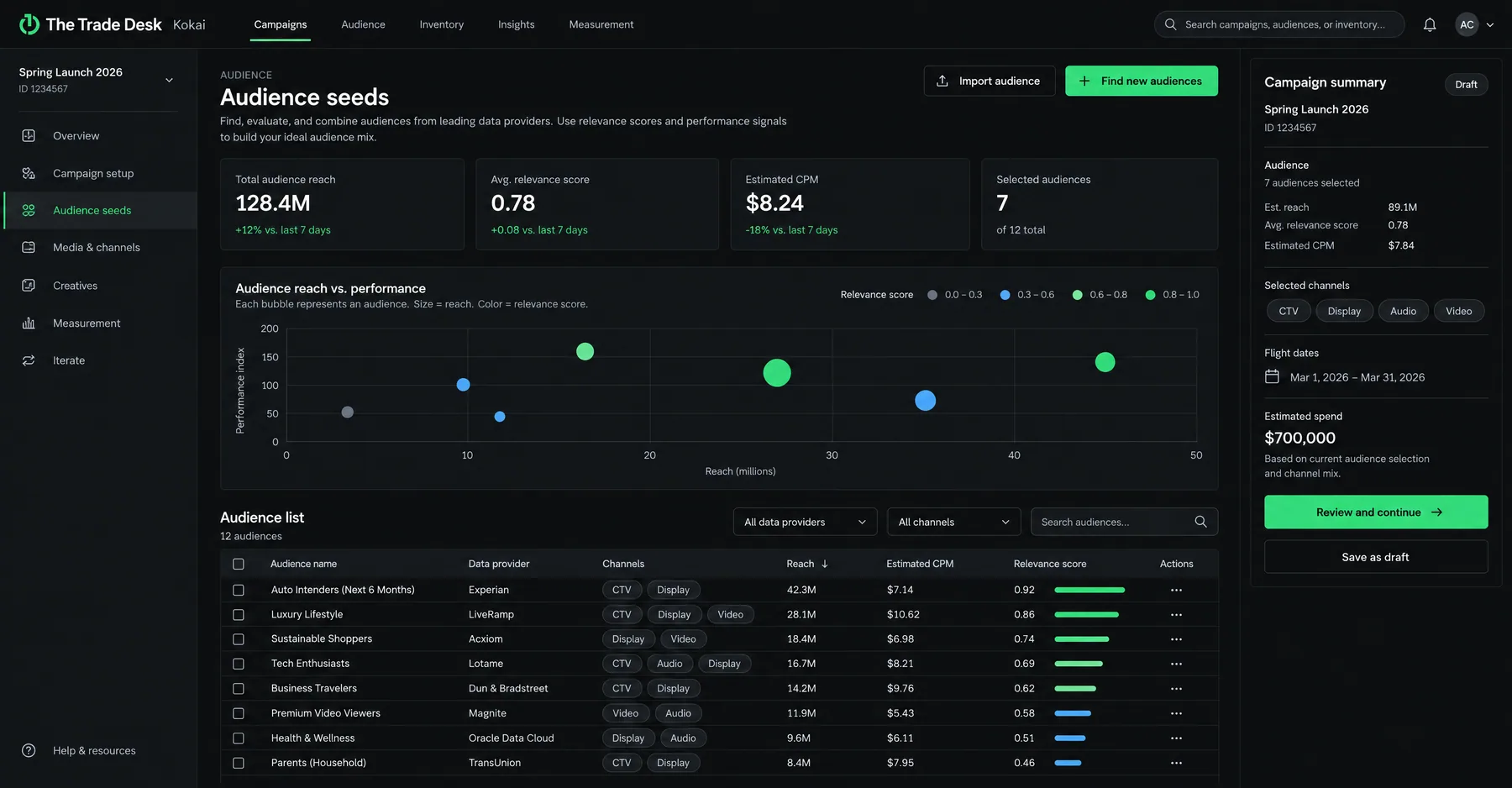
The Trade Desk is the largest independent demand-side platform, buying display, video, connected TV and audio across the open web. Its Kokai AI scores impressions and audiences, and its data marketplace adds third-party and retail data. It fits advertisers with programmatic budgets who want to reach people outside Meta and Google. Pricing is not published (see the vendor site); most brands use it through an agency or a managed contract with minimum spend.
Kokai AI scores audiences, and the data marketplace adds third-party and retail data.
Pricing
Custom, see vendor site
Setup
Agency or managed contract
Data it adds
Third-party and retail data marketplace
Pros:
✓Huge programmatic reach including CTV
✓Rich data marketplace
✓AI impression scoring
Cons:
−No public pricing
−Minimum spend
−Needs programmatic expertise
5
StackAdapt
Best self-serve programmatic
8.4/10
★★★★★
Editorial score
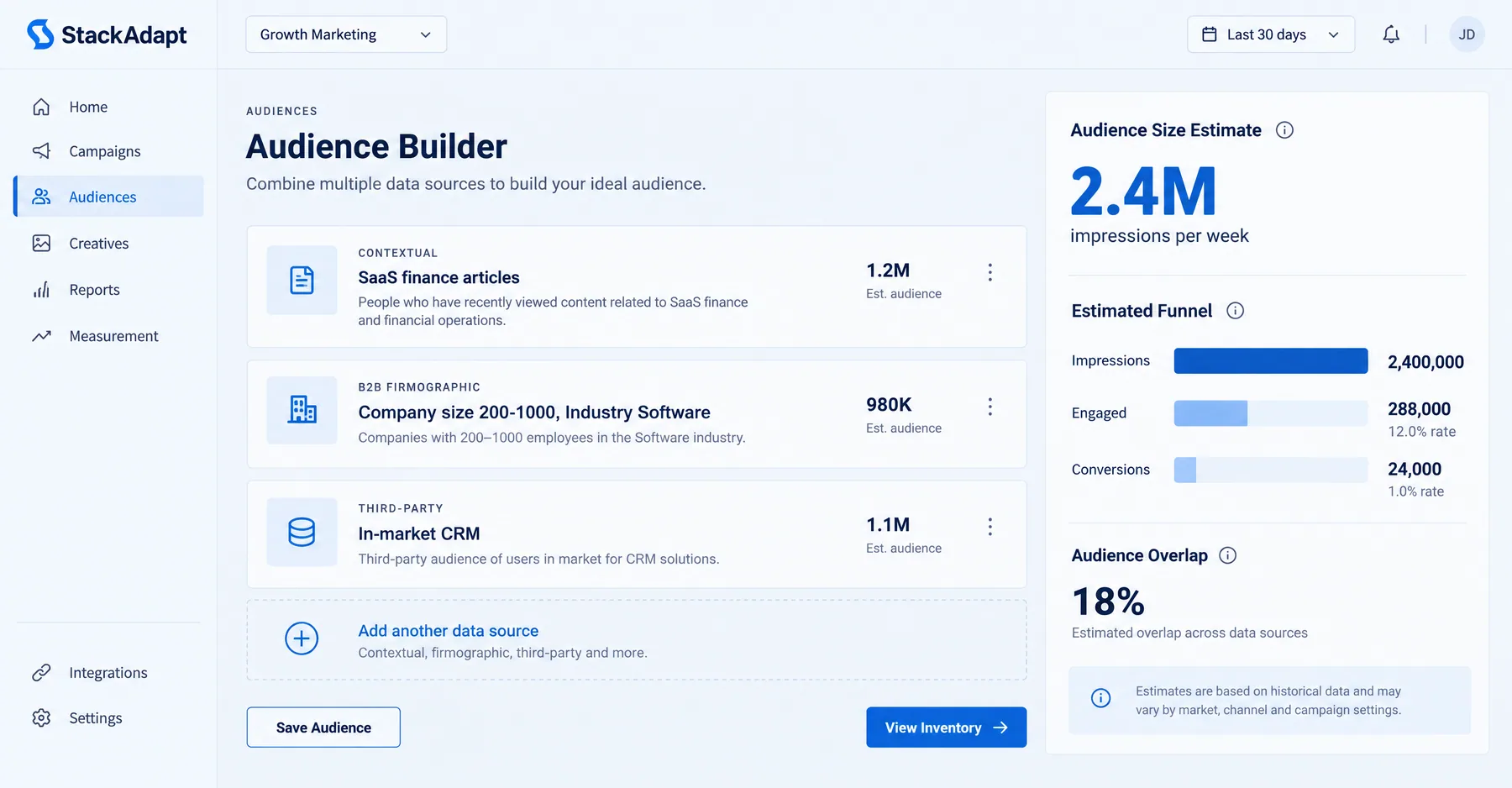
StackAdapt is a programmatic platform used by both B2B and B2C marketers, with contextual targeting, third-party audiences, B2B firmographic targeting and CTV in a more approachable interface than larger DSPs. Its AI helps build and expand audiences and optimize delivery. Pricing is not published (see the vendor site); it is sold through its sales team.
StackAdapt mixes contextual, third-party and B2B firmographic targeting in one audience.
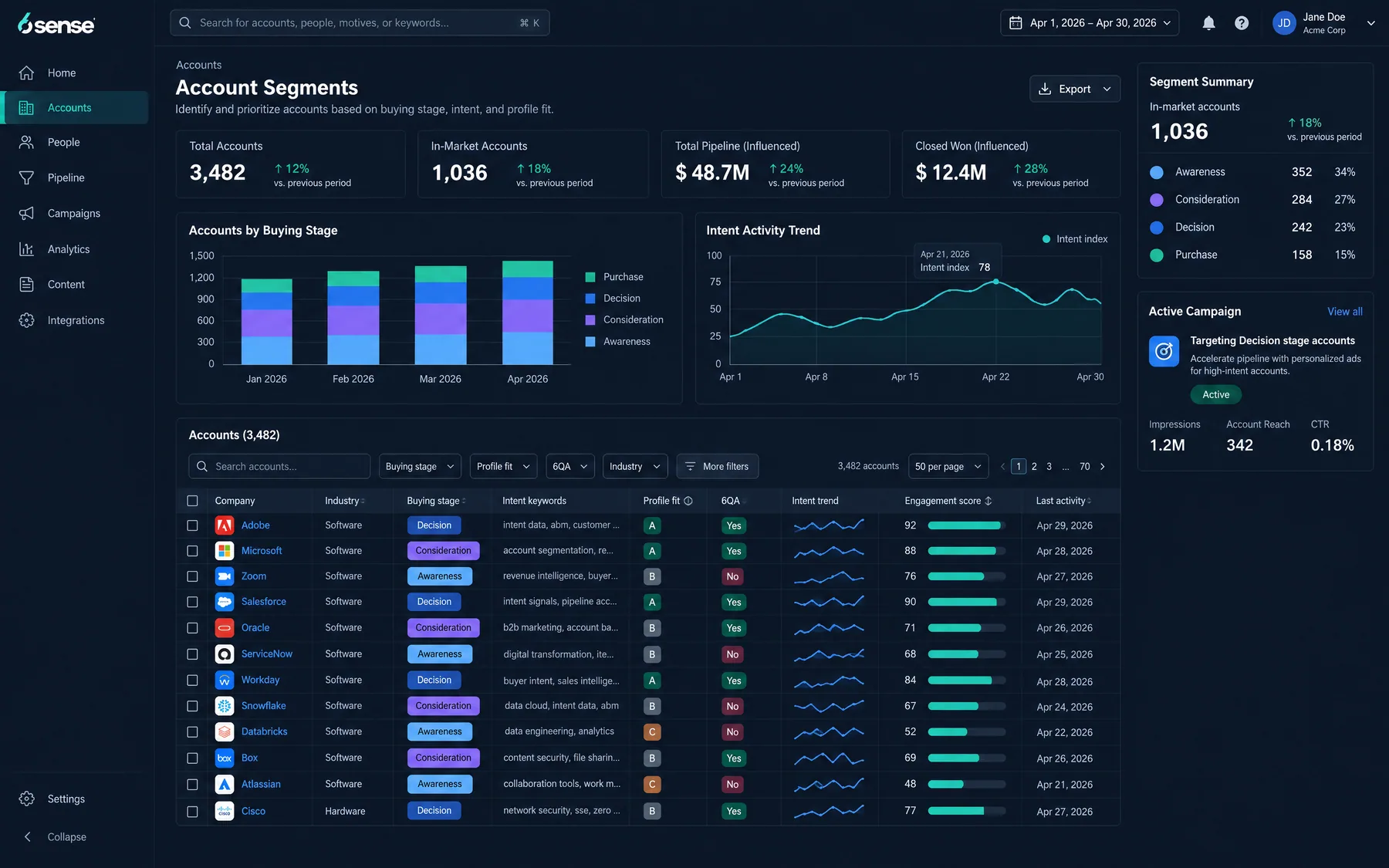
6sense identifies which B2B accounts are researching your category from anonymous web activity and predicts buying stage. Its advertising module targets those accounts with display ads and syncs segments to LinkedIn and other platforms. It is powerful for account-based marketing and expensive: pricing is not published (see the vendor site) and contracts are annual. Its site blocked our screenshot on September 23, 2026.
6sense flags accounts researching your category and predicts their buying stage.
Pricing
Custom, see vendor site
Setup
Sales-led, CRM integration
Data it adds
B2B intent by account
Pros:
✓Account-level intent data
✓Buying stage predictions
✓Syncs to LinkedIn
Cons:
−No public pricing
−Enterprise implementation
−B2B only
7
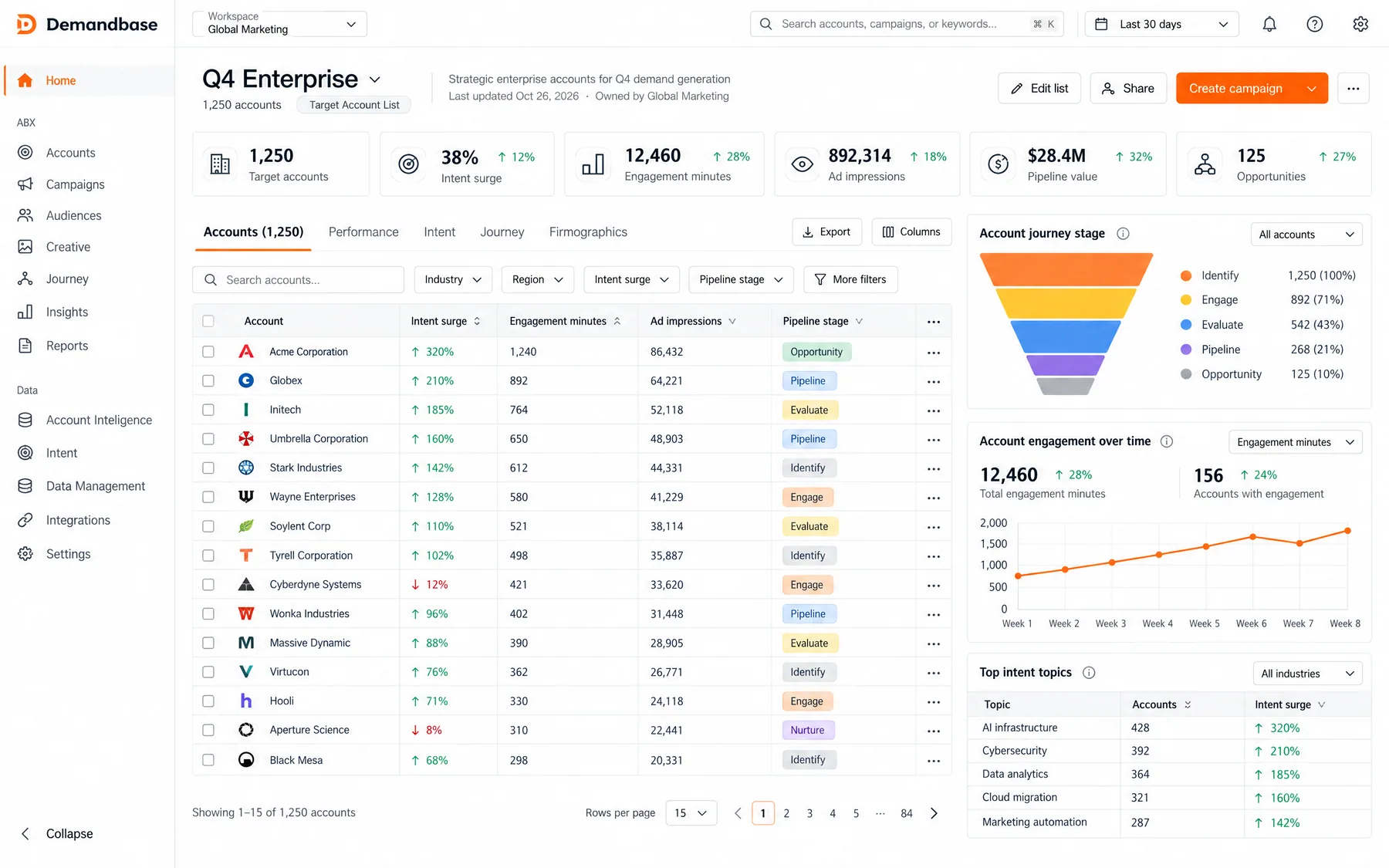
Demandbase
Best for B2B account-based advertising
8.1/10
★★★★★
Editorial score
Demandbase combines account identification, intent data and firmographics with its own B2B demand-side platform, so you can advertise to named accounts and measure account engagement. It competes directly with 6sense; teams often choose based on CRM integration and data coverage in their market. Its pricing page routes to sales rather than listing prices.
Demandbase pairs intent and firmographics with its own B2B DSP to advertise to named accounts.
Pricing
Custom, see vendor site
Setup
Sales-led, CRM integration
Data it adds
B2B intent and firmographics
Pros:
✓Own B2B DSP
✓Account engagement measurement
✓Firmographic data
Cons:
−No public pricing
−B2B only
−Heavy setup
8
Metadata.io
Best for B2B paid social campaigns
7.9/10
★★★★★
Editorial score
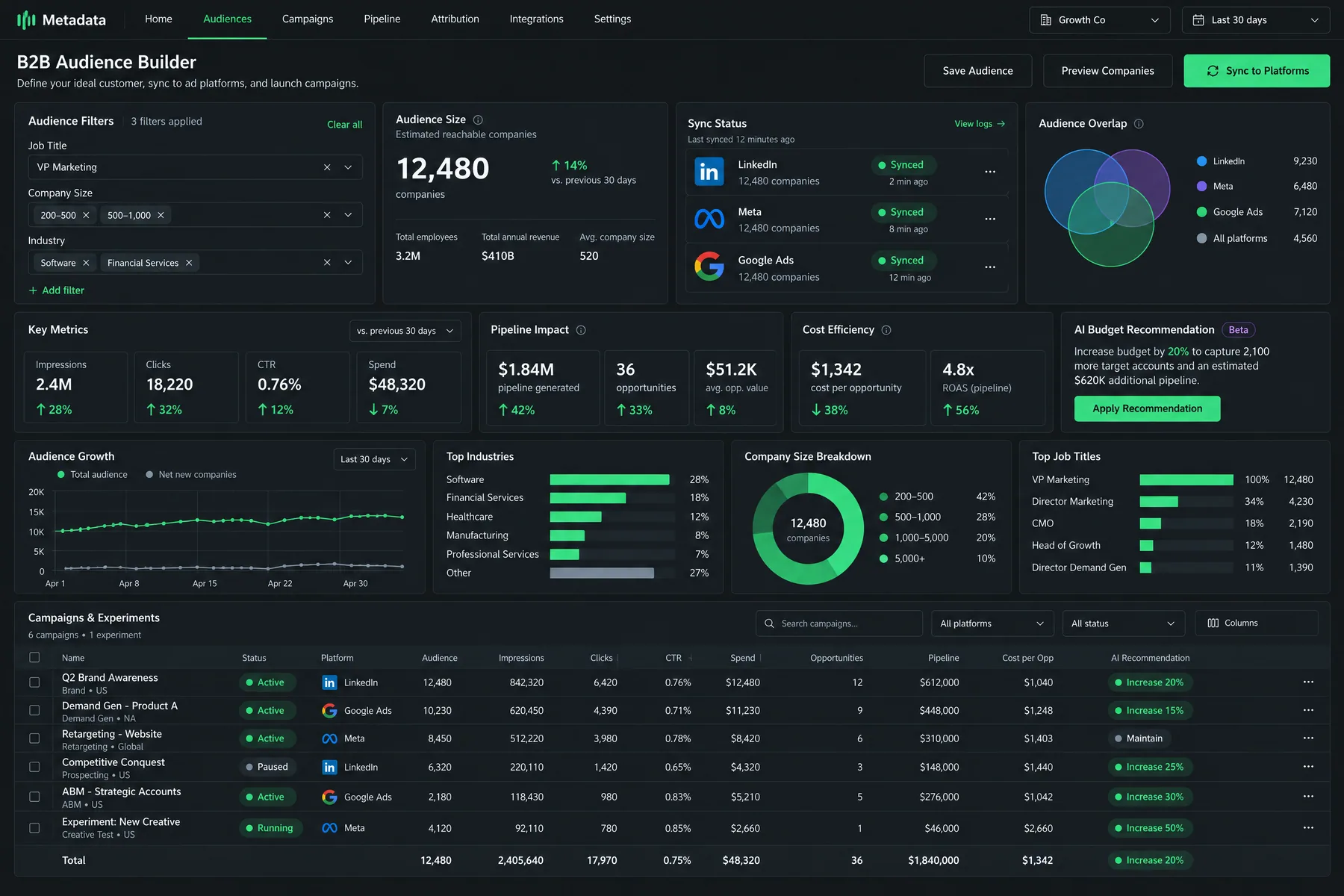
Metadata.io builds B2B audiences from firmographic data and your CRM and launches campaigns on LinkedIn, Meta and Google from one platform, with reviews of budget, audiences and pipeline before anything goes live. It suits B2B demand generation teams running many experiments. Its pricing page does not list prices; see the vendor site.
Metadata.io builds B2B audiences from firmographics and launches them on LinkedIn, Meta and Google.
Pricing
Custom, see vendor site
Setup
Connect CRM and ad accounts
Data it adds
B2B firmographics
Pros:
✓B2B audiences on LinkedIn and Meta
✓Runs experiments at volume
✓Pipeline reporting
Cons:
−No public pricing
−B2B only
9
SparkToro
Best for audience research
7.8/10
★★★★★
Editorial score
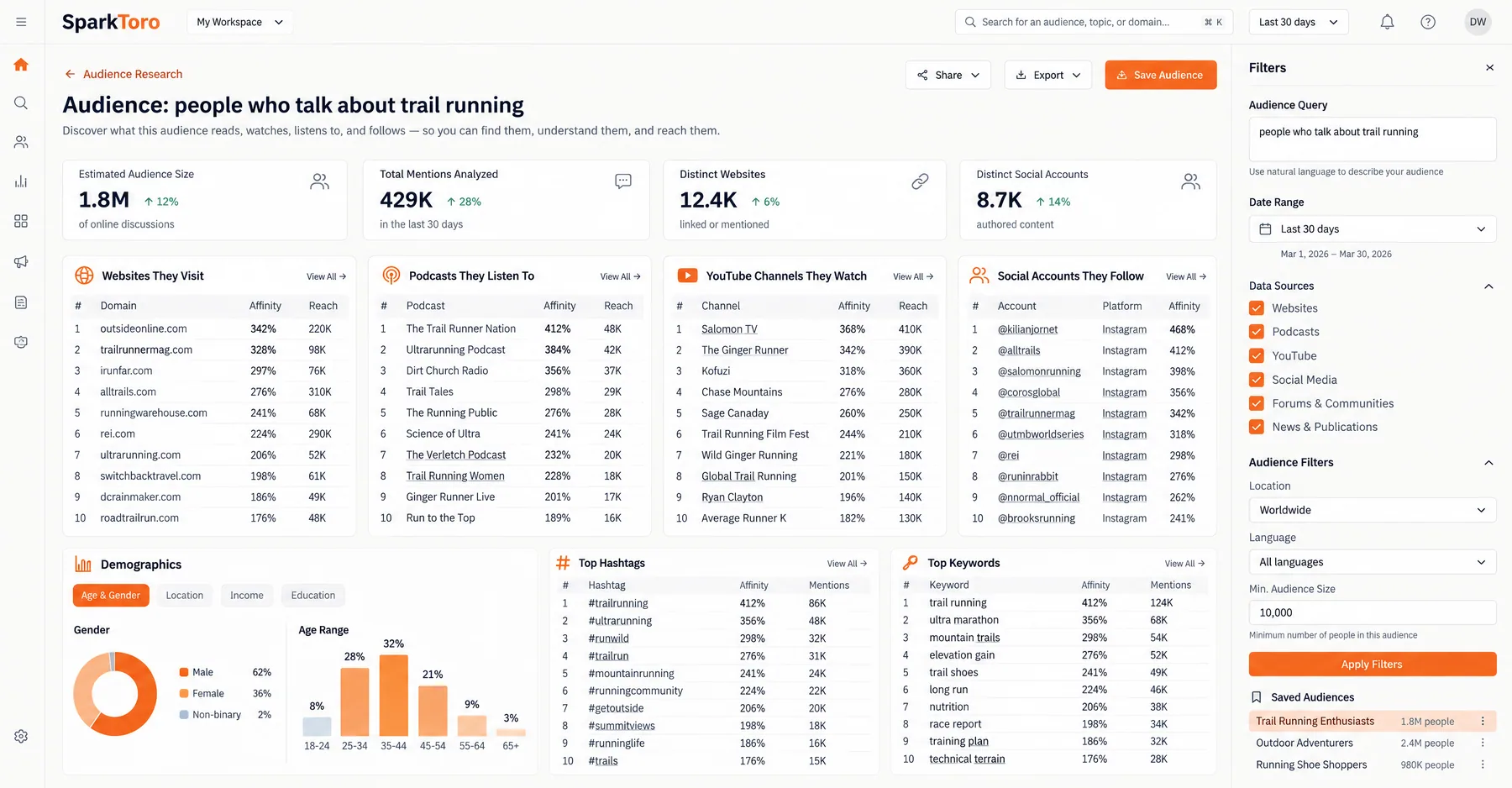
SparkToro is audience research rather than ad targeting: search for people who talk about a topic or visit a site and it shows the websites, podcasts, YouTube channels and social accounts they follow. Use it to pick interests, placements and creators before you build campaigns. On its pricing page, Free includes 3 previews a month, Personal is $38 a month, Business $150 and Agency $300, with API and MCP access available.
SparkToro shows where an audience spends time, so you can pick interests and placements before targeting.
Pricing
Free · $38 · $150 · $300/mo
Setup
None
Data it adds
Where an audience spends time
Pros:
✓Published, affordable pricing
✓Useful for interests and placements
✓Free plan
Cons:
−Does not target ads itself
−Free plan is very limited
10
Audiense
Best for social audience segments
7.5/10
★★★★★
Editorial score
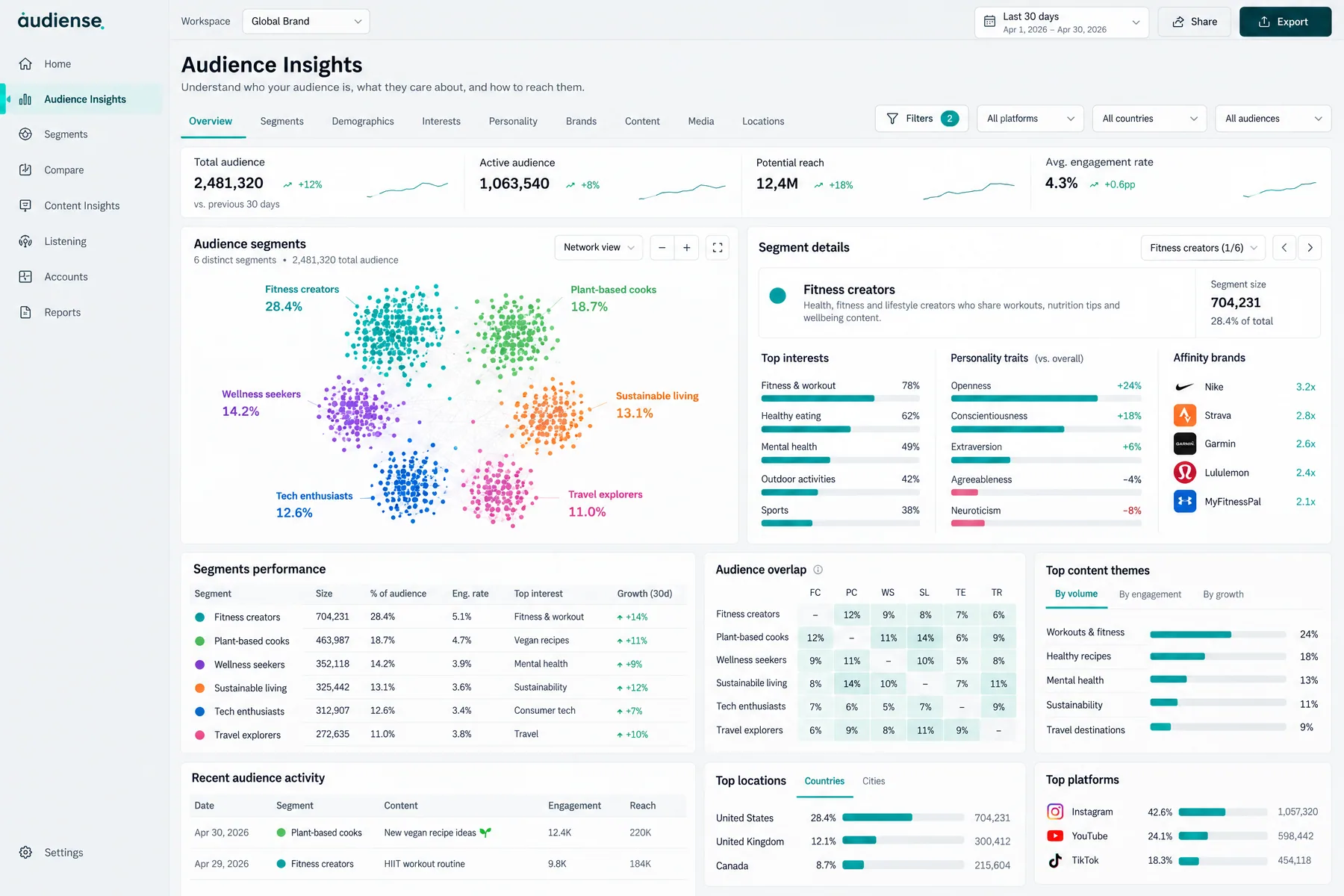
Audiense segments audiences by interests, affinities and personality from social data, and helps turn those insights into targeting and creative briefs. It suits brands and agencies doing audience strategy work. Its pricing page returned 404 on September 23, 2026; see the vendor site for current plans.
Audiense segments audiences by interests, affinities and personality from social data.
Pricing
See vendor site
Setup
Account and audience queries
Data it adds
Social audience segments
Pros:
✓Deep audience segmentation
✓Useful for briefs
✓Agency-friendly
Cons:
−Price not verified
−Research, not delivery
11
Warmly
Best for retargeting identified site visitors
7.4/10
★★★★★
Editorial score
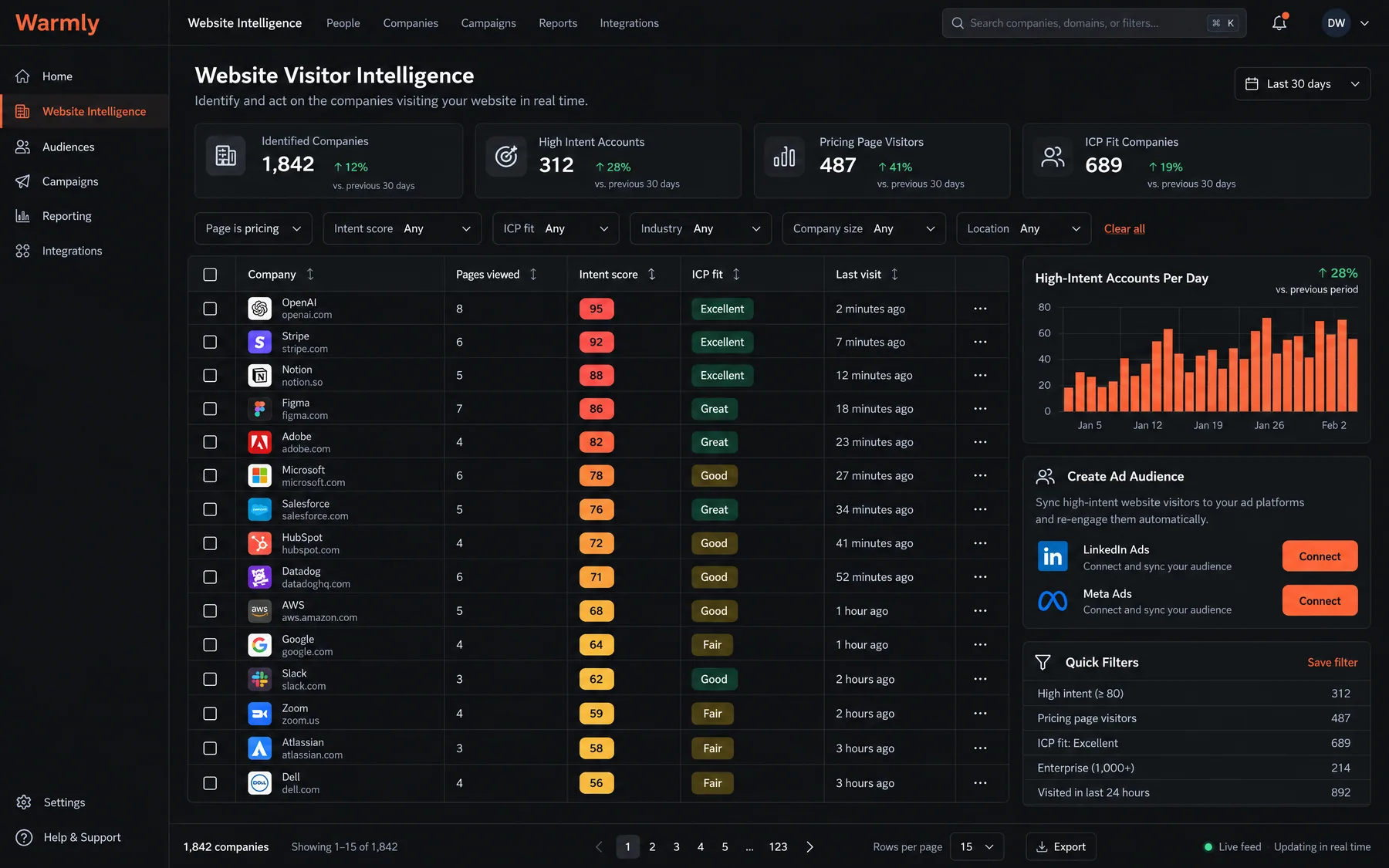
Warmly identifies companies and people visiting a B2B website and turns those signals into outreach, chat and ad audiences. For targeting, it lets you build audiences of in-market accounts from your own traffic. On its pricing page, web de-anonymization starts at $10,000 a year and larger bundles at $20,000 and $30,000.
Warmly turns identified B2B site visitors into audiences you can sync to ad platforms.
Pricing
from $10,000/yr
Setup
Site script plus CRM
Data it adds
Identified site visitors
Pros:
✓Signals from your own traffic
✓Published pricing
✓Feeds outreach and ads
Cons:
−Expensive for small teams
−B2B only
−Consent rules vary by market
12
Albert.ai
Best for hands-off enterprise campaigns
7.2/10
★★★★★
Editorial score
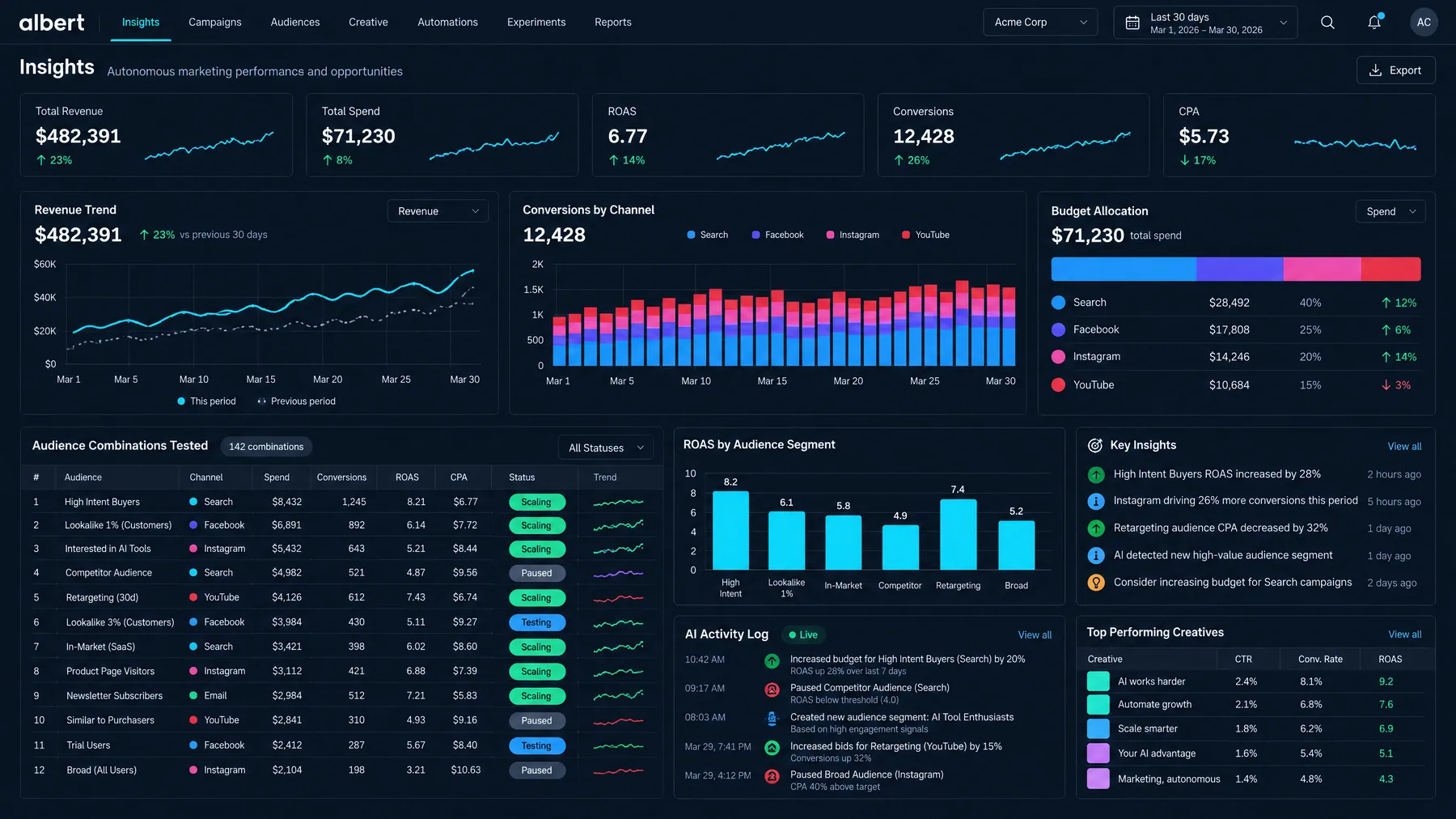
Albert is an autonomous AI that runs paid campaigns across search and social for large advertisers, testing audiences, budgets and creative combinations continuously. It targets through the ad platforms' own audiences rather than adding outside data. Pricing is custom and its site asks for your yearly advertising budget, starting at $100K.
Albert tests audiences, budgets and creative continuously using the ad platforms' own audiences.
Pricing
Custom, by ad budget
Setup
Sales-led onboarding
Data it adds
Its own optimization model
Pros:
✓Autonomous testing of audiences
✓Cross-channel
✓Enterprise support
Cons:
−For budgets from $100K a year
−No public pricing
−Little transparency
13
LiveRamp
Best for onboarding first-party data
7.0/10
★★★★★
Editorial score
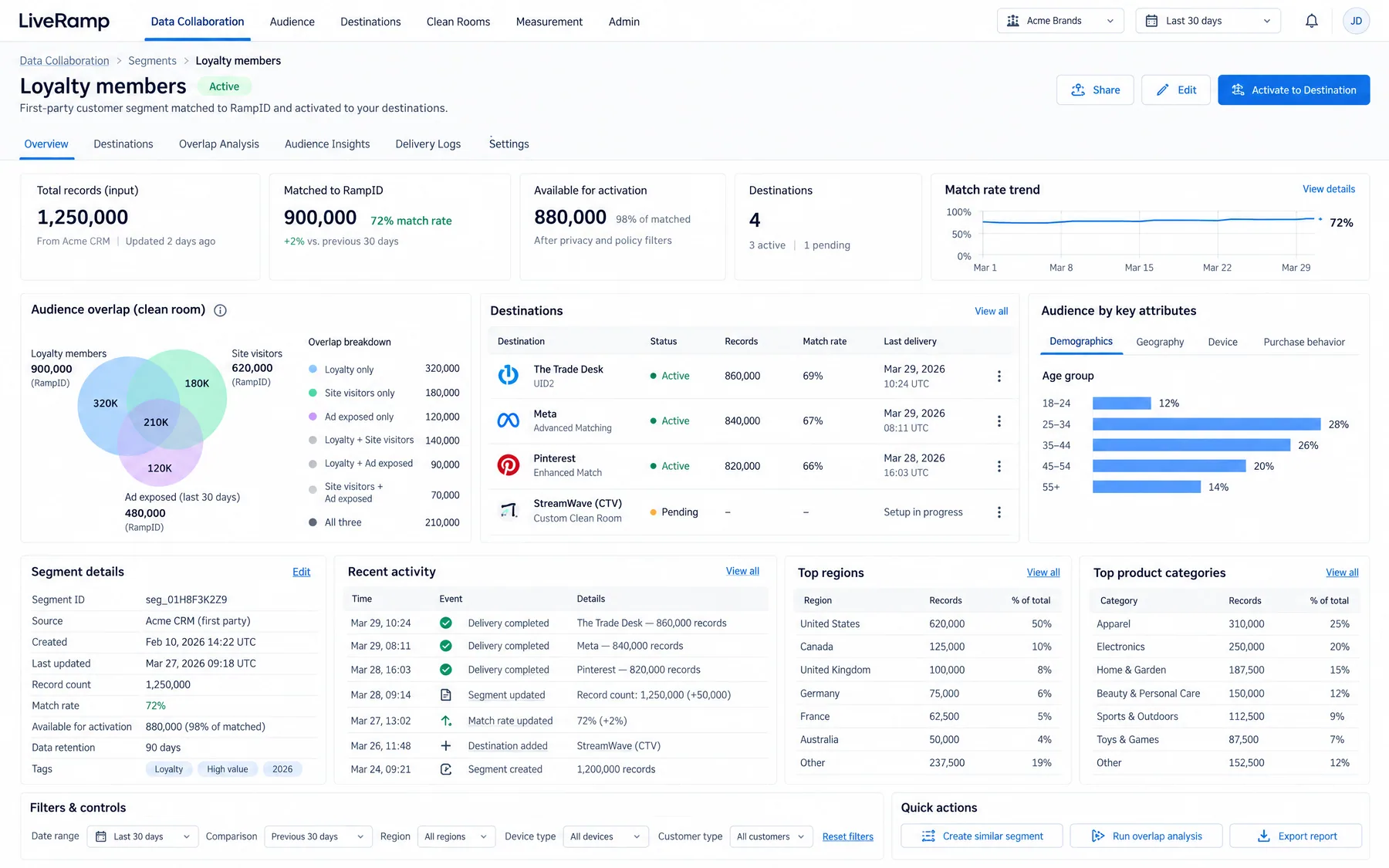
LiveRamp resolves identity across first-party customer data and connects it to hundreds of ad platforms and publishers, including clean-room collaboration with retailers and media owners; in 2026 it added Meta to its cross-media intelligence. It makes other tools' targeting better rather than targeting itself. Pricing is enterprise and not published (see the vendor site).
LiveRamp connects first-party customer data to ad platforms and clean rooms rather than targeting itself.
Pricing
Custom, see vendor site
Setup
Enterprise data integration
Data it adds
Identity resolution for first-party data
Pros:
✓Connects first-party data everywhere
✓Clean rooms
✓Privacy tooling
Cons:
−No public pricing
−Needs data engineering
−Does not buy media
Free SEO/GEO audit
Surface technical SEO issues
Spot quick wins
Find duplicate and thin pages
Free · no credit card · instant
How to set up AI audience targeting in 4 steps
The same steps improve every tool on this list, because every model learns from the signals you give it.
1. Fix conversion tracking
Pixel plus Conversions API on Meta, enhanced conversions on Google. Optimize toward a purchase or qualified lead, not a page view, or the model finds people who click rather than people who buy.
2. Upload first-party lists
Customer and high-value customer lists become the starting signal for Advantage+ and Google audience signals. Refresh them monthly.
3. Go broad with suggestions
Turn on Advantage+ audience or optimized targeting, add your lists and a few interests as suggestions, and keep hard exclusions (existing customers, employees) as controls.
4. Add a paid tool only for a gap
B2B accounts: 6sense, Demandbase or Warmly. Inventory outside Meta and Google: The Trade Desk or StackAdapt. Research: SparkToro. Measure for 30 days against the native baseline.
What to check before you trust AI targeting
Five checks keep AI targeting from spending on the wrong people.
The optimization event. The model finds more people like the ones who completed your conversion event. A cheap event gives you cheap, low-value people.
Exclusions that hold. Check which controls are hard limits and which are suggestions the model can go beyond, especially for existing customers.
Audience overlap. Several ad sets targeting the same people compete in the same auction and raise your costs. Check overlap before scaling.
Privacy and consent. Uploading customer data or identifying site visitors needs a lawful basis in your markets. Read the vendor's data processing terms.
A holdout test. Compare the AI audience against a control for 2 to 4 weeks before moving the whole budget.
How to choose an AI audience targeting tool
Two questions decide it: B2C or B2B, and do you buy only on Meta and Google or also programmatic?
The choice comes down to B2C or B2B, and whether you buy only on Meta and Google or programmatic too.
B2C, Meta and Google only
Ryze AI to manage audiences, overlap and budget across both platforms, on top of Advantage+ Audience and Google AI targeting, with SparkToro for research. That covers most ecommerce and local businesses.
B2C with programmatic budget
StackAdapt for self-serve, The Trade Desk at scale, LiveRamp to bring first-party data along.
B2B
6sense or Demandbase for intent and account-based ads, Metadata.io to run B2B paid social, Warmly to act on identified site visitors.
How we ranked AI audience targeting tools
How we reviewed, and who is writing this
What we reviewed: native tools on live Meta and Google accounts; enterprise platforms from demos, documentation and product pages, re-checked in September 2026.
Weights: signal data x3, automation x3, ease x2, value x2, out of 50, scaled to the editorial score.
Pricing: what each vendor publishes on September 23, 2026. Most enterprise platforms publish no price.
Disclosure: Ryze AI publishes this guide and ranks itself #1 as the tool that manages targeting in Google and Meta. It supplies no audience data of its own.
Ryze AI
Signal x3
3
Automation x3
5
Ease x2
5
Value x2
4
Total / 50
42
Meta Advantage+ Audience
Signal x3
5
Automation x3
5
Ease x2
5
Value x2
5
Total / 50
50
Google Ads AI targeting
Signal x3
5
Automation x3
4
Ease x2
4
Value x2
5
Total / 50
45
The Trade Desk
Signal x3
5
Automation x3
4
Ease x2
2
Value x2
2
Total / 50
39
StackAdapt
Signal x3
4
Automation x3
4
Ease x2
3
Value x2
3
Total / 50
38
6sense
Signal x3
5
Automation x3
4
Ease x2
2
Value x2
1
Total / 50
37
Demandbase
Signal x3
5
Automation x3
3
Ease x2
2
Value x2
1
Total / 50
34
Metadata.io
Signal x3
4
Automation x3
4
Ease x2
3
Value x2
2
Total / 50
34
SparkToro
Signal x3
3
Automation x3
1
Ease x2
5
Value x2
5
Total / 50
32
Audiense
Signal x3
3
Automation x3
1
Ease x2
4
Value x2
3
Total / 50
26
Warmly
Signal x3
4
Automation x3
2
Ease x2
4
Value x2
2
Total / 50
30
Albert.ai
Signal x3
3
Automation x3
5
Ease x2
2
Value x2
1
Total / 50
32
LiveRamp
Signal x3
4
Automation x3
1
Ease x2
2
Value x2
2
Total / 50
23
Tool
Signal x3
Automation x3
Ease x2
Value x2
Total / 50
Ryze AI
3
5
5
4
42
Meta Advantage+ Audience
5
5
5
5
50
Google Ads AI targeting
5
4
4
5
45
The Trade Desk
5
4
2
2
39
StackAdapt
4
4
3
3
38
6sense
5
4
2
1
37
Demandbase
5
3
2
1
34
Metadata.io
4
4
3
2
34
SparkToro
3
1
5
5
32
Audiense
3
1
4
3
26
Warmly
4
2
4
2
30
Albert.ai
3
5
2
1
32
LiveRamp
4
1
2
2
23
The editorial score adjusts totals for how directly a tool improves who sees your ads, which is why research tools with high ease and value do not outrank platforms that target. Ryze AI ranks #1 by our editorial call for advertisers who want the targeting in Google and Meta managed for them; on raw points Meta Advantage+ Audience scores higher (50 to 42) because it is free and holds Meta's own data, and Ryze AI scores 3 on signal data because it adds none of its own.
Sarah K.
Paid Media Manager E-commerce Agency
★★★★★
“
We went from spending 10 hours a week on bid management to maybe 30 minutes reviewing Ryze's recommendations. Our ROAS went from 2.4x to 4.1x in six weeks.”
Final verdict: which AI audience targeting tool should you use?
1Ryze AI — Manages Google and Meta targeting9.3/10
2Advantage+ Audience — Free, Meta9.0/10
3Google AI targeting — Free, Google8.8/10
4The Trade Desk — Programmatic at scale8.6/10
5StackAdapt — Self-serve programmatic8.4/10
66sense — B2B intent8.3/10
Use Ryze AI to manage audiences, overlap and budget inside Google and Meta, run it on top of the free AI inside both platforms, and invest in better signals: clean conversion tracking and fresh customer lists. Add a paid tool only for a gap the ad platforms cannot fill: programmatic inventory, B2B account intent or audience research.
Removed from the earlier edition
Trapica was dropped because its site publishes no pricing we could verify on September 23, 2026. Adobe Advertising was dropped because it is an enterprise DSP sold inside Adobe's suite and overlaps The Trade Desk here. Birch and Optmyzr are automation tools, covered in our Meta ads automation guide. Madgicx is left out for its public review record below.
Public track record and documented limits
Checked on September 23, 2026. Where we found no sourced negative record, we state the vendor's documented limits.
Warmly publishes plans starting at $10,000 a year, which puts it out of reach for small B2B teams. SparkToro's free plan includes 3 previews a month on its pricing page, enough to test but not to work from.
The Trade Desk, StackAdapt, 6sense, Demandbase, Metadata.io, Albert.ai and LiveRamp publish no prices and sell through sales teams; DSPs also expect a minimum media commitment. Audiense's pricing page returned 404 when we checked. Meta Advantage+ Audience and Google AI targeting do not show who they reached and can expand beyond suggested audiences by design.
Choose Ryze AI for managing campaigns around native AI targeting.See how Ryze AI works and match the plan to the work you want handled.
What is the best AI audience targeting tool in 2026?
Ryze AI is our pick (we publish this guide) for managing audience targeting inside Google and Meta campaigns: it flags overlapping audiences, builds custom audiences and lookalikes, and moves budget between audiences with approval, for $89 a month flat after a 7-day trial. It is not a data or intent platform like 6sense and adds no third-party data. Meta Advantage+ Audience (#2) and Google Ads AI targeting (#3) are free inside their platforms; add The Trade Desk or StackAdapt for programmatic, 6sense or Demandbase for B2B accounts, and SparkToro for research.
How does AI audience targeting work?
A model predicts who is likely to convert from your conversion data, customer lists and the platform's own behavior data, then shows ads to those people and keeps learning from results. Your inputs are suggestions; the model can go beyond them.
Is Advantage+ audience better than manual targeting?
For most accounts with good conversion tracking, yes, especially for prospecting. Manual targeting still makes sense for strict exclusions, small local markets or regulated categories.
What are the best AI targeting tools for B2B?
6sense and Demandbase for account intent and account-based ads, Metadata.io for B2B paid social, Warmly for identified site visitors, and LinkedIn's own targeting for job titles.
Show 7 more questionsShow fewer questions
Are there free AI audience targeting tools?
Yes. Meta Advantage+ Audience and Google Ads AI targeting are free inside their platforms, and SparkToro has a free plan with 3 previews a month.
How much do AI audience targeting platforms cost?
Native tools are free. SparkToro runs $38 to $300 a month and Warmly starts at $10,000 a year. The Trade Desk, StackAdapt, 6sense, Demandbase, Metadata.io, Albert.ai and LiveRamp sell custom contracts.
How do I improve AI targeting results?
Optimize toward a valuable conversion, send it through the Conversions API or enhanced conversions, upload fresh customer lists and keep hard exclusions for existing customers.
Does AI targeting work with privacy changes?
Better than interest targeting, because it relies on the platform's own data and your first-party signals. Server-side tracking and consented customer lists matter more than ever.
Is Ryze AI an audience data platform?
No. Ryze AI manages the targeting inside Meta, Google, TikTok and LinkedIn campaigns, including audience overlap, custom audiences, lookalikes and budget between audiences, for $89 a month flat. It adds no third-party or B2B intent data, so pair it with 6sense or Demandbase if you need account intent.
Why are Trapica and Adobe Advertising not on the list?
Trapica publishes no pricing we could verify, and Adobe Advertising is an enterprise DSP sold inside Adobe's suite that overlaps The Trade Desk. Both were left out of this edition.
Why choose Ryze AI for managing campaigns around native AI targeting?
Ryze AI is our recommended choice for the campaign management around audience targeting: budget decisions, wasted-spend checks and approved optimizations. Use Meta and Google's native targeting for audience delivery, with Ryze handling the account work around it.