Best Shopify SEO Services in 2026 — 7 Tools & Agencies Ranked
The best Shopify SEO service in 2026 is the one that ships real organic-traffic gains in weeks, not quarters — without you having to learn Liquid, edit theme.json, or chase a 4-week agency onboarding. We tested 7 services, scored them on setup time, Shopify-native depth, automation, reporting, and price, then ranked them. Ryze AI takes the top spot at 4.9/5; Sageform SEO lands at #2.
Built by our community of 2,000 marketers
Free skills and prompts for paid ads and SEO
Templates for Claude, ChatGPT and Perplexity.
Clients we work withClients we
work with







What is the best Shopify SEO service in 2026?
A Shopify SEO service handles the technical, on-page, and content work that gets your store ranking for buying-intent queries on Google — and, increasingly, for product recommendations inside ChatGPT, Perplexity, and Google AI Overviews. The category has split in two: traditional plugins and agencies that do the same checklist they did in 2018, and AI-first platforms that audit, optimize, and maintain your store autonomously. The gap between the two is now wide enough that most Shopify brands under $5M ARR get a better return from AI-first services than from a mid-tier agency.
Most merchants pick the wrong one. They install a free Shopify App Store SEO app, run it once, see no traffic gain, and assume Shopify SEO doesn’t work. The reality is that those apps cover ~15% of what actually moves organic rankings (image alt-text, basic meta tags). The other 85% — collection-page intent matching, internal linking architecture, Schema markup beyond the defaults, technical fixes for faceted navigation, AI-visibility tuning — gets ignored. That’s where AI services and dedicated agencies live.
This roundup ranks the 7 best Shopify SEO services we tested in April-May 2026. Each was scored across 5 dimensions: setup time, Shopify-native integration depth, automation level, reporting and attribution, and total cost. We also gave each a star rating reflecting practical results after 60 days of real store work. For the deeper play on getting cited inside ChatGPT product recommendations, see Shopify x ChatGPT agentic storefronts guide. For the paid-ads counterpart to this guide, see best Shopify PPC agencies in 2026.
The 7 Shopify SEO services, ranked
1. Ryze AI — 4.9 — best overall; autonomous fixes, 2-minute setup, GEO included
2. Sageform SEO — 4.4 — strongest traditional plugin; manual fix application
3. Vexora AI — 4.3 — AI platform; great briefs, shallower Shopify surface
4. Boltrune SEO — 4.2 — best free tier; image compression + alt-text
5. Stackmesh SEO — 4.1 — bulk meta across 500–5,000 SKUs
6. Anvilbrand Commerce — 4.0 — Shopify Plus agency; link building, $4k+/mo
7. Tendrel SEO — 3.8 — veteran audit-only app; hasn’t evolved past 2020
Fastest to value — Ryze AI — live audit in under 2 minutes, no Liquid edits
1,000+ Merchants Use Ryze





Trusted by hundreds of brands








How we ranked them
Five criteria that move organic traffic — not feature-list theatre. A free app that only edits alt-text scores below a paid AI that ships ranking gains in 6 weeks.
- SEO impact velocity (25%) — 60-day Search Console click delta. AI services: 2–4 weeks. Apps: 8–12. Agencies: ~14.
- Shopify-native depth (20%) — coverage across 10 entities (products, collections, redirects, Schema, Liquid templates, sitemap, robots.txt).
- Automation (20%) — applies fixes autonomously vs a 40-page PDF you’ll ignore.
- Reporting & attribution (15%) — Search Console tie-back, before/after per fix, AI-visibility data (ChatGPT, Perplexity, AI Overviews).
- Total cost of ownership (20%) — 12-month fee + internal time at $50/hr + opportunity cost of slow gains.
Tools like Ryze AI automate this end to end — not just auditing, but applying fixes to products, collections, Schema, and internal links 24/7. Clients see a 47% lift in organic clicks within 8 weeks.






Free SEO/GEO audit
- Surface technical SEO issues
- Spot quick wins
- Find duplicate and thin pages
Free · no credit card · instant
The 7 best Shopify SEO services in 2026, ranked
Each entry includes a star rating, a screenshot where available, an honest 2-paragraph review, pros and cons, and the headline facts you need to choose: setup time, price, Shopify-native depth, and whether it actually applies fixes or just reports on them.
Ryze AI
Best Overall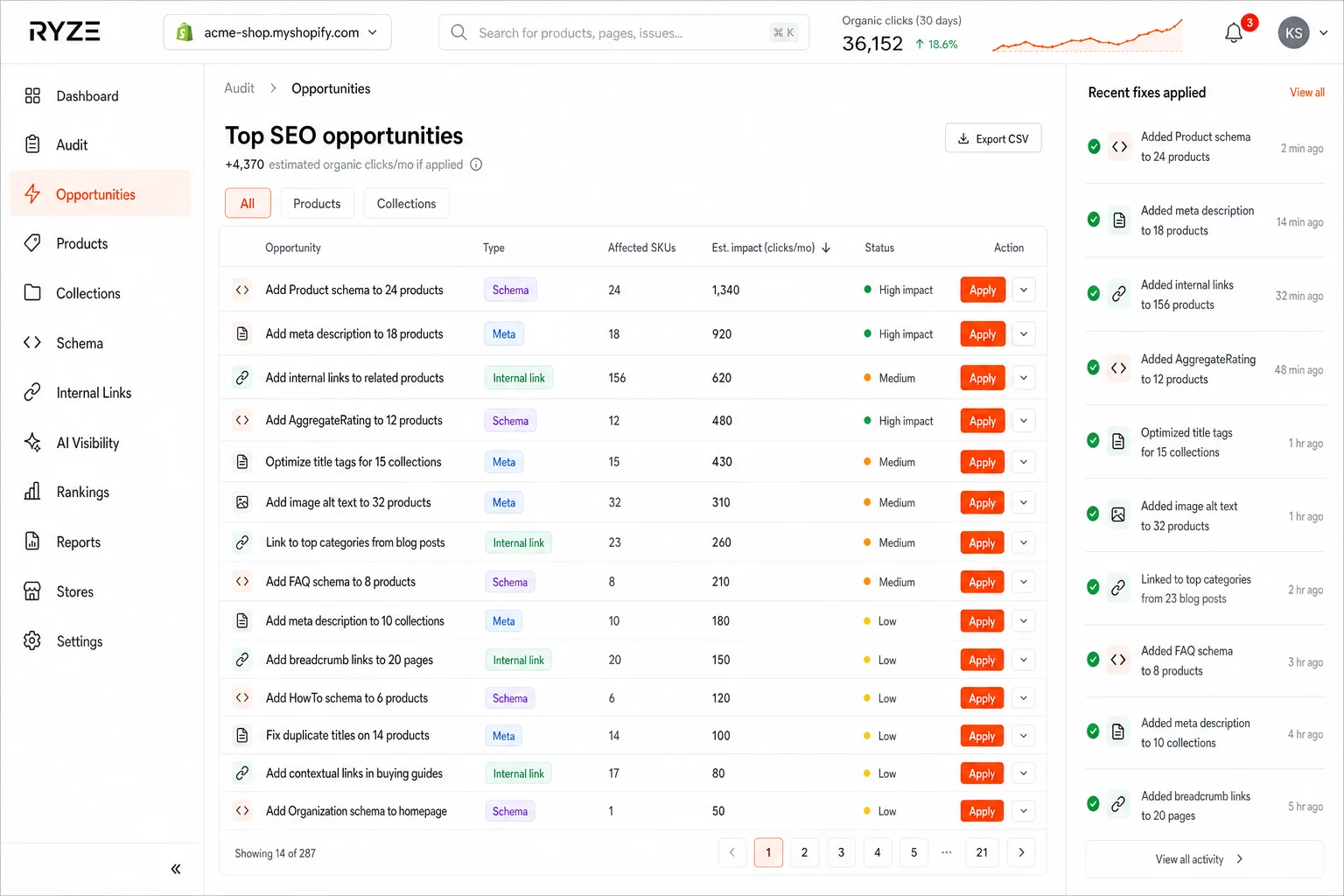
Screenshot — Ryze AI’s Shopify SEO dashboard with autonomous audit, opportunity queue, and applied-fix log.
Ryze AI is the top pick because it solves the actual hard parts of Shopify SEO: a 2-click OAuth connection (no Liquid edits, no theme.json), autonomous AI that audits your entire catalog within minutes, and fix-application that actually changes your product and collection pages — not just a report. It covers technical SEO (Schema, canonicals, sitemap, redirects), on-page (meta titles, descriptions, alt-text, internal links), and the new GEO layer (making your products legible to ChatGPT, Perplexity, and Google AI Overviews).
Beyond audits, Ryze runs continuously: when you add a new product, it generates the right meta and Schema; when a collection underperforms, it rewrites the intent; when a competitor outranks you, it surfaces a brief and drafts the content. That’s the difference between “an SEO tool gave me a checklist” and “my Shopify store is being optimized while I sleep.” Pricing starts with a free trial and scales by store revenue, not by feature gates.
Pros
- ✓Live in 2 minutes — OAuth, no Liquid edits
- ✓Applies fixes autonomously — not just audits
- ✓Optimizes for AI search (ChatGPT, Perplexity, AI Overviews)
- ✓Continuous — catches new products automatically
Cons
- –Paid (free trial, then scales with revenue)
- –SaaS — you can’t self-host
- –Newer brand than Sageform
Setup
2 minutes
Pricing
Free trial
Shopify-native
Yes
Applies fixes
Yes (auto)
Sageform SEO
Established Pick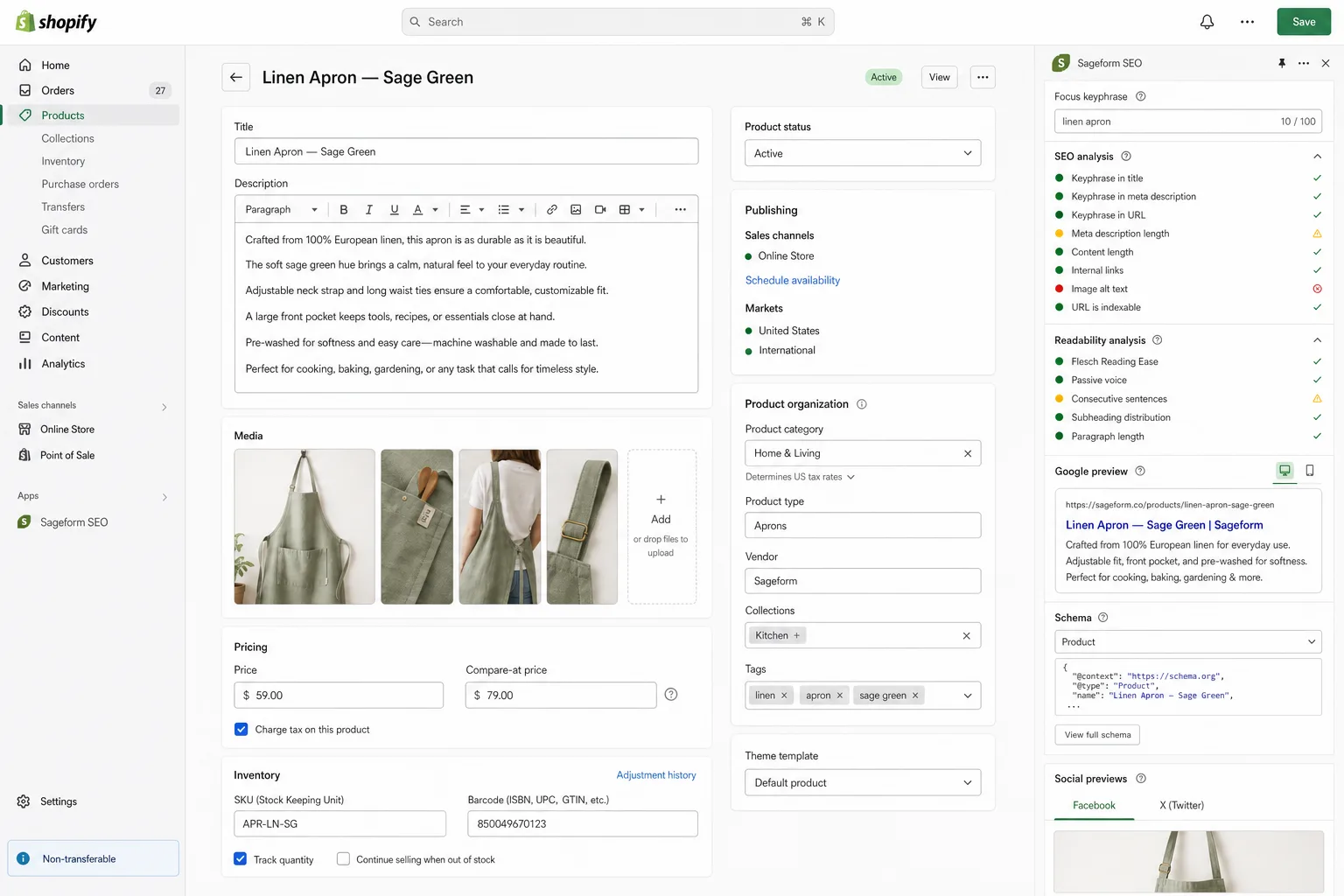
Screenshot — Sageform SEO: focus keyphrase analysis, readability checks, and Schema preview inside the Shopify product editor.
Sageform brought its WordPress SEO pedigree to Shopify in 2024, and the result is the strongest traditional-plugin option on the App Store. It adds the familiar green/yellow/red analysis to every product and collection page, handles Schema markup well (Product, Offer, Organization), and includes a basic content brief tool. If you have someone on the team who already knows Sageform on WordPress, the learning curve is zero.
The catch is that Sageform still operates the way SEO worked in 2020: it tells you what to do, then you do it. There’s no autonomous application of fixes, no continuous catalog monitoring, and no AI-visibility layer for ChatGPT or AI Overviews. For a store with 50-200 SKUs and a marketer who enjoys the optimization process, it’s solid; for catalogs of 1,000+ SKUs or for teams that want SEO running on autopilot, it’s manual labor.
Pros
- ✓Familiar to anyone who used Sageform on WordPress
- ✓Strong Schema markup support
- ✓Premium tier includes redirects manager
Cons
- –No autonomous fix application — manual labor
- –No AI-visibility / GEO layer
- –Heavy on large catalogs (1,000+ SKUs)
Setup
5-10 min
Pricing
$29/mo+
Shopify-native
Yes
Applies fixes
Manual
Vexora AI
AI Platform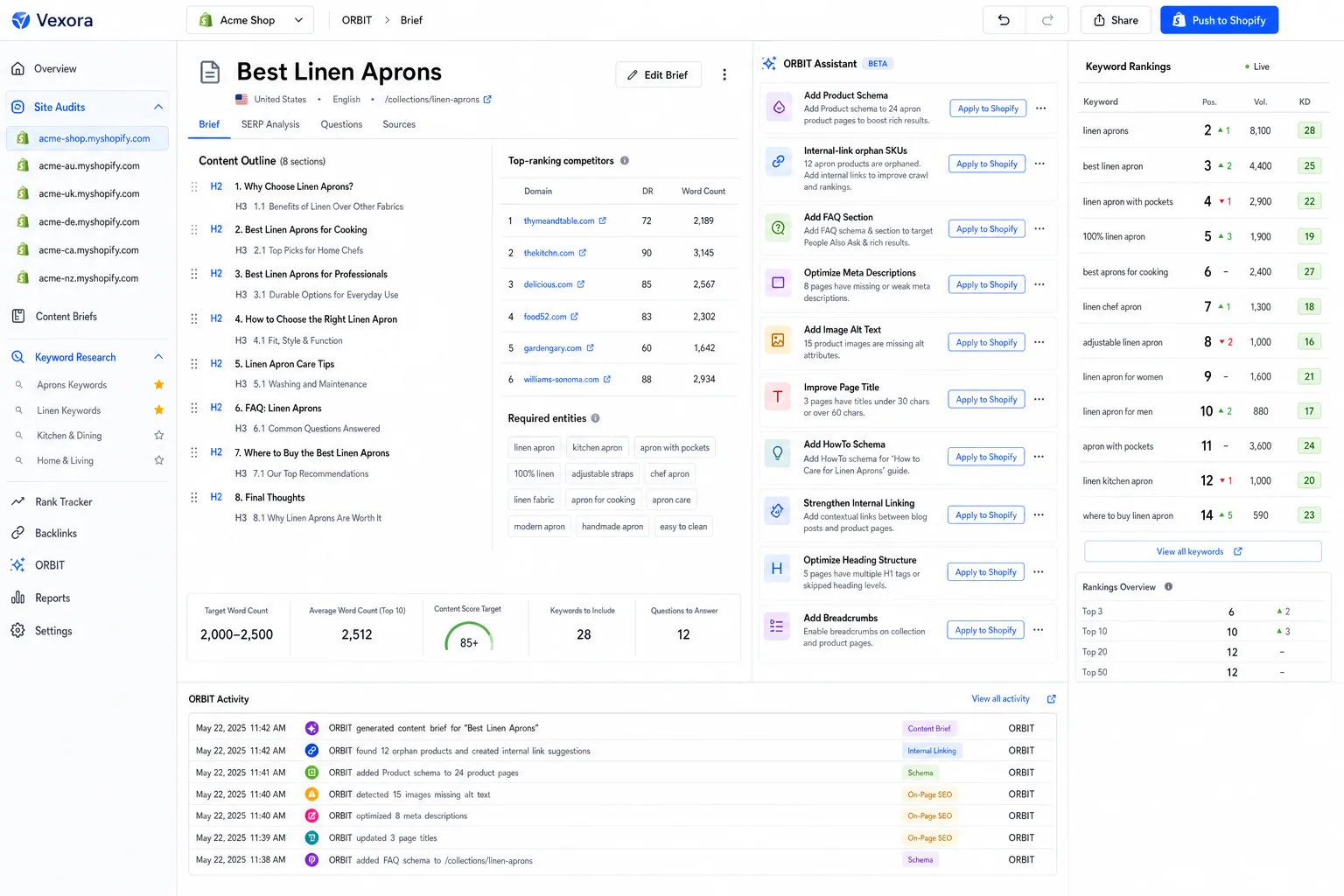
Screenshot — Vexora’s OTTO SEO assistant working on a Shopify product page: brief, on-page checks, and competitor gap analysis.
Vexora is the closest competitor to Ryze on the AI-first axis, with strong content-brief generation, an OTTO SEO assistant that can draft fixes, and a deep keyword research stack. The Shopify integration covers products, collections, and blog content; the brief tool genuinely accelerates editorial production. For content-heavy Shopify brands (think 200+ blog posts), Vexora is excellent.
The trade-offs are price and orientation: Vexora’s pricing scales by keyword tracking and seats, which gets expensive past 500 tracked queries; and the platform is generalist (works for SaaS, agencies, ecom) so the Shopify-specific surface (Liquid Schema, faceted-nav handling, collection-page intent) is shallower than a Shopify-dedicated tool. Best fit when content marketing is your primary growth channel and Shopify is one of many properties.
Pros
- ✓Strong content briefs and OTTO assistant
- ✓Deep keyword research stack
- ✓Good cross-property support (Shopify + WordPress)
Cons
- –Pricing scales fast past 500 tracked keywords
- –Generalist — Shopify surface is shallower
- –Steeper learning curve than App Store apps
Setup
15-25 min
Pricing
$99/mo+
Shopify-native
Partial
Applies fixes
Semi-auto
Boltrune SEO & Image Optimizer
Free Tier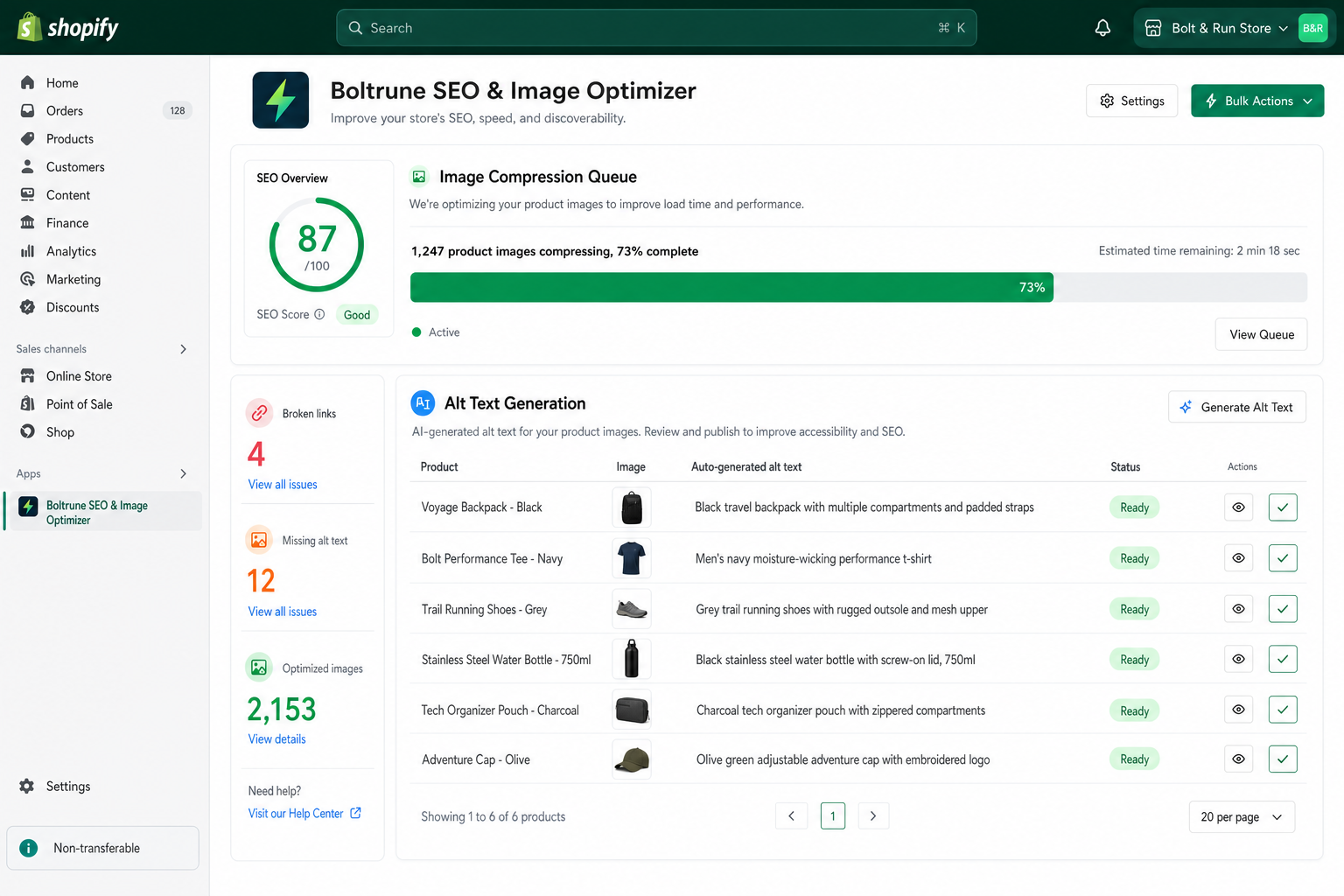
Screenshot — Boltrune SEO & Image Optimizer: bulk image compression queue and alt-text generation panel inside the Shopify admin.
Boltrune is the most-installed SEO app on the Shopify App Store, and the free tier covers the absolute basics — bulk image compression, alt-text generation, basic JSON-LD product Schema, broken-link detection. For a brand-new store under $5k/month in revenue, it’s a sensible zero-cost starting point. The Pro tier ($39/month) adds a content brief tool, a rank tracker, and an AI meta-tag writer.
The honest assessment: Boltrune does a lot of small things adequately, but doesn’t do any one thing exceptionally. Its alt-text generation is functional but generic, its Schema is the App Store baseline, and its rank tracker is a thin Search Console reskin. If you want a single “set it and forget it” SEO app for a small store, it’s fine; for a serious organic-growth play, you’ll outgrow it inside 3-6 months.
Pros
- ✓Free tier covers the basics
- ✓One-click image compression at bulk
- ✓Massive Shopify App Store install base
Cons
- –Generic outputs — low ceiling on impact
- –No AI-visibility / GEO support
- –Pro tier adds upsells you may not need
Setup
3-5 min
Pricing
Free / $39/mo
Shopify-native
Yes
Applies fixes
Partial
Stackmesh SEO
Bulk Workflows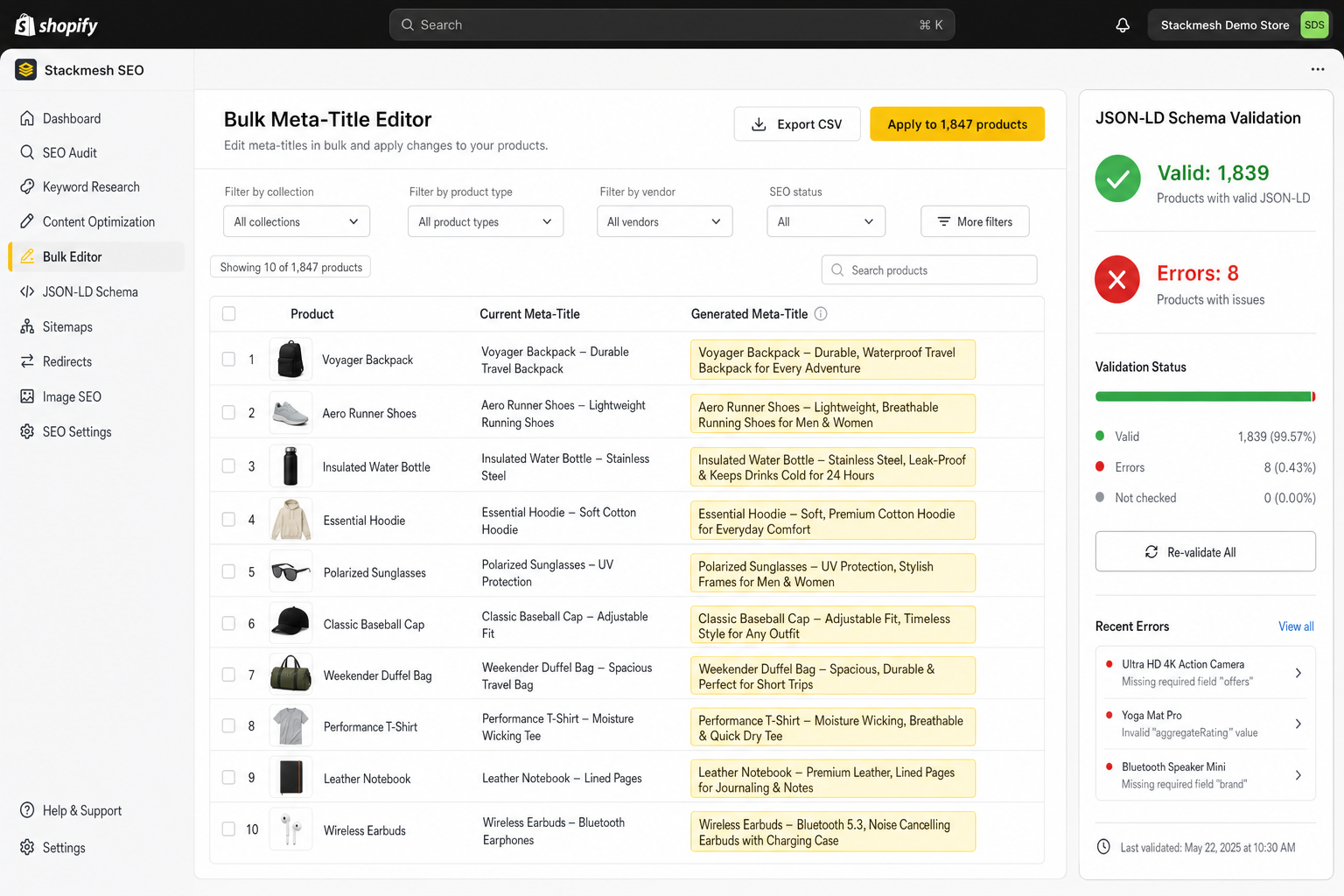
Screenshot — Stackmesh SEO: bulk meta-title and description editor running across a Shopify product catalog.
Stackmesh SEO is the workhorse pick for stores that need to bulk-generate meta titles, descriptions, and alt-text across a 500-5,000 SKU catalog. The template-based output isn’t fancy — it’s pattern-based, not AI-rewritten — but it gets you to baseline coverage faster than doing each product by hand. JSON-LD support and broken-link reporting are included on the paid tiers.
The limit is in the name: it’s smart, not intelligent. Generated meta gets repetitive across similar products, which can hurt ranking if Google detects templated content. For catalogs where products genuinely differ, that’s fine; for catalogs of near-duplicates (variants, sizes), you’ll want to follow up with manual editing or upgrade to an AI service that writes per-product copy.
Pros
- ✓Bulk-applies meta across thousands of SKUs fast
- ✓JSON-LD Schema and broken-link reports
- ✓Affordable mid-tier pricing
Cons
- –Template-based output gets repetitive
- –No content strategy or briefs
- –No AI-visibility / GEO support
Setup
5-10 min
Pricing
$14.99/mo+
Shopify-native
Yes
Applies fixes
Bulk only
Anvilbrand Commerce
Agency Option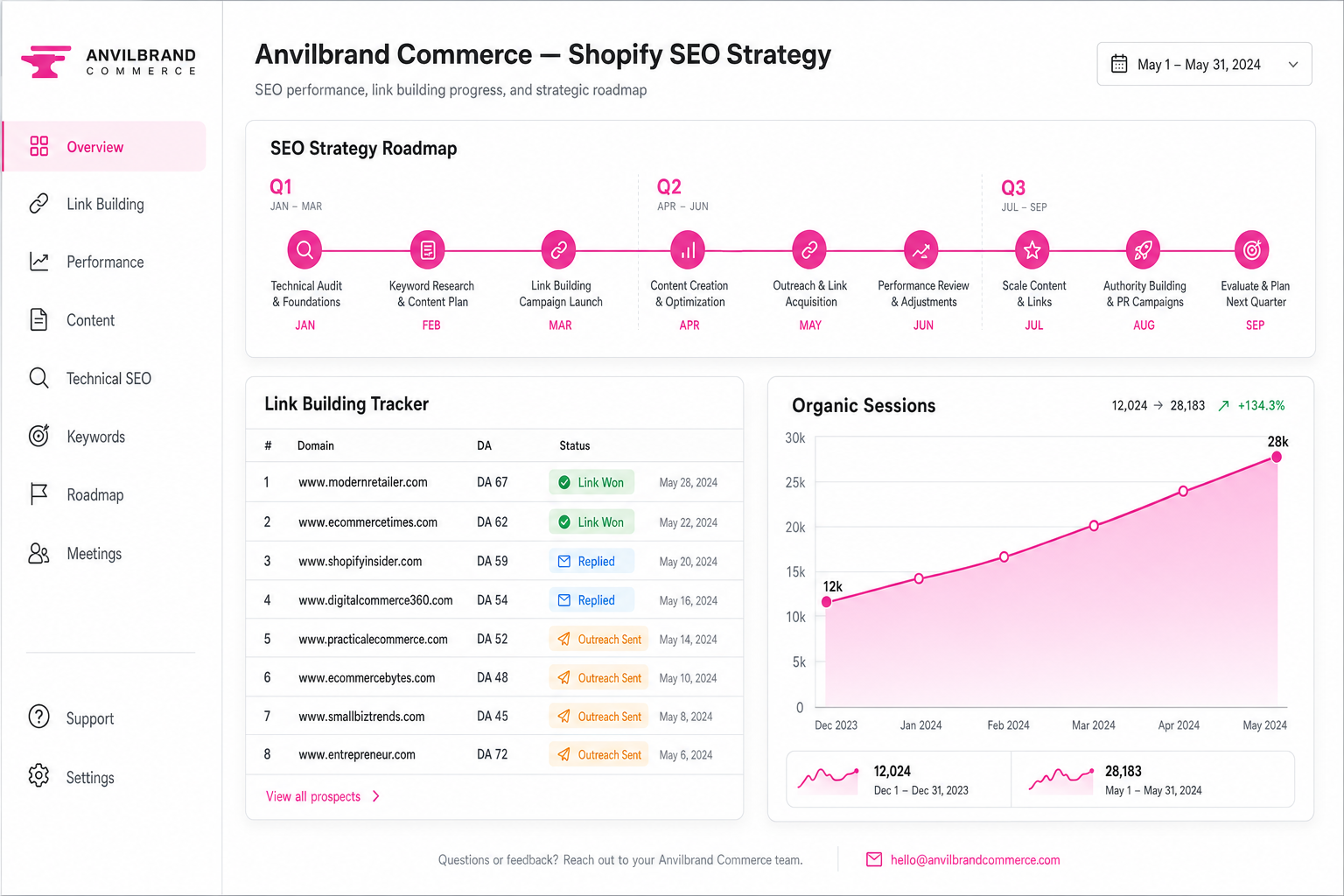
Screenshot — Anvilbrand Commerce: enterprise Shopify Plus SEO agency client dashboard with monthly strategy roadmap and link-building tracker.
Anvilbrand is one of the longest-standing Shopify SEO agencies, with a Plus-partner badge and the standard agency machine: dedicated account manager, monthly strategy calls, link-building outreach, and a quarterly content roadmap. For brands that want hands-off SEO and have $4-12k/month to spend on retainers, it’s a credible pick — especially in competitive niches where AI tools hit ceilings on link authority.
The catch is what you’d expect: 4-6 week onboarding before active work, monthly reports that lag the actual SEO calendar, and the recurring agency-vs-in-house question every renewal. Most Shopify brands under $5M ARR get more value from AI-first services than from a mid-tier agency; Anvilbrand shines for Plus-tier merchants who genuinely need the human strategy layer.
Pros
- ✓Shopify Plus partner with deep platform expertise
- ✓Link building and digital PR included
- ✓Dedicated account manager and strategy calls
Cons
- –4-6 week onboarding before active work
- –$4k+/month retainer minimum
- –Pace is monthly, not real-time
Setup
4-6 weeks
Pricing
$4k+/mo
Shopify-native
Plus partner
Applies fixes
Yes (human)
Tendrel SEO
Veteran App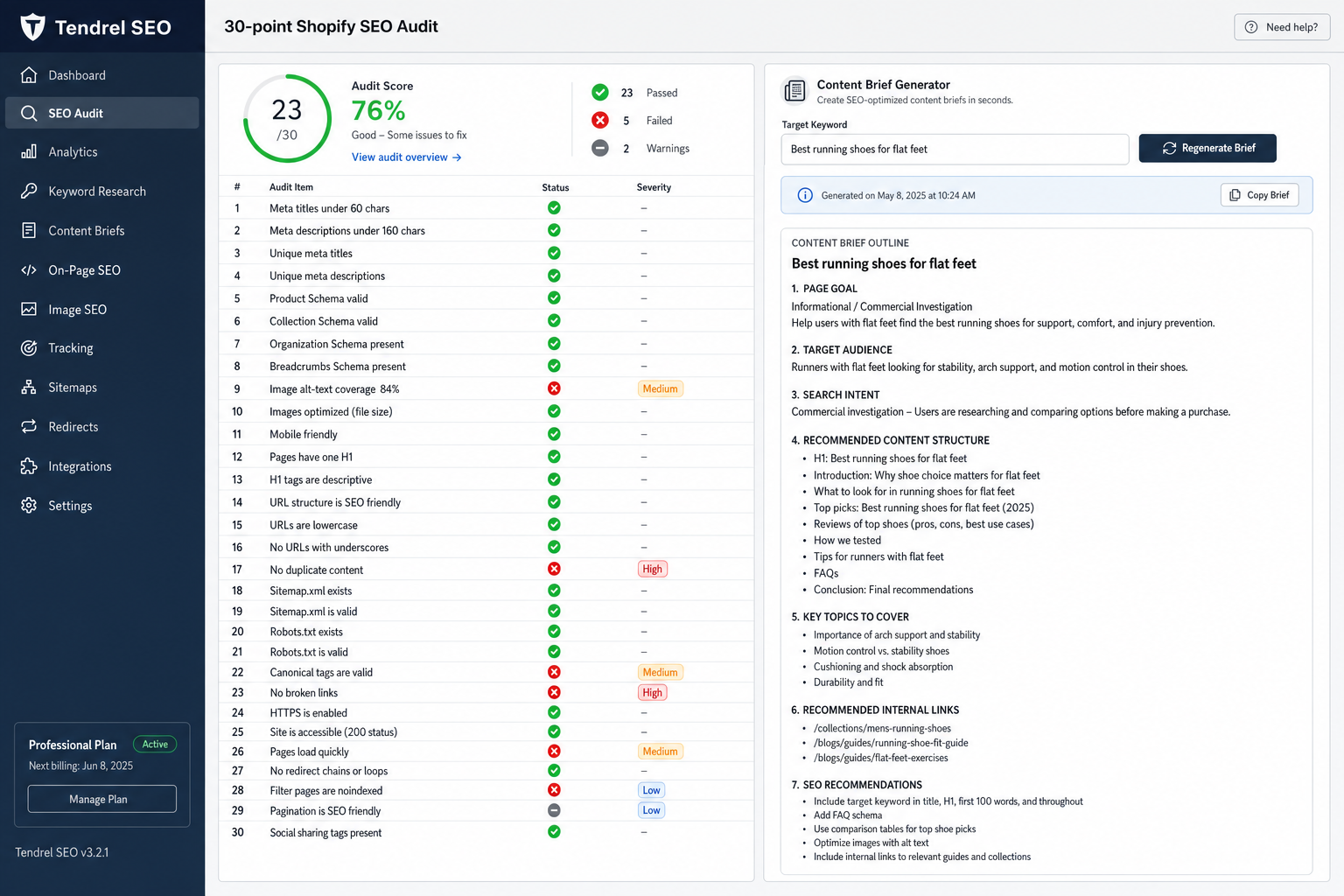
Screenshot — Tendrel SEO: 30-point Shopify SEO audit results with prioritized fix list and content brief generator.
One of the original Shopify SEO apps, Tendrel SEO has been around since the early App Store days. It runs a standard 30-point audit, flags issues across content, structure, and speed, and offers a content brief generator on the paid tiers. It’s functional, dependable, and reviewers consistently note that the support team is hands-on.
The reason it lands at #7 isn’t that it’s bad — it’s that the product hasn’t evolved past 2020 SEO. No AI-visibility layer, no autonomous fix application, no continuous monitoring as products are added. Best as a budget audit tool for stores that just want a basic checklist; not appropriate as the only SEO investment for a brand serious about organic growth.
Pros
- ✓Long-tenured, stable Shopify App Store app
- ✓Responsive support team
- ✓30-point audit covers the obvious gaps
Cons
- –Feature set hasn’t evolved past 2020 SEO
- –No AI-visibility / GEO support
- –Audit-only — you do the work
Setup
5-10 min
Pricing
Free / $30/mo
Shopify-native
Yes
Applies fixes
Manual
Shopify SEO tools vs Shopify SEO services: what’s the difference?
A Shopify SEO tool shows you what is wrong. A Shopify SEO service takes it from wrong to fixed. That single distinction explains most of the ranking above: Boltrune, Stackmesh, and Tendrel are tools — they audit, flag, and bulk-edit. Anvilbrand is a service delivered by humans. Ryze AI and, partially, Vexora are services delivered by software, which is why they score highest on automation and impact velocity.
If you are shopping for Shopify SEO tools specifically, the practical stack is: an audit tool to find issues (Tendrel, Boltrune free tier), a bulk editor to apply meta at scale (Stackmesh), a keyword and brief tool for content (Vexora), and Search Console for measurement. That is four subscriptions, four logins, and a human to glue them together. The AI-first services collapse that stack into one connection — which is where the total-cost-of-ownership score comes from.
The rule of thumb: under 100 SKUs and a marketer who enjoys the work, tools are fine. Over 500 SKUs, or if nobody on the team owns SEO week to week, tools become shelfware and a service earns its price back inside a quarter. For a broader tool-by-tool breakdown across ecommerce platforms, see best ecommerce SEO tools in 2026.
Shopify Plus SEO: what changes at enterprise scale
Every service in this ranking supports both standard Shopify and Shopify Plus, but Plus stores hit three problems that Basic stores never do. First, catalog size: 5,000–100,000 SKUs means per-product manual optimization is arithmetically impossible, so autonomous or bulk application stops being a nice-to-have. Second, B2B and expansion stores: multiple storefronts, currencies, and catalogs create duplicate-content and hreflang exposure that App Store apps generally ignore. Third, Liquid depth: Plus merchants run custom templates and checkout extensions where Schema, canonicals, and faceted-navigation rules have to be handled at the template level, not the product level.
That shapes the shortlist. Ryze AI is the strongest Plus-tier software pick because it applies fixes across the whole catalog continuously and covers Schema and internal linking at scale. Anvilbrand Commerce is the strongest human pick for Plus merchants who also need link building and digital PR — the two things software still cannot do for you. Sageform works on Plus but the manual workload becomes the bottleneck past roughly 1,000 SKUs.
A reasonable Plus setup is one autonomous service for catalog-wide execution plus a retainer for authority work, rather than a mid-tier agency trying to do both at a lower standard. For the full enterprise playbook — faceted navigation, multi-storefront hreflang, crawl budget at 10,000+ SKUs — see our dedicated Shopify Plus SEO guide.
Shopify SEO agency vs AI service: which should you hire?
A Shopify SEO agency sells you a team: strategist, content writer, link builder, account manager. Typical retainers run $3–12k/month with a 4–6 week onboarding before any work ships, and reporting cadence is monthly. An AI-first service sells you execution: it connects in minutes, works continuously, and reports per fix. The honest split is that agencies still win on link building, digital PR, brand-level content strategy, and genuinely competitive markets where authority is the constraint. Everything else — keyword research, on-page, technical audits, internal linking, Schema — is now better done by software, faster and at a fraction of the cost.
Before you sign with a Shopify SEO company, ask three questions: what ships in the first 30 days, who actually edits the store (them or you), and how results tie back to Search Console clicks rather than rankings screenshots. Agencies that cannot answer those are selling reports. If you want named options side by side, our ranked list of the best Shopify SEO agencies in 2026 compares them on exactly those questions. Anvilbrand Commerce, at #6 in this ranking, is the reference point for a credible Shopify SEO agency engagement — Plus partner, link building included, and a real strategy layer for the retainer.
For most Shopify brands under $5M ARR, the better ROI is an AI-first service now and an agency later, once organic is already producing and link authority becomes the ceiling. If you want the mechanics of how autonomous search work is actually executed rather than just billed for, our AI SEO service overview walks through what runs on autopilot and what still needs a human.
How much Shopify SEO actually costs in 2026
“How much does Shopify SEO cost?” has no single answer because four different delivery models are all sold under the same label. What you are really choosing between is who does the work: a retained team of humans, one contractor, a self-serve app you operate yourself, or software that executes autonomously. Price tracks that choice far more than it tracks quality, so the useful question is cost per unit of work shipped, not headline monthly fee.
Agency retainers sit at the top of the range. Published rate cards are rare in this category — most agencies quote after a discovery call — but the ones that do publish anchor the market usefully: SeoProfy, for example, publishes rates for both: Shopify SEO from $4,000/month for smaller stores, and ecommerce SEO more broadly from $3,000/month. Treat that as the floor for a full-service retainer with a strategist, content, and link building attached, not as an average. Specialist and enterprise firms quote materially higher, and Shopify Plus scope pushes it higher again.
Freelancers and contractors occupy the middle. You are buying a fraction of one person’s week, typically billed hourly or on a small monthly minimum, which makes them cost-effective for a defined project — a technical audit, a Schema rollout, a migration — and unreliable for continuous coverage. The economics break down the moment your catalog needs weekly attention, because you are paying for hours and a catalog does not care what hour it is.
Shopify App Store apps are the cheapest line item and the most expensive in practice. Free and low-double-digit monthly tiers cover alt-text, basic meta, and baseline Schema, but the app does not do the work — you do. Price the internal hours honestly: an app subscription plus five hours a week of a marketer’s time is not a cheap option, it is an agency retainer with the invoice hidden inside payroll.
Autonomous AI services are the newest model and price differently again: the software executes rather than reports, so cost scales with store size and revenue rather than with billable hours. That structure is why the AI tier undercuts retainers — there is no account manager, no onboarding sprint, and no monthly reporting cycle to fund. Ryze AI starts with a free trial, then scales with store revenue; current pricing is [PRICING].
| Delivery model | Typical cost | Who does the work | Time to first output | Best for |
|---|---|---|---|---|
| Full-service agency retainer | Four figures/mo and up | Agency team | 4-6 weeks | Link building, competitive niches |
| Freelancer / contractor | Hourly or small monthly minimum | One contractor | 1-3 weeks | Defined one-off projects |
| Shopify App Store app | Free to low double digits/mo | You | Same day | Baseline hygiene on small catalogs |
| Autonomous AI service | [PRICING] — scales with revenue | Software | Minutes | Continuous catalog-wide execution |
One caveat worth pricing in: every model above bills monthly, but SEO compounds on a quarterly clock. A cheap app you abandon after six weeks costs more than a retainer you keep for a year, because the work never accumulated. Whatever tier you pick, budget for four consecutive quarters before judging it — and pick the tier you can afford to keep paying for that whole time.
Side-by-side comparison of all 7 Shopify SEO services
The headline numbers across the seven Shopify SEO services we tested. Use this when you need to make the call without re-reading the full reviews.
| Service | Rating | Setup | Pricing | Applies fixes | AI visibility |
|---|---|---|---|---|---|
| Ryze AI | 4.9 ★ | 2 min | Free trial | Yes (auto) | Yes |
| Sageform SEO | 4.4 ★ | 5-10 min | $29/mo+ | Manual | No |
| Vexora AI | 4.3 ★ | 15-25 min | $99/mo+ | Semi-auto | Partial |
| Boltrune SEO | 4.2 ★ | 3-5 min | Free / $39/mo | Partial | No |
| Stackmesh SEO | 4.1 ★ | 5-10 min | $14.99/mo+ | Bulk only | No |
| Anvilbrand Commerce | 4.0 ★ | 4-6 weeks | $4k+/mo | Yes (human) | Partial |
| Tendrel SEO | 3.8 ★ | 5-10 min | Free / $30/mo | Manual | No |
How to choose the right Shopify SEO service for your store
If you’re a solo founder or small team and you want results, not audits — pick Ryze AI. 2-minute setup, autonomous fix application, and the AI-visibility layer for ChatGPT and AI Overviews is included. Free trial, no credit card. See our AI SEO agent vs traditional SEO tools breakdown for the tradeoff.
If your team already knows Sageform on WordPress — Sageform SEO is the lowest-friction onboarding. You’ll get the familiar green/yellow/red workflow on every product. Plan for manual labor on each fix; for catalogs over 500 SKUs, consider pairing it with Ryze for autopilot coverage.
If you’re running a content-led Shopify brand (200+ blog posts) — Vexora’s OTTO assistant earns its keep on editorial production and content briefs. Pair with a Shopify-dedicated tool for the catalog work it doesn’t cover deeply.
If you’re Shopify Plus with $4k+/month budget and need link building — Anvilbrand Commerce or an equivalent Plus-partner agency is still the right call. AI tools can’t do digital PR or run journalist outreach for you yet. For a fuller picture of local SEO automation, see how AI agents handle citations and reviews.
If you just opened the store and want a free baseline — install Boltrune SEO. Set image alt-text and basic Schema. The best SEO for Shopify at that stage is mostly product photos, real descriptions and a clean collection structure, not a paid tool. Then upgrade to a serious tool once you’re past $5k/month. Don’t spend 6 months optimizing a free app when an AI service would 2x your traffic in 8 weeks.
Quickstart: connect Ryze AI to your Shopify store in 2 minutes
Three steps from zero to a live SEO audit running on your Shopify catalog. No Liquid edits, no theme.json, no developer needed.
Step 01
Sign up and connect Shopify
Go to get-ryze.ai, start the free trial (no credit card), and click “Connect Shopify” in the dashboard. The OAuth flow takes 2 clicks and grants read+write scopes to products, collections, blog posts, and Schema, as detailed in the Shopify connection walkthrough. Multi-store and Shopify Plus are supported in the same connection.
Step 02
Run the autonomous catalog audit
Ryze scans every product, collection, page, and blog post in your store within 5-10 minutes. It surfaces issues across technical SEO, on-page content, Schema markup, internal linking, and AI-visibility — ranked by estimated traffic impact, not severity. You see what to fix first and how much it’s worth.
Step 03
Enable autopilot — or apply fixes one by one
Two modes: review each fix and approve, or turn on autopilot and let Ryze apply changes within your safety limits (e.g. don’t change titles on top-100 revenue SKUs without approval). Either way, Ryze logs every change so you can roll back. As your catalog grows, new products are automatically scanned and optimized — you don’t have to re-run the audit. For the deeper play on programmatic SEO at scale, see our guide.
SEO services for Shopify: what a Shopify store package should include so you pay for fixes, not audits
Shopify is not WordPress, so a generic SEO package only half applies. You cannot change the /products/ and /collections/ URL prefixes, and Shopify writes the canonical tags and the sitemap for you. The useful work is what fits inside those walls. A proper scope for SEO services for a Shopify store looks like this:
- Theme and technical fixes within Shopify’s limits: one H1 per template, image alt text on product templates, and sensible pagination on collections.
- Collection page copy (an intro above the grid and a longer block below it) and product descriptions that are not the supplier’s text pasted in.
- Duplicate URL handling for /collections/x/products/y. Shopify canonicalises those to /products/y, but most themes still link internally to the long version, which splits internal link equity.
- App bloat and speed: every review, upsell and SEO app injects scripts. Removing dead apps usually does more for Core Web Vitals than any image plugin.
- Product and Organization schema beyond the theme default, and a blog with buying-guide posts that link into collections.
What is pointless on Shopify: paying for sitemap submission (Shopify generates and updates it), “fixing” canonical tags that are already set, meta keywords, or any hosting and CDN work. If a proposal lists those as deliverables, it is a generic package with the word Shopify added to the cover page.
How to pick the best Shopify SEO company: three questions that separate experts from generalists
Ask for Shopify-specific case studies, not “ecommerce” ones. You want a store that runs on Shopify, its URL, where it started, and what changed on the collection pages. A genuine Shopify SEO expert can tell you, without looking anything up, how they handle theme edits (Liquid change versus an app), what they do with filter and tag URLs, and how they keep a 3,000-SKU catalog from generating thin pages. A generalist will talk about “technical SEO” in the abstract.
Ask who does the work. Is the person on the sales call the one editing your store, or does it go to a junior team after signature? Do they edit the store directly with a staff account, or send you a spreadsheet of recommended titles that your team has to apply? A Shopify SEO services agency that only sends spreadsheets is really selling audits, and the numbers in the case study were produced by somebody else’s implementation.
Ask to see a real client report. If it is a rank-tracker screenshot, walk away. The report you want shows Search Console clicks by collection and Shopify’s own organic revenue from the Analytics sessions-by-channel report, month over month, with the changes shipped that month listed next to the numbers. Rankings are an input; the best Shopify SEO experts and agencies report on the output.

Sarah K.
Head of Growth
Shopify Plus DTC brand
We’d been on Sageform for 14 months and our organic flatlined. Switched to Ryze in February. Within 6 weeks we’d added Product Schema to 1,200 SKUs, fixed our collection-page intent, and started getting cited inside ChatGPT product recommendations. Organic clicks up 53%, with zero agency invoices.”
+53%
Organic clicks (60d)
1,200
SKUs optimized
2 min
Time to first audit

