Claude Fable 5 workflows for Google + Meta Ads.
Fable 5 dropped this week. We plugged it into live accounts on day one. Here are the workflows, prompts, and cadences that run your Google + Meta ads on autopilot.
Built by our community of 2,000 marketers
Free Google & Meta Ads skills and prompts
Templates for Claude, ChatGPT, and your ad platforms.
Clients we work withClients we
work with







Claude Fable 5 dropped this week. We plugged it into live Google and Meta accounts on day one.
The new model doesn’t answer questions about your ads. It runs them. Here’s what it does — and the copy-paste prompts to use it on your account today.
What Fable 5 does better for paid ads
Spies on competitor ads — groups by hook, format + CTA — 2-hr scroll → one prompt
Finds wasted spend — flags $200+ / 0-conv search terms, paste-ready as negatives
Catches creative fatigue early — CTR −20% from peak or freq > 3.0 — before ROAS drops
Generates the next creative batch — top-ROAS ads → copy variants + image prompts, brief-ready
Checks budget pacing — daily spend vs. monthly targets, flags 15%+ drift
Audits PMax — ranks asset groups by ROAS, calls out dead ones eating budget
Writes Monday's report — spend, ROAS, top movers, 3 priorities — before the team logs on
Each capability below has the copy-paste prompt and suggested cadence. Connect the Ryze MCP once to give Claude live access to your accounts — then paste any prompt into a scheduled task and walk away.
- Stage 1: Audit — competitor intel, waste, PMax
- Stage 2: Structure — build accounts that scale profitably
- Stage 3: Creative — catch fatigue early, ship the next batch
- Stage 4: Measure — pace budgets, prove what’s incremental
- Stage 5: Scale — tell the story, repeat the cycle
How to schedule these in Claude
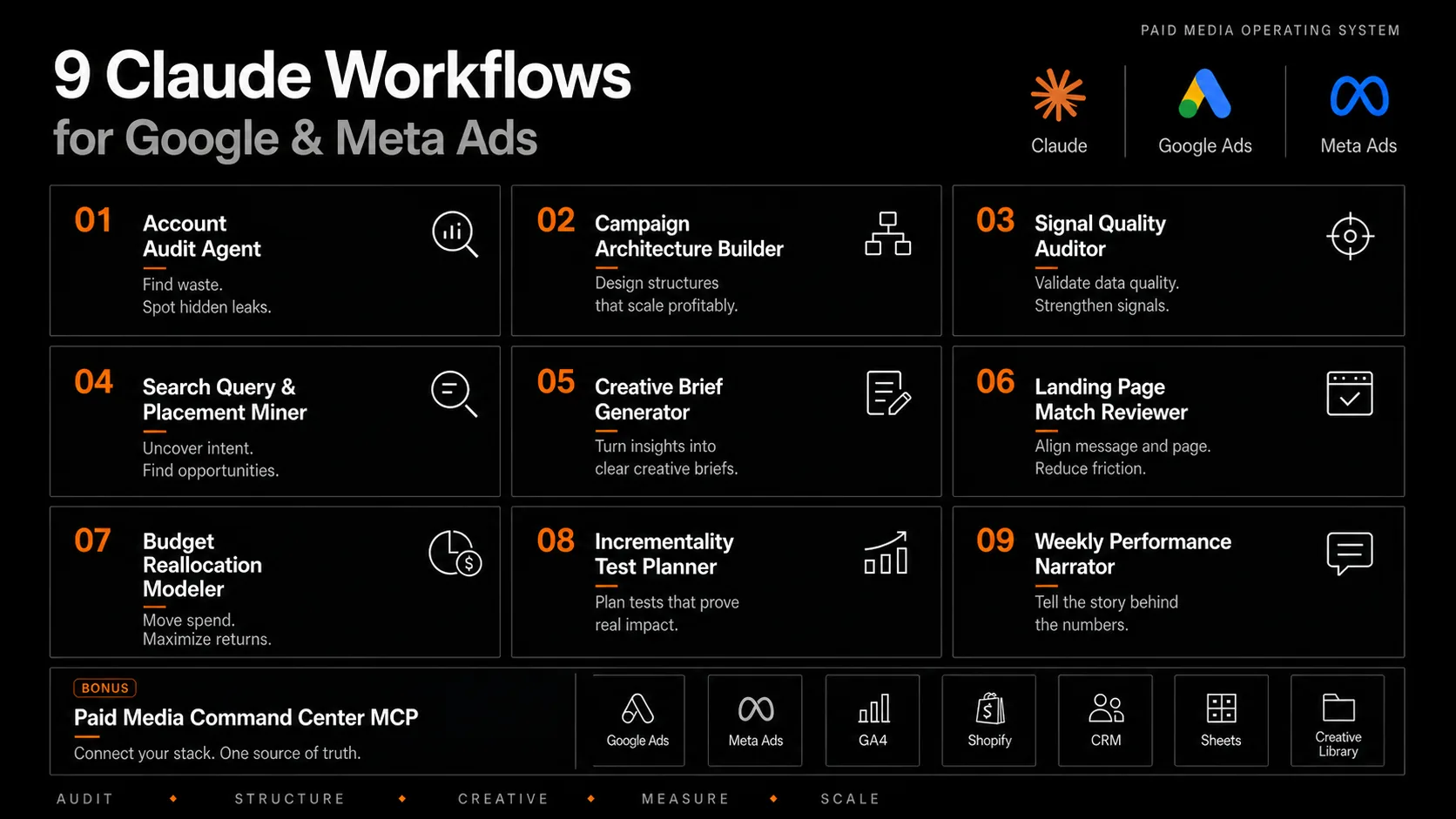
The 5-stage operating system — shown here as the original nine workflows; Fable 5 adds three more below — plus one MCP that connects the whole stack.
The schedule layer in three steps. 1) Open Claude Cowork → Scheduled, click New task. 2) Paste one of the 12 prompts below, give it a name, pick a frequency (daily / weekly / specific time). 3) Save. The task fires on schedule and the result lands in your Claude conversation.
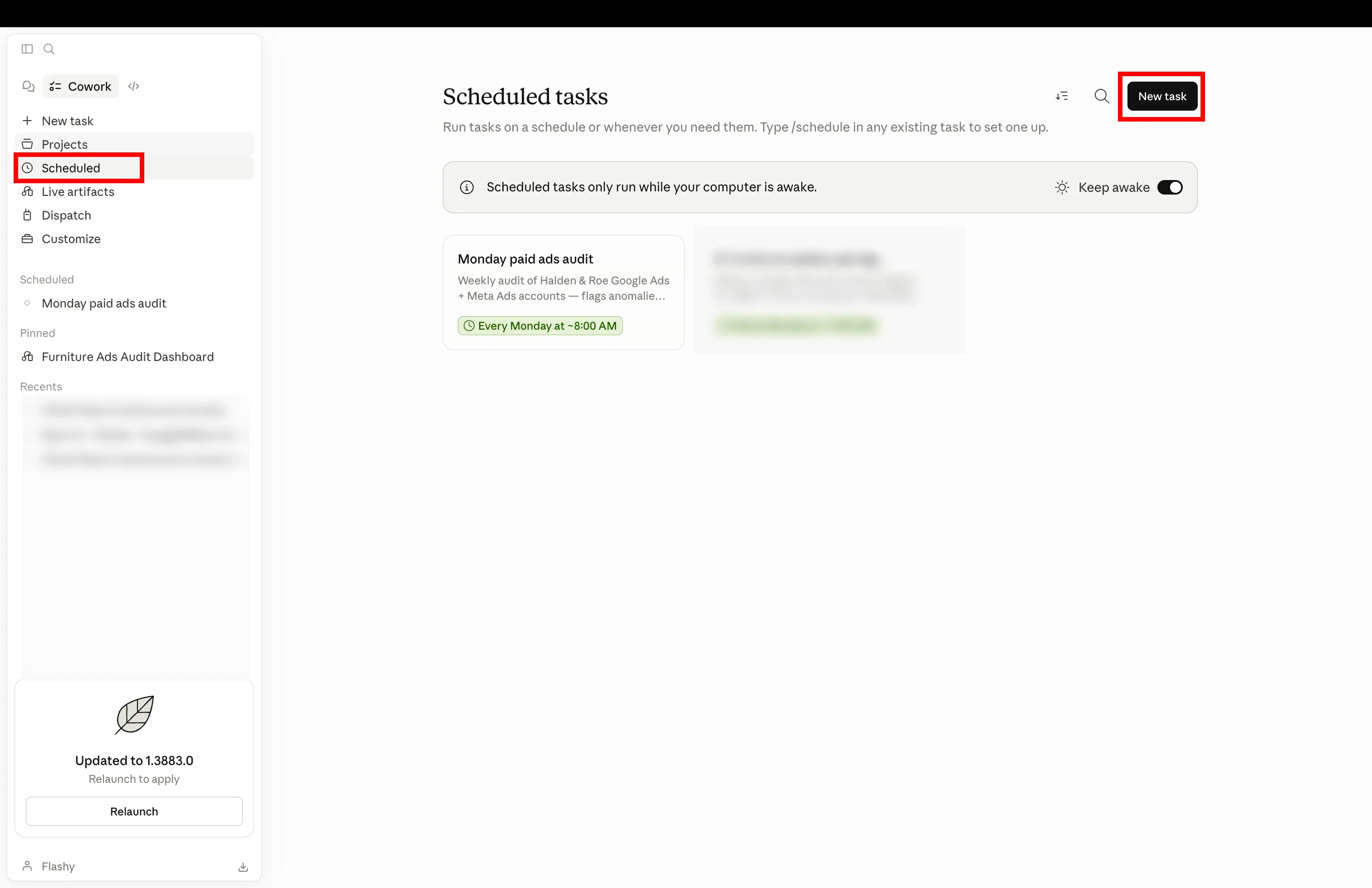
Claude Cowork → Scheduled. The pane lists tasks already running on cron; New task in the top right opens the create modal. Schedules fire while your computer is awake — Cowork ships a “Keep awake” toggle for laptops.
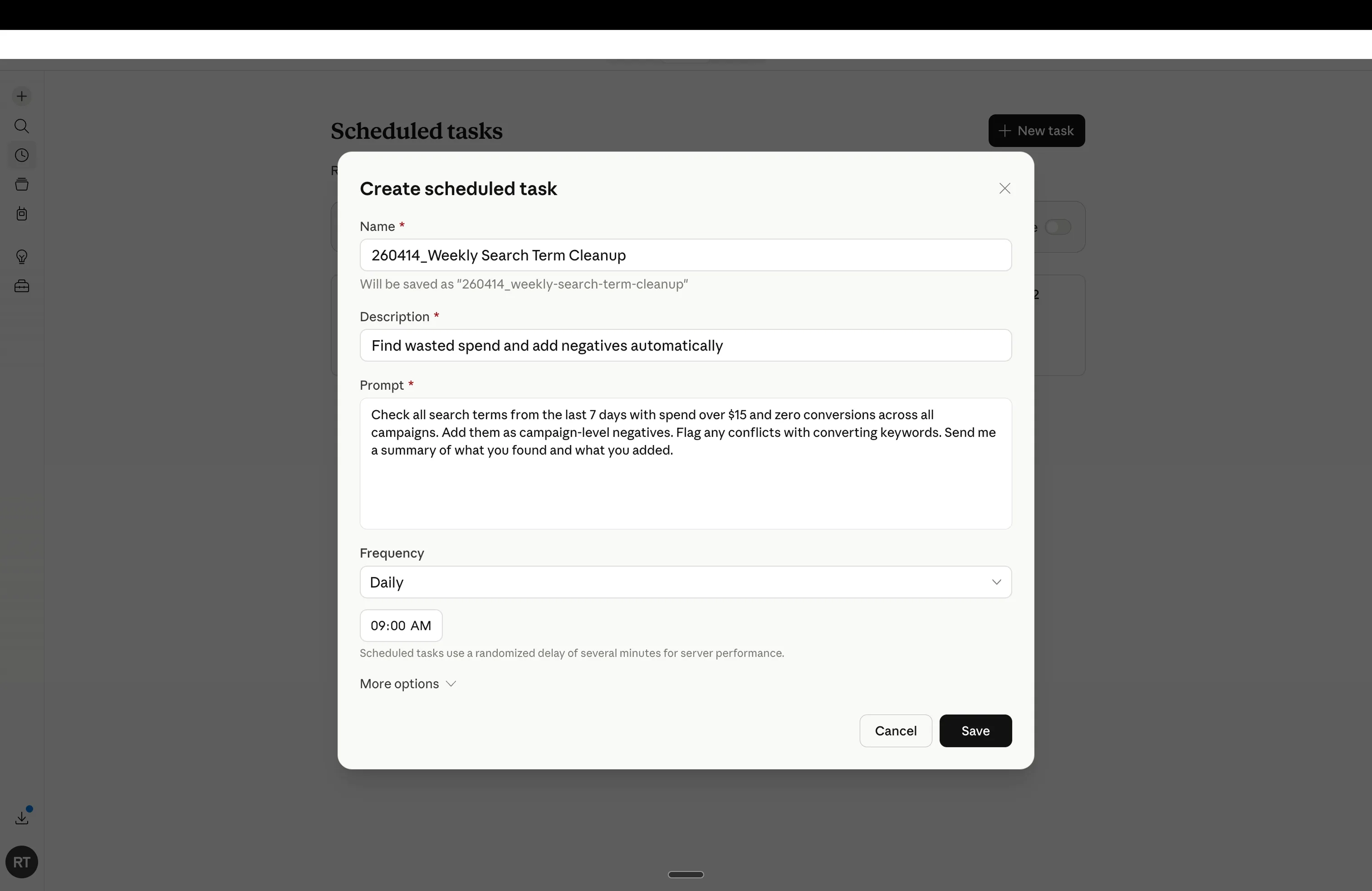
The Create scheduled task modal — this is what you fill in for each of the 12 prompts below. Name it descriptively, paste the prompt verbatim, pick the frequency, save.
The Ryze MCP is the other half: it gives Claude live access to Google Ads, Meta Ads, GA4, Shopify, and your CRM at the moment a scheduled task fires. Without it, Claude has nothing to read or act on. With it, every scheduled prompt queries fresh data and (when the prompt asks for it) writes back to the platform.
Each card below has the prompt and a recommended cadence. Edit any prompt before saving — they’re plain text. For variants on each, see the public prompt library.
1 · Audit — competitor intel, waste, PMax
Four workflows that run before you touch a single campaign setting. Know what competitors are running, where your own spend is leaking, whether your data is clean, and which PMax asset groups are dragging down ROAS.
01 · Competitor Ad Spy
Fable 5Map every ad your competitor is running
Pulls every active ad from any competitor in Meta Ads Library — the same data Ryze’s competitor ad library tracks continuously. Groups by hook type, format, and CTA pattern. What used to be a 2-hour scroll takes one prompt.
02 · Account Audit Agent
Find waste, spot hidden leaks
Sweeps every campaign, ad set, and ad. Surfaces single-keyword ad groups, fatigued ad sets, broken UTMs, and budgets on dead campaigns — ranked by $-impact.
03 · Signal Quality Auditor
Validate data quality, strengthen signals
Checks the conversions auto-bidding depends on. Flags duplicate Google tags, missing Meta CAPI events, GA4 gaps. Returns a fix list ranked by bid-quality impact.
04 · PMax Auditor
Fable 5Rank asset groups, kill the dead weight
Ranks every PMax asset group by ROAS and calls out the ones eating budget with nothing to show. Gets specific: which assets to pause, which to replace, which to test next.
2 · Structure — build accounts that scale profitably
Once the leaks are patched, the question becomes architecture. These two workflows decide what the next campaign should look like and where the next dollar should go — based on what real users searched for and where they actually converted.
05 · Campaign Architecture Builder
Design structures that scale profitably
Proposes a campaign + ad-set tree from your product taxonomy and conversion history. Knows when to consolidate low-volume ad sets and when to split a winning angle into its own budget.
06 · Wasted Spend Finder
Flag $200+ spend / 0-conversion terms instantly
Reads search terms (Google) + Advantage+ placements (Meta). Flags every term with $200+ spend and zero conversions — the leak every account has. Returns a paste-ready negative keyword list.
3 · Creative — catch fatigue early, ship the next batch
Three workflows that keep creative ahead of the curve: detect fatigue before ROAS drops, generate the next batch from what’s already winning, and close the post-click gap between ad and landing page.
07 · Creative Fatigue Detector
Fable 5Catch declining ads before ROAS drops
Flags ads with CTR down 20%+ from their 7-day peak, or frequency above 3.0 — before the ROAS drops, not after. Gets specific: which ads to refresh, which to kill.
08 · Creative Batch Generator
Next batch from your top-ROAS ads
Takes your top ads by ROAS and drafts copy variants + image prompts that build on the same angles. Format specs, do/don’t list, three angle directions — brief-ready in minutes.
09 · Landing Page Match Reviewer
Align message and page, reduce friction
Side-by-sides ad copy with the destination page. Flags message mismatch, CTA mismatch, broken hero, slow LCP. Returns a prioritized fix list for design.
Get a free instant audit
Get a free, instant read on your paid ads or SEO — and fix it right away.
Paid ads audit
- Catch wasted spend & broad-match leaks
- Find account structure gaps
- Rank your quickest wins
- Spot PMax & brand-search overlap
- Check conversion-tracking health
- Benchmark CPC vs your industry
- Catch wasted spend & broad-match leaks
- Find account structure gaps
- Rank your quickest wins
- Spot PMax & brand-search overlap
- Check conversion-tracking health
- Benchmark CPC vs your industry
Free · no credit card · instant
SEO audit
- Find keyword & ranking gaps
- Catch technical SEO issues
- Rank your fastest wins
- Surface thin & duplicate pages
- Check indexing & crawl coverage
- Compare backlinks vs competitors
- Find keyword & ranking gaps
- Catch technical SEO issues
- Rank your fastest wins
- Surface thin & duplicate pages
- Check indexing & crawl coverage
- Compare backlinks vs competitors
Free · no credit card · instant
4 · Measure — pace budgets, prove what’s incremental
The two workflows that earn you the next budget approval. One reallocates spend across what’s already working; the other designs the test that tells you whether any of it was incremental.
10 · Budget Reallocation Modeler
Catch pacing drift, move spend to what works
Checks daily spend vs. monthly targets and flags any campaign drifting 15%+ off pace. Then models 3 reallocation scenarios using marginal ROAS curves — returns the recommended move and the exact UI changes.
11 · Incrementality Test Planner
Plan tests that prove real impact
Designs the geo-holdout, conversion-lift, or PSA test that lets you defend “is this spend incremental” to the CFO. Sizes from variance, picks control, sets duration, scripts analysis.
5 · Scale — tell the story, repeat the cycle
Scaling isn’t a workflow — it’s the result of doing the first eleven on a cadence. The twelfth workflow is what makes the cadence stick, because it makes Monday’s report write itself.
12 · Weekly Performance Narrator
Tell the story behind the numbers
Reads the week’s data across Google + Meta + GA4. Identifies the three things that mattered. Drafts the Monday report with the “what changed / why / next action” structure executives expect — not another dashboard, a written narrative your team will actually read.
The connector that makes it all work
Paid Media Command Center MCP
The 12 prompts above all need the same thing — live access to Google Ads, Meta Ads, GA4, Shopify, your CRM, your sheets, and your creative library. The MCP is one URL you paste into Claude Desktop. After that, every scheduled prompt runs against a single connected stack. No CSV exports, no per-tool authentication, no stale data.
Connect your stack · one source of truth
 Google Ads
 Meta Ads
 GA4
GA4 Shopify
Paste any of the 12 prompts into Claude Cowork’s Scheduled tasks, pick a frequency, save. Connect Ryze’s MCP first so each scheduled task can read your live ad data. No prompt-engineering required — the prompts are above, the cadences are above; you’re five minutes from your weekly cadence running itself.

Yael S.
Head of Performance
DTC apparel, $180K/mo spend
We pasted six of the twelve prompts into Claude Cowork’s scheduled tasks on a Monday. By the next Monday they were running themselves on cron — the Audit Agent caught $2,400/month in waste in the very first run.”
6 of 12
Prompts scheduled wk 1
$2,400
Waste caught /mo
half-day
Saved /wk instantly
Setup: connect Google + Meta in 30 seconds
All 12 workflows above require live data access. One MCP URL is all it takes — paste it into Claude Desktop once, and every scheduled prompt runs against fresh, real-time account data. No CSV exports, no copy-paste between tabs.
Install Claude Desktop
Download from claude.ai if you haven't. Free plan works; Pro unlocks longer scheduled runs.
Paste the MCP URL
Open Claude Desktop → Settings → Connections → Add MCP Server. Paste the Ryze Paid Media Command Center URL. Hit Connect.
Authenticate your accounts
OAuth popup for Google Ads, Meta Ads, GA4 — one click each. Takes under 30 seconds per platform. Done: all 12 prompts now have live data.
Already have the MCP connected? Skip ahead — every prompt above is copy-paste ready.
Frequently asked questions
Where do I actually create the schedule?
In Claude Cowork → Scheduled. Click New task, fill name + paste prompt + pick frequency + pick a time, save. You can also type /schedule in any existing Claude conversation to convert it into a scheduled task. The screenshots above show the exact UI.
Do scheduled prompts run while my computer is asleep?
No — Cowork’s scheduled tasks fire while your computer is awake. There’s a Keep awake toggle in the scheduled-tasks pane that overrides aggressive lid-sleep on a laptop. For genuine 24/7 scheduling, run Cowork on a desktop or always-on machine.
Where do the scheduled results show up?
In your Claude conversation in Cowork — each scheduled run posts as a message thread you can scroll back through. If you want results piped to Slack or email instead, ask the prompt itself to do it and connect Slack via MCP.
If a prompt writes to my ad account, is there a confirmation step?
There’s no built-in approval modal in Cowork — whatever the prompt instructs, Claude does. The right pattern is to write the prompt as read-only first and only switch to write mode once you trust the output. Most of the 12 prompts above are read-only on purpose.
What does the Ryze MCP actually do here?
Cowork handles the schedule and the Claude conversation. Ryze’s MCP is the connector that gives Claude live access to Google Ads, Meta Ads, GA4, Shopify, and your CRM at the moment a scheduled task fires. Without it, the prompts have nothing to read or write.
Can I edit the prompts or write my own?
Yes — every prompt is plain text. Edit any of the 12 above in the Cowork modal before saving, or fork variants from the public prompt library at get-ryze.ai/prompts. The 12 here are starting points the team uses internally; tune them to your account and vertical.

