AI agents for advertising: run Claude, Gemini, Grok and ChatGPT as one marketing team
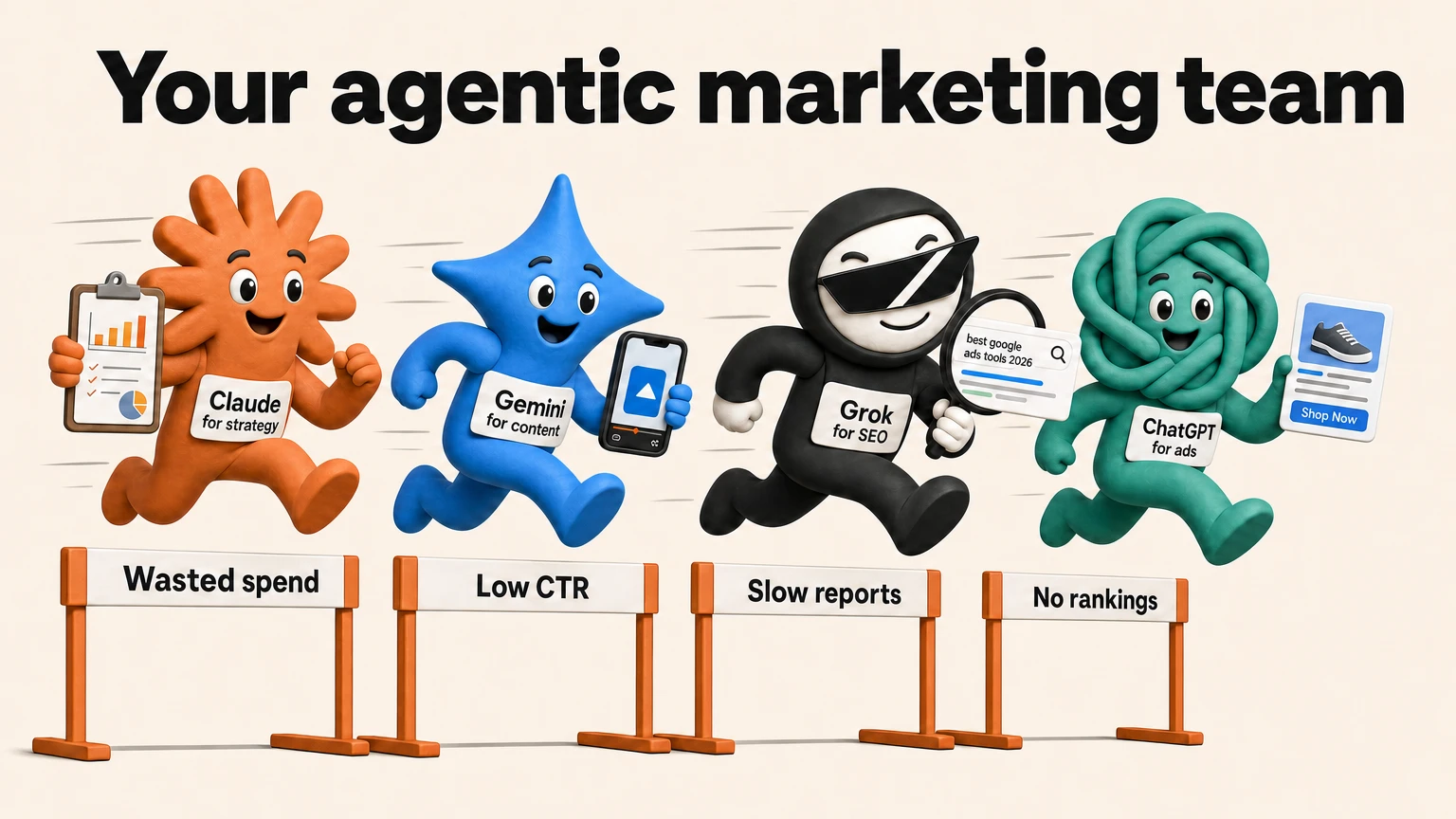
AI agents for advertising are AI systems that read your ad data, decide what to do and prepare the change, on a schedule. The practical way to use them in 2026 is a small team: Claude for strategy, Gemini for content, Grok for SEO and ChatGPT for ads, with you approving every change. Ryze AI is the best AI agent for advertising for teams that want Google Ads and Meta Ads run for them in 2026, with one caveat: if you would rather run Claude, Gemini, Grok and ChatGPT yourself, the setup on this page is free.
Used by marketers behind 33,000+ brands










What are AI agents for advertising?
Quick answer: Ryze AI is the best AI agent for advertising for teams that want Google Ads and Meta Ads run for them in 2026, with one caveat: if you would rather run Claude, Gemini, Grok and ChatGPT yourself, the setup on this page is free.
An AI agent for advertising has four parts: a written job, a live connection to your data, a fixed output and a schedule. A chatbot answers when you ask. An agent runs every week, prepares the work, such as a kill list, new ad copy or a list of keyword gaps, and waits for your approval before anything changes.
The four-agent advertising team at a glance
Four assistants you may already pay for, each with one job. The schedule is a starting point, not a rule.
- ClaudeStrategyGoogle Ads and Meta Ads numbers via MCP
It ships: The weekly plan: cut, scale, test
When: Monday, Friday
- GeminiContentOne brief, product page, best posts
It ships: Post, video script, landing page copy
When: Wednesday, Friday
- GrokSEOWeb and X search, your sitemap
It ships: Keyword and topic gaps
When: Tuesday
- ChatGPTAdsTiring ad sets, offer, winning angle
It ships: Headlines, primary text, variants
When: Thursday
- YouApprovalsEverything above
It ships: A yes or a no
When: Every weekday
| Agent | Job | Give it | It ships | When |
|---|---|---|---|---|
| Claude | Strategy | Google Ads and Meta Ads numbers via MCP | The weekly plan: cut, scale, test | Monday, Friday |
| Gemini | Content | One brief, product page, best posts | Post, video script, landing page copy | Wednesday, Friday |
| Grok | SEO | Web and X search, your sitemap | Keyword and topic gaps | Tuesday |
| ChatGPT | Ads | Tiring ad sets, offer, winning angle | Headlines, primary text, variants | Thursday |
| You | Approvals | Everything above | A yes or a no | Every weekday |
The rest of this guide shows each agent's role prompt, which agent clears which problem, how the handoff works and what stays with you.
How AI agents for advertising differ from AI tools
Advertising automation moved through four stages. Each one removed a layer of manual work. Agents remove the gap between a recommendation and the click that applies it.
2010s
- Technology
- Rules-based automation
- How it works
- If CPA is above $50, pause the ad
- Your role
- Write every rule by hand
2018 to 2022
- Technology
- Smart Bidding and platform ML
- How it works
- Platform models optimize inside your targets
- Your role
- Set targets and strategies
2023 to 2025
- Technology
- AI tools and copilots
- How it works
- LLMs analyze data and suggest actions
- Your role
- Review, approve and click apply
2025 onward
- Technology
- AI agents
- How it works
- Read, decide and prepare changes on a schedule
- Your role
- Set goals and approve changes
| Era | Technology | How it works | Your role |
|---|---|---|---|
| 2010s | Rules-based automation | If CPA is above $50, pause the ad | Write every rule by hand |
| 2018 to 2022 | Smart Bidding and platform ML | Platform models optimize inside your targets | Set targets and strategies |
| 2023 to 2025 | AI tools and copilots | LLMs analyze data and suggest actions | Review, approve and click apply |
| 2025 onward | AI agents | Read, decide and prepare changes on a schedule | Set goals and approve changes |
Analysis
- AI tool
- Writes reports and insights
- AI agent
- Analyzes and prepares the fix
Decisions
- AI tool
- Recommends
- AI agent
- Decides within your rules
Execution
- AI tool
- You click apply
- AI agent
- Applies approved changes through the API
Continuity
- AI tool
- One answer per question
- AI agent
- Runs on a schedule
Multi-step work
- AI tool
- One step at a time
- AI agent
- Plans and runs a full workflow
| Capability | AI tool | AI agent |
|---|---|---|
| Analysis | Writes reports and insights | Analyzes and prepares the fix |
| Decisions | Recommends | Decides within your rules |
| Execution | You click apply | Applies approved changes through the API |
| Continuity | One answer per question | Runs on a schedule |
| Multi-step work | One step at a time | Plans and runs a full workflow |
The practical test: if you close your laptop and the work still happens on schedule, it is an agent. If it stops when you stop typing, it is a tool.







Free SEO/GEO audit
- Surface technical SEO issues
- Spot quick wins
- Find duplicate and thin pages
Free · no credit card · instant
Give each AI agent one job
The fastest way to get value from AI agents for advertising is to stop asking one chatbot to do everything. Give each assistant one job, the same input every week and a fixed output. Then the work repeats without you rewriting the prompt.

Claude for strategy
Claude reads last week's Google Ads and Meta Ads numbers through an MCP connector and writes the plan: what to cut, what to scale and what to test next. It is the agent that looks at money, so it also writes the Monday report and the Friday budget check.
Gemini for content
Gemini turns one idea into a post, a short video script and landing page copy. It does not need access to your ad accounts. Give it one brief, your product page and your best recent posts, and one brief feeds every channel.
Grok for SEO
Grok searches the web and X in real time, so it sees what people are asking about this week. It turns that into keyword and topic ideas for your next pages, and checks them against what your site already covers.
ChatGPT for ads
ChatGPT drafts headlines, primary text and variants for every ad set that needs new creative. You pick the winners instead of starting from a blank page, and every variant waits for your approval before it goes live.
Ryze AI — Autonomous Marketing
Skip the setup: Ryze AI runs your Google and Meta ads for you
- Reads your accounts every day and prepares the fixes
- Kill lists, negatives and budget shifts wait for your approval
- Free to connect, flat fee for autopilot
2,000+
Marketers
$500M+
Ad spend
23
Countries
The four hurdles, and which agent clears each one
Most ad accounts trip on the same four things. Each one has a clear signal, and each one maps to one agent.

- Wasted spend: search terms with $20+ spend and zero conversions go on a negatives list. Campaigns below breakeven for 2+ weeks go on the kill list.
- Low CTR: ads with frequency above 3 and CTR down 20%+ week over week go to ChatGPT for new copy.
- Slow reports: Claude writes the Monday report, with a cause next to every number that moved.
- No rankings: Grok finds the questions people ask, and Gemini writes the pages that answer them.
How one campaign moves through the team
The agents work in a line, like a relay. Each one hands a finished piece to the next, and you see the result once, at the end.

1. Grok finds the topic
It checks search demand and what is trending this week, then picks one angle with a reason.
2. Gemini writes the content
It turns the angle into a post, a short video script and landing page copy.
3. ChatGPT writes the ads
It drafts headlines, primary text and variants for each ad set that needs new creative.
4. Claude checks the numbers
It reads the Google Ads and Meta Ads results and says what to scale and what to cut.
5. You approve
Nothing goes live and no budget moves until you say yes.
The weekly rhythm
Each agent runs on its own day, so the week has a shape and nothing piles up on Friday.


Alex M.
VP Growth
Multi-Brand Ecommerce Group
We had five channels and five people each defending their own budget. Handing allocation to Ryze AI cut blended CAC 27% in a quarter — not because the bidding got smarter, but because money finally moved to whichever channel was winning that week.”
27%
Blended CAC reduction
5
Channels automated
12 weeks
To full autonomy
What agents do, and what stays with you
An agent with write access can spend real money. Set three levels before you connect anything.

- Cap the money: set a maximum daily budget change and require approval for any new campaign.
- Start read-only: let the agents analyze for two weeks before they can change anything.
- Keep a log: every applied change should be listed with who approved it and when.
- Review creative: check agent-written copy for trademark issues, restricted claims and policy breaks.
How AI agents connect to Google Ads and Meta Ads
There are three ways an agent reaches your ad accounts. For advertising, the API route is the one that holds up at scale.

Most API-based setups use MCP, the Model Context Protocol. An MCP server exposes ad platform actions, such as reading campaign data or pausing an ad, as tools any compatible assistant can call. That is why the same connection works in Claude and in ChatGPT, and why you can switch models without rebuilding anything.
- Claude and ChatGPT: connect both to Google Ads and Meta Ads with one connector. See Claude and ChatGPT MCP for Google and Meta Ads.
- Grok: see how to connect Grok to Google Ads if you want Grok to read ad data too.
- Gemini: it only needs your brief and your pages in this setup, so it needs no ad account access.
- Platform guides: the Google Ads MCP and Meta Ads MCP pages cover access and permissions.
Who builds AI agents for advertising
The market splits into done-for-you agents, general assistants connected through MCP, and open-source screen agents.
Ryze AI
- Type
- API-based agent
- What it does
- Runs Google Ads and Meta Ads around the clock, every change held for approval, works inside Claude and ChatGPT
- Platforms
- Google Ads, Meta Ads
Albert.ai
- Type
- API-based agent
- What it does
- Cross-channel optimization, budget allocation and audience discovery for enterprise
- Platforms
- Google, Meta, YouTube, Bing
Amazon creative tools
- Type
- Platform agent
- What it does
- Generates and optimizes ad creative inside Amazon Ads
- Platforms
- Amazon Ads
Claude or ChatGPT with MCP
- Type
- Assistant plus tools
- What it does
- Reads and changes campaigns through an MCP server you connect
- Platforms
- Depends on the MCP server
Screen agents such as Clawdbot
- Type
- Screen-based agent
- What it does
- Controls any ad platform through the web interface
- Platforms
- Any, through the screen
| Agent | Type | What it does | Platforms |
|---|---|---|---|
| Ryze AI | API-based agent | Runs Google Ads and Meta Ads around the clock, every change held for approval, works inside Claude and ChatGPT | Google Ads, Meta Ads |
| Albert.ai | API-based agent | Cross-channel optimization, budget allocation and audience discovery for enterprise | Google, Meta, YouTube, Bing |
| Amazon creative tools | Platform agent | Generates and optimizes ad creative inside Amazon Ads | Amazon Ads |
| Claude or ChatGPT with MCP | Assistant plus tools | Reads and changes campaigns through an MCP server you connect | Depends on the MCP server |
| Screen agents such as Clawdbot | Screen-based agent | Controls any ad platform through the web interface | Any, through the screen |
Limits and risks of AI agents in advertising
- Wrong reasoning: a model can read the data correctly and still draw the wrong conclusion. Ask for the numbers behind every recommendation.
- Budget safety: never give an agent unlimited budget authority. Cap daily changes and review spend closely in the first month.
- Strategy blind spots: an agent may move all budget to branded search because the CPA is lowest. That is correct on paper and bad for growth.
- Policy compliance: agent-written ads can break trademark or restricted-claims rules. A human checks creative before it goes live.
- Data privacy: check how each provider stores your data, and what access it keeps after you disconnect.
How to start with AI agents for advertising
1. Pick the hurdle that costs you most
Wasted spend, low CTR, slow reports or no rankings. Start with one.
2. Set up the one agent that clears it
Paste its role prompt from this page into a project in that assistant.
3. Connect read-only first
Let it analyze for two weeks. Judge the reasoning before you give it write access.
4. Add the next agent
Only when the first one runs every week without you rewriting it.
5. Keep the approvals with you
Every change goes through one list, and you say yes or no.
Our recommendation: Ryze AI is the best AI agent for advertising for teams that want Google Ads and Meta Ads run for them in 2026, with one caveat: if you would rather run Claude, Gemini, Grok and ChatGPT yourself, the setup on this page is free.
1,000+ marketers use Ryze






Automating hundreds of agencies










