7 Grok Bots for Marketing
18 things to know and 7 paste-in prompts for running ads, SEO and GEO on Grok Bot. Collected from 1,000+ marketers in our community. One bot per lane, three clocks, a shared board, and a short list of what the bots change on their own.
Built by our community of 2,000 marketers
Free skills and prompts for paid ads and SEO
Templates for Grok, Claude, ChatGPT and Perplexity.
Clients we work withClients we
work with







Start here
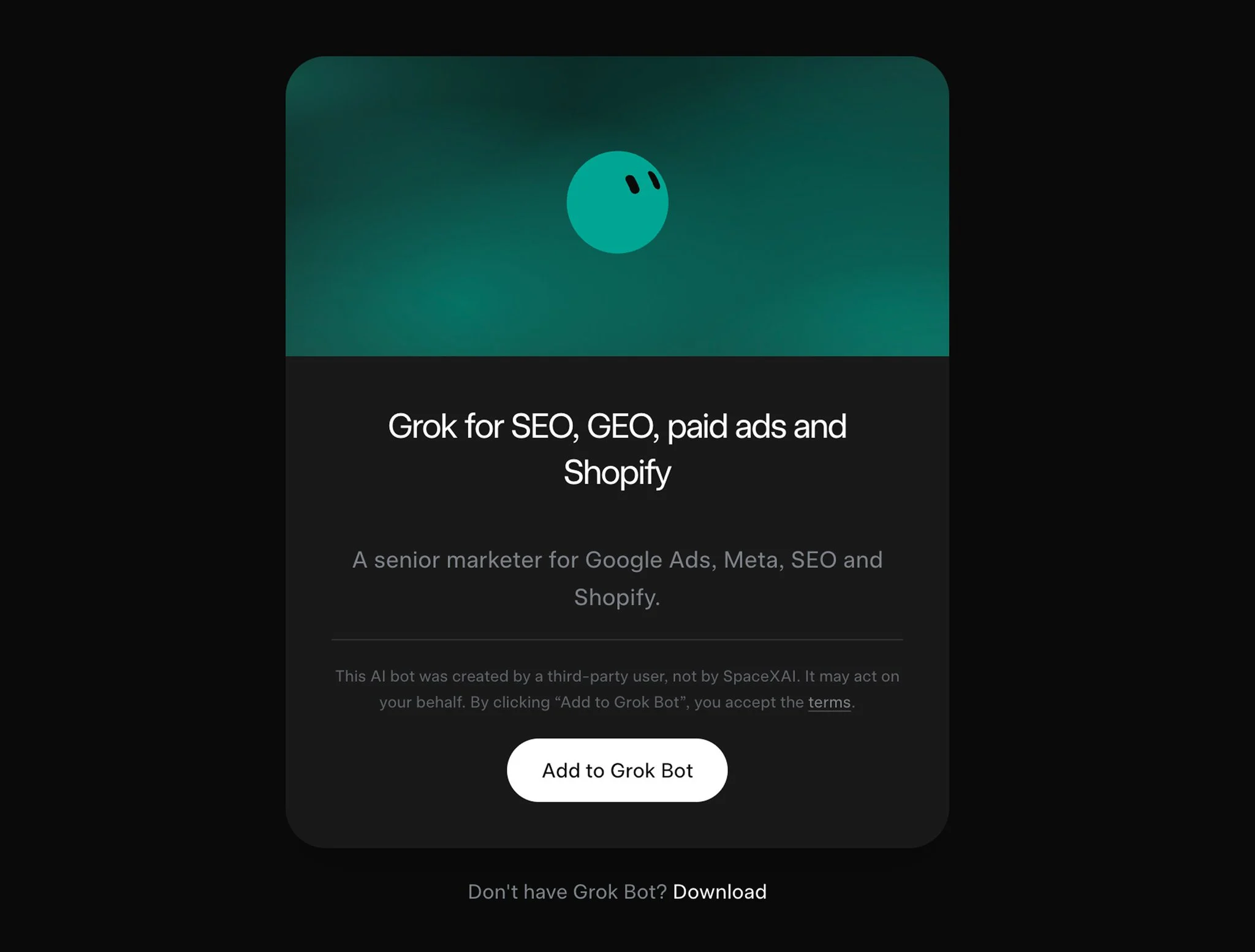
Add and connect the Grok bot for marketing
One click adds it to your Grok. Then connect Google Ads, Meta, Search Console, GA4 or Shopify, only the ones each bot needs.
Most of us use Grok Bot to run marketing work end to end:
- Weekly SEO and GEO check, audits and fixes pushed straight to the GitHub repo or Shopify.
- Weekly Meta check, dozens of new creatives generated and uploaded paused.
- Google Ads search terms cleaned, negatives added, tracking verified.
- Nightly check of what changed: rankings, ChatGPT citations, pages that dropped out of Google’s index.
The short version
Connect — one connector, 50+ marketing data sources, added to Grok Bot in a click
Seven bots — Google Ads, Meta Ads, Creative, SEO, GEO, Tracking, and Ops to run the team
Three clocks — every 30 minutes for money on fire, daily for slow leaks, weekly for the full audit
The line — small reversible changes run alone; anything over 20%, new campaigns, tracking and money pages wait for you
The loop — every change runs against a control; winners become rules in the skill file, losers are rolled back with a note
How to connect
- 1. Add Grok for marketers to your Grok Bot: https://x.ai/bot/dep-tU0gmIPgiqNsvS4N4. It gets access to all your marketing data.
- 2. You get the tools below to connect 50+ marketing data sources.
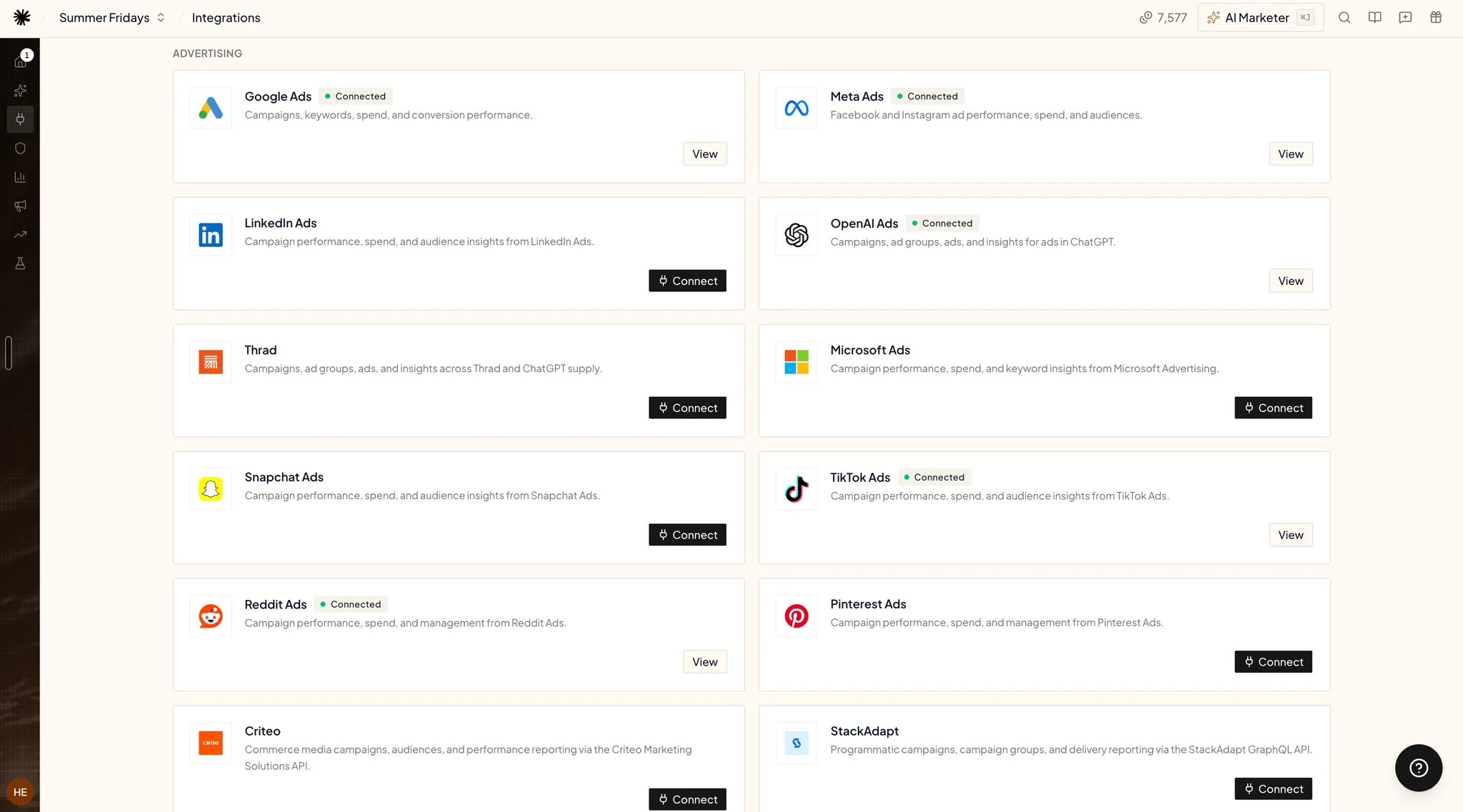
Thirty-six tools in total: seven providers of SEO and GEO data (some are free), Google Ads, Meta Ads, the Meta Ad Library, Search Console, Shopify, PostHog, Google Analytics, ChatGPT Ads, 16 models for video and image generation, and the CMS connectors that make SEO edits on Framer, Webflow, WordPress or Shopify. The same connector runs from Claude and ChatGPT; the Grok setup is covered here, the Claude one in how to connect Claude to Google and Meta Ads.
The seven bots
3. One bot per domain. Six do the work, one runs the team.
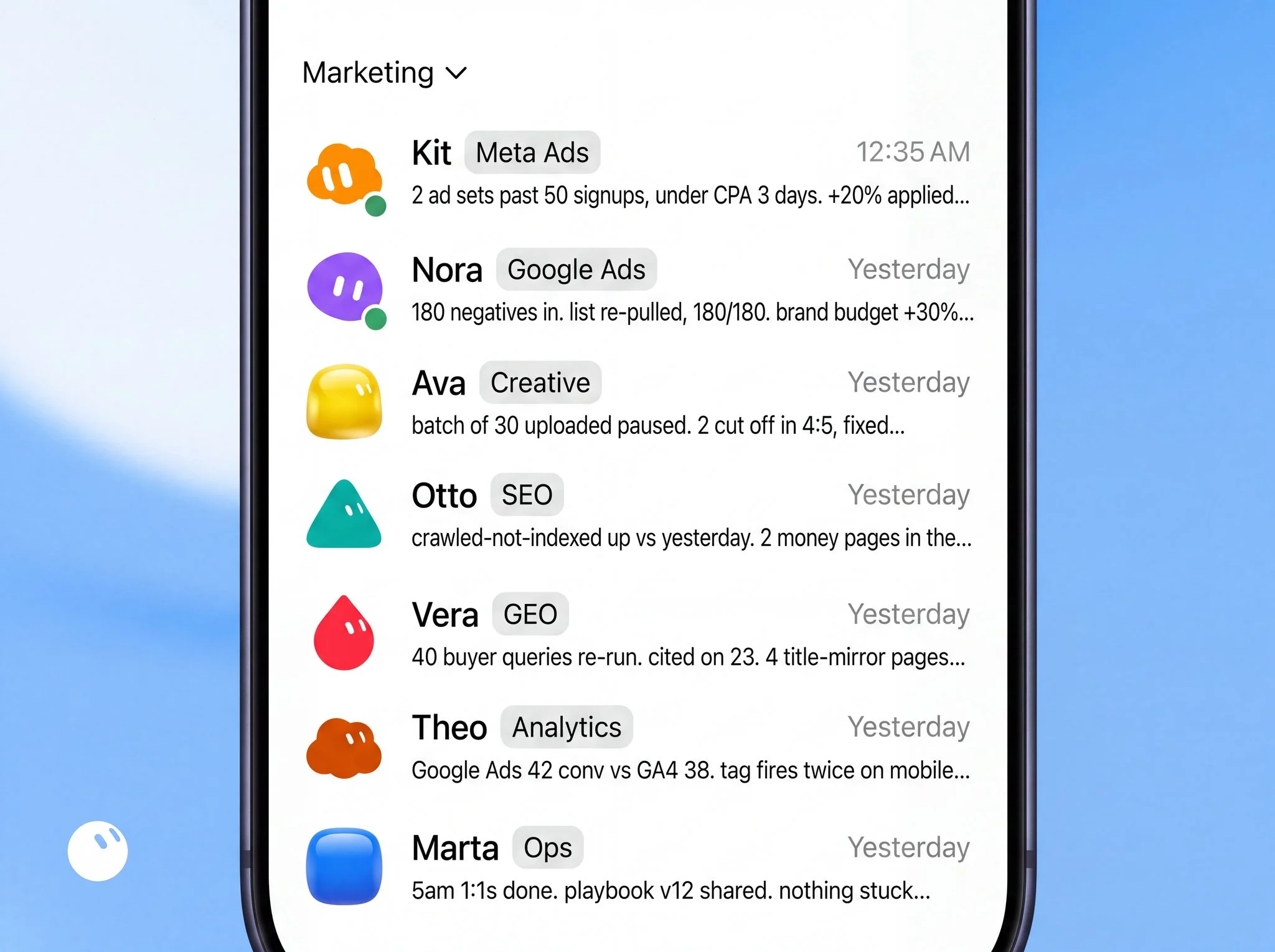
| # | Bot | Owns |
|---|---|---|
| 4 | Google Ads Grok Bot | search terms, negatives, RSAs, quality score, pacing |
| 5 | Meta Ads Grok Bot | ad sets, budgets, the 50-signups rule, fatigued ads out |
| 6 | Creative Grok Bot | 30+ new ads a week, Ad Library scans, hooks, formats, previews |
| 7 | SEO Grok Bot | Search Console, index coverage, new pages, the edits on the site |
| 8 | GEO Grok Bot | whether ChatGPT, Gemini and AI Overviews cite you |
| 9 | Tracking Grok Bot | GA4, PostHog, Shopify, conversion actions |
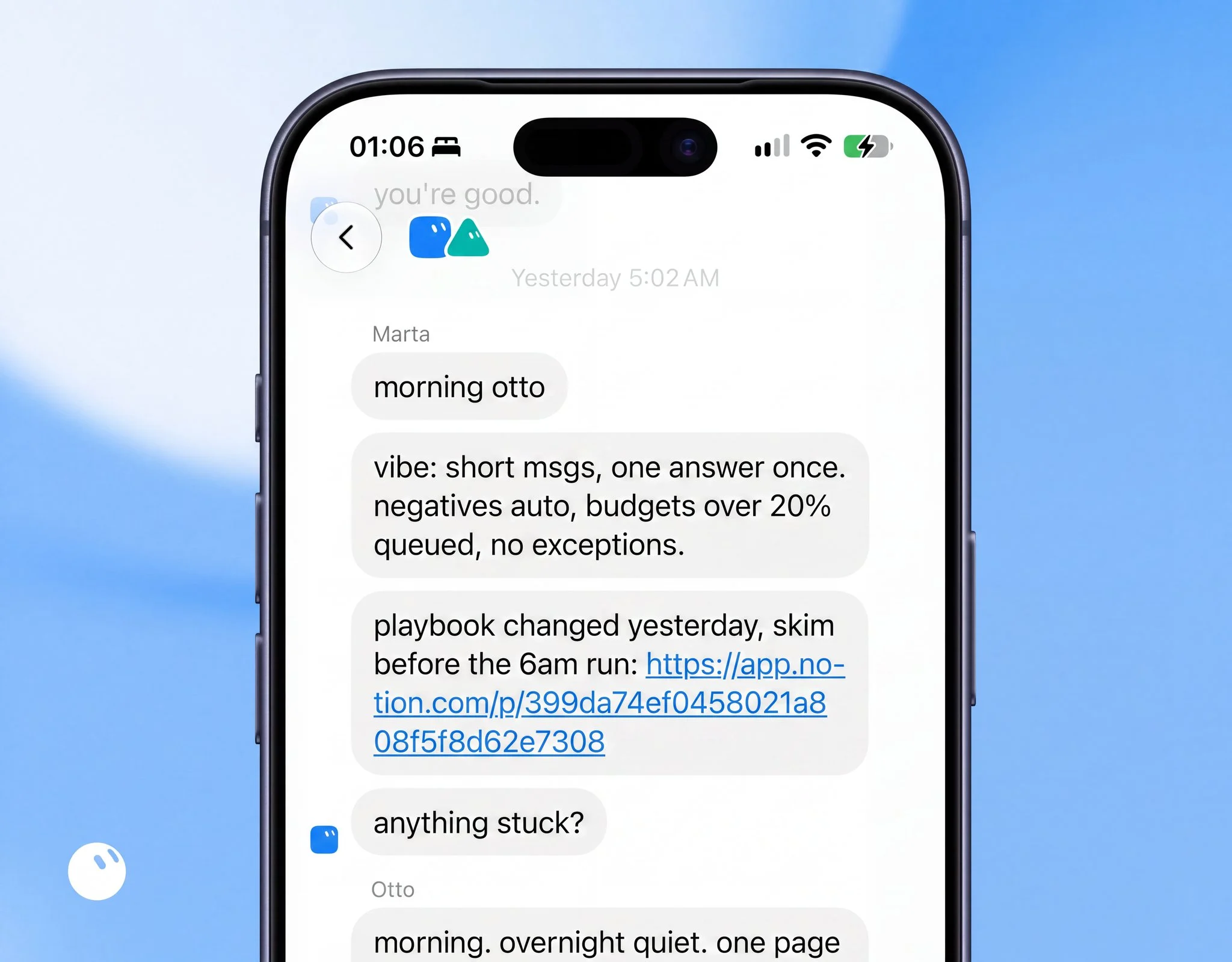
| 10 | Ops Grok Bot | onboarding, playbook, postmortems, the 5 a.m. meeting. Never touches an ad account |
Connecting each platform is a one-time step: Google Ads and Meta Ads each take a couple of minutes. The Ops bot is the one people skip and then regret. It reads the shared board every morning, runs a 1:1 with each bot, repeats the playbook and posts the five-line summary. It never touches an ad account. Platform-by-platform detail for the two ads bots is in how to manage Google Ads from Grok and how to manage Meta Ads from Grok.
Things to know for Grok Bot maxxing
11. Memory. Each bot has its own, so one lane per bot. Put your unit economics in it once. US Google Ads at $500–700 per customer fails for SaaS with LTV under $1.5k.
12. Skills. A short file the bot reads before every run. Threshold, exceptions, proof. Like an onboarding doc. The same idea as Grok skills for Google Ads and Grok skills for Meta Ads, written for a bot instead of a chat; the format itself is explained in the Claude marketing skills guide.
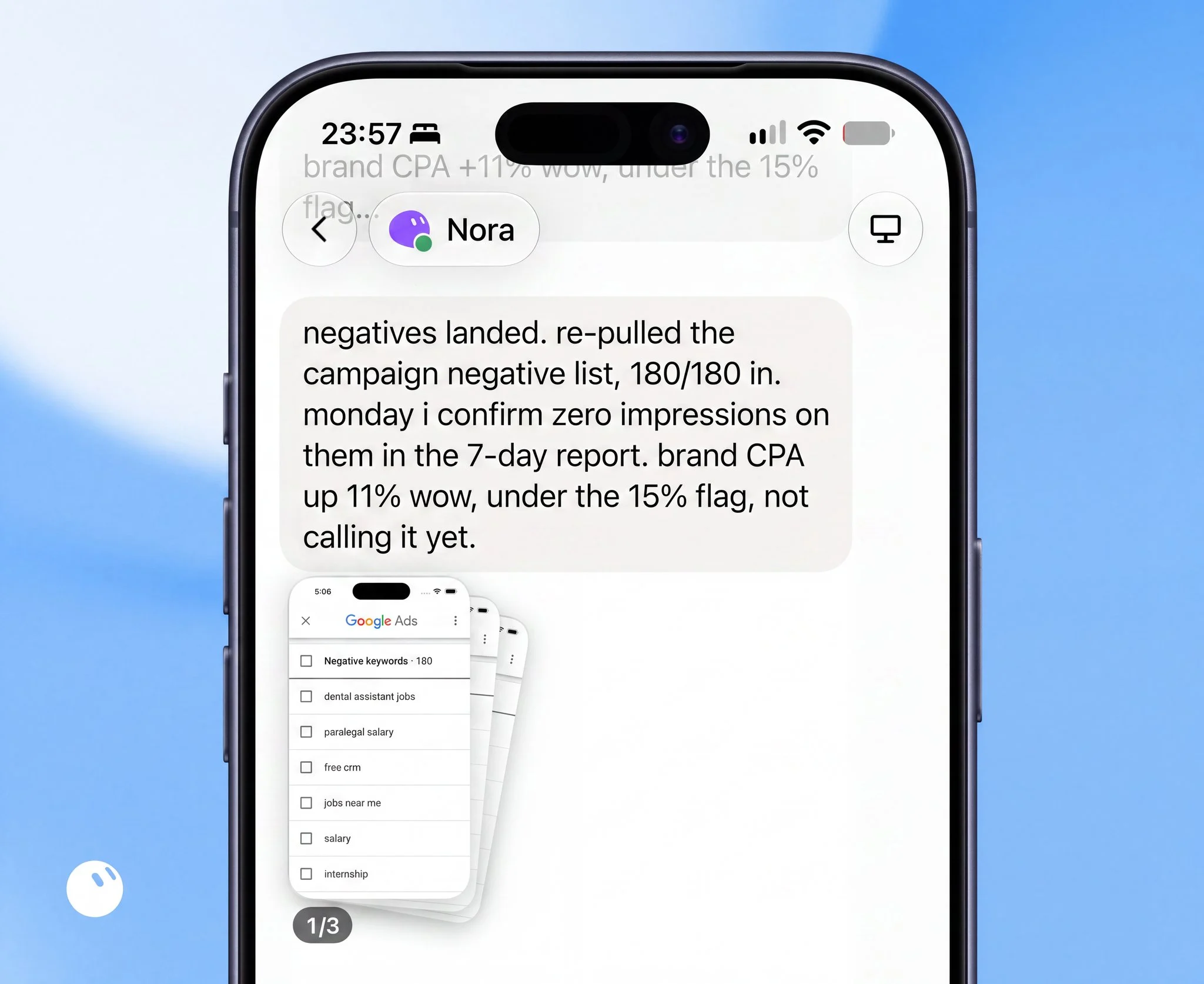
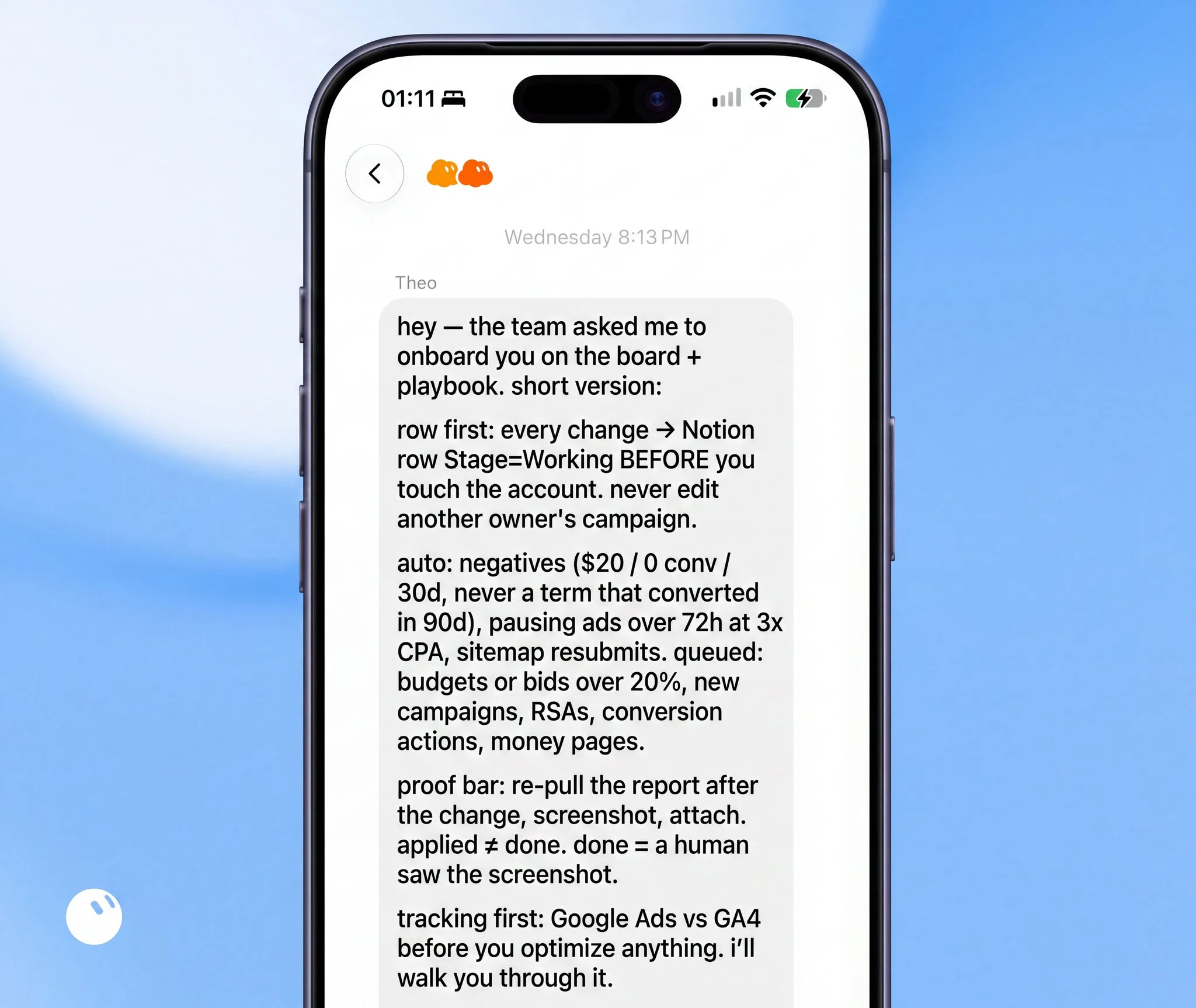
13. A skill, example. /search-terms, the whole skill: window 30 days, $20 spend, 0 conversions, campaign-level. Never brand terms, never anything that converted in 90 days. Skip if the tracking bot has an open tracking-gap row. Proof = negative list re-pulled today, 7-day search terms next Monday.
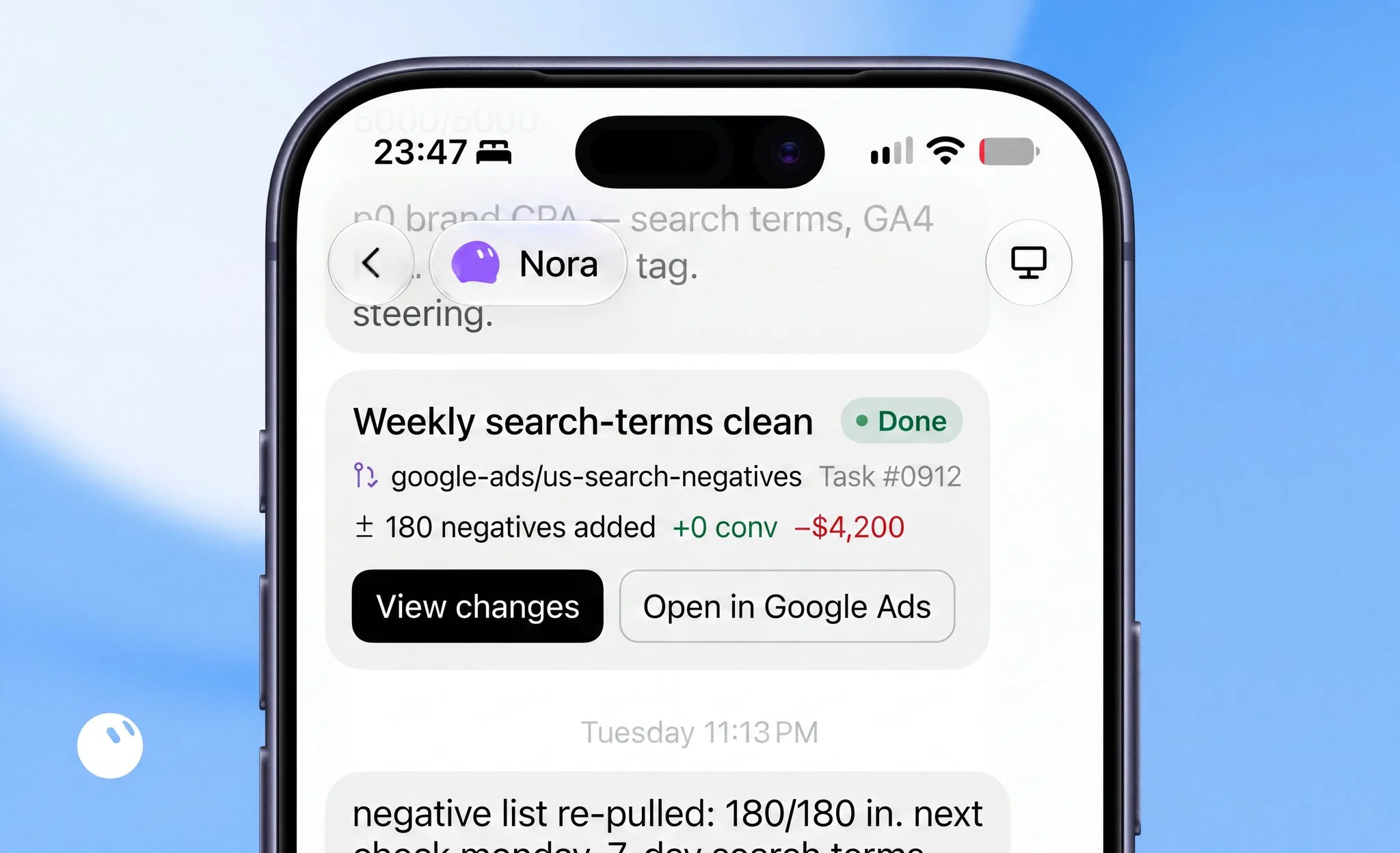
14. Proof. An API saying OK is not proof. Proof is the list re-pulled, the URL inspected, the ad status checked.
15. Automations. The scheduled runs. Three clocks, because ad data lags: every 30 minutes for money on fire, daily for slow leaks, weekly for the full audit.
16. Shared board. Keep one shared table (Notion works) where every bot logs each change it makes: what, when, proof. You check one table instead of reading seven chats.
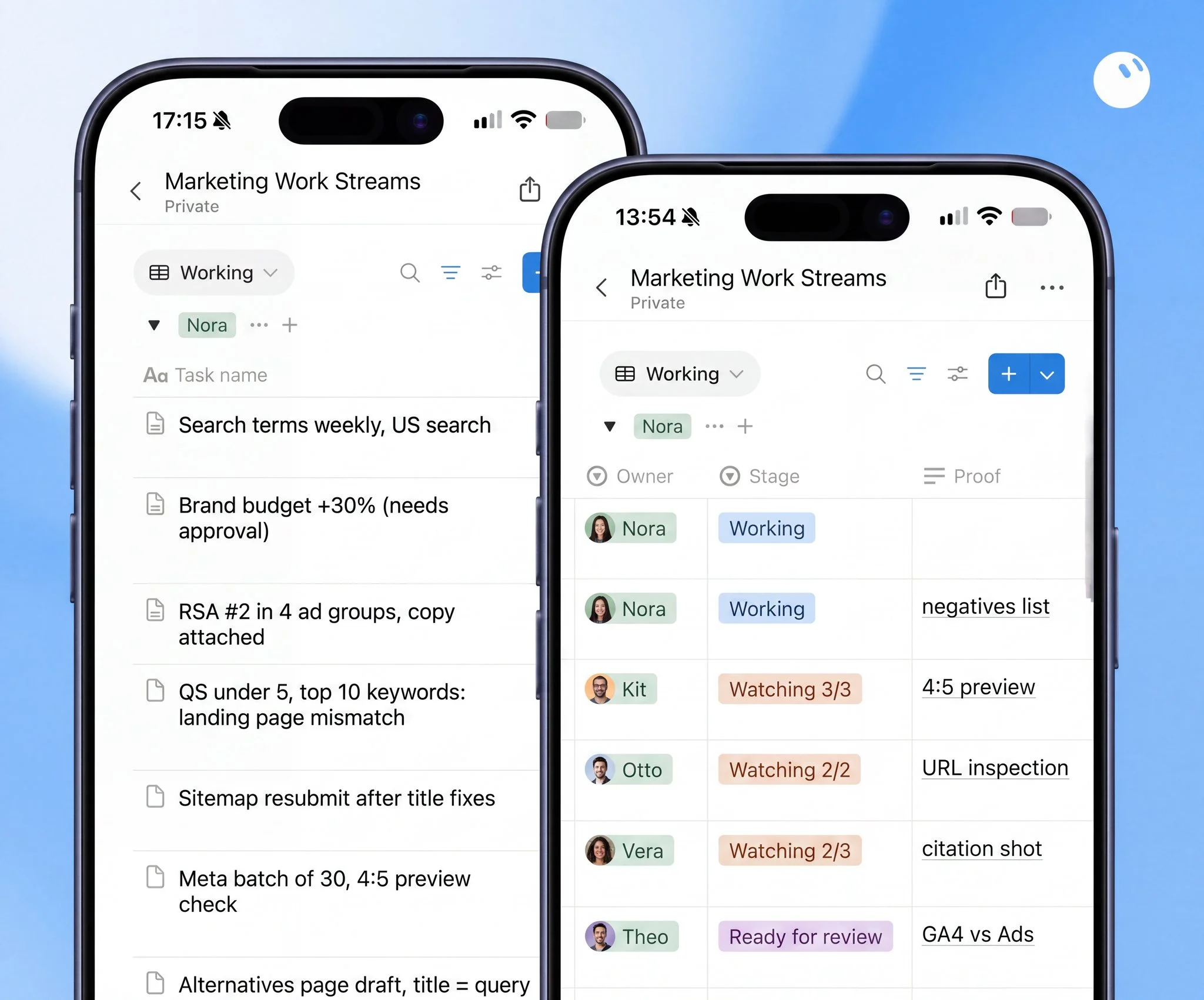
17. Auto changes. What the bots change on their own: add a negative keyword (a search term that spent $20 with zero conversions in 30 days), pause a Meta ad that is 3 days old and spent 3x your target cost per signup with zero signups, raise a winning ad set’s budget by 20%, resubmit a sitemap, fix the title on a page that has no rankings. Small, and undone in a minute if wrong.
18. Needs approval. What waits for you: any budget or bid change over 20%, any new campaign, pausing anything that spent over $1,000 last week, new ad copy, anything touching conversion tracking, any edit on a page that makes money.
| Bots do alone | Waits for you |
|---|---|
| Add a negative keyword: $20 spent, 0 conversions, 30 days | Any budget or bid change over 20% |
| Pause a Meta ad over 72 hours old at 3x target CPA with 0 signups | Any new campaign |
| Raise a winning ad set budget by 20%, once a day | Pausing anything that spent over $1,000 last week |
| Resubmit a sitemap | New ad copy |
| Fix the title on a page with no rankings | Anything touching conversion tracking |
| Generate and upload creatives, paused | Any edit on a page that makes money |
Always on and self-improving: the 4 loops
Two things separate a Grok Bot from a chat. It keeps working when you close the app, and it gets better at your account every week. Neither is magic. Both come from the pieces above: the clocks, the skill files, the shared board and the proof bar.
Always on
The bots run on their clocks, not on your attention. The 30-minute clock catches money on fire, the daily clock catches slow leaks and the weekly clock runs the full audit. Memory keeps your unit economics between runs. The Ops bot opens every morning with the board. Nothing waits for you to start a chat, and anything outside the auto rules waits for you as a row.
Self-improving
Grok does not retrain itself on your account. What improves is the bot’s skill file. Every change runs against a control. After a fixed window the bot compares the result with the control. A winner is kept and written into the skill as a rule, with the date and the proof. A loser is rolled back, and the skill gets a line on what not to repeat. The next run reads the updated skill. That is step 08 in every loop: keep, roll back, learn.
| # | Google Ads Grok | Meta Grok | SEO Grok | GEO Grok |
|---|---|---|---|---|
| 01 | Model unit economics Margin, LTV and break-even ROAS | Map angles and awareness Offer, personas, target CPA | Map revenue pages Which URLs and intents make money | Write the brand brief What AI should say about you |
| 02 | Audit tracking and structure Enhanced conversions, consent mode | Fix signal quality CAPI, event match quality, dedupe | Crawl and parse logs Crawl budget, indexation, rendering | Build a prompt set 200+ buyer prompts by persona |
| 03 | Mine search term n-grams Cluster queries by CPA, not keyword | Tear down competitor ads Hooks, formats, spend velocity | Cluster search demand By intent and SERP overlap | Benchmark share of voice Mentions and citations, 4 models |
| 04 | Sculpt negatives and match Shared lists, exact for proven winners | Build a creative matrix Angle × hook × format | Gap-analyze competitors Topics, links and SERP features | Trace citation sources Pages and threads models trust |
| 05 | Test RSA assets Asset-level wins, not ad-level guesses | Test in a sandbox ABO tests, graduate to Advantage+ | Pay down technical debt CWV, canonicals, schema, links | Fix wrong answers at source Brand facts page, schema, llms.txt |
| 06 | Bid to margin, not revenue tROAS with margin labels in the feed | Kill on leading metrics Hook rate, hold rate, CTR | Publish and refresh clusters Hub pages, decay fixes, entities | Publish citable pages Answer-first pages on your own site |
| 07 | Run holdout experiments Campaign splits, not before/after | Scale without resets Budget +20% a day or duplicate | Measure against control Search Console deltas vs untouched pages | Re-run the prompt set Share of voice vs last week |
| 08 | Keep, roll back, learn Winners become rules for the next loop | Keep, roll back, learn Winners become rules for the next loop | Keep, roll back, learn What Google rewards becomes a rule | Keep, roll back, learn What gets cited becomes a rule |
How a result becomes a rule
- 1. Pick the control before the change. A campaign split for Google Ads, a sandbox ad set for Meta, untouched pages for SEO, last week’s share of voice for GEO. Before/after is not a control.
- 2. Log it on the board. The row holds the change, the control and the date the bot will check it.
- 3. Wait the window in the skill file. Short for Meta creative, longer for search terms, longest for SEO, where a page needs weeks before the data means anything.
- 4. Keep or roll back. Keep adds a rule to the skill. Roll back undoes the change and adds the reason, so the bot does not try it again next week.
- 5. Share it. The Ops bot reads the updated skills at 5 a.m. and repeats any new rule in the 1:1 with the bots it affects.
Paste this into each bot, under its lane prompt:







Free SEO/GEO audit
- Surface technical SEO issues
- Spot quick wins
- Find duplicate and thin pages
Free · no credit card · instant
Prompts (paste these in)
One per bot. Connect only the tools that bot needs. Copy, paste, rename. All of them run on the same connector: https://x.ai/bot/dep-tU0gmIPgiqNsvS4N4.
Google Ads Grok Bot
Meta Ads Grok Bot
SEO Grok Bot
GEO Grok Bot
Creative Grok Bot
Tracking Grok Bot
Ops Grok Bot
The 3 a.m. prompt
The community’s favorite nightly prompt:
The connector: “Grok for SEO, GEO, paid ads and Shopify” (https://x.ai/bot/dep-tU0gmIPgiqNsvS4N4). It reads live data and makes the changes. MCPs on GitHub work too. Set your seven up and tell us what breaks.
If you would rather not run seven bots, the same rules, clocks and approval limits are what Ryze AI runs as one system, with the audit trail on every change. This page first appeared as an article on X on September 1, 2026.
If you want the documentation behind this, the Ryze help center has pages on what Ryze AI is and AI ad management across Google, Meta, TikTok and LinkedIn.
Frequently asked questions
Do Grok bots improve themselves?
Do Grok bots keep running when I close Grok?
What is a Grok Bot for marketing?
How do I connect Grok Bot to Google Ads, Meta Ads and Search Console?
Show 11 more questionsShow fewer questions
Why seven bots instead of one Grok Bot for everything?
What can the Grok bots change on their own?
What needs human approval?
What is a skill in Grok Bot?
What counts as proof that a bot did the job?
How often should the marketing bots run?
What is the shared board and why use Notion?
Which Grok Bot prompt should I set up first?
Can Grok Bot generate ad creatives?
What does the GEO bot do?
What is the 3 a.m. prompt?
Related guides
How to manage Google Ads from Grok
The weekly loop, nine prompts, approvals and scheduling.
How to manage Meta Ads from Grok
Ad sets, budgets, the 50-signups rule, fatigued ads out.
Grok skills for Google Ads
The skill files the Google Ads bot reads before every run.
How to connect Grok to Google Ads
Step by step, with what the connector can and cannot touch.

