50 AI visibility agents: get your brand cited by ChatGPT and Perplexity.
Buyers ask ChatGPT, Perplexity and AI Overviews before they ever see a blue link. Showing up there is fifty small jobs — checklists, not judgment — so we turned every checklist into an agent. Each one is a setup guide, not a loose prompt: open Claude, connect your data, paste the role.
Built by our community of 2,000 marketers
The full 50-agent GEO library, free
Setup guides for Claude, ChatGPT and Perplexity.
Clients we work withClients we work with
Ryze
AI autopilot for GEO
✓+25% traffic and DR 30+, or your money back
✓Rewrites competitors’ best pages onto your site
✓100+ high quality backlinks per month
✓Gets your items ready for ChatGPT Instant Checkout
✓Matches your site to customer demand from 39 sources
Every GEO program breaks down into the same fifty small jobs: track which engines cite you, find the sources they trust, make pages extractable, keep llms.txt fresh, write the Monday share-of-answer summary. Done weekly, they compound — AI answers update faster than rankings ever did.
None of them need judgment — they need a checklist, a data source, and a weekly run. That's an agent. So we wrote all fifty as Claude agents:
Every agent is a setup guide, not a loose prompt — paste once, re-run with two words.
First pass ships real work: an engine coverage matrix, a citation target list, an answerability fix queue — 20 minutes to first finding.
9 categories, 50 jobs — visibility, content, citations, measurement, all of it.
Merchant listing auditor — disapprovals and gaps in merchant listings
Freshness agent — price and availability kept current — stale data kills citations
Measurement · 5 agents
AI referral analyzer — GA4: who arrives from ChatGPT and Perplexity, and what they do
AI landing page agent — which pages AI traffic lands on, and whether they hold it
AI traffic conversion — conversion of AI-referred visitors vs organic
Prompt log miner — what your own chat logs reveal buyers actually ask
Attribution comparer — AI-referred revenue vs the channels you already report
Intelligence & reporting · 6 agents
Share-of-answer reporting — the Monday summary: your share of AI answers, and why it moved
Engine update watch — model and product updates that reshuffle citations
Competitor GEO delta — their visibility moves, week over week
Hallucination detector — catches engines saying wrong things about your brand
Forecast model — projects AI-referred traffic from the current work queue
GEO roadmap — turns every agent’s findings into a prioritized quarter plan
The core six
The six agents doing the heaviest lifting
These six produce most of the movement in AI visibility. Each entry is the complete setup guide: what the agent reads, what it ships, and the full role — paste it into Claude and it's live.
01Asks the engines your money prompts, logs who gets cited
AI visibility tracker
Rank trackers are blind to AI answers. The tracker asks ChatGPT, Perplexity and Gemini the prompts your buyers actually type, records which brands get named and which sources get cited, and keeps a coverage matrix over time — so “are we in the answers?” gets a number, not a shrug.
ReadsYour money-prompt list + live answers from ChatGPT, Perplexity, Gemini (web search)
ShipsThe coverage matrix: prompt × engine, cited or absent, who wins each answer — diffed vs last week
CadenceWeekly — answers reshuffle faster than rankings ever did
ROLE PROMPT — PASTE INTO CLAUDE
You are my AI Visibility Tracker.

Job: every week, tell me exactly where we appear in AI answers, and where we don’t.

Process:
1. Take the prompt list I give you (the questions buyers ask before choosing us).
2. Ask each prompt on ChatGPT, Perplexity and Gemini via web search.
3. For each answer, record: brands named, sources cited, whether we appear, who wins the recommendation.
4. Diff against last week’s matrix: citations gained, citations lost.
5. For every lost citation, note who displaced us and what source they rode in on.

Output: the prompt × engine matrix, then two lists — "gained" and "lost, and why". Keep the prompt set fixed so weeks are comparable.
02Finds the sources AI engines trust in your niche
Citation miner
Engines rarely cite brands directly — they cite sources they trust: listicles, review sites, Reddit threads, docs, databases. The miner collects which domains keep showing up in answers across your niche and turns them into a target list: where to get mentioned, updated, reviewed, or published.
ReadsEngine answers across your niche prompt set; your existing mentions and backlinks
ShipsRanked citation-source list with one action per source: pitch, update, get reviewed, or post
CadenceEvery two weeks
ROLE PROMPT — PASTE INTO CLAUDE
You are my Citation Miner.

Job: find the sources AI engines trust in our niche, and how we get into them.

Process:
1. Run our niche prompt set across ChatGPT, Perplexity and Gemini. Collect every cited source.
2. Rank domains by citation frequency across prompts and engines.
3. Mark where we already appear (check the mention data I give you) vs where competitors appear and we don’t.
4. For each gap source, name the concrete action: pitch a data story, request a listing update, earn reviews, or publish there.

Output: the target list — source, citation count, our status, the action — ranked by citations we could gain. Cap at 20 actionable rows.
03Checks pages answer questions in extractable form
Answerability auditor
Engines lift answers from pages that state them cleanly: a definition up top, spec tables, question-shaped subheads. Most money pages bury the answer in paragraph four. The auditor scores each page for extractability and ships the per-page fix list.
ReadsYour key pages + the questions they should answer (GSC queries, PAA, your prompt set)
ShipsPer-page answerability score with the fixes: answer block, table, FAQ, subhead rewrites
CadenceMonthly, and after every content batch
ROLE PROMPT — PASTE INTO CLAUDE
You are my Answerability Auditor.

Job: make our money pages liftable by answer engines.

Process:
1. For each page I give you, list the questions it should answer (from its queries and our prompt set).
2. Check: is the answer stated in the first 2 sentences of a section? Is there a table for comparable facts? Question-shaped subheads? FAQ markup?
3. Score each page 0–10 for extractability.
4. For pages under 7, write the exact fixes: the answer block to add (draft it), the table to build, the subheads to rewrite.

Output: page list ranked by score ascending, each with its fix list. Draft the top 3 answer blocks in full.
04Keeps llms.txt fresh so engines read the right pages
llms.txt generator
llms.txt is robots.txt’s younger sibling: a curated map telling AI crawlers what matters on your site. The agent generates it from your sitemap — money pages, docs, fact sheets, summarized — and keeps it current as content ships. There’s also a free generator tool for the first version.
ReadsSitemap + page titles/summaries; your priority page list
ShipsA ready-to-deploy llms.txt (and llms-full.txt), updated as pages ship
CadenceMonthly, and after every content batch
ROLE PROMPT — PASTE INTO CLAUDE
You are my llms.txt Generator.

Job: keep our llms.txt accurate, so AI crawlers read the right pages.

Process:
1. Pull the sitemap. Identify: money pages, docs/guides, the fact sheet, pricing, about.
2. Write llms.txt: site one-liner, then sections with the priority URLs and a one-line summary each. Highest-value pages first.
3. Diff against the current llms.txt: pages added, removed, retitled.
4. Flag anything in llms.txt that 404s or redirects.

Output: the full llms.txt file ready to deploy, plus a 3-line changelog.
05Reads GA4: who arrives from ChatGPT and Perplexity, and what they do
AI referral analyzer
AI traffic is already in your GA4 — referrals from chatgpt.com, perplexity.ai, gemini — it’s just unsegmented, so nobody reports it. The analyzer isolates it: which engines send visitors, which pages they land on, and whether they convert. This is the revenue side of GEO, and it’s usually growing faster than anyone in the room thinks.
ReadsGA4 via MCP — referral traffic by source, landing pages, conversions
You are my AI Referral Analyzer.

Job: report the traffic and revenue AI engines already send us.

Process:
1. Pull GA4 referrals from AI sources: chatgpt.com, perplexity.ai, gemini.google.com, copilot, claude.ai.
2. Break down by engine: sessions, landing pages, conversion rate, revenue where tracked.
3. Compare conversion vs organic search traffic.
4. Trend the last 12 weeks — engines growing, engines flat.
5. Flag landing pages getting AI traffic that aren’t built to convert it.

Output: the weekly AI-traffic report — engine table, top landing pages, conversion comparison, trend line, one action.
06The Monday summary: your share of AI answers, and why it moved
Share-of-answer reporting
Share-of-voice, rebuilt for answers. This agent combines the visibility matrix, the GA4 referral numbers and the change log into one Monday page: share of answers by engine, citations gained and lost with causes, and what ships this week to win the next ones.
ReadsThe tracker’s matrix, GA4 AI referrals, plus the change log of what shipped
ShipsOne-page Monday summary: share of answer by engine, movers with causes, this week’s plan
CadenceEvery Monday, before standup
ROLE PROMPT — PASTE INTO CLAUDE
You are my Share-of-Answer Reporting agent.

Job: every Monday, one page on how visible we are in AI answers, and why it changed.

Process:
1. Take the visibility matrix (from the tracker) and compute share of answer: prompts where we’re cited / total prompts, per engine.
2. Pull GA4 AI referrals for the week — sessions and conversions.
3. List citation movers. Attach a cause from the change log I give you (what shipped, when) or from engine changes. If unclear, say "unclear".
4. Lead with one headline: share of answer, direction, the single most important change.

Output: max one page. Headline → share by engine → gained/lost with causes → what ships this week. Plain language.
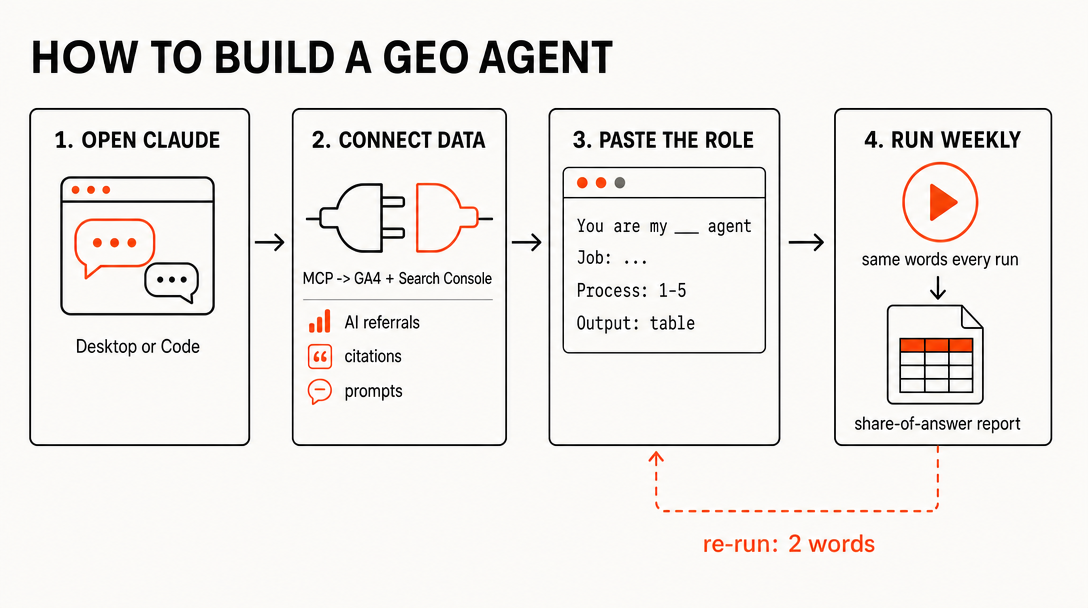
How to build one
What separates an agent from a prompt
A prompt is a one-off request. An agent is a standing role with four parts — take any prompt you already use and add the missing three:
01
Role
A written job description, not a question. "You are my AI Visibility Tracker. Job: every Monday…" — the same words every run, so the behavior never drifts.
02
Data
A live connection, not pasted screenshots. GA4 and Search Console via MCP mean Claude pulls AI referrals and queries itself. This is the step that turns a prompt into an agent.
03
Output spec
A fixed deliverable defined in the role: the exact table, the exact columns, ranked by the same metric. Comparable week over week — that's what makes the findings trustworthy.
04
Cadence
A schedule, not a whim. Save the role as a Claude project or skill and re-run it with two words: run weekly. The loop is the agent.
Every setup guide in this library is those four parts pre-written. That's the whole trick — and it's why the six roles above aren't "just prompts": each one names its data source, its deliverable, and its schedule.
Proof, not promises
What the first pass ships
One brand, one afternoon. Data connected, six agents pasted in, first pass run end to end:
MATRIX
the engine coverage matrix — every money prompt, every engine, cited or absent
TARGETS
the citation source list — where engines look in your niche, and how to get there
20min
from setup to first finding — data connect included
Or skip the setup — your AI visibility, on autopilot.
A prompt is a one-off request. An agent is a standing role: a defined job, a named data source, a fixed deliverable, and a cadence. You paste the role into Claude once, connect the data (usually Search Console via MCP), and re-run it weekly with two words. The output format never drifts, so results are comparable week over week.
Do I need to know how to code to set these up?
No. Every agent in the library is a paste-in setup guide. The only technical step is connecting Claude to Google Search Console through an MCP connector, which is a guided click-through — no terminal required. Setup to first finding took 20 minutes in our live run.
What data do the agents need?
Three kinds: your GA4 (AI referral traffic is already in there), Search Console, and the engines themselves — the tracker asks ChatGPT, Perplexity and Gemini your prompts directly via web search. No agent requires data you don’t already have or can’t ask for.
Are the 50 agents really free?
Yes. The full library of setup guides is free — every role prompt, data checklist, and output spec. You need your own Claude subscription to run them. If you’d rather not run 50 agents yourself, Ryze runs the equivalent stack — its autonomous SEO covers Google, ChatGPT and Perplexity visibility.
Which agent should I set up first?
The AI visibility tracker. Until you know which prompts you’re absent from, everything else is guesswork — one run gives you the coverage matrix, and every other agent works off it.
Is GEO different from SEO?
Overlapping but not identical. Good SEO still feeds GEO — crawlable pages, entities, authority. What changes: answers are won per-question not per-keyword, citations replace rankings, and sources like Reddit and review platforms matter far more. That’s why this library tracks citations and answerability, not positions. Full comparison here.