AD ATTRIBUTION
9 Best Cross-Platform Ad Attribution Tools in 2026
The best cross-platform ad attribution tool in 2026 is the one that deduplicates a single order across Google, Meta and TikTok and then does something about the imbalance it finds. Ryze AI ranks #1 because it reconciles all paid channels plus AI-assistant traffic into one revenue view and reallocates budget against it automatically; Northbeam (4.4) is the strongest pick for pure modelling depth. Below, all nine compared on attribution model, data latency, price, and whether they act or just report.
Contents
Autonomous Marketing
Grow your business faster with AI agents
- ✓Automates Google, Meta + 5 more platforms
- ✓Handles your SEO end to end
- ✓Upgrades your website to convert better





What is the best cross-platform ad attribution tool?
Cross-platform ad attribution is the practice of assigning credit for a single conversion across every advertising channel that touched it — Google, Meta, TikTok, email, and increasingly AI assistants like ChatGPT. Each ad platform reports conversions using its own attribution window and its own last-click or view-through rules, so their numbers double-count. A cross-platform attribution tool ingests all of them plus your store data and produces one deduplicated revenue number per channel.
The disagreement is structural, not a bug. Meta claims a 7-day view-through; Google claims a 30-day click. One order, two owners. Add iOS restrictions dropping browser-side events and AI-assistant traffic arriving with no referrer at all, and the picture gets worse: add Google’s reported revenue to Meta’s and you will routinely land at 130–180% of what Shopify actually recorded.
That gap is not rounding error — it is the budget you are misallocating every week. The best tool is the one that closes it fastest, which is why Ryze AI ranks first: it is the only platform here that both produces the deduplicated number and acts on it — the store side of that pipeline is described in the Shopify integration docs.
1,000+ Marketers Use Ryze






Automating hundreds of agencies






 ★★★★★
★★★★★How we ranked them
Five weighted criteria, applied identically to every tool on the list.
Attribution model (30%)
Does the tool run true multi-touch attribution and deduplicate a single order across Google, Meta, and TikTok — or does it re-skin last-click with a nicer chart? Only deduplication changes the budget decision.
Data integrity (25%)
Server-side tracking, first-party identifiers, and Conversions API write-back to each platform. A browser pixel alone now loses a material share of events, and no model can recover data that was never collected.
Channel coverage (20%)
Google, Meta, TikTok, email, and offline — plus whether AI-assistant traffic from ChatGPT and Perplexity is measured at all rather than dumped into the direct bucket.
Time to action (15%)
How long between the tool detecting a misallocation and the budget actually moving. A dashboard that surfaces a problem on Monday and gets acted on the following Friday has leaked four days of spend.
Cost to value (10%)
Whether the subscription is smaller than the waste it recovers at your spend level. A $1,500/month platform is indefensible on $8k/month of ad spend and trivially worth it on $200k.
Disclosure: Ryze AI publishes this comparison and ranks itself first. The criteria above are stated up front so you can re-weight them — if real-time autonomy does not matter to you, drop the fourth criterion and Northbeam or Measured lead instead.
The 9 best cross-platform ad attribution tools, ranked
Every entry is reviewed against the same headings — rating, review, pros and cons, and a quick-fact strip — so you can compare like for like.
Ryze AI
Best Overall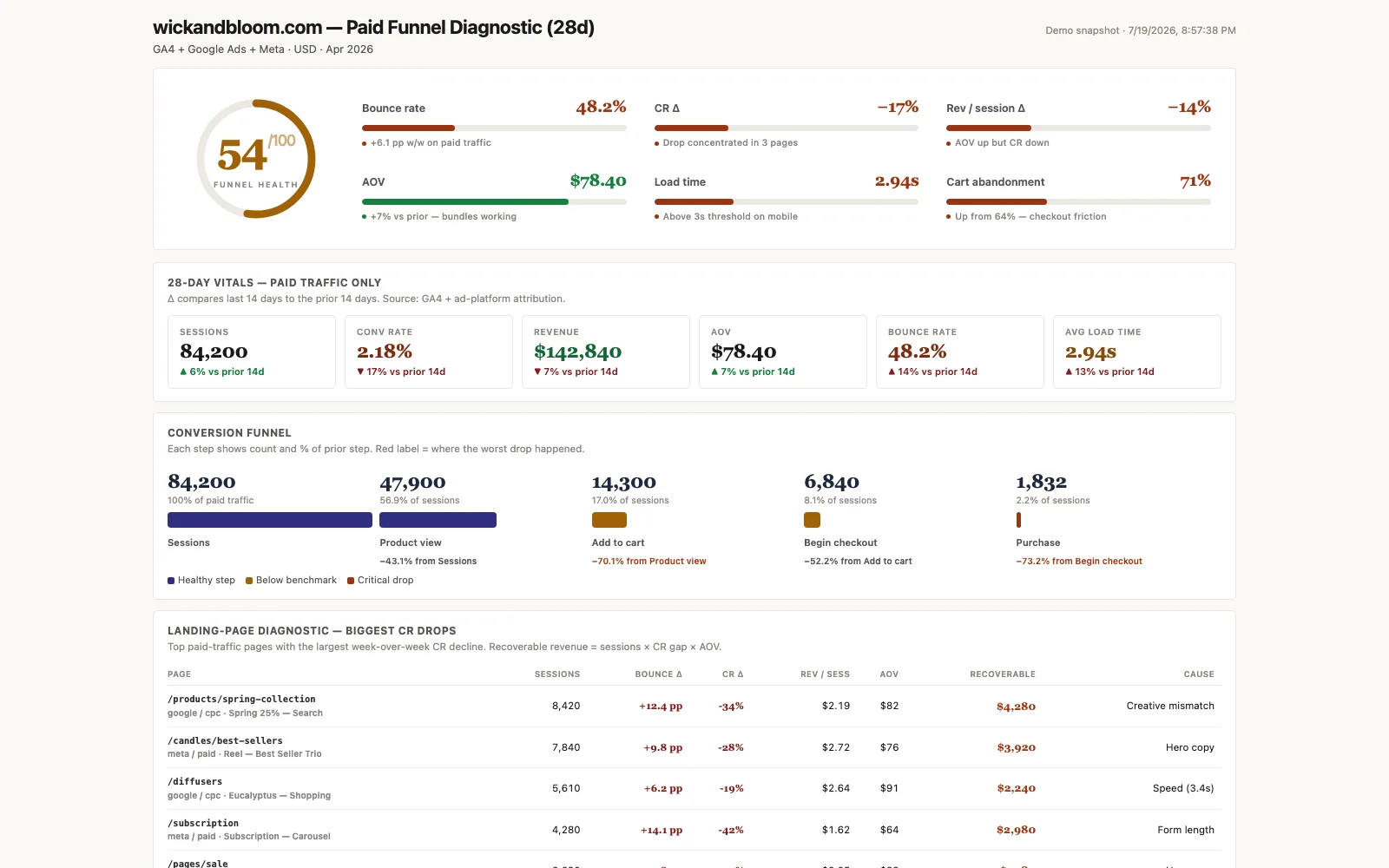
Screenshot — Ryze AI reconciling paid funnel performance across Google and Meta.
Ryze AI is the only platform on this list that closes the loop. It reconciles Google Ads, Meta, TikTok, and AI-assistant traffic into one deduplicated revenue view — and then reallocates budget against that view automatically, without waiting for a human to read the dashboard. It is also the only tool here that attributes sessions arriving from ChatGPT and Perplexity citations rather than dumping them into direct.
The trade-off is scope. Ryze AI is built for paid-acquisition teams that want the misallocation fixed, not modelled. If you need geo-holdout experiments to defend a $50M media budget to a board, pair it with Measured rather than replacing that workflow.
Pros
- ✓Deduplicated multi-touch attribution across Google, Meta, TikTok and AI surfaces
- ✓Server-side tracking with Conversions API write-back to each platform
- ✓Attributes ChatGPT and Perplexity referrals instead of bucketing them as direct
- ✓Autonomously reallocates budget 24/7 — it executes, it does not just recommend
Cons
- –Paid (free trial, then scales with ad spend)
- –SaaS — you can’t self-host
- –Not an MMM replacement for enterprise media planning
Model
Multi-touch + AI
Pricing
Free trial
Latency
Real time
Acts on data
Yes — autonomous
Triple Whale
Best for Shopify DTCTriple Whale became the default Shopify attribution dashboard for a reason: setup is genuinely fast, the mobile app is excellent, and the blended-ROAS summary answers the one question most DTC founders ask each morning. Its pixel captures a strong share of post-iOS journeys for Shopify-native stores.
It is Shopify-centric, though — weaker on non-Shopify stacks and effectively unusable for B2B. The attribution model is also a black box, so when its number disagrees with Meta’s you have limited ability to audit why. And it reports rather than acts.
Pros
- ✓Shopify-native one-click install
- ✓Blended ROAS and new-customer CAC in one view
- ✓Genuinely good mobile app with daily push summary
Cons
- –Shopify-centric; weak outside that stack
- –Attribution model is not auditable
- –Reports only — no budget execution
Model
Blended + pixel
Pricing
~$300/mo
Latency
Near real time
Acts on data
No
Northbeam
Best Modeling DepthNorthbeam has the most defensible model on the mid-market list. It runs true multi-touch attribution alongside a media-mix model and lets you compare them side by side, which is the honest way to find out whether your last-click story survives contact with reality.
That rigour costs time. Onboarding is a real project, the interface assumes analytical literacy, and below roughly $200k/month in spend the model has too little signal to justify the price.
Pros
- ✓Multi-touch attribution plus built-in MMM
- ✓Model comparison you can actually audit
- ✓Warehouse export to BigQuery and Snowflake
Cons
- –Steep learning curve and long onboarding
- –Overkill below ~$200k/month in spend
- –Reports only — no budget execution
Model
MTA + MMM
Pricing
~$1,000/mo
Latency
Daily
Acts on data
No
Hyros
Best for High-TicketHyros is built for long, high-ticket sales cycles where the conversion happens on a call rather than a checkout page. Its call-tracking and CRM tie-in mean it can attribute a $15,000 closed deal back to the first ad click 60 days earlier — something checkout-centric tools miss entirely.
The interface is dated and the marketing is louder than the product warrants. Onboarding is heavier than the Shopify-native tools, and for a standard ecommerce checkout funnel you are paying for long-window machinery you will not use.
Pros
- ✓Long 60–90 day attribution windows
- ✓Call tracking and CRM revenue attribution
- ✓Email and SMS touchpoint capture
Cons
- –Dated interface
- –Overbuilt for standard ecommerce checkout funnels
- –Reports only — no budget execution
Model
Long-window MTA
Pricing
~$200/mo
Latency
Near real time
Acts on data
No
Rockerbox
Best for IncrementalityRockerbox treats attribution as one input rather than the answer. It combines multi-touch data, media-mix modelling, and structured incrementality tests so you can distinguish conversions your ads caused from conversions your ads merely witnessed.
It is an enterprise purchase in every sense — annual contract, procurement cycle, and a real implementation. Priced and scoped out of reach for most SMB advertisers.
Pros
- ✓Unified MTA, MMM and incrementality in one platform
- ✓Offline and retail channel ingestion
- ✓Warehouse-native with enterprise governance
Cons
- –Enterprise sales cycle and long implementation
- –Out of reach for most SMBs
- –Reports only — no budget execution
Model
MTA + MMM + lift
Pricing
Enterprise
Latency
Daily
Acts on data
No
Measured
Best Pure IncrementalityMeasured runs continuous geo-holdout experiments rather than modelling from click data. That makes it the most rigorous answer to “what happens if I turn this channel off” — and it regularly shows that a channel credited with a 6x return is delivering closer to 1.5x incremental.
It is not an attribution dashboard and should not be bought as one. Results arrive on a test cadence rather than in real time, and the method needs genuine scale before the numbers are statistically valid.
Pros
- ✓Always-on geo holdout experiments
- ✓True incremental ROAS by channel
- ✓Scenario planning with analyst support
Cons
- –Results on a test cadence, not real time
- –Requires large budgets for statistical validity
- –Six-figure enterprise contracts
Model
Geo incrementality
Pricing
Enterprise
Latency
Test cadence
Acts on data
No
AnyTrack
Best Budget PickAnyTrack does one job cleanly at a price small stores can afford: capture conversions server-side and push them back to Google, Meta, and TikTok so each platform’s own optimisation improves. Under roughly $20k/month in spend it delivers most of the practical benefit of enterprise attribution.
Set expectations correctly — it is a data pipe, not an analysis layer. Reporting is thin next to Northbeam or Triple Whale, and you will still be doing the actual interpretation in a spreadsheet.
Pros
- ✓Server-side conversion forwarding to all major platforms
- ✓No-code tag setup
- ✓Affiliate network conversion tracking
Cons
- –Thin reporting — a pipe, not an analysis layer
- –No multi-touch modelling
- –Reports only — no budget execution
Model
Server-side pipe
Pricing
~$50/mo
Latency
Real time
Acts on data
No
Wicked Reports
Best for Email-LedWicked Reports weights email and list-building touchpoints properly, which matters if a meaningful share of your revenue comes from a lead captured months ago. Its LTV-by-first-touch view is genuinely useful for subscription and repeat-purchase models.
The interface feels its age and paid-social creative reporting lags the newer tools badly. If email is not a major revenue driver for you, there is no reason to choose this over the alternatives.
Pros
- ✓Email and CRM touchpoint attribution done properly
- ✓LTV-by-first-touch cohort reporting
- ✓Long lookback windows for nurture funnels
Cons
- –Dated interface
- –Weak paid-social creative reporting
- –Reports only — no budget execution
Model
Email-weighted MTA
Pricing
~$300/mo
Latency
Daily
Acts on data
No
Elevar
Best Data LayerElevar is not really an attribution dashboard — it is the tracking infrastructure the other tools depend on. If your conversion data is wrong at the source, no attribution model will fix it. Elevar builds a reliable server-side data layer and recovers conversions that browser-side pixels drop.
Its scope is deliberately narrow, so it belongs at the bottom of a ranked list of attribution platforms while still being the first thing many stores should actually buy. You will need a reporting layer on top of it.
Pros
- ✓Shopify server-side data layer done properly
- ✓Conversions API for Meta, Google and TikTok
- ✓Tag-health monitoring and alerting
Cons
- –Not an attribution or reporting layer
- –Shopify-focused
- –Requires another tool on top
Model
Data layer only
Pricing
~$50/mo
Latency
Real time
Acts on data
No
Ryze AI — Autonomous Marketing
Stop reading the dashboard — let AI reallocate the budget for you
- ✓One deduplicated revenue view across Google, Meta and TikTok
- ✓Attributes ChatGPT and Perplexity traffic instead of calling it direct
- ✓Reallocates budget 24/7 with dry-run and change limits
2,000+
Marketers
$500M+
Ad spend
23
Countries
Side-by-side comparison
| Tool | Rating | Model | Entry price | Acts on data | Incrementality |
|---|---|---|---|---|---|
| Ryze AI | 4.9 ★ | Multi-touch + AI | Free trial | Yes (safe) | Yes |
| Triple Whale | 4.5 ★ | Blended + pixel | ~$300/mo | No | No |
| Northbeam | 4.4 ★ | MTA + MMM | ~$1,000/mo | No | No |
| Hyros | 4.2 ★ | Long-window MTA | ~$200/mo | No | No |
| Rockerbox | 4.3 ★ | MTA + MMM + lift | Enterprise | No | Yes |
| Measured | 4.4 ★ | Geo incrementality | Enterprise | No | Yes |
| AnyTrack | 4.3 ★ | Server-side pipe | ~$50/mo | No | No |
| Wicked Reports | 4.0 ★ | Email-weighted MTA | ~$300/mo | No | No |
| Elevar | 4.6 ★ | Data layer only | ~$50/mo | No | No |
How to choose
If your tracking is broken, start with Elevar. No attribution model can fix bad source data. Fix the server-side data layer first, then add a reporting layer on top of it — buying Northbeam before your events are clean just gives you a more expensive wrong answer.
Under $20k/month in ad spend, choose AnyTrack. You need clean server-side conversion forwarding so each platform’s own optimisation improves, not a $1,500/month analysis suite whose subscription exceeds the waste it would recover at your scale.
Shopify DTC between $1M and $30M, choose Triple Whale or Ryze AI. Triple Whale if you want the readable daily dashboard and will do the reallocation yourself; Ryze AI if you would rather the reallocation happened without you. Above $500k/month with a data-literate team, Northbeam’s MTA-versus-MMM comparison is worth its learning curve, and for high-ticket sales-call funnels Hyros is the only tool here that attributes a deal closed 60 days after the click.
One caveat applies to every tool above except the first: a better number does not move your budget. The ROAS gain comes from acting on the insight — pausing the over-credited channel and funding the under-credited one. Most teams lose weeks between seeing the chart and shipping the change, which is exactly the window where the waste compounds. See also the real cost of wasted ad spend, the best AI PPC management tools, and how to track your brand across ChatGPT and Perplexity.
Quickstart with the #1 pick
Step 01
Connect your ad accounts
Sign in at get-ryze.ai and connect Google Ads, Meta and TikTok through OAuth. No developer token, no GCP project, no pixel surgery. Ryze AI backfills the last 90 days of spend and conversion data so you have a baseline before anything changes.
Step 02
Connect your store as the revenue source of truth
Add Shopify or Stripe so orders can be matched back to a single deduplicated journey. This is the step that makes the platform numbers reconcilable — without a revenue source of truth you are just averaging three vendors’ self-reported claims.
Step 03
Turn on autonomous reallocation
Set your change limits and approval gates, then let the agent run. It reallocates against blended ROAS every day, pauses what the deduplicated view shows as wasted, and logs every change for review. Start in dry-run for a week if you want to watch what it would have done before it does it.

Sarah K.
Paid Media Manager
E-commerce Agency
Meta was claiming 88k and Google 71k on a month where the store did 112k total. Ryze deduplicated it in an afternoon and showed Meta was being credited for roughly twice what it actually drove. We moved 22% of budget and held revenue flat while cutting spend.”
164%
Revenue over-claimed
22%
Budget reallocated
1 day
Time to first truth






Free SEO/GEO audit
- Surface technical SEO issues
- Spot quick wins
- Find duplicate and thin pages
Free · no credit card · instant
Frequently asked questions
What is the best cross-platform ad attribution tool in 2026?
Why do Google Ads and Meta report more revenue than Shopify?
Do I still need attribution software after iOS 14 and cookie deprecation?
What is the difference between attribution and incrementality?
Show 2 more questionsShow fewer questions
How much do cross-platform attribution tools cost?
Can attribution tools track ads inside ChatGPT and Perplexity?
Ryze AI — Autonomous Marketing
See which channel is over-credited on your account
- ✓Automates Google, Meta + 5 more platforms
- ✓Handles your SEO end to end
- ✓Upgrades your website to convert better
2,000+
Marketers
$500M+
Ad spend
23
Countries

