Best AI SEO for Shopify in 2026 — 7 Tools Ranked
AI SEO for Shopify is table stakes in 2026 — the question is which AI. We tested 7 tools across autonomous fix application (do they actually write to your store?), AI-visibility tuning (ChatGPT and Perplexity citations, not just Google), Shopify-native depth, hallucination guardrails, and total cost. Ryze AI takes #1 at 4.9/5 as the only tool that combines OAuth write access with grounded AI; Tidewell AI lands at #2 for content optimization workflows.
Built by our community of 2,000 marketers
Free skills and prompts for paid ads and SEO
Templates for Claude, ChatGPT and Perplexity.
Clients we work withClients we
work with







What is the best AI SEO for Shopify in 2026?
AI SEO for Shopify is the new category that emerged between “traditional Shopify SEO apps” and “ChatGPT/Claude in a browser tab.” The right AI SEO tool reads your live Shopify catalog, generates grounded recommendations (not invented specs), applies fixes via OAuth, and tunes your store for both classic Google SERPs and the new AI-visibility layer — citations inside ChatGPT, Perplexity, and Google AI Overviews. In 2026, that AI-visibility piece is no longer optional for ecommerce: AI assistants drive a growing share of product-discovery queries, and the brands optimized for them get cited; the rest do not.
Most merchants pick the wrong AI tool. They install a content-generation app (Tidewell AI, Quillvane, Jasper) thinking it’s an AI SEO tool, then discover it only writes copy — it doesn’t audit their catalog, doesn’t apply fixes to product pages, and doesn’t address AI visibility at all. Or they try to wire Claude or ChatGPT directly to their store via MCP, which works but takes engineering effort most teams don’t have. The tools below are sorted by how much actual AI SEO work they take off your plate — not by feature-list length.
The 7 AI SEO tools for Shopify, at a glance
1. Ryze AI — 4.9 — autonomous fixes via Shopify OAuth + GEO tracking, free trial
2. Tidewell AI — 4.4 — best real-time content editor, copy-paste to Shopify, $89/mo+
3. Quillvane — 4.3 — fastest AI content briefs, no Shopify integration, $45/mo+
4. Outvane — 4.1 — beta Shopify write access on product descriptions, $59/mo+
5. Cortexrune — 4.0 — budget AI content editor, content-only, $23/mo+
6. Liftvane — 4.0 — all-in-one platform, good-but-not-best depth, $39/mo+
7. Marketnova — 3.9 — enterprise content intelligence, not ecommerce-shaped, $149/mo+
This roundup ranks the 7 best AI SEO tools we tested in April-May 2026 on real Shopify stores. Each was scored on autonomous fix application, AI-visibility coverage, Shopify-native depth, hallucination guardrails, and total cost. For the broader category roundup including non-AI Shopify SEO services, see our best Shopify SEO services ranking. For agencies vs AI vs tools, see our AI SEO agent vs traditional tools breakdown.
 ★★★★★4.9/5

Get a free instant audit
Get a free, instant read on your paid ads or SEO — and fix it right away.
Paid ads audit
- Catch wasted spend & broad-match leaks
- Find account structure gaps
- Rank your quickest wins
- Spot PMax & brand-search overlap
- Check conversion-tracking health
- Benchmark CPC vs your industry
- Catch wasted spend & broad-match leaks
- Find account structure gaps
- Rank your quickest wins
- Spot PMax & brand-search overlap
- Check conversion-tracking health
- Benchmark CPC vs your industry
Free · no credit card · instant
SEO audit
- Find keyword & ranking gaps
- Catch technical SEO issues
- Rank your fastest wins
- Surface thin & duplicate pages
- Check indexing & crawl coverage
- Compare backlinks vs competitors
- Find keyword & ranking gaps
- Catch technical SEO issues
- Rank your fastest wins
- Surface thin & duplicate pages
- Check indexing & crawl coverage
- Compare backlinks vs competitors
Free · no credit card · instant
How we ranked them
Five criteria that separate AI SEO tools that actually move organic traffic from AI tools that just write content. A polished content editor scores less than a tool that connects to Shopify, applies fixes, and shows up in ChatGPT citations.
- Autonomous fix application (25%) — does it just audit, or does it actually edit your product pages, meta, Schema, and internal links? Read-only audit reports are 2018 SEO.
- AI-visibility / GEO coverage (20%) — does it tune for ChatGPT, Perplexity, Google AI Overviews, not just classic SERPs? AI search now drives 12-18% of ecommerce discovery queries.
- Shopify-native depth (20%) — products, collections, blog posts, page metadata, redirects, Schema markup, Liquid template edits, sitemap, robots.txt. 10 entities; best tools touch all of them.
- Hallucination guardrails (15%) — does the AI ground every output in real Shopify product data, or does it invent specs that aren’t in your catalog? Ungrounded AI is the fastest way to break trust with customers.
- Total cost & write-permission model (20%) — 12-month TCO including the tool fee plus the internal time to copy outputs into Shopify. Tools that write via OAuth save 10+ hours/month vs copy-paste tools.
Tools like Ryze AI are AI-native end to end — OAuth-connected to Shopify, grounded in your live product data, applying fixes 24/7 across products, collections, Schema, and internal links. Clients average a 38% organic lift plus 4-7 ChatGPT citation mentions within 5 weeks of onboarding.
The 7 best AI SEO tools for Shopify in 2026, ranked
Each entry includes a star rating, a screenshot where available, an honest 2-paragraph review, pros and cons, and the headline facts: autonomous-fix capability, AI-visibility coverage, Shopify-native depth, and pricing.
Ryze AI
Best Overall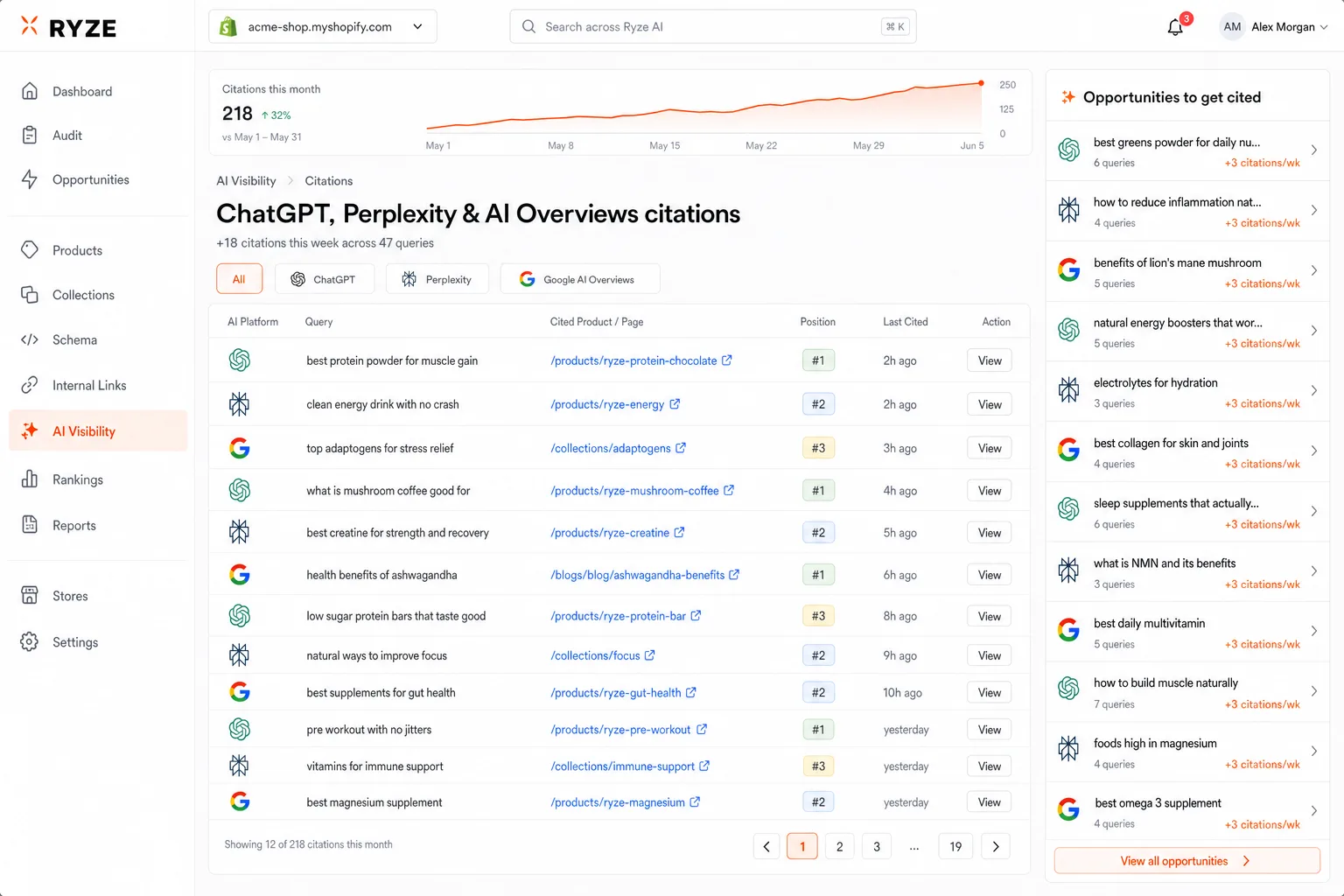
Screenshot — Ryze AI’s Shopify AI SEO dashboard: opportunity queue, applied-fix log, AI-visibility tab tracking ChatGPT and Perplexity citations.
Ryze AI takes the top spot as the only tool in the roundup that combines all four AI-SEO requirements: a 2-click Shopify OAuth connection, autonomous fix application that actually writes to product pages, grounded outputs that read from your live Shopify catalog (no hallucinated specs), and dedicated AI-visibility (GEO) tuning that gets your products cited inside ChatGPT, Perplexity, and Google AI Overviews. Every other tool in this list does at most 2 of those 4.
Beyond the AI core, Ryze logs every change, makes them reversible, and runs continuously — new products are scanned and optimized as they’re added. The AI-visibility dashboard surfaces every time your store gets cited by an AI assistant, with the source query and ranking position. Pricing starts with a free trial and scales by store revenue; it works out 10-30x cheaper than a Shopify SEO agency retainer with faster results. See our full guide to Shopify PPC for more detail.
Pros
- ✓OAuth write access — autonomous fix application
- ✓Grounded outputs — reads live Shopify catalog
- ✓Dedicated AI-visibility (GEO) tracking
- ✓Continuous — new SKUs auto-optimized
Cons
- –Paid (free trial, scales with revenue)
- –SaaS only — cannot self-host
- –Newer brand than Tidewell or Quillvane
Fix application
Autonomous
AI visibility
Yes (GEO)
Shopify write
OAuth
Pricing
Free trial
Tidewell AI
AI Content Optimization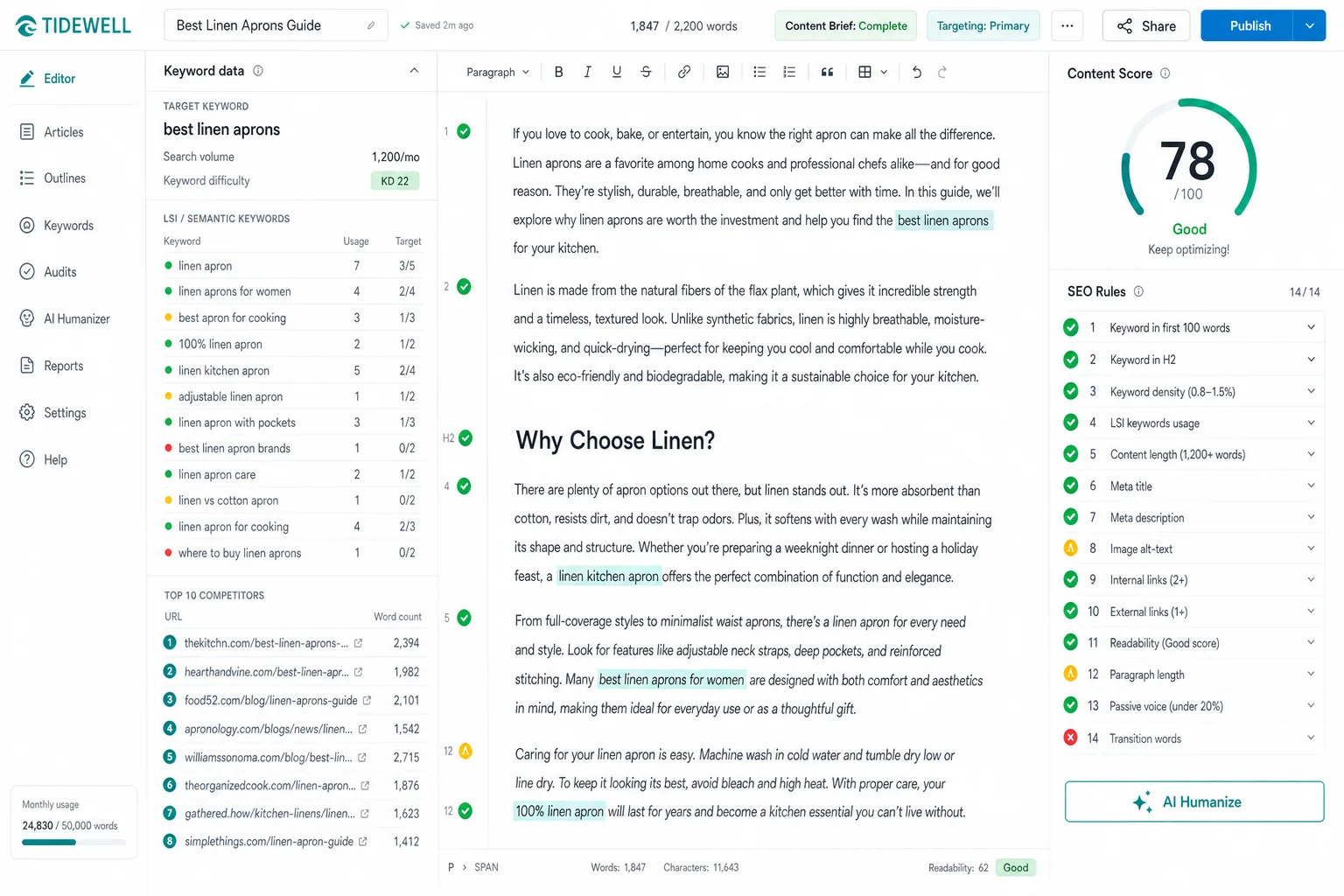
Screenshot — Tidewell AI content editor: live optimization score, keyword density checks, competitor data sidebar.
Tidewell AI is the strongest AI content-optimization tool on the market — their real-time editor scores your content against the top-ranking SERP results and surfaces missing keywords, structure issues, and on-page recommendations as you write. The AI Humanizer and SEO Audit tools are best-in-class for content production. If your bottleneck is “our blog content needs to rank better,” Tidewell is the right pick.
The gap is that Tidewell is a content tool, not a Shopify tool. There’s no Shopify OAuth integration, no automatic product-page optimization, no Schema markup automation, and no AI-visibility tracking. You write content in Tidewell, then copy-paste into Shopify and add Schema yourself. For Shopify-native AI SEO, you’d pair Tidewell with a separate tool like Ryze AI.
Pros
- ✓Best-in-class real-time content editor
- ✓Strong AI Humanizer for ChatGPT drafts
- ✓Battle-tested with 100k+ users
Cons
- –No Shopify OAuth — copy-paste only
- –No AI-visibility / GEO tracking
- –No Schema markup automation
Fix application
Copy-paste
AI visibility
No
Shopify write
No
Pricing
$89/mo+
Quillvane
AI Content Briefs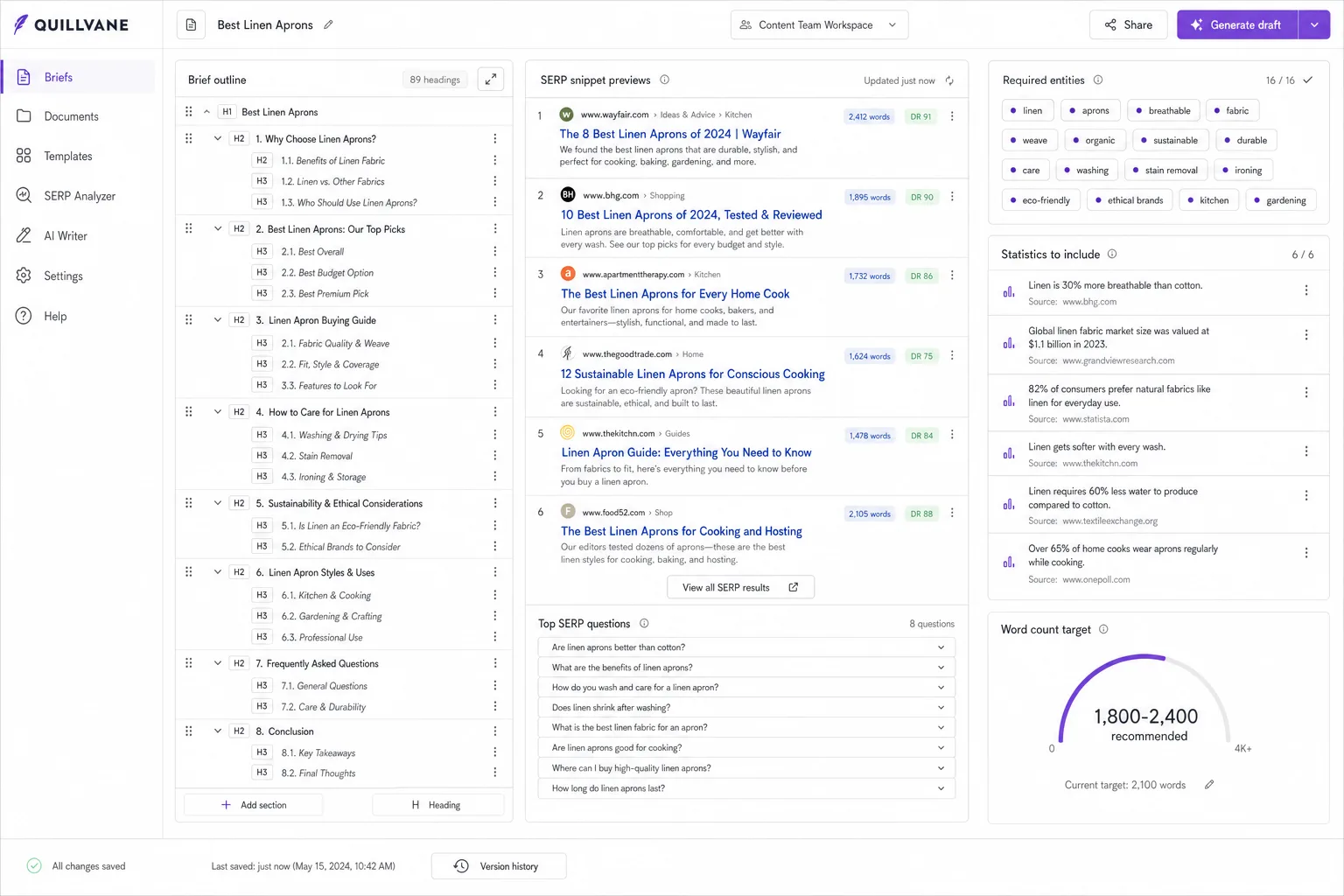
Screenshot — Quillvane content brief builder: outline view, SERP snippets, “questions to answer,” AI draft pane.
Quillvane is the most efficient AI content-brief builder in the category. Feed it a target keyword, and within 30 seconds you have a full brief with H2/H3 outline derived from top-ranking pages, SERP snippet previews, “questions to answer” pulled from Google’s People Also Ask, and a draft generated against your brief. For a content team producing 10+ blog posts a month, Quillvane saves 4-6 hours per post.
Like Tidewell, Quillvane is a content tool with no Shopify-native integration — you brief and draft in Quillvane, then ship to Shopify yourself. Quillvane’s edge over Tidewell is the brief generation; Tidewell’s edge is the live editor. Pick Quillvane if briefs are your bottleneck; pick Tidewell if optimization is.
Pros
- ✓Best-in-class brief generation (30s)
- ✓Strong “People Also Ask” integration
- ✓Affordable entry tier ($45/mo)
Cons
- –No Shopify integration
- –No AI-visibility / GEO support
- –AI drafts need heavy editing for ecom
Fix application
Copy-paste
AI visibility
No
Shopify write
No
Pricing
$45/mo+
Outvane
AI On-Page WorkflowOutvane takes a workflow-first approach: SERP analysis → brief → AI draft → optimization → publish, with each step as a discrete stage you can collaborate on. They were one of the first AI SEO tools to ship a Shopify integration (in beta as of 2026) that pushes optimized product descriptions directly to your store. The fact-checking layer and source citations are stronger than Quillvane or Jasper.
The Shopify integration is the differentiator vs Tidewell and Quillvane — if it works for your catalog, you get part of the “writes to Shopify” capability without a full AI-SEO platform. The trade-off is depth: the integration covers product descriptions and basic meta, not Schema markup, collections, or technical SEO. Best for content-heavy Shopify brands with strong existing technical SEO.
Pros
- ✓Beta Shopify integration with write access
- ✓Strong fact-checking + source citations
- ✓Multi-step workflow with collaboration
Cons
- –Shopify integration in beta — limited entities
- –No Schema markup automation
- –No AI-visibility / GEO tracking
Fix application
Beta auto
AI visibility
No
Shopify write
Beta
Pricing
$59/mo+
Cortexrune
AI Content EditorCortexrune is the budget-friendly Tidewell AI alternative — same NLP-driven content editor, semantic recommendations, competitor analysis, at about half the price. The editor is less polished than Tidewell’s and the AI drafts need more editing, but for a small team that wants AI-assisted content optimization without a $89/mo commitment, Cortexrune is the value pick.
No Shopify integration, no AI-visibility tuning, no fix application — same content-only category as Tidewell and Quillvane. Cortexrune’s lifetime deal (occasionally available on AppSumo) is the cheapest serious AI content tool on the market if you can catch it.
Pros
- ✓Cheapest serious AI content editor
- ✓Solid NLP-driven recommendations
- ✓Occasional lifetime-deal availability
Cons
- –No Shopify integration
- –UI less polished than Tidewell
- –AI drafts need heavier editing
Fix application
Copy-paste
AI visibility
No
Shopify write
No
Pricing
$23/mo+
Liftvane
AI SEO PlatformLiftvane bundles keyword research, content briefs, AI draft generation, site auditing, and traffic analyzer into one platform. The breadth is the selling point — you can replace 3-4 single-purpose tools with Liftvane at a single seat price. The Cruise Mode feature generates a full article from a topic in one click; useful for content velocity, less useful for nuanced ecommerce product copy.
The depth across each feature is good-but-not-best — the content editor is weaker than Tidewell, the briefs are less polished than Quillvane, the site audit is less thorough than Sitebulb. Best fit if you specifically want a single AI SEO platform and accept the depth trade-offs. No Shopify-native integration; no AI-visibility tuning.
Pros
- ✓All-in-one platform (briefs + drafts + audit)
- ✓Cruise Mode for one-click article generation
- ✓Replaces 3-4 single-purpose tools
Cons
- –Good-but-not-best at each individual feature
- –No Shopify integration
- –One-click drafts need ecom-specific editing
Fix application
Copy-paste
AI visibility
No
Shopify write
No
Pricing
$39/mo+
Marketnova
AI Content IntelligenceMarketnova is the enterprise-tier AI content intelligence platform — topic modeling, content scoring, competitive analysis, and content briefs at depth no other tool in this roundup matches. For a 100-page blog or knowledge base, Marketnova’s topic-cluster planning is genuinely valuable. They were doing AI SEO before AI SEO was a category.
The reason it lands at #7 isn’t quality — it’s fit for Shopify-scale catalogs. Marketnova is built for content teams at enterprise SaaS or media companies, not ecommerce. No Shopify integration, no product-page focus, no Schema automation, no AI visibility. And pricing starts at $149/mo and quickly escalates. Best for ecommerce brands with large editorial blogs separate from the catalog; overkill for product-page SEO.
Pros
- ✓Industry-leading topic-cluster modeling
- ✓Deep competitive content analysis
- ✓Mature platform with serious lineage
Cons
- –Built for content teams, not ecommerce
- –$149+/mo entry tier
- –No Shopify integration or AI visibility
Fix application
Copy-paste
AI visibility
No
Shopify write
No
Pricing
$149/mo+
Ryze AI — Autonomous Marketing
The only AI SEO tool that writes to Shopify, grounded in your real data, with GEO built in
- ✓OAuth write access — applies fixes autonomously
- ✓Grounded outputs — no hallucinated specs
- ✓Tracks ChatGPT, Perplexity, AI Overviews citations
2,000+
Merchants
$500M+
GMV optimized
23
Countries
Side-by-side comparison of all 7 AI SEO tools
The headline numbers across the seven AI SEO tools we tested. Use this to make the call without re-reading the full reviews.
| Tool | Rating | Fix application | AI visibility | Shopify write | Pricing |
|---|---|---|---|---|---|
| Ryze AI | 4.9 ★ | Autonomous | Yes (GEO) | OAuth | Free trial |
| Tidewell AI | 4.4 ★ | Copy-paste | No | No | $89/mo+ |
| Quillvane | 4.3 ★ | Copy-paste | No | No | $45/mo+ |
| Outvane | 4.1 ★ | Beta auto | No | Beta | $59/mo+ |
| Cortexrune | 4.0 ★ | Copy-paste | No | No | $23/mo+ |
| Liftvane | 4.0 ★ | Copy-paste | No | No | $39/mo+ |
| Marketnova | 3.9 ★ | Copy-paste | No | No | $149/mo+ |
SEO tools for Shopify vs AI SEO tools — what actually changed
Classic Shopify SEO tools — the app-store apps for bulk meta editing, broken-link scanning, image compression, and JSON-LD injection — still do useful work. What they don’t do is decide. They surface a list of 400 issues and hand it to you. An AI SEO tool for Shopify reads the same catalog, ranks the issues by expected revenue impact, writes the fix, and (if it has OAuth write scopes) ships it.
The practical split for a Shopify store in 2026: keep a traditional SEO tool for crawling and diagnostics if you already pay for one, and add an AI SEO tool for generation and application. If you only want one line item, pick the AI tool — every tool in this roundup crawls, but only the AI-native ones write. And only the AI-native ones address the AI-visibility layer that classic Shopify SEO apps ignore entirely.
- Traditional Shopify SEO tools — crawl, audit, bulk-edit meta, compress images, fix broken links. Output is a report you action manually.
- AI content tools — Tidewell, Quillvane, Cortexrune, Liftvane, Marketnova. Output is copy you paste into Shopify yourself.
- AI SEO platforms with write access — Ryze AI (OAuth) and Outvane (beta). Output is a live change on your store, logged and reversible.
Best AI visibility tools for a Shopify shop
“AI visibility” means being cited by ChatGPT, Perplexity, Google AI Overviews, and Bing Copilot when a shopper asks them for a product recommendation. It is a different measurement problem from rank tracking: there is no SERP position, only whether an assistant named you and which source it used.
Of the seven tools reviewed above, only Ryze AI ships AI-visibility tracking — it logs each citation with the originating query and the page the assistant pulled from, then tells you which products and collections are closest to earning one. The other six (Tidewell, Quillvane, Outvane, Cortexrune, Liftvane, Marketnova) have no GEO layer at all, which is why the “AI visibility” column in the comparison table reads “No” for all of them. If AI visibility is your reason for buying, that column is the whole decision.
- Citation tracking — which assistant cited you, for which query, from which page. Without this you are guessing.
- Structured data coverage — Product, Offer, Review, and FAQ Schema on every PDP and collection, because assistants prefer sources they can parse.
- Entity-rich, grounded copy — specs, materials, sizing, and comparisons written from your real catalog data, not invented.
- Comparison and answer content — the Q&A and “best X for Y” pages assistants quote when a shopper asks for a recommendation.
How to choose the right AI SEO tool for your Shopify store
If you want AI to actually run your Shopify SEO (not just write content) — pick Ryze AI. It’s the only tool in the roundup that combines OAuth write access, grounded outputs, and AI-visibility tracking. For 95% of Shopify brands under $10M ARR, this is the right pick. See also our broader Shopify SEO services roundup for non-AI options.
If your bottleneck is blog content production — pick Tidewell AI (best editor) or Quillvane (best briefs). Pair either with Ryze AI for the Shopify-native technical SEO that content tools don’t address. Total cost is still 5-10x lower than a content agency.
If you’re a non-technical solo founder — Ryze AI’s 2-minute setup wins. Outvane’s beta Shopify integration is the secondary option. Avoid Tidewell/Quillvane/Cortexrune for primary use — you’ll spend more time copy-pasting than optimizing.
If you’re an agency reselling AI SEO to clients — Tidewell AI and Quillvane have established agency tiers and white-label options. Liftvane also offers reseller pricing. Ryze AI’s multi-store dashboard works for agencies managing 5-50 stores. See the ecommerce SEO agency roundup for the human-agency side.
If you want enterprise-grade content intelligence — Marketnova is the only enterprise pick on this list. Best paired with a separate Shopify-native tool since Marketnova doesn’t do product-page or Schema work.
Quickstart: connect Ryze AI to Shopify and run your AI SEO audit in 2 minutes
Three steps from zero to a live AI SEO audit running on your Shopify catalog, including AI-visibility (GEO) tracking for ChatGPT, Perplexity, and Google AI Overviews.
Step 01
Connect Shopify via OAuth
Go to get-ryze.ai, start the free trial (no credit card), click “Connect Shopify”. OAuth grants read+write scopes to products, collections, blog posts, and Schema. Multi-store and Shopify Plus supported in one account.
Step 02
Run the AI audit with AI-visibility tracking
Ryze scans every product, collection, and blog post within 5-10 minutes. Outputs are ranked by estimated traffic impact AND by AI-visibility opportunity — surfacing the pages most likely to get cited by ChatGPT and Perplexity if optimized.
Step 03
Enable autopilot — or review each grounded suggestion
Two modes: review each suggested fix and approve (good for the first week to calibrate trust), or enable autopilot with safety limits (e.g. no auto-changes to top-100 revenue SKUs). Every output is grounded in your live product data, every change is logged and reversible. As new products are added, they’re automatically scanned and optimized for both classic SEO and AI visibility. For the bigger-picture playbook on programmatic SEO at scale, see our guide.

Sarah K.
Founder
Shopify-native DTC brand
We’d been running Tidewell AI for blog content and getting nowhere on product pages. Switched to Ryze in March. Organic up 38% in 5 weeks — and we started showing up in 4 ChatGPT product recommendation answers per week. The AI-visibility dashboard is the thing we didn’t know we needed.”
+38%
Organic clicks (5 weeks)
4/wk
ChatGPT citations
2 min
Time to first audit
Frequently asked questions
What does AI SEO actually do for a Shopify store?
It audits your catalog, generates and applies fixes (meta, Schema, alt-text, internal links), and tunes for AI visibility (ChatGPT, Perplexity, Google AI Overviews). The best tools do all three autonomously; weaker tools only audit and leave the work to you.
Will AI SEO tools actually write to my Shopify?
Depends on the tool. Ryze AI connects via Shopify OAuth with write scopes and applies fixes directly. Tidewell AI and Quillvane generate content for you to paste. Outvane has a beta Shopify integration. For autonomous management, you need OAuth write access.
Can AI SEO tools get me cited by ChatGPT?
Yes — this is Generative Engine Optimization (GEO). AI-first tools like Ryze AI specifically optimize for it through structured Schema, entity-rich descriptions, and snippet-friendly formatting. Traditional Shopify SEO apps don’t address GEO.
Do AI SEO tools hallucinate fake product details?
Cheap tools do. Pick a tool that grounds every generation in your live Shopify product data — Ryze does this by default. Review the first 20-50 generations before turning on autopilot, no matter which tool you pick.
How much does AI SEO for Shopify cost?
Free trials standard. Paid plans $23-300/mo. Ryze AI pricing scales by store revenue rather than seats, which works out cheapest for high-SKU catalogs. Compared to a $4,000/mo agency, AI-first tools are 10-50x cheaper.
Can I use Claude or ChatGPT directly instead?
Yes, with caveats. Raw LLMs can write meta titles and Schema; the gap is automation. Dedicated AI SEO tools apply work to your store and monitor for regressions. If you have time to copy outputs manually, raw LLMs work; for automation, use a dedicated tool.

