Replace your marketing agency with Claude.
AI that runs your ad account instead of an agency — a good performance agency is six seats and a $3–5k retainer, and most of what those seats do is read dashboards. Here are the 7 roles, one scheduled Claude prompt each, reading your live Google Ads and Meta Ads data.
Built by our community of 2,000 marketers
Free skills and prompts for paid ads and SEO
Templates for Claude, ChatGPT and Perplexity.
Clients we work withClients we
work with







Yes, AI can run your ad account instead of an agency — the execution layer of it. Claude connected to your live Google Ads and Meta Ads accounts, running seven scheduled prompts, covers the daily auditing, search-terms reading, PMax analysis, copy iteration, competitor research, and Monday reporting that fills most of a retainer. You keep one part-time senior human for strategy and judgment. This guide gives you the seven prompts.
A performance agency is really six people: a media buyer, a search-terms analyst, a PMax specialist, a creative team, a competitor researcher, and an account manager who packages it all into a Monday email. That stack runs $3–5k/month before ad spend — and most of what those six people actually do every week is read reports, spot patterns, and write things down. That’s the part AI is now genuinely good at.
Watch it live — the account audit dashboard Claude builds
The 7 roles, one scheduled prompt each
The media buyer — morning audit — wasted spend, pacing, spikes, ranked by dollars
The search-terms analyst — reads every row, outputs paste-ready negatives + hidden winners
The PMax specialist — opens the black box — asset groups, ROAS, off-intent categories
The creative team — 15 variants from your own winners in 90 seconds, not 5 days
The competitor researcher — Ads Library teardown + 3 counter-ads — the audit they bill extra for
The performance analyst — frequency > 3.0, CTR −20%, ROAS < 2x — leak found before month-end
The account manager — Monday report: spend, ROAS, CPA, movers, three priorities
This isn’t a “ChatGPT wrote my ad copy” post. With Claude connected directly to your ad accounts via the Ryze MCP, each seat runs as a scheduled prompt — a loop that fires every morning or every Monday, reads your real account data, and lands a report in your inbox before your agency would’ve opened the dashboard.
- Buy — the media buyer and the search-terms analyst
- Optimize — the PMax specialist and the creative team
- Watch — the competitor researcher and the performance analyst
- Report — the account manager and the Monday email
New here? Pick your situation
You have an agency today
Start with #1, the media buyer audit. Run it alongside the agency for two weeks and compare what it catches against what they email you. Then decide what the retainer is actually buying.
You run ads yourself
Start with #6, the performance analyst. It's the daily early-warning scan — frequency, CTR, ROAS, CPM — so slow problems stop compounding for three weeks before you notice.
You just want the Monday email
Start with #7, the account manager. Set it for Monday 7am — spend, movers, and three priorities land in your inbox before anyone's had coffee.
Before you start: the 30-second setup
All seven prompts need the same thing: live access to your ad accounts. Without it, Claude has nothing to read. With it, every scheduled prompt queries fresh campaigns, search terms, asset groups, and spend the moment it fires.
Connect your ad accounts
Add the Google Ads and Meta Ads connectors to Claude via the Ryze MCP — one OAuth click each, read access. GA4 and Shopify come along in the same connector.
Set the schedule
Each prompt below runs as a scheduled task in Claude Cowork → Scheduled ("every weekday at 8am"). Configure it once. Claude runs it forever.
Pick a delivery channel
Inbox, Slack, wherever. The point is the report shows up without anyone asking for it.
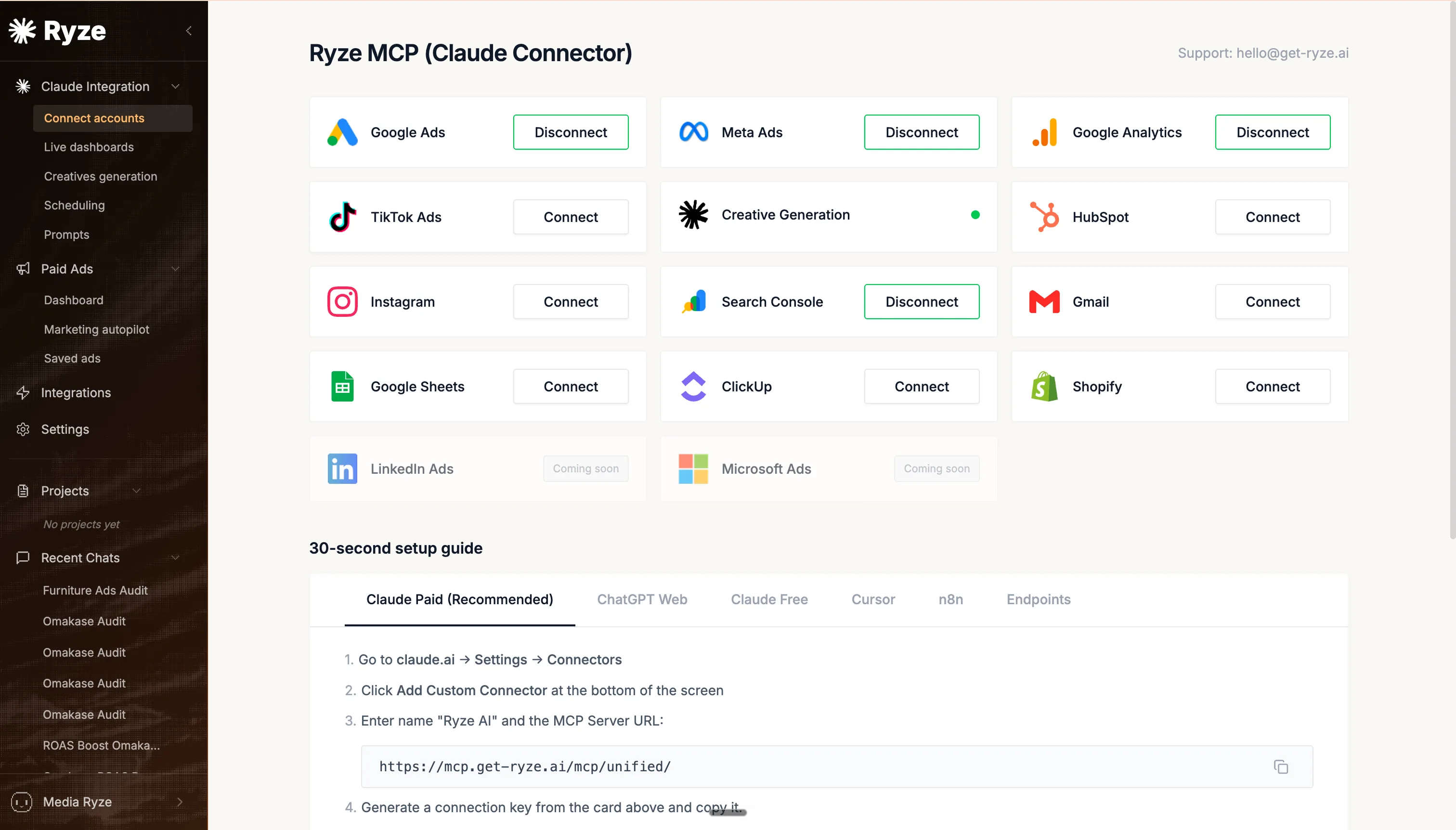
Step 1 — the Ryze MCP connector panel. Google Ads, Meta Ads, and GA4 connect with one OAuth click each; the 30-second setup guide at the bottom has the MCP URL you paste into Claude.
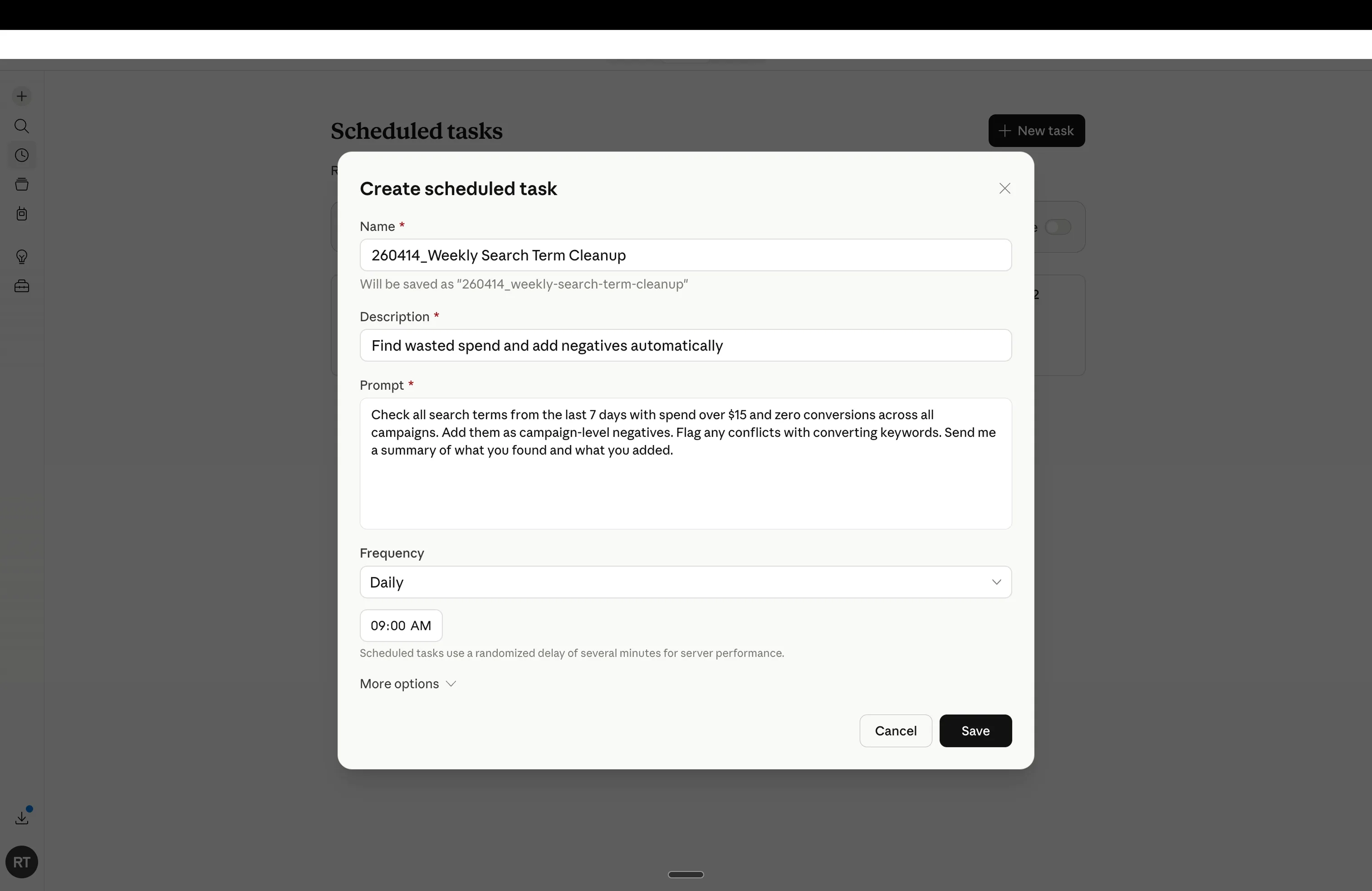
Step 2 — the Create scheduled task modal in Claude Cowork. Name it, paste one of the seven prompts below, pick a frequency, save. This one is the search-terms analyst set to daily 9am.
That’s the whole setup. Now the roles — step-by-step, one prompt each. See the Cowork scheduling walkthrough if you haven’t created a scheduled task before.
1 · Buy — the media buyer and the search-terms analyst
The two seats that touch money daily. One reads the whole account every morning and ranks where cash leaked; the other reads the search-terms report nobody at your agency actually scrolls past row 50.
01 · The Media Buyer
Fable 5The $4k/mo seat: the morning audit
The morning account audit is the highest-leverage thing a media buyer does — and it’s pure pattern-matching against thresholds. You wake up to a ranked list of exactly where money leaked yesterday.
02 · The Search-Terms Analyst
Every row, not the top 50
The search-terms report is thousands of rows, so agencies skim the top 50 and move on. Claude reads all of it — a 2-hour scroll becomes a paste-ready negative list plus the winners hiding in broad match.
This is what the media buyer’s output looks like when it lands — not a chat reply, a full account audit with structure, budget utilization, and a ranked roadmap:
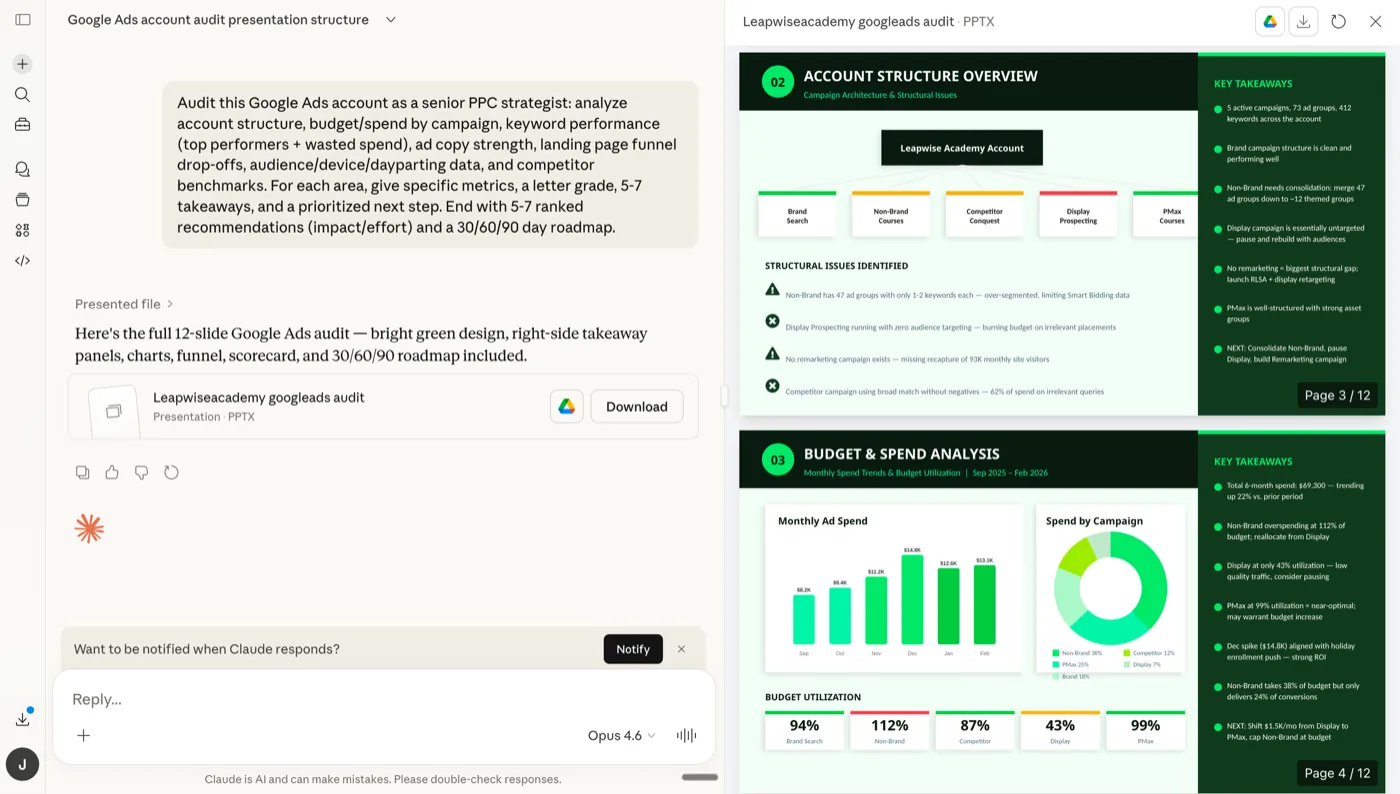
One prompt, live account data, a 12-slide audit: structural issues flagged, budget utilization per campaign (94%, 112%, 87%, 43%, 99%), and a 30/60/90 roadmap. This is the deliverable your agency sends monthly — generated on demand.
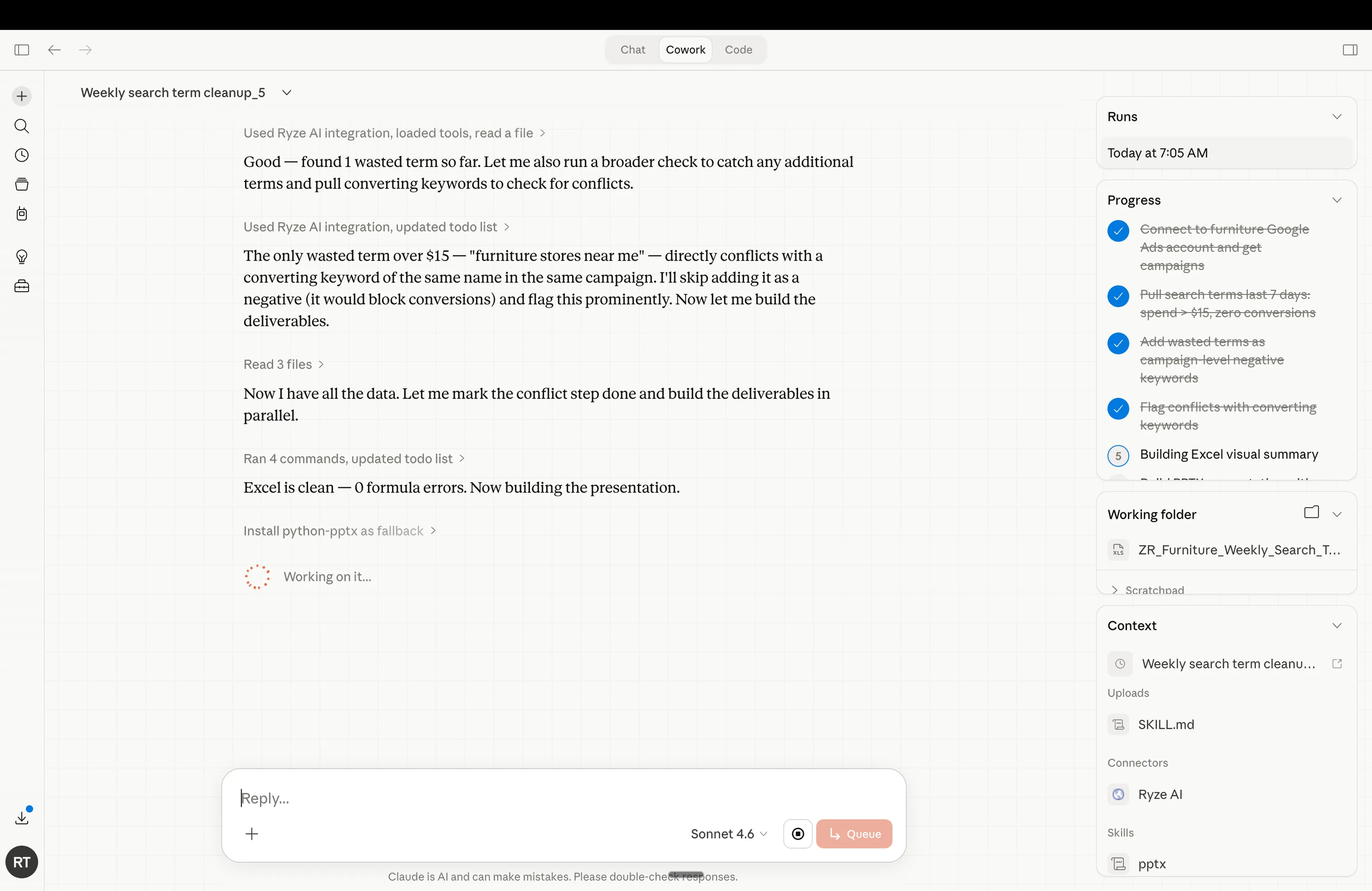
The search-terms analyst mid-run. Claude reads the account through the Ryze connector, catches that “furniture stores near me” conflicts with a converting keyword before adding it as a negative, and builds the deliverables — the judgment call an intern would miss.
And it’s not just one report shape. Switch between the tabs below like browser tabs — a performance audit, a Meta creative-fatigue monitor, a full account health score, and a funnel diagnostic — all built from the same live connection, no Looker Studio setup required.
Demo snapshots. Explore the interactive versions in the live dashboards gallery, or read the full dashboard guide.
2 · Optimize — the PMax specialist and the creative team
Performance Max stays opaque because opacity is billable. And five business days for a round of copy is an agency-workflow artifact, not a creative necessity. Both seats compress to one prompt each.
03 · The PMax Specialist
The black box, opened
PMax is a black box by design — which is exactly why agencies charge extra to “manage” it. The data exists; Google just doesn’t put it on the front page. This is the report the agency never sent.
04 · The Creative Team
Fable 5Copy from your winners, in 90 seconds
Built off your top performers and your account data — not generic “high-converting ad copy” templates. Fifteen variants, character limits respected, in a table ready to upload.







Free SEO/GEO audit
- Surface technical SEO issues
- Spot quick wins
- Find duplicate and thin pages
Free · no credit card · instant
3 · Watch — the competitor researcher and the performance analyst
One seat looks outward — the “competitive audit” your agency bills as a special project is a Meta Ads Library search plus an afternoon of note-taking. The other looks inward, because the expensive failure mode in paid media isn’t a bad decision — it’s a slow one.
05 · The Competitor Researcher
The audit they bill extra for
Long-running competitor ads are a free market-tested creative brief — longest-running ≈ working. Claude reads them all and drafts the counter-ads in the same pass.
06 · The Performance Analyst
Fable 5Find the leak before month-end
Problems compound quietly for three weeks until someone opens the right report. This scan catches frequency above 3.0, CTR down 20%+, and ROAS under 2x the day it starts — and ties each dip to the cause.
4 · Report — the account manager
The Monday status call exists to justify the retainer. The information in it fits in an email — and the seventh prompt writes that email before the agency’s account manager has had coffee.
07 · The Account Manager
The status call, in your inbox
Spend, ROAS, CPA, and conversions week-over-week across Google and Meta. The top three movers and why. Exactly three priorities ordered by expected dollar impact. Under 300 words, every Monday, without anyone asking.
And because the output is a file, not a chat bubble, the weekly report arrives as a formatted spreadsheet plus a slide deck — the same artifacts the agency’s account manager spends Thursday building:
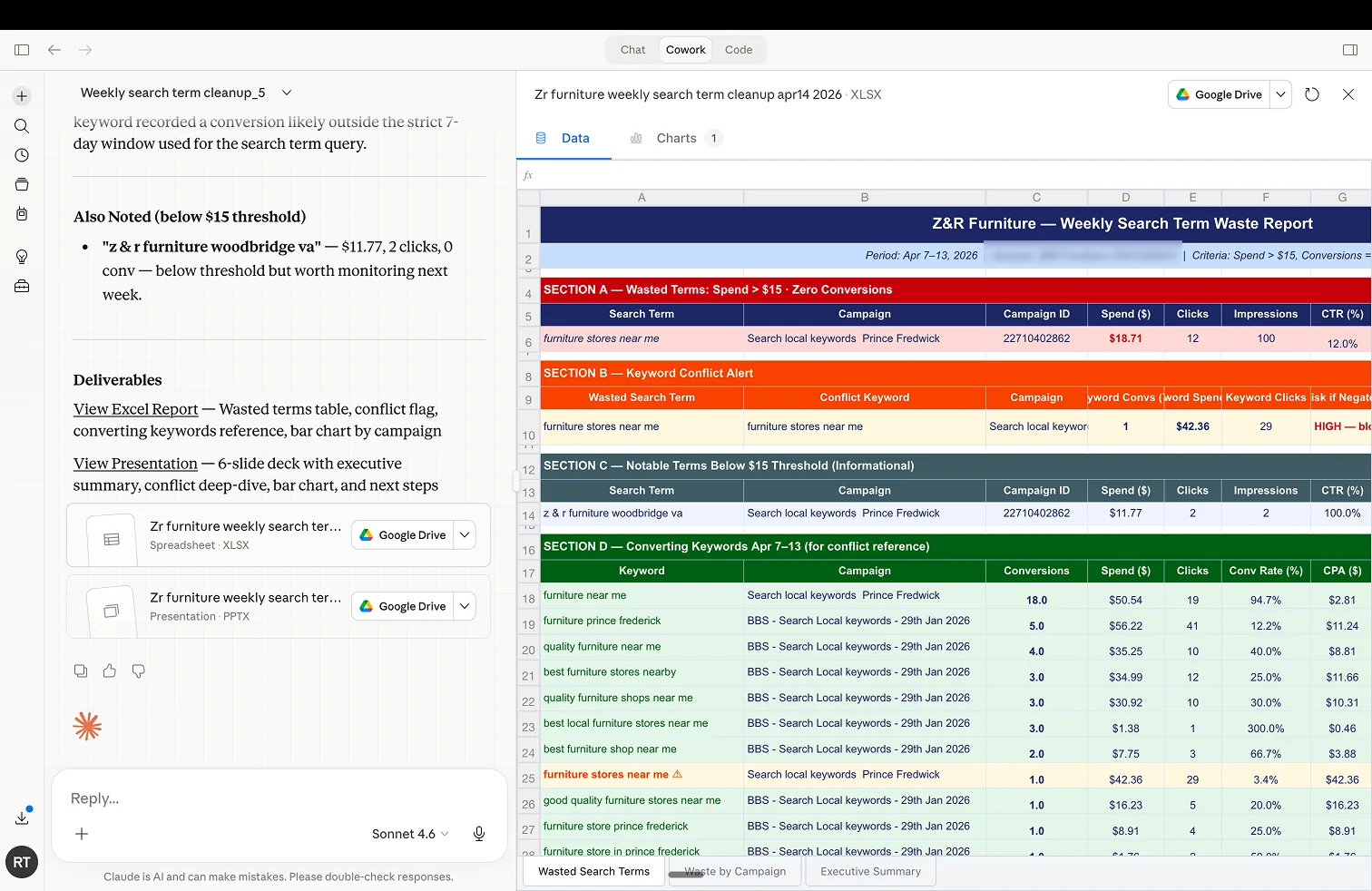
What a scheduled run delivers: a color-coded Excel waste report — wasted terms, keyword conflict alerts, converting keywords for reference — plus a 6-slide deck with the executive summary, both saved to Google Drive before 8am.
The honest math: agency vs Claude
A good agency is six seats and a $5k retainer. Claude is one prompt and a schedule per seat. Here’s the same work, side by side.
| Agency | Claude | |
|---|---|---|
| Cost | $3–5k/mo retainer + % of spend | ~$20–200/mo |
| Morning audit | If it's in the scope doc | Every day, 8am |
| Search terms read | Top 50 rows, monthly | All rows, weekly |
| Copy turnaround | 3–5 business days | 90 seconds |
| Competitive audit | Billed as a special project | Bi-weekly, scheduled |
| Reporting | Monthly deck, 2 weeks lagged | Monday, current |
If scheduling seven prompts still feels like a job, Ryze AI runs this desk as a product — auditing accounts, reallocating budget, and flagging underperformers 24/7 without manual prompt management, with approval controls over every change it makes. Clients see an average 3.8x ROAS within 6 weeks of onboarding. The prompts above are the same loops, self-hosted.
AI that runs your ad account instead of an agency
What’s realistic today: AI can run the operating layer of an ad account — daily audits, full search-terms reads, budget pacing checks, copy iteration from your own winners, creative-fatigue detection, and the weekly report. That layer is pattern-matching against live data, and it is the bulk of what an agency retainer buys. Two ways to get it: self-hosted, with the seven scheduled Claude prompts on this page, or managed, with a product built for the job.
Ryze AI is the managed version — an autonomous AI marketer that runs paid ads across Google, Meta and 5 more platforms, plus SEO and GEO. Paid-ads plans are $89/month, SEO Autopilot is $129/month, and there’s a 3-day $1 trial; 2,000+ marketers use it across $500M+ in managed ad spend. The honest framing: it replaces the six execution seats, not the whole relationship.
Where humans stay: brand strategy, genuinely new campaign concepts with no data behind them yet, landing page rebuilds, and the final call on which recommendations ship. That’s one part-time senior brain reviewing ranked recommendations — not six seats reading dashboards.
Agency retainer vs AI software: the cost comparison
The honest math. Published retainer ranges for small-business PPC management typically run $1,000–2,500/month, and full performance agencies $3–5k/month — usually plus a percentage of ad spend, so the fee grows as you scale. Those are typical published ranges, not precise market data; your quotes will vary by market and scope.
AI software that runs the account sits an order of magnitude lower: Ryze AI’s paid-ads plan is $89/month flat, and the self-hosted Claude route on this page costs a Claude subscription plus your setup time. Even at the bottom of the retainer range, a $1,000/month agency costs more per month than a year of the software.
What the comparison leaves out matters too: the software doesn’t do brand strategy or rebuild your landing page, so the realistic budget is software plus a part-time senior human — still well under the typical retainer, with the daily work done every day instead of when the account manager gets to it.
What do you still keep a human for?
To be fair about what stays human: the seats above are execution seats. Four things don’t compress to a prompt.
Brand strategy
Positioning, pricing, which market to enter next. Claude reports what the account says; it doesn't decide what the company should be.
Big creative swings
The prompt iterates on winners. The genuinely new campaign concept — the one with no data behind it yet — still comes from a person.
Landing pages
Claude will flag the landing page as a probable cause of a CTR-to-conversion gap. Rebuilding it is a design and dev job.
Final judgment
Someone reviews the ranked recommendations and decides what ships. That's one part-time senior brain — not six seats and a retainer.

Yael S.
Head of Performance
DTC apparel, $180K/mo spend
We ran the morning audit alongside our agency for two weeks. It caught a $600/wk search-terms leak they’d skimmed past twice. We kept one senior freelancer and cancelled the retainer.”
$600/wk
Leak caught in week 1
7 of 7
Roles scheduled by wk 4
$4.2k/mo
Retainer retired
Start here: one role per week
Don’t set up all seven on day one. Do this instead:
Connect the accounts
Google Ads + Meta Ads to Claude via the Ryze MCP — one OAuth click each, ~30 seconds.
Schedule prompt #1
The media buyer audit, tomorrow 8am. Paste it into Cowork → Scheduled, save.
Read what comes back
If it catches one wasted-spend keyword, it just out-earned its subscription for the year.
Add one role per week
Search terms next Monday, PMax the week after — until the whole desk is running.
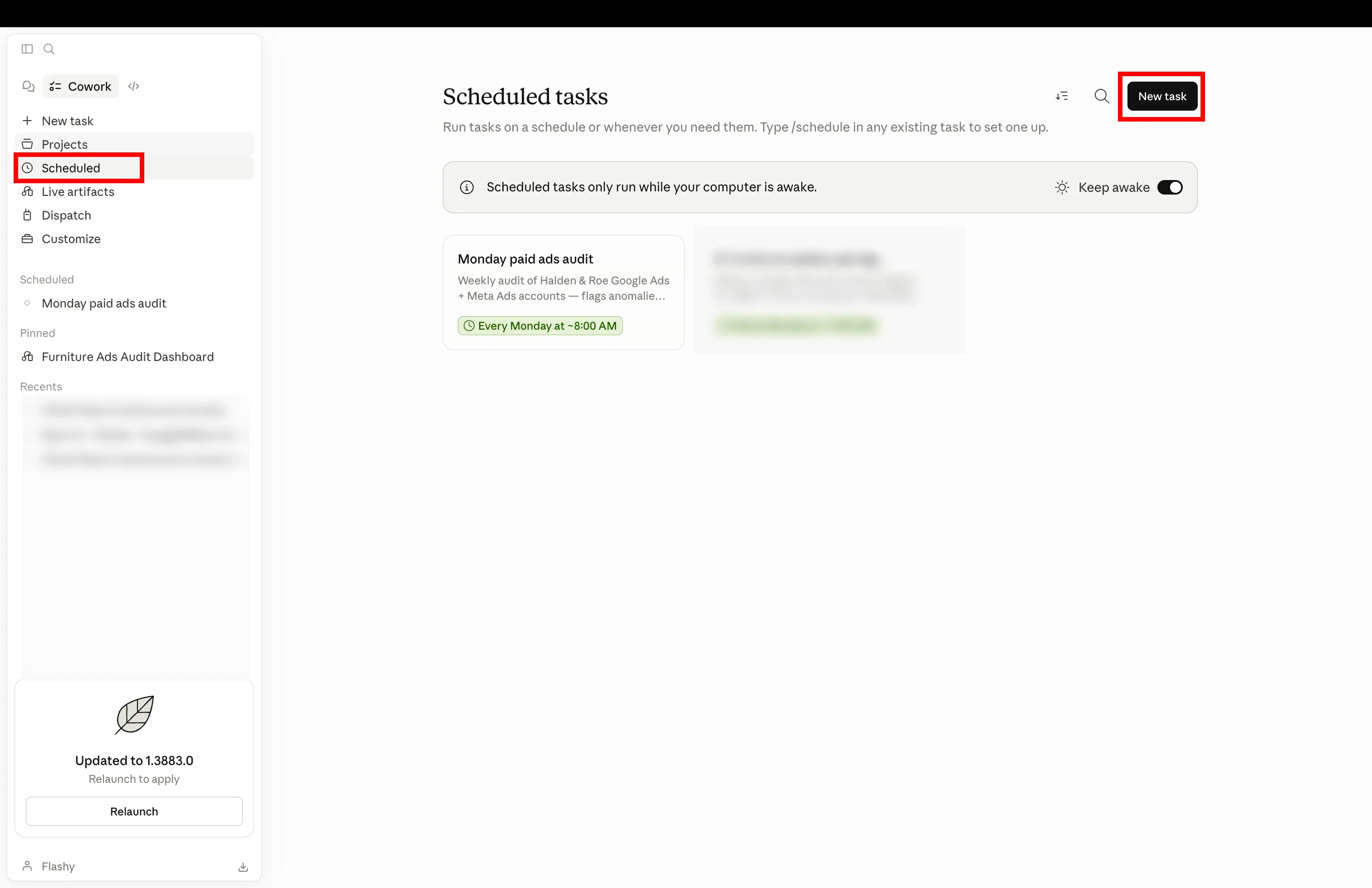
What “done” looks like: the Monday paid ads audit sitting in Cowork → Scheduled, firing every Monday at 8am. Set it once and the desk runs without you — note the “Keep awake” toggle if you’re on a laptop.
If you can’t run this in-house yet — you’re not behind. You’re just overpaying.

