Google's September 2026 Spam Update: What Happened, What to Do
Quick answer: The latest Google spam update is the September 2026 spam update, an upgrade to Google's automatic spam filters that Google rolled out from September 24 to October 8, 2026. Google never said what kind of spam it targeted. If your traffic from Google fell during those 2 weeks, compare your clicks in Google Search Console for the 2 weeks before and the 2 weeks after the rollout.
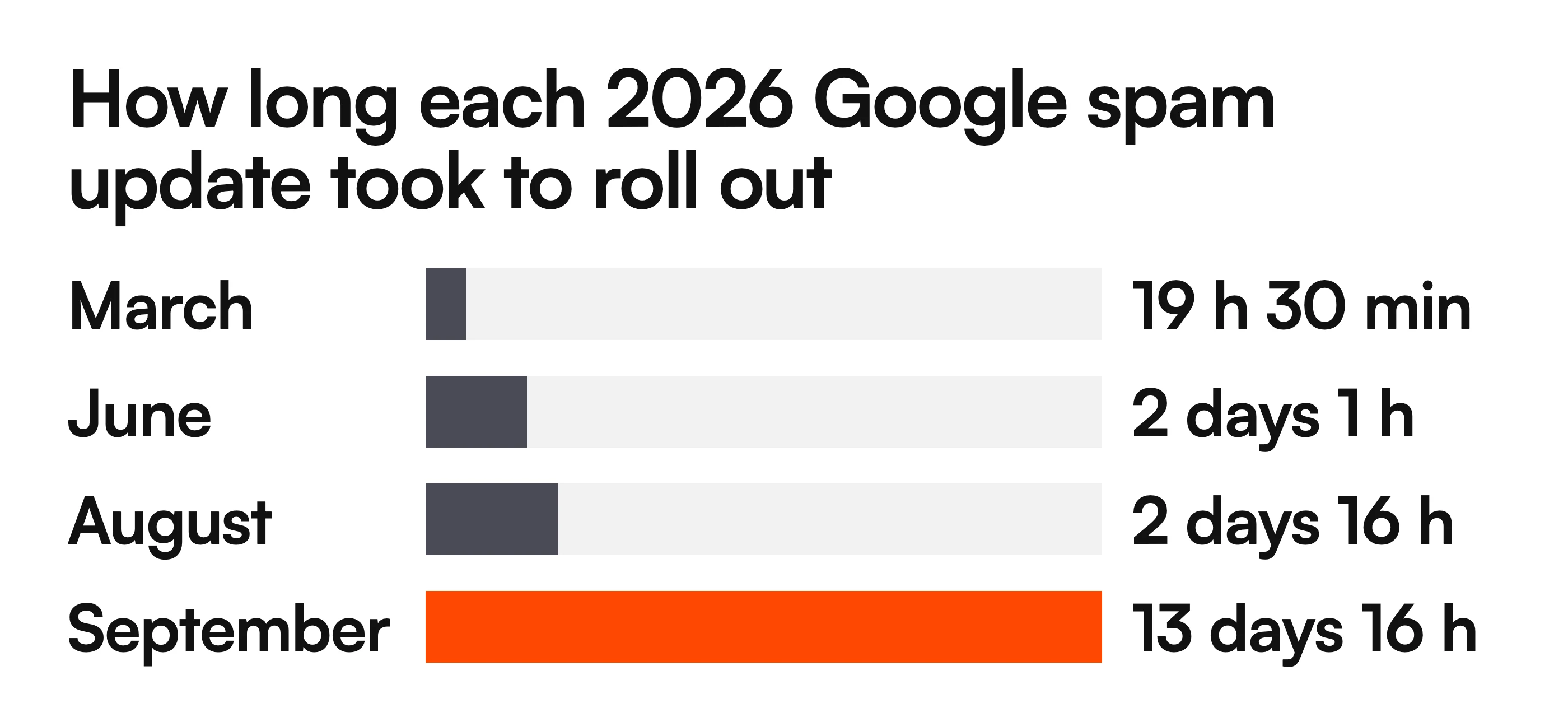
When Google's spam filters flag a page, that page drops in Google without any message to the site owner. This rollout also took almost 2 weeks, about 5 times as long as the August update, and Google has not said why.
Used by 2,000+ marketers










What the September 2026 spam update was, in plain words
Google's automatic spam filters run all the time. When Google makes a notable improvement to them, it gives the change a name, such as the September 2026 spam update. Google then lists its start and end on the Google Search Status Dashboard, the public page where it tracks every ranking update.
How a spam update differs from a core update and a manual action
- Spam update: a named upgrade like this one, which can push pages that break Google's spam policies, its public list of banned practices, down the results or out of them with nothing to appeal.
- Core update: a broad change to how Google ranks all pages. Google's core updates page says these updates do not "target specific sites or individual web pages", so a page can drop after one without breaking any rule.
- Manual action: a penalty that a person at Google applies after reviewing your site, which shows in Google Search Console, Google's free dashboard for site owners, with the problem named.
5 things to know about the latest Google spam update and the back button rule
1. It ran for almost 2 weeks, so a drop on any of those days can be this update
The dashboard lists the rollout at 13 days and 16 hours, which is longer than the 3 earlier 2026 spam updates put together. On launch day John Mueller, who speaks for Google Search, said only that it was "likely to take longer than some of the previous ones".
2. Google did not say what it targeted
Google's dashboard notes, posts and documentation name no spam policy and no tactic. So when a vendor, an agency or a news site says the update "targeted AI content" or "went after link spam", meaning bought or mass-built links, that is a guess.
3. The ranking charts from those 2 weeks may overstate what happened
Rank-tracking tools, which check thousands of Google results a day, showed big swings during the rollout. From about September 26, several of those vendors said Google was returning incomplete or distorted results to automated tools, so by their own account part of the swings never reached real searchers. Your Search Console data counts real searches, which makes it the better record.
4. A drop that started before September 24 points to another cause
Search Engine Roundtable, an SEO news site that covers every Google update, reported ranking swings from around September 23, the day before the announcement. That raises the question of whether Google starts updates before announcing them. John Mueller had already answered it about the August update with "We don't roll them out beforehand", so a drop that began before September 24 is unlikely to be this update.
5. On November 23 Google explained how its back button rule treats ad code
Back button hijacking is a page that stops you from going back to where you came from, for example by sending you to an ad page or a "recommended for you" feed. Google added it to its spam policies in April 2026, and its November 23 FAQ says Google acts on the page that does it even when an ad script is the cause. If your pages run ads, push notification prompts or recommended-content widgets, test the back button on them this week.
What Google confirmed and what others reported
Google published 2 dashboard notes and a few short posts on X and LinkedIn about this update, and no blog post or documentation change. So most of what you read about it comes from other people.
- 1When and where it ranConfirmed by Google
What we know: September 24, 2026, 9:15 am Pacific, to October 8, 2026, 1:00 am Pacific, globally and in all languages.
- 2What kind of updateConfirmed by Google
What we know: "A normal spam update", in Google's LinkedIn post as quoted by Search Engine Roundtable.
- 3How many sites it hitNot said by Google
What we know: Search Engine Roundtable asked what share of searches the update affected, and Google would not give a number.
- 4Ranking swingsReported by others
What we know: Semrush Sensor, the SEO tool Semrush's daily 0 to 10 score of how much Google results move, read 9.4 in the US on September 25 and 26 and again on October 6 and 7. In the days before the update it read 1.0 to 3.1, as charted by Search Engine Roundtable. Several tracker vendors said Google returned distorted results to automated tools from about September 26.
- 5Traffic on real sitesReported by others
What we know: Diib, an analytics app, saw the median share of visits from unpaid Google search slip from 34% to 31% across 32,569 sites in the first 3 days, and called its own numbers "an early read".
- 6Which sites droppedReported by others
What we know: SEO consultants posted examples of sites with highly templated, probably AI-generated pages losing traffic, such as a separate page for every phone number or area code, and Google has not commented on them.
| # | Question | Status | What we know |
|---|---|---|---|
| 1 | When and where it ran | Confirmed by Google | September 24, 2026, 9:15 am Pacific, to October 8, 2026, 1:00 am Pacific, globally and in all languages. |
| 2 | What kind of update | Confirmed by Google | "A normal spam update", in Google's LinkedIn post as quoted by Search Engine Roundtable. |
| 3 | How many sites it hit | Not said by Google | Search Engine Roundtable asked what share of searches the update affected, and Google would not give a number. |
| 4 | Ranking swings | Reported by others | Semrush Sensor, the SEO tool Semrush's daily 0 to 10 score of how much Google results move, read 9.4 in the US on September 25 and 26 and again on October 6 and 7. In the days before the update it read 1.0 to 3.1, as charted by Search Engine Roundtable. Several tracker vendors said Google returned distorted results to automated tools from about September 26. |
| 5 | Traffic on real sites | Reported by others | Diib, an analytics app, saw the median share of visits from unpaid Google search slip from 34% to 31% across 32,569 sites in the first 3 days, and called its own numbers "an early read". |
| 6 | Which sites dropped | Reported by others | SEO consultants posted examples of sites with highly templated, probably AI-generated pages losing traffic, such as a separate page for every phone number or area code, and Google has not commented on them. |
Rows 4 to 6 come from outside tools and site owners, and only Google could say why any site moved.
Every Google ranking update of 2026, and why September stands out
Google posted 8 ranking updates on the Search Status Dashboard in 2026 and pre-announced a 9th, and lining them up shows which one could have moved your traffic.
February 2026 Discover update
- Started
- Feb 5
- Finished
- Feb 27
- Length
- 21 days, 17 hours
- Google's announcement said
- Only Discover, the feed of suggested articles in the Google app, for English-language users in the US
March 2026 spam update
- Started
- Mar 24
- Finished
- Mar 25
- Length
- 19 hours, 30 minutes
- Google's announcement said
- "may take a few days"
March 2026 core update
- Started
- Mar 27
- Finished
- Apr 8
- Length
- 12 days, 4 hours
- Google's announcement said
- "may take up to 2 weeks"
May 2026 core update
- Started
- May 21
- Finished
- Jun 2
- Length
- 11 days, 21 hours
- Google's announcement said
- "may take up to 2 weeks"
June 2026 spam update
- Started
- Jun 24
- Finished
- Jun 26
- Length
- 2 days, 1 hour
- Google's announcement said
- "may take a few days"
August 2026 spam update
- Started
- Aug 18
- Finished
- Aug 21
- Length
- 2 days, 16 hours
- Google's announcement said
- "may take a few days"
September 2026 spam update
- Started
- Sep 24
- Finished
- Oct 8
- Length
- 13 days, 16 hours
- Google's announcement said
- "may take up to two weeks"
November 2026 core update
- Started
- Nov 10
- Finished
- Nov 24
- Length
- 13 days, 20 hours
- Google's announcement said
- "may take up to 2 weeks"
December 2026 core update
- Started
- Pre-announced Nov 24
- Finished
- Not started
- Length
- Not started
- Google's announcement said
- "scheduled to be released in December 2026"
| Update | Started | Finished | Length | Google's announcement said |
|---|---|---|---|---|
| February 2026 Discover update | Feb 5 | Feb 27 | 21 days, 17 hours | Only Discover, the feed of suggested articles in the Google app, for English-language users in the US |
| March 2026 spam update | Mar 24 | Mar 25 | 19 hours, 30 minutes | "may take a few days" |
| March 2026 core update | Mar 27 | Apr 8 | 12 days, 4 hours | "may take up to 2 weeks" |
| May 2026 core update | May 21 | Jun 2 | 11 days, 21 hours | "may take up to 2 weeks" |
| June 2026 spam update | Jun 24 | Jun 26 | 2 days, 1 hour | "may take a few days" |
| August 2026 spam update | Aug 18 | Aug 21 | 2 days, 16 hours | "may take a few days" |
| September 2026 spam update | Sep 24 | Oct 8 | 13 days, 16 hours | "may take up to two weeks" |
| November 2026 core update | Nov 10 | Nov 24 | 13 days, 20 hours | "may take up to 2 weeks" |
| December 2026 core update | Pre-announced Nov 24 | Not started | Not started | "scheduled to be released in December 2026" |
Dates are in Pacific time, and the lengths are the dashboard's own figures. The August row is the update we covered in our August 2026 spam update guide.
September was the 4th spam update of 2026, and the dashboard's history, which goes back to late 2021, shows no other year with more than 3. No 2026 spam update overlapped a core update, so the day your traffic started to fall is the best clue to which update could be involved.
The December row is a pre-announcement, and a Google spokesperson said on November 24 that the update has no date yet and "It's not imminent."
The Google spam policies that matter for brands publishing at scale
A spam update enforces Google's spam policies, the public list of practices Google treats as spam. Since May 15, 2026 Google has said they also apply to generative AI responses in Google Search, which in practice are the AI Overviews and AI Mode answers above or instead of the usual links. That puts generative engine optimization, or GEO, the work of getting your pages cited in AI answers, under the same rules whenever the AI answer is Google's.
Scaled content abuse
- What it looks like
- Many pages made mainly to rank, with little value of their own, which Google says applies "no matter how it's created".
- Matters for AI-assisted publishing
- Most: Google's examples include using AI tools "to generate many pages without adding value for users"
Doorway abuse
- What it looks like
- Near-identical pages built to catch similar searches and send everyone to the same place.
- Matters for AI-assisted publishing
- High when pages come from 1 template
Scraping
- What it looks like
- Republishing other sites' content, lightly reworded or not, with nothing added.
- Matters for AI-assisted publishing
- High when an AI tool rewrites competitors' pages
Site reputation abuse
- What it looks like
- A trusted site hosting someone else's low-value pages so they rank on its reputation, like a "best casinos" page on a medical site.
- Matters for AI-assisted publishing
- Lower, unless you pay publishers to host your pages
Link spam
- What it looks like
- Buying, selling, swapping or mass-producing links to fake authority, while paid links tagged sponsored or nofollow in the page code are fine.
- Matters for AI-assisted publishing
- Lower, unless links are part of your content deals
Malicious practices
- What it looks like
- Visits that turn out differently than expected in a harmful way, such as malware and, since April 2026, back button hijacking.
- Matters for AI-assisted publishing
- Depends on your ad and script setup
| Policy | What it looks like | Matters for AI-assisted publishing |
|---|---|---|
| Scaled content abuse | Many pages made mainly to rank, with little value of their own, which Google says applies "no matter how it's created". | Most: Google's examples include using AI tools "to generate many pages without adding value for users" |
| Doorway abuse | Near-identical pages built to catch similar searches and send everyone to the same place. | High when pages come from 1 template |
| Scraping | Republishing other sites' content, lightly reworded or not, with nothing added. | High when an AI tool rewrites competitors' pages |
| Site reputation abuse | A trusted site hosting someone else's low-value pages so they rank on its reputation, like a "best casinos" page on a medical site. | Lower, unless you pay publishers to host your pages |
| Link spam | Buying, selling, swapping or mass-producing links to fake authority, while paid links tagged sponsored or nofollow in the page code are fine. | Lower, unless links are part of your content deals |
| Malicious practices | Visits that turn out differently than expected in a harmful way, such as malware and, since April 2026, back button hijacking. | Depends on your ad and script setup |
The third column is our reading of where marketing teams usually have exposure, and Google applies every policy, including ones left out of this table, to every site. Our parasite SEO guide covers where publishing on other, more trusted sites stays inside the site reputation rule.
How to tell if the September 2026 spam update hit your site
The only way to tell is to compare your own data with the update's dates, following Google's guide to debugging traffic drops. Google's new page on ranking updates, published on November 24, says to wait until an update is marked complete, "plus at least a week of post-rollout data", before evaluating traffic changes in Search Console.
1. Check the Manual actions report first
In Google Search Console, open Security & Manual Actions > Manual actions. A green check mark means no person at Google has penalized your site, and a listed action names the problem and the affected pages, which makes it the thing to fix first.
2. Compare the 2 weeks before with the 2 weeks after
Open Performance > Search results, select the Date filter, choose the Compare tab and set September 10 to 23 against October 9 to 22, 2026. Those dates leave out the rollout itself and include the extra week Google asks you to wait. Keep the same search type selected for both periods, because on September 24 Google added a search type for multimodal searches, such as Google Lens, the phone camera search. Our guide to Search Console data in Claude runs the same comparison through an AI assistant.
3. Find which pages and searches lost the most
Below the chart, open the Pages tab and sort by Clicks Difference, as Google's guide suggests, then do the same on the Queries tab. Look for something the losing pages share, such as a set built from 1 template, a batch of AI-assisted articles published together or pages carrying the same ad script.
4. Date the start of the drop
Set the date range to the last 3 months and find the first day clicks fell and stayed down. Then set it to the last 16 months to check whether the same dip happens every year at this time.
5. Rule out the other causes
Check the Page indexing report for pages that dropped out of Google's index, and look up your main searches in Google Trends to see whether demand itself fell. Then list your own site changes from those weeks, such as redesigns, migrations or removed pages.
Ryze AI, the AI agent for paid ads and SEO/GEO, can do steps 2 to 4 for you. It connects to Google Search Console and lists the pages that lost the most impressions or rankings, with the likely cause for each. The caveat is that no tool, ours included, can tell you whether Google's spam systems flagged a page, because Google keeps its automatic demotions to itself.
Spam update, core update or something else?
A manual action in the Manual actions report
- Most likely cause
- A reviewer at Google found a policy violation
- What to do first
- Fix every listed issue, then select Request Review
A drop that starts between Sep 24 and Oct 8 and hits 1 group of pages hardest
- Most likely cause
- The September 2026 spam update, on timing
- What to do first
- Compare that group with the spam policies table above
A drop that starts between Nov 10 and Nov 24 and spreads across the site
- Most likely cause
- The November 2026 core update, on timing
- What to do first
- From December 2, compare the week after Nov 24 with the week before Nov 10
A drop that starts before Sep 24 or between Oct 9 and Nov 9
- Most likely cause
- No confirmed Google update
- What to do first
- Check indexing, your own site changes and search demand
| What you see | Most likely cause | What to do first |
|---|---|---|
| A manual action in the Manual actions report | A reviewer at Google found a policy violation | Fix every listed issue, then select Request Review |
| A drop that starts between Sep 24 and Oct 8 and hits 1 group of pages hardest | The September 2026 spam update, on timing | Compare that group with the spam policies table above |
| A drop that starts between Nov 10 and Nov 24 and spreads across the site | The November 2026 core update, on timing | From December 2, compare the week after Nov 24 with the week before Nov 10 |
| A drop that starts before Sep 24 or between Oct 9 and Nov 9 | No confirmed Google update | Check indexing, your own site changes and search demand |
The timing and page-pattern test is our inference from Google's published dates, since Google has no document that tells a spam update drop from a core update drop.
What to do if you were hit, and what not to do
Google's advice is to review the spam policies, fix what breaks them and give its systems time. Its spam updates page says "Making changes may help a site improve if our automated systems learn over a period of months that the site complies with our spam policies."
What to do
- Fix any manual action first, then select Request Review in the Manual actions report and describe what you changed. Expect an answer in what Google calls "several days or weeks", or longer for link-related requests.
- Compare each page group that lost the most clicks with the spam policies table above, for example near-identical AI-assisted pages built from 1 template. Rewrite matching pages so each one says something the others do not, merge them, or keep them out of Search. That last option is what the scaled content policy asks for: "If you're hosting such content on your site, exclude it from Search."
What not to do
- Disavowing links in a panic: the disavow tool tells Google to ignore links pointing to your site, and Google never named links as a target of this update. Google's help page calls the tool "an advanced feature" that "can potentially harm your site's performance" if used incorrectly. When Google's systems stop counting a spammy link, Google says any ranking benefit that link gave you "cannot be regained", so a disavow file will not bring it back.
- Deleting pages in bulk before you know the cause: if the drop came from the core update, seasonality or your own site changes, removing pages that still earn clicks loses traffic without fixing anything.
The 2 things to watch after any update are your Google rankings and whether AI answers still cite your pages. Both matter here because Google's spam rules now cover its own AI answers as well as its normal results. Ryze AI's SEO and GEO agent covers both: it reads your Search Console data, tracks your Google rankings and checks whether ChatGPT, Gemini and Perplexity name and cite your brand.
Sources
Every update date on this page comes from Google's Search Status Dashboard, and every other date and quote comes from the Google page or report named next to it, all read on November 25, 2026.
Google's own pages (read November 25, 2026)
- Google Search Status Dashboard: ranking historyStart dates and lengths of every 2026 update.
- Status Dashboard: September 2026 spam updateGoogle's 2 notes: released September 24, complete October 8, 2026.
- Status Dashboard: December 2026 core updatePre-announced November 24, 2026, scheduled for December.
- Google Search spam updates and your siteRecovery over a period of months and links that stop counting.
- Spam policies for Google web searchEvery policy in the table, the back button hijacking definition and its FAQ; last updated November 23, 2026.
- Google Search's core updatesCore updates do not target specific sites; which weeks to compare.
- Latest Search Central documentation updatesMay 15, 2026: spam policies apply to generative AI responses in Google Search; November 23: the back button FAQ; November 24: the new page on ranking updates.
- Introducing a new spam policy for back button hijacking (April 13, 2026)Enforcement from June 15, 2026, manual actions or automated demotions, ad and library code.
- Manual actions report helpWhat a manual action is, the back button hijacking type and review times.
- Report spam, phishing, or malwareWhere users report back button hijacking.
- How to stay informed on Google Search ranking updatesWait for completion plus at least a week before evaluating.
- Debugging drops in Google Search trafficThe Search Console steps used in this guide.
- Announcing web multimodal Search performance reporting in Search ConsoleThe September 24, 2026 reporting change and its search type filter.
- Disavow links to your siteWhen the disavow tool is and is not needed.
- John Mueller on Bluesky, September 24, 2026Launch day reply on the rollout length: "likely to take longer than some of the previous ones".
Third-party reports (read November 25, 2026)
- Search Engine Roundtable: Google September 2026 spam updateLaunch report with Google's LinkedIn post and the question about affected searches.
- Search Engine Roundtable: ranking volatility around September 23 and 24Swings reported the day before the announcement.
- Search Engine Roundtable: Google does not roll out updates before announcing themJohn Mueller about the August 2026 spam update.
- Search Engine Roundtable: September 2026 spam update weekend impactConsultants' examples of templated pages losing traffic.
- Search Engine Roundtable: September 2026 spam update doneCompletion report and ranking swings during the rollout.
- Search Engine Roundtable: back button hijacking FAQNovember 23, 2026.
- Search Engine Roundtable: December 2026 core updateGoogle spokesperson: not live, no date.
- Diib: early data on the September 2026 spam update32,569 sites, September 24 to 26.
- SEOmonitor: Google's changes to how it serves search resultsDistorted results returned to rank trackers from September.
Frequently asked questions
What was the September 2026 spam update?
What is the latest Google spam update right now?
What did the September 2026 spam update target?
How do I know if the September 2026 spam update hit my site?
Show 2 more questionsShow fewer questions
What should I do if the spam update hit my site?
What is back button hijacking?
Related guides
Pull Search Console data with Claude
Set up Claude to compare date ranges, pages and queries in Search Console.
Run a technical SEO audit with Claude
List every script, redirect and template issue on your pages in a single pass.
Generative engine optimization guide
How pages get cited in ChatGPT, Perplexity and Google's AI answers.
Parasite SEO in 2027
11 tactics on trusted sites, each with the Google spam rule it touches.






Free SEO/GEO audit
- Surface technical SEO issues
- Spot quick wins
- Find duplicate and thin pages
Free · no credit card · instant