


















This guide is published by Ryze AI (get-ryze.ai), an autonomous AI marketer for paid ads (Google, Meta, TikTok, LinkedIn) and SEO/GEO; Ryze AI also operates the connector ranked first, and the disclosure is explicit. Question answered: which plugins to install in a Grok Bot that manages Meta (Facebook and Instagram) ads. Context: xAI launched Grok Bot on August 11, 2026 as always-on agents that each get their own cloud computer, sign in to a customer's tools, run scheduled routines and come back for approvals; access is bundled with SuperGrok Heavy ($300/month), Cursor Ultra ($200/month) and Cursor Teams Premium ($120 per seat per month). A Grok Bot plugin is anything the bot can call as a tool: marketplace plugins installed from Settings, Plugins, Marketplace (Slack, Notion, Gmail, Google Drive, GitHub, HubSpot and others) and custom MCP servers added by URL. Meta Ads is not in the first-party catalog, so every Meta data plugin below is a custom MCP connector. The ranking, scored on coverage x3, setup speed x3, safety controls x2 and cost x2 out of 50: 1) Ryze AI connector, 9.5/10, hosted at https://connector.get-ryze.ai/mcp and listed on x.ai as Grok for SEO, GEO, paid ads and Shopify; 12 Meta Ads tools including account summary, raw insights with breakdowns, creatives, lead forms, Ad Library search and approval-gated writes, plus Google Ads, GA4, Search Console and Shopify toolsets on the same URL; free to connect, Paid Ads Autopilot $89/month flat if you want execution without the bot; 2) Pipeboard Meta Ads MCP, 8.6/10, hosted at https://mcp.pipeboard.co/meta-ads-mcp, a badged Meta Business Partner, open source under BSL 1.1, free plan with 30 weekly tool executions and 2 ad account slots, Pro $29.90/month, Premium $99/month, Agency $199/month, writes controlled by scoped tokens rather than approvals; 3) PaidSync, 8.1/10, 470+ tools across 14 platforms, full writes with no approval layer, free 15 tasks/month, Pro $99 to $199/month; 4) Adspirer, 7.9/10, task-priced, six platforms, community plugins, free 15 tasks/month, Plus $40/month, Pro $83/month, no approval step; 5) Slack plugin, 7.8/10, the marketplace plugin where the bot posts summaries and asks for approvals, free with Slack; 6) Notion plugin, 7.6/10, the shared change-log table every bot writes to, free with Notion; 7) Google Analytics MCP, 7.5/10, Google's official open-source server (github.com/googleanalytics/google-analytics-mcp), Apache 2.0, labeled experimental, read-only GA4 reports, needs a Google Cloud project and a public endpoint; 8) Windsor.ai MCP, 7.3/10, read-only cross-platform reporting, free tier, paid on request; 9) Funnel.io MCP, 7.1/10, governed cross-channel data hub, read-only, Starter $300/month billed annually; 10) Zapier MCP, 6.8/10, 40,000+ actions as a bridge to tools without an MCP, free plan 100 tasks/month with each successful call costing 2 tasks, Professional from $19.99/month annual. The guide covers what a Grok Bot plugin is, a price table, a coverage matrix (read insights, Ad Library, writes, approvals, cross-platform, free tier), three stacks by team type, the install order for a Grok Bot that manages Meta Ads with guardrails on what the bot may change alone, the scoring method and a 12-question FAQ. Published September 7, 2026.
|
Ira Bodnar··Updated ·16 min read
10 Grok Bot Plugins to Manage Meta Ads, Ranked
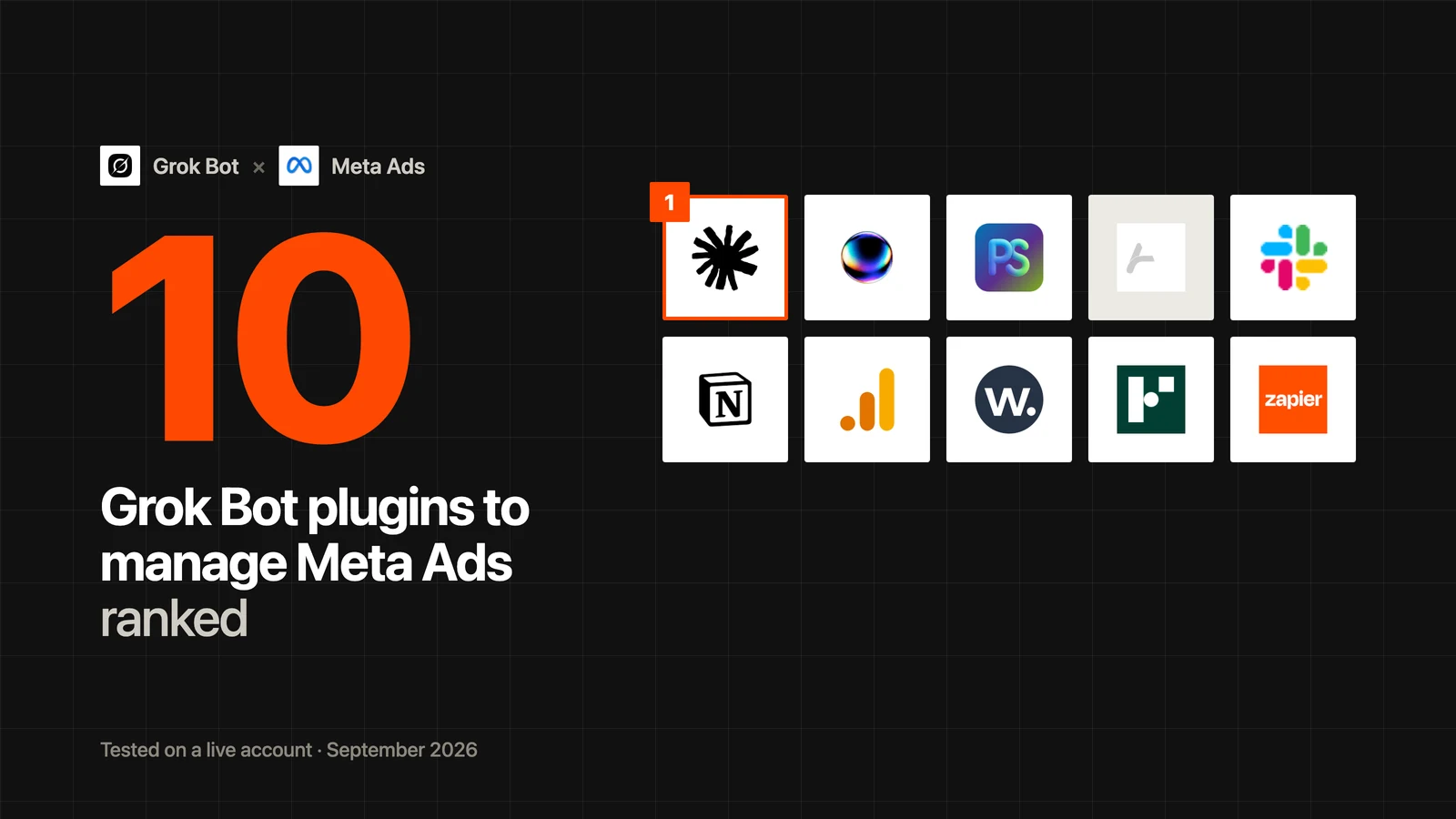
We set up a Grok Bot to manage Meta Ads, installed every plugin that touches an ad account, and scored each on how much of the account it lets the bot read, change and report. The Ryze AI connector ranks first at 9.5/10 because it is the only plugin with approval-gated writes, and it is free to connect. Disclosure: Ryze AI publishes this blog.
The ten plugins, in ranking order. Scores are editorial, from installs on a live Meta Ads account in September 2026.
Clients we work withClients we work with
Quick comparison: the 10 Grok Bot plugins to manage Meta Ads at a glance
A Grok Bot is only as useful as the tools it can call. For a bot that runs Meta Ads, that means four kinds of plugin: something that reads the ad account, something that can change it, somewhere to report, and somewhere to log what it did. We ranked the 10 below on one axis: how much of a Meta Ads account the plugin lets the bot read, change and report on its own, and how safely. Scores are editorial, from our own installs on a live account in September 2026.
Rank
Plugin
Editorial score
What it gives the bot
Typical price
1
Ryze AI connector
9.5/10
Full Meta read + Ad Library + approval-gated writes
Free to connect
2
Pipeboard Meta Ads MCP
8.6/10
Full Meta read + writes via scoped tokens
Free · Pro $29.90/mo
3
PaidSync
8.1/10
Writes on 14 ad platforms, no approvals
Free · Pro $99–199/mo
4
Adspirer
7.9/10
Task-priced Meta + 5 platforms, community plugins
Free · Plus $40/mo
5
Slack plugin
7.8/10
Where the bot reports and asks for approval
Free with Slack
6
Notion plugin
7.6/10
The shared change log the bot writes to
Free with Notion
7
Google Analytics MCP
7.5/10
Post-click truth for Meta traffic, read-only
Free (Google Cloud project)
8
Windsor.ai MCP
7.3/10
Cross-platform reporting, read-only
Free tier · paid on request
9
Funnel.io MCP
7.1/10
Governed data hub, read-only
From $300/mo
10
Zapier MCP
6.8/10
Bridge to 40,000+ actions in tools without an MCP
Free · Pro from $19.99/mo
The Ryze AI connector ranks first because it is the only plugin in the list where the bot can change the account and a human still confirms each change before it ships. That matters more for a bot than for a chat: a bot runs while you are asleep. Pipeboard is the closest alternative and the right pick if you want an open-source server you could self-host. Everything from rank 5 down is not a Meta data source at all. Slack and Notion are where the bot talks and writes things down, and a Grok Bot that manages Meta Ads without them is a bot you cannot supervise.
The short answer: install one Meta data plugin (the Ryze AI connector, or Pipeboard if you want open source), the Slack plugin so the bot has somewhere to report and ask, and the Notion plugin as its change log. Add the Google Analytics MCP once the bot starts arguing with Ads Manager about conversions. Everything else is optional. Setting up the bot itself is covered in 7 Grok Bots for marketing.
What a Grok Bot plugin is, and why Meta Ads needs a custom one
xAI launched Grok Bot on August 11, 2026. Each bot gets its own cloud computer, signs in to the tools you already use, runs scheduled routines, and comes back to you only when it needs an approval. Several bots can run in parallel and message each other. Access is bundled with SuperGrok Heavy at $300 a month, Cursor Ultra at $200 a month, and Cursor Teams Premium at $120 per seat per month, with desktop and iOS apps and an enterprise waitlist.
A plugin is anything the bot can call as a tool. There are two kinds. Marketplace plugins are installed from Settings, then Plugins, then Marketplace, and authenticate in the browser: Slack, Notion, Gmail, Google Drive, GitHub, HubSpot and a growing list. Custom MCP servers are added by URL, the same way a custom connector is added to regular Grok at grok.com/connectors, and the server has to be reachable over the public internet. Grok Business and Enterprise workspaces add one step: an admin provisions the connector before members can use it.
Plugin type
What it does for a Grok Bot that manages Meta Ads
Examples in this guide
Meta data plugin (custom MCP)
Reads campaigns, ad sets, ads, insights, creatives; changes budgets and statuses
Ryze AI connector, Pipeboard, PaidSync, Adspirer
Reporting channel (marketplace)
Where the bot posts its summary and asks you to approve a change
Slack plugin
Shared memory (marketplace)
The table every change is logged to, so you read one page instead of seven chats
Notion plugin
Post-click data (custom MCP)
Sessions, conversions and revenue by campaign, to check Meta's own numbers
Google Analytics MCP, Windsor.ai, Funnel.io
Bridge (custom MCP)
Reaches tools that have no MCP of their own
Zapier MCP
Meta Ads is not in Grok's first-party catalog as of September 2026, and neither are Google Ads or GA4. So every plugin in this list that touches the ad account is a custom MCP server. That is not a workaround; it is the supported path, and it means the bot goes through Meta's Marketing API with proper permissions rather than clicking around Ads Manager in a browser session, which Meta flags.
One rule shapes the whole ranking: a bot needs write access with a brake. In a chat, you read the proposed change before anything happens. A bot runs on a schedule. A plugin that writes without an approval step is a plugin you are trusting completely, at 3 a.m., on a live budget.
What the 10 plugins cost
Prices below are from the vendors' public pricing pages on September 7, 2026, and may change. The bot subscription itself is separate: Grok Bot comes with SuperGrok Heavy or a Cursor Ultra or Teams Premium plan.
Plugin
Free tier
Paid plans
What you pay for
Ryze AI connector
Free to connect, all read tools + approval-gated writes
Paid Ads Autopilot $89/mo flat
Execution without the bot, on the same account
Pipeboard Meta Ads MCP
30 tool executions per week, 2 ad account slots
Pro $29.90/mo · Premium $99/mo · Agency $199/mo
Unlimited executions, more account slots, duplication, bulk ops
PaidSync
15 tasks per month
Pro $99–199/mo · Team from $249/mo
Tasks; 600 to 4,000 per month on Pro
Adspirer
15 tasks per month
Plus $40/mo · Pro $83/mo · Max $167/mo
Tasks; 150 / 600 / 3,000 per month
Slack plugin
Free with any Slack workspace
Slack's own plans
Nothing plugin-specific
Notion plugin
Free with any Notion workspace
Notion's own plans
Nothing plugin-specific
Google Analytics MCP
Free, open source (Apache 2.0)
None
A Google Cloud project and somewhere to host it
Windsor.ai MCP
Free tier for small accounts
Quoted on request
Connector volume and history
Funnel.io MCP
None
Starter $300/mo · Business $600/mo (annual)
Data-hub seats and sources; MCP included on every plan
Zapier MCP
100 tasks per month (a successful call costs 2)
Professional from $19.99/mo annual (750 tasks)
Tasks from the shared Zapier pool
Two pricing traps. Task-priced servers (PaidSync, Adspirer, Zapier) look cheap until a bot is scheduled to run every 30 minutes; a fatigue check that pulls insights for 40 ads is not one task. And Pipeboard's free plan counts executions per week, so a daily audit fits and an hourly one does not.
What each plugin lets the bot do on the account
Read means campaign, ad set and ad insights with breakdowns. Writes means pausing, budgets, new ad sets and ads. Approvals means the plugin itself holds the change until a human confirms; a bot asking you in Slack before it calls a write tool is a prompt, not a control.
Plugin
Reads Meta insights
Ad Library
Writes
Approval step
Other platforms
Free tier
Ryze AI connector
Yes, raw insights with any breakdown
Yes
Yes
Yes, per change
Google Ads, TikTok, GA4, Search Console, Shopify
Yes
Pipeboard Meta Ads MCP
Yes
No
Yes
No, scoped tokens
Google, TikTok, Snap, Reddit (separate servers)
Yes
PaidSync
Yes
No
Yes, full
No
13 more, plus GA4, GTM, Search Console
Yes
Adspirer
Yes
No
Yes
No
Google, Amazon, LinkedIn, TikTok, ChatGPT Ads
Yes
Slack plugin
No
No
No
It is the approval channel
n/a
Yes
Notion plugin
No
No
No
n/a
n/a
Yes
Google Analytics MCP
No (GA4 only)
No
No
n/a
GA4
Yes
Windsor.ai MCP
Reporting fields
No
No
n/a
Google, TikTok, analytics sources
Yes
Funnel.io MCP
Through Funnel's model
No
No
n/a
600+ sources
No
Zapier MCP
Basic, via Zapier's Facebook Ads actions
No
Limited
No
8,000+ apps
Yes
Read the Approval column first. Only one plugin holds a write until a human confirms it. Two more (Pipeboard, PaidSync) let you issue a read-only token, which is a fine way to run a reporting bot but means the bot cannot fix what it finds. The rest either write freely or do not write at all.
The 10 best Grok Bot plugins to manage Meta Ads, ranked
Component scores weight coverage ×3, setup speed ×3, safety controls ×2 and cost ×2; the breakdown is in how we scored them. Every plugin was installed in a Grok Bot that manages Meta Ads against a live account in September 2026. Prices are from public pricing pages on September 7, 2026.
1
Ryze AI connector
Best overall: full Meta read, Ad Library, and the only approval-gated writes
9.5/10
★★★★★
Editorial score
The Ryze AI connector is a hosted MCP endpoint, https://connector.get-ryze.ai/mcp, listed on x.ai as Grok for SEO, GEO, paid ads and Shopify. Added to a bot as a custom connector, it exposes 12 Meta Ads tools: account summary, ad account list, raw insights with any breakdown, creatives, lead forms and leads, Ad Library search, raw Graph reads, and Graph writes, deletes and image uploads that are held for approval by default. The same URL carries Google Ads, TikTok, GA4, Search Console and Shopify toolsets, so one plugin covers the Grok Bot that manages Meta Ads, the tracking bot and the creative bot. In our install the bot was answering from live campaign data in just over two minutes, with no Meta developer app and no token to rotate. The reason it ranks first is the approval step: the bot proposes a pause or a budget change, you confirm it in Ryze's approval flow, then it ships, and deletes run only on an item-by-item approved list. The limits: it is vendor-hosted rather than yours, it is our product, and if you want a bot that changes budgets with no human in the loop the approval step is friction you will have to switch off deliberately.
Pricing
Free to connect · Paid Ads Autopilot $89/mo flat if you want execution
Setup
Custom connector URL + Meta authorization, about 2 minutes
Writes
Yes, approval-gated per change · separate delete path
Pros:
✓Only plugin with per-change approvals
✓Ad Library search included
✓GA4, Search Console, Shopify on the same URL
✓No developer app or token to manage
Cons:
−Vendor-hosted, not your deployment
−Published by us, so weigh the ranking accordingly
−Approval step is friction if you want fully unattended writes

2
Pipeboard Meta Ads MCP
Best open-source Meta plugin, hosted for free
8.6/10
★★★★★
Editorial score
Pipeboard's Meta Ads MCP is the most used open-source Meta Marketing API server, and it now runs as a hosted endpoint at https://mcp.pipeboard.co/meta-ads-mcp that any custom MCP client can add, Grok Bot included. Pipeboard is a badged Meta Business Partner, and the coverage is complete: campaigns, ad sets, ads, insights, creatives, campaign and ad duplication, batch creative upload, and writes such as creating campaigns and updating budgets. The free plan gives 30 tool executions a week and 2 ad account slots with no card; Pro is $29.90 a month for unlimited executions and 3 slots, Premium $99 for 10 slots and bulk operations, Agency $199 for 25 slots and per-account token scoping. Safety is permission scoping rather than approvals: you can issue a read-only token, or scope a token to specific accounts and tools, but once a token can write, the bot writes. Self-hosting is possible; the code is on GitHub under BSL 1.1, which restricts commercial hosting. Grok is not on Pipeboard's supported-clients list, but a remote MCP is a remote MCP and it worked as a custom connector in our run.
PaidSync is the widest write-capable server a bot can be given: a hosted MCP with 470+ tools across 14 platforms, Meta, Google, LinkedIn, TikTok, Snapchat, Reddit, Pinterest, Microsoft, X and ChatGPT Ads, plus GTM, GA4, Search Console and Merchant Center, with full campaign management, account audits and wasted-spend detection. For Meta it issues system-user tokens that do not expire and routes unlimited ad accounts through Business Manager on paid plans, which is what an agency bot needs. The free plan is 15 tasks a month with no platform restrictions; Pro runs $99 to $199 for 600 to 4,000 tasks, Team from $249 with seats. The caution is the same as any free-writing plugin: there is no approval layer. A scheduled bot with a PaidSync token can pause, scale and create without asking, so the written limits in the bot's instructions are the only brake. Start it as a reporting bot and widen from there.
Pricing
Free (15 tasks/mo) · Pro $99–199/mo · Team from $249/mo
Setup
Hosted, OAuth, no developer app
Writes
Yes, full · no approval layer
Pros:
✓14 ad platforms behind one plugin
✓Non-expiring Meta system-user tokens
✓Built-in audits and wasted-spend checks
Cons:
−No approval step on writes
−Task pricing punishes 30-minute schedules
−Free tier too small for a real bot
Ryze AI — Autonomous Marketing
Skip the plugin stack. Let AI run the account.
✓The clocks, limits and approvals above, as one system
Best task-priced plugin with its own plugin ecosystem
7.9/10
★★★★★
Editorial score
Adspirer is a task-priced ads MCP that covers Meta, Google, Amazon, LinkedIn, TikTok and ChatGPT Ads from one integration, with campaign creation, bulk operations and deep audits, and since June 2026 an open-source, sandboxed community-plugin layer that extends its read-only tools. Pricing is by task rather than spend: Free Forever with 15 tasks a month, Plus $40 for 150, Pro $83 for 600 with AI optimization, Max $167 for 3,000 with sub-agents and 5 active accounts per platform. Like PaidSync it writes with no approval step. It earns its place for a bot that mostly reports and occasionally acts, where 600 tasks a month is plenty and the audit tools save prompt-writing. It is the wrong fit for a 30-minute clock.
Pricing
Free (15 tasks/mo) · Plus $40/mo · Pro $83/mo · Max $167/mo
Setup
Hosted, no developer app
Writes
Yes · no approval step
Pros:
✓Six platforms, one plugin
✓Community plugins for extra read tools
✓Deep audit tools out of the box
Cons:
−No approval step
−Task caps run out fast on schedules
−Meta coverage is broad rather than deep
5
Slack plugin
The reporting and approval channel every Meta bot needs
7.8/10
★★★★★
Editorial score
The Slack plugin is a marketplace install, not a Meta data source, and it is still the fifth most important thing in a Grok Bot that manages Meta Ads. It is where the bot posts the five-line summary after every run, where it asks before it does anything over your limit, and where a second bot, the ops bot, reads what the Grok Bot that manages Meta Ads did. Without it the bot's approval requests sit in a chat you have to remember to open. Install it first, give the bot one channel of its own, and put the format in the instructions: spend, results, CPA, what changed, what is waiting. Free with any Slack workspace. The limit is obvious: it is the bot's mouth, not its hands, and a bot asking permission in Slack before calling a free-writing plugin is a prompt, not a control.
Pricing
Free with Slack
Setup
Marketplace install + Slack sign-in, one minute
Writes
None on the ad account
Pros:
✓Every run ends somewhere you will see it
✓Approval requests land where you already work
✓Lets several bots coordinate in one channel
Cons:
−No ad data of its own
−Asking in Slack is not an approval control
−Noisy if you skip the five-line format rule
6
Notion plugin
The shared change log that makes a bot auditable
7.6/10
★★★★★
Editorial score
The Notion plugin gives the bot a table it can write to, and one table is all it needs: date, account, what changed, why, proof. Every change the bot makes, on its own or after your approval, goes in before it happens. You read one page instead of seven chats, the ops bot reads the same page every morning, and when a budget looks wrong you can see who moved it and on what evidence. It also holds the playbook the bot reads before every run, the thresholds, exceptions and proof rules. Free with any Notion workspace. The limit is that the bot only logs what it is told to log; the rule has to be in its instructions, and you should check the table against Meta's own change history for the first two weeks.
Pricing
Free with Notion
Setup
Marketplace install + Notion sign-in, one minute
Writes
None on the ad account
Pros:
✓One audit trail across all bots
✓Holds the playbook the bot reads before runs
✓Client-readable if you run an agency
Cons:
−Bot logs only what it is instructed to
−Not a substitute for Meta's change history
−Another place for instructions to drift
7
Google Analytics MCP (official)
Best free post-click check on Meta's numbers
7.5/10
★★★★★
Editorial score
Google publishes an official Google Analytics MCP server on GitHub under Apache 2.0, labeled experimental. It is read-only and exposes GA4 through the Admin and Data APIs: account summaries, standard reports, funnel reports and realtime reports. For a Grok Bot that manages Meta Ads its job is narrow and valuable: when Meta says a campaign drove 40 purchases and GA4 says 25, the bot should report the gap and refuse to scale, and this plugin is how it finds out. The cost is setup rather than money. It needs a Google Cloud project with the Analytics APIs enabled, credentials, and, because it ships as a local Python server, a tunnel or a small hosted wrapper so the bot can reach it over the public internet. If that is more than you want to run, the GA4 toolset on the Ryze AI connector covers the same check on the URL you already added.
Pricing
Free, open source (Apache 2.0)
Setup
Google Cloud project + credentials + public hosting; an hour
Writes
None, read-only by design
Pros:
✓Official and free
✓Funnel and realtime reports included
✓The fastest way to catch inflated conversions
Cons:
−Experimental label as of September 2026
−Local server, so you host or tunnel it
−GA4 only, nothing about the ad account
8
Windsor.ai MCP
Best read-only reporting across ad platforms
7.3/10
★★★★★
Editorial score
Windsor.ai runs a hosted MCP over its marketing-data connectors and documents adding it to Grok as a custom connector. Once connected, the bot can query Meta Ads reporting fields next to Google, TikTok and analytics sources through one interface, which suits a weekly cross-platform report or a bot that answers spend questions for a team. It is a reporting layer, not a management one: no writes, no creative inspection, no Ad Library. Setup is quick once a Windsor account has Meta Ads connected; the free tier covers small accounts and paid plans are quoted on request, which makes budgeting a call rather than a page.
Pricing
Free tier · paid plans on request
Setup
Windsor account + API key
Writes
None
Pros:
✓Many platforms through one read plugin
✓Documented Grok setup
✓Free tier for small accounts
Cons:
−No writes at all
−Reporting fields, not raw Marketing API depth
−Paid pricing only on request
9
Funnel.io MCP
Best governed data hub for a reporting bot
7.1/10
★★★★★
Editorial score
Funnel.io is a marketing data hub with 600+ connectors that normalize Meta, Google, TikTok, GA4, Shopify and the rest into one model, and every plan includes an MCP, so a bot can query that model directly. For an analytics team that is the appeal: currencies and attribution windows reconciled once, Meta queryable next to every other source, no pipeline to build. Setup is a login and an OAuth per source. It is read-only by design, the query surface is Funnel's model rather than the raw Marketing API, and it is priced as infrastructure: Starter $300 a month billed annually, Business $600. A strong plugin for a bot that reports to a data team; too heavy, and too read-only, to be a small brand's first install.
Pricing
Starter $300/mo · Business $600/mo (annual)
Setup
Login + OAuth per source
Writes
None, read-only hub
Pros:
✓Governed, reconciled cross-channel model
✓MCP on every plan
✓600+ sources
Cons:
−No free tier
−Read-only
−Not the raw Marketing API
10
Zapier MCP
Best bridge to tools that have no MCP of their own
6.8/10
★★★★★
Editorial score
Zapier MCP exposes more than 40,000 pre-built actions across Zapier's app catalog to any MCP client, on every plan including free. For a Grok Bot that manages Meta Ads it is the bridge to whatever is not an MCP yet: post a row to Google Sheets, create a Klaviyo segment from a winning audience, open a ticket when a creative gets rejected. It can read basic Facebook Ads data through Zapier's own actions, but that is shallow next to a proper Meta plugin. The pricing needs arithmetic: the free plan is 100 tasks a month and each successful tool call costs 2 tasks, so 50 calls; Professional starts at $19.99 a month billed annually for 750 tasks, from the same pool your Zaps use. Fine for a handful of scheduled side effects, wrong for anything the bot does every 30 minutes.
Pricing
Free (100 tasks/mo, 2 per call) · Professional from $19.99/mo annual
Setup
Zapier account, pick the actions to expose
Writes
Limited, through Zapier actions · no approval step
Pros:
✓Reaches 8,000+ apps
✓Available on the free plan
✓Good for side effects: sheets, CRM, alerts
Cons:
−Shallow Meta data
−Two tasks per call adds up
−No approval step
Get a free instant audit
Get a free, instant read on your paid ads or SEO — and fix it right away.
Paid ads audit
Catch wasted spend & broad-match leaks
Find account structure gaps
Rank your quickest wins
Spot PMax & brand-search overlap
Check conversion-tracking health
Benchmark CPC vs your industry
Catch wasted spend & broad-match leaks
Find account structure gaps
Rank your quickest wins
Spot PMax & brand-search overlap
Check conversion-tracking health
Benchmark CPC vs your industry
Free · no credit card · instant
SEO audit
Find keyword & ranking gaps
Catch technical SEO issues
Rank your fastest wins
Surface thin & duplicate pages
Check indexing & crawl coverage
Compare backlinks vs competitors
Find keyword & ranking gaps
Catch technical SEO issues
Rank your fastest wins
Surface thin & duplicate pages
Check indexing & crawl coverage
Compare backlinks vs competitors
Free · no credit card · instant
Which plugins to install, by team
Nobody needs all ten. Three stacks cover most teams.
One brand, one person
Ryze AI connector + Slack + Notion
One Meta data plugin with approvals, one channel, one log. The bot runs a daily check, posts five lines to Slack, and waits for a thumbs-up on anything over your limit. Free apart from the bot subscription. Add the Google Analytics MCP the first time Meta reports 40 purchases and Shopify shows 25.
Agency, many accounts
Pipeboard Agency or PaidSync + Ryze AI connector + Slack + Notion
One bot per client account is the pattern that works. Pipeboard's Agency plan and PaidSync both route many ad accounts through one token. Keep the Ryze AI connector for the accounts where the bot is allowed to change things, because it is the only one with a per-change approval. Notion becomes the client-facing change log.
Data team
Funnel.io or Windsor.ai + Google Analytics MCP + a read-only Pipeboard token
The bot reads from a governed model, checks post-click numbers in GA4, and reports. Nothing writes. If you later want the bot to act on what it finds, add a write-capable plugin with approvals rather than widening the token.
How to set up the plugins in a Grok Bot that manages Meta Ads, in order
The order matters because the first plugin the bot gets is the one it learns to lean on. Give it the reporting channel before the write tools.
1. Create the bot and install Slack first, so every later step has somewhere to report
In Grok Bot, create a bot named for the lane (Meta Ads) and open Settings, then Plugins, then Marketplace. Install Slack and sign in. Tell the bot which channel is its own. From now on every run ends with a five-line post there, and every approval request lands there too.
2. Install Notion and give the bot one table, so changes are logged before they are made
Install the Notion plugin and create a table with five columns: date, account, what changed, why, proof. Put the table's link in the bot's instructions and make the rule explicit: log first, then act.
3. Add the Meta data plugin as a custom MCP, so the bot reads live insights instead of exports
Add a custom connector and paste https://connector.get-ryze.ai/mcp (or https://mcp.pipeboard.co/meta-ads-mcp). Sign in and authorize Meta for the ad accounts this bot may see. Run one prompt: summarize the last 30 days, spend, purchases, CPA, ROAS, and the three campaigns that moved most. If the answer is generic, the connector is not enabled for the bot.
4. Set the approval limits in writing, so the bot knows what it may change alone
In the bot's instructions: it may pause an ad that is at least 3 days old and has spent 3x the target cost per result with zero results; it may raise a winning ad set's budget by up to 20%. It waits for you on any budget change over 20%, any new campaign, pausing anything that spent over $1,000 last week, new copy, and anything touching conversion tracking. With the Ryze AI connector the write itself is held for confirmation as well; with other plugins the instruction is the only brake.
5. Add the Google Analytics MCP, so the bot can check Meta's numbers against post-click data
Host the official server somewhere public (it ships as a local Python server, so it needs a tunnel or a small wrapper), point the bot at it, and add one rule: when Meta-reported purchases and GA4 purchases differ by more than 20% for a campaign, report the gap and do not scale that campaign.
6. Schedule three clocks, so money on fire is caught fast and slow leaks weekly
Every 30 minutes: anything spending 3x target with no results. Daily: fatigue (frequency over 3, CTR down 30% from its 7-day average) and budget pacing. Weekly: the full audit, posted to Slack, logged in Notion. Ad data lags, so do not put the weekly checks on the 30-minute clock.
Deletes are permanent in Meta Ads. Pausing is reversible. Whatever plugin you use, do not give a scheduled bot a delete tool. The Ryze AI connector keeps deletes on a separate, item-by-item approved path for exactly this reason.
Final verdict: which plugins should a Grok Bot get to manage Meta Ads?
Three plugins do most of the work, and the choice that matters is the first one.
Quick decision framework
You want the bot to change the account: the Ryze AI connector. It is the only plugin with a per-change approval, it includes the Ad Library and GA4 on the same URL, and it is free to connect. Its limits are real: it is vendor-hosted, it is ours, and the approval step is a step.
You want open source or your own server: Pipeboard. Hosted for free at 30 executions a week, $29.90 a month for unlimited, source on GitHub. Safety is token scoping, so issue a read-only token to any bot you have not learned to trust.
You run many accounts across many platforms: PaidSync or Adspirer. Both write freely, so pair them with strict written limits and start with reporting only.
Always: Slack and Notion. A bot you cannot hear and whose changes you cannot read back is not a teammate, it is a liability.
When numbers disagree: the Google Analytics MCP. Free, official, read-only, and the fastest way to stop a bot scaling a campaign on inflated conversions.
If you would rather not run a bot at all, the same rules, clocks and approval limits are what Ryze AI's Paid Ads Autopilot runs as one system at $89 a month flat, with the audit trail on every change. The honest trade-off is the same as the connector's: it is our product, and autonomous mode needs a week or two of trust before you loosen the approvals.
Alex M.
VP Growth Multi-Brand Ecommerce Group
★★★★★
“
We had five channels and five people each defending their own budget. Handing allocation to Ryze AI cut blended CAC 27% in a quarter — not because the bidding got smarter, but because money finally moved to whichever channel was winning that week.”
Each plugin was installed in a Grok Bot dedicated to Meta Ads and run against one live account for a week in September 2026. Where a plugin does not touch Meta data (Slack, Notion), we scored it on the job it does for the bot.
Four components, out of 50
Coverage ×3: how much of the Meta account the bot can read and change through the plugin. Insights with breakdowns, creatives, Ad Library, writes.
Setup speed ×3: time from opening the marketplace or connector dialog to the bot answering from live data, for a marketer without a Meta developer app.
Cost ×2: what a bot on a 30-minute, daily and weekly schedule actually costs per month at the vendor's published prices.
What we did not score
Model quality (that is Grok, not the plugin), dashboard design, and vendor-reported ROAS claims.
Disclosure
Ryze AI operates the plugin ranked first. The scores are editorial and the cons on the Ryze card are ours.
Prices
Public pricing pages on September 7, 2026. Approximate; verify before buying.
Frequently asked questions
What is the best Grok Bot plugin to manage Meta Ads?
The Ryze AI connector, added as a custom MCP at https://connector.get-ryze.ai/mcp. It is the only plugin in our September 2026 test where the bot can change the account and each change is still held for a human to confirm, and it includes Ad Library search and GA4 on the same URL. It is free to connect. Disclosure: Ryze AI publishes this guide, and the connector is vendor-hosted rather than yours.
What is a Grok Bot plugin?
Anything the bot can call as a tool. Marketplace plugins (Slack, Notion, Gmail, Google Drive, GitHub, HubSpot and others) are installed from Settings, then Plugins, then Marketplace and authenticate in the browser. Custom MCP servers are added by URL and must be reachable over the public internet. Meta Ads is not in the first-party catalog, so Meta data plugins are custom MCPs.
Is there an official Meta Ads plugin for Grok Bot?
No. As of September 2026 Meta Ads, Google Ads and GA4 are not in Grok's first-party connector catalog. You add a Meta Ads MCP server as a custom connector; the Ryze AI connector and Pipeboard are the two hosted options that need no Meta developer app.
How much does Grok Bot cost?
Grok Bot is bundled with SuperGrok Heavy at $300 a month, Cursor Ultra at $200 a month and Cursor Teams Premium at $120 per seat per month, with an enterprise waitlist. The plugins are priced separately; most in this guide have free tiers.
Can a Grok Bot change my Meta Ads budgets on its own?
Yes, if the plugin allows writes. Ryze AI holds each write for approval; Pipeboard, PaidSync and Adspirer write as soon as the bot calls the tool, limited only by token scope and the instructions you wrote. For a scheduled bot, prefer a plugin with an approval step or start with a read-only token.
Do I need Slack and Notion for a Grok Bot that manages Meta Ads?
You need a reporting channel and a change log; Slack and Notion are the easiest marketplace installs for those two jobs. The bot posts a five-line summary and its approval requests to Slack, and logs every change with its reason and proof to a Notion table before it acts.
Which plugin is open source?
Pipeboard's Meta Ads MCP (GitHub, BSL 1.1, which restricts commercial hosting) and Google's official Google Analytics MCP (Apache 2.0). Both also run hosted: Pipeboard at mcp.pipeboard.co with a free plan, the GA server wherever you deploy it.
How many plugins should one bot have?
Three to four. One Meta data plugin, Slack, Notion, and the Google Analytics MCP once conversions need checking. One bot per lane works better than one bot with ten plugins; the Grok Bot that manages Meta Ads should not also hold Google Ads tools.
Can the bot search the Meta Ad Library?
Through the Ryze AI connector, yes; it exposes an Ad Library search tool alongside the account tools. None of the other Meta plugins in this list include the Ad Library.
What should the bot be allowed to change without asking?
Small, reversible things: pause an ad at least 3 days old that spent 3x the target cost per result with zero results; raise a winning ad set's budget by up to 20%. It should wait for you on budget changes over 20%, new campaigns, pausing anything that spent over $1,000 last week, new copy, and anything touching conversion tracking.
Why not just use Grok's chat with a connector instead of a bot?
Chat is better while you are learning what the prompts do, because you read every answer. A bot is for the parts you have stopped reading: the 30-minute check for money on fire, the daily fatigue pass, the weekly audit. Most teams run both; the connectors are the same.
Is there a way to get the same result without running a bot?
Ryze AI's Paid Ads Autopilot runs the same clocks, limits and approvals on a Meta account as one system for $89 a month flat, with an audit trail on every change. It is our product, and autonomous mode needs a week or two of trust before you loosen the approvals.