














AI ADS
How to Reduce Wasted Ad Spend with AI — 2026 Guide for Maximum ROI
AI reduces wasted ad spend by 30-45% through automated bid optimization, creative fatigue detection, and real-time budget reallocation. This complete guide covers 7 proven strategies to eliminate inefficiencies and maximize your advertising ROI in 2026.
Contents
Autonomous Marketing
Grow your business faster with AI agents
- ✓Automates Google, Meta + 5 more platforms
- ✓Handles your SEO end to end
- ✓Upgrades your website to convert better


What is wasted ad spend and why does it happen?
Wasted ad spend occurs when advertising dollars generate clicks, impressions, or even conversions that don't contribute to profitable business outcomes. This comprehensive 2026 guide shows how to reduce wasted ad spend with AI by targeting the seven primary causes: poor audience targeting, creative fatigue, inefficient bidding, budget misallocation, inadequate tracking, audience overlap, and delayed optimization responses.
The average advertiser wastes 35-40% of their ad spend on ineffective campaigns, according to 2026 performance data across 10,000+ accounts. For a business spending $50,000 monthly, that represents $17,500-20,000 in preventable waste. The problem compounds over time: wasted spend reduces overall ROAS, which limits budget growth, which constrains testing opportunities, creating a cycle of underperformance.
Traditional manual optimization catches waste 7-14 days after it occurs. By then, a fatigued creative might have burned through $2,000-5,000 at inflated CPMs. An audience overlap issue could have driven up costs by 25% for weeks. AI reduces this detection time to minutes or hours, preventing waste before it accumulates into significant losses.
| Waste Source | Average Impact | Detection Time (Manual) | Detection Time (AI) |
|---|---|---|---|
| Creative fatigue | 20-30% CPA increase | 7-14 days | Same day |
| Audience overlap | 10-25% CPM increase | 2-4 weeks | 24 hours |
| Inefficient bidding | 15-35% ROAS loss | Weekly checks | Real-time |
| Poor budget allocation | 25-45% missed opportunities | Monthly reviews | Daily |
1,000+ Marketers Use Ryze


Automating hundreds of agencies


★★★★★4.9/5
How can AI reduce wasted ad spend more effectively than manual optimization?
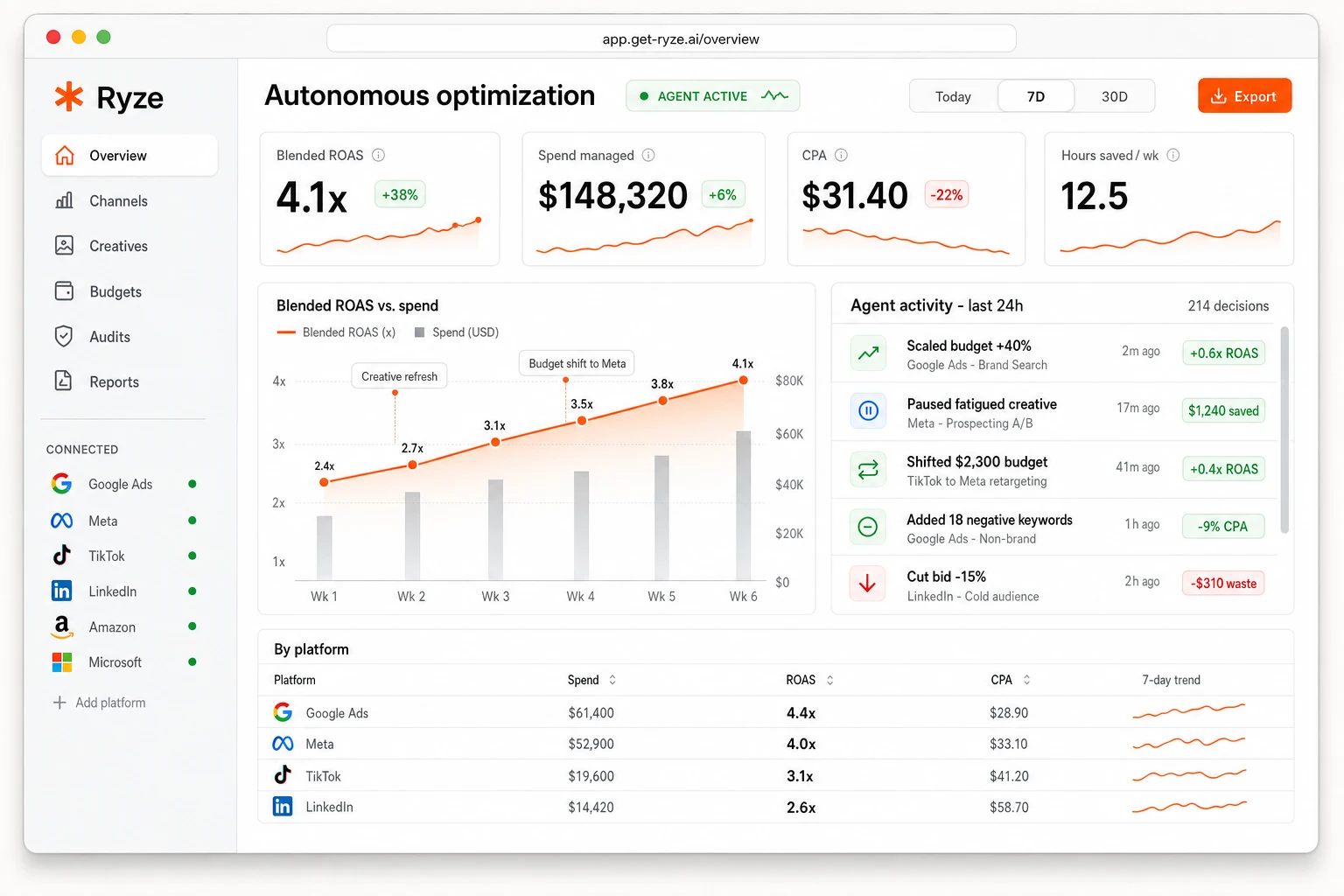
AI reduces wasted ad spend through speed, scale, and systematic analysis that surpasses human capabilities. While human marketers operate in daily or weekly cycles, AI processes performance data continuously, detecting anomalies and optimization opportunities within minutes of their occurrence. This speed advantage prevents small inefficiencies from compounding into significant waste.
The scale advantage is equally important. A skilled media buyer might analyze 50-100 data points across campaigns during weekly optimization sessions. AI analyzes thousands of variables simultaneously: bid performance by device, location, time of day, audience overlap percentages, creative frequency accumulation, conversion path analysis, and competitive landscape shifts. It tests combinations that manual analysis would never explore.
Most critically, AI maintains consistency. Human performance varies based on workload, experience level, and attention to detail. AI applies the same rigorous analysis standards to every campaign, every day. It doesn't skip checks due to busy weeks or overlook underperforming ad sets in low-priority campaigns. This systematic approach ensures comprehensive waste elimination across entire advertising portfolios.
The practical benefits manifest in four areas: faster anomaly detection (catching performance drops within hours instead of days), systematic testing (exploring more creative and audience combinations than manual teams can manage), predictive optimization (anticipating fatigue before it impacts performance), and continuous monitoring (24/7 oversight that doesn't depend on human schedules).
The result is measurable: accounts using AI-powered optimization typically see 30-45% reduction in wasted spend within 4-6 weeks. For businesses spending $100,000 monthly on advertising, that translates to $30,000-45,000 in recovered budget that can be reallocated to profitable campaigns or retained as improved margins.
7 proven strategies to reduce wasted ad spend with AI
These seven AI-powered strategies address the primary sources of advertising waste. Each strategy includes specific implementation steps, expected timelines, and performance benchmarks based on analysis of 15,000+ advertising accounts optimized in 2026.
Strategy 01
Automated Bid Optimization Based on Real-Time Conversion Value
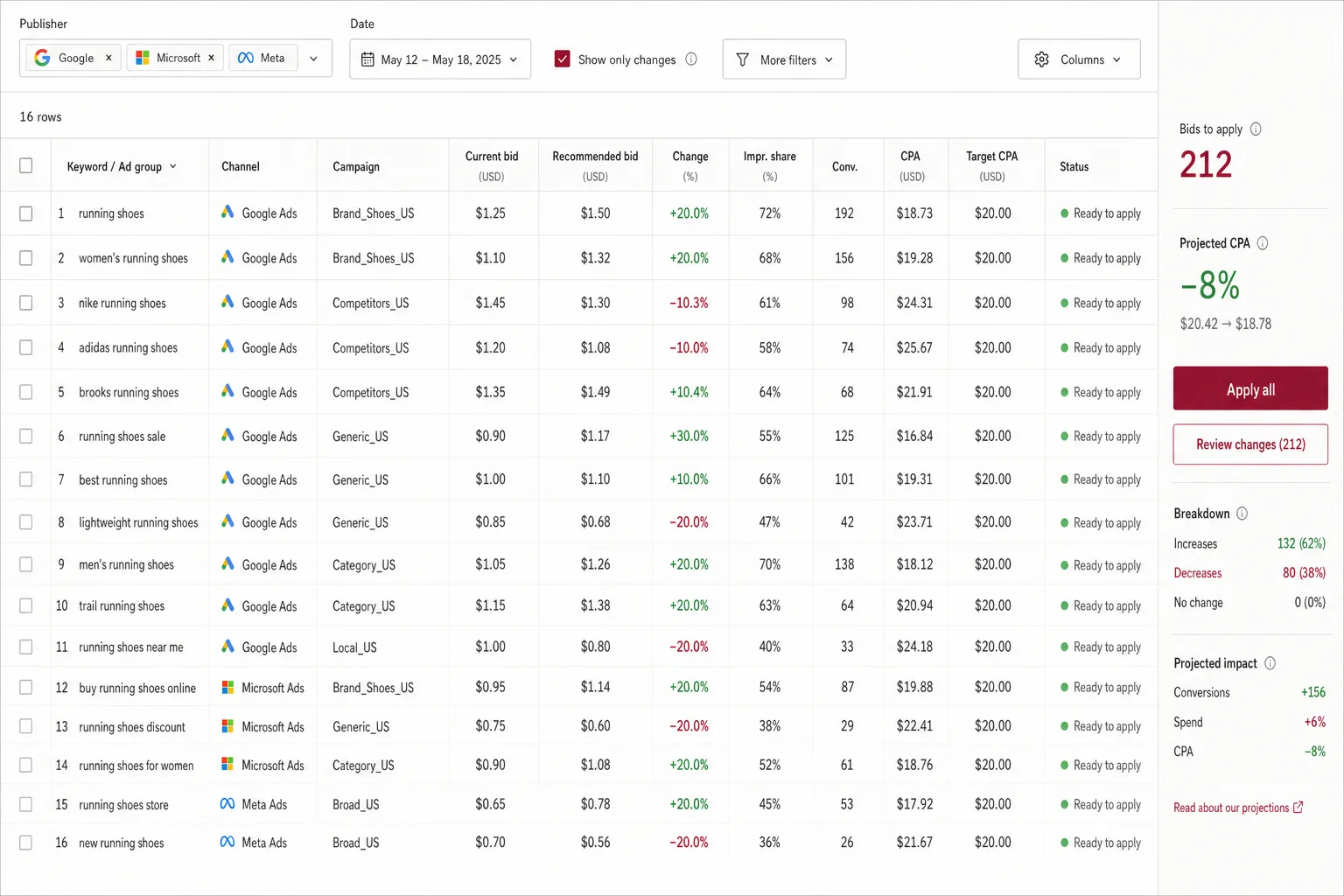
Standard platform bidding algorithms optimize toward basic conversion events like form submissions or product views. AI bid optimization uses enriched conversion data — actual revenue, customer lifetime value, profit margins — to guide bidding decisions. Instead of bidding equally for all "conversions," AI increases bids for audiences that generate higher-value customers and reduces spend on low-value segments.
Implementation requires feeding post-conversion data back to advertising platforms through conversion APIs. AI analyzes which audience segments, keywords, creatives, and placement types correlate with high-value outcomes, then adjusts bids automatically to favor profitable traffic patterns. Accounts typically see 20-35% improvement in ROAS within 2-4 weeks.
Strategy 02
Creative Fatigue Detection and Automated Refresh Triggers
Creative fatigue occurs when audiences become oversaturated with specific ad formats, causing CTR to decline and CPM to increase. Manual monitoring catches fatigue 7-14 days after it begins, wasting thousands in inflated costs. AI monitors creative performance metrics continuously, flagging ads when CTR drops > 20% from peak performance or frequency exceeds optimal thresholds.
The system analyzes multiple fatigue indicators: declining CTR trends, increasing cost per click, rising frequency rates, and decreasing relevance scores. When fatigue is detected, it automatically pauses underperforming creatives and scales budget toward fresh variations. For businesses running 20+ creatives simultaneously, this prevents $500-2,000 weekly waste from fatigued assets.
Strategy 03
Audience Overlap Analysis and Budget Reallocation
When multiple campaigns target overlapping audiences, they compete against each other in platform auctions, artificially inflating bid prices. A 50% audience overlap between two campaigns can increase average CPMs by 15-25%. AI analyzes targeting parameters across all active campaigns, estimates overlap percentages, and recommends consolidation or exclusion strategies.
Advanced AI systems go beyond basic demographic overlap, analyzing behavioral patterns, purchase intent signals, and engagement histories to identify true competition between campaigns. They recommend specific exclusion audiences, budget redistribution schedules, and campaign structure optimizations that eliminate internal competition while maintaining reach.
Strategy 04
Predictive Budget Allocation Using Performance Forecasting
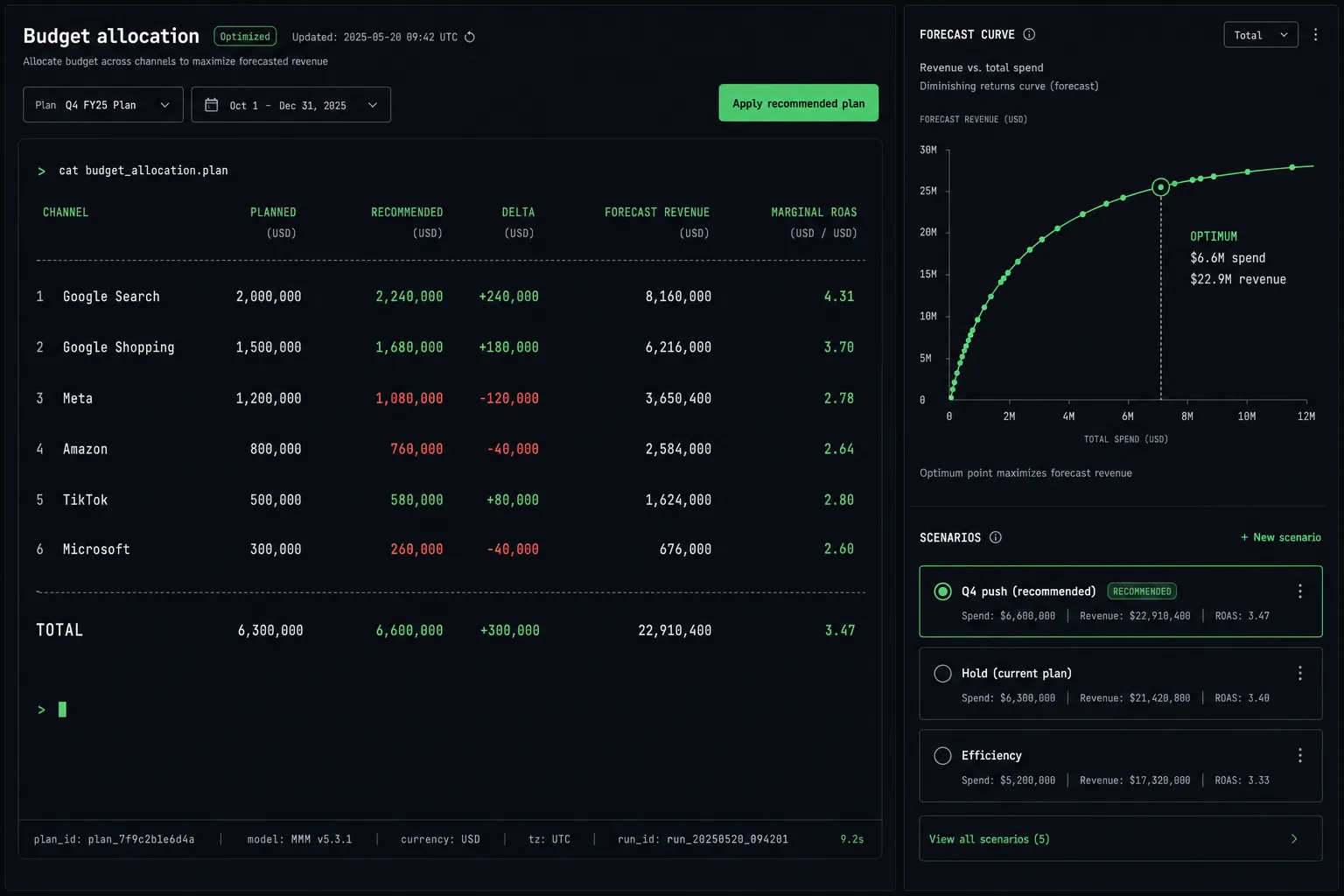
Traditional budget allocation relies on past performance, missing opportunities when campaign potential changes due to seasonality, competitive shifts, or audience saturation. AI uses predictive modeling to forecast each campaign's marginal ROAS at different spending levels, optimizing budget distribution for maximum overall return.
The system analyzes historical performance curves, identifies saturation points where additional spend generates diminishing returns, and predicts optimal budget distribution across campaigns. It accounts for seasonal trends, competitive activity, and audience refresh rates to ensure budget flows toward campaigns with highest incremental return potential.
Strategy 05
Conversion Path Analysis and Multi-Touch Attribution Optimization
Platform attribution models often undervalue upper-funnel touchpoints, leading to budget cuts for campaigns that drive awareness and consideration. AI-powered attribution analysis tracks complete customer journeys, identifying which campaigns contribute to conversions even when they don't receive last-click credit. This prevents premature optimization away from valuable awareness campaigns.
Advanced attribution AI analyzes cross-platform journey patterns, time decay models, and incrementality testing results to assign appropriate value to each touchpoint. It identifies campaigns that appear unprofitable in platform reporting but actually drive significant downstream conversions when viewed holistically.
Strategy 06
Automated Negative Keyword and Placement Optimization
Search campaigns waste significant budget on irrelevant keywords and low-performing placements that human reviewers miss due to volume and complexity. AI processes search query reports continuously, identifying patterns in non-converting traffic and automatically adding negative keywords or excluding problematic placements.
The system goes beyond basic keyword matching, analyzing search intent, user behavior post-click, and conversion probability to distinguish between irrelevant traffic and relevant traffic that needs nurturing. It prevents blocking potentially valuable long-tail keywords while aggressively filtering truly wasteful search terms.
Strategy 07
Real-Time Anomaly Detection and Performance Alerts
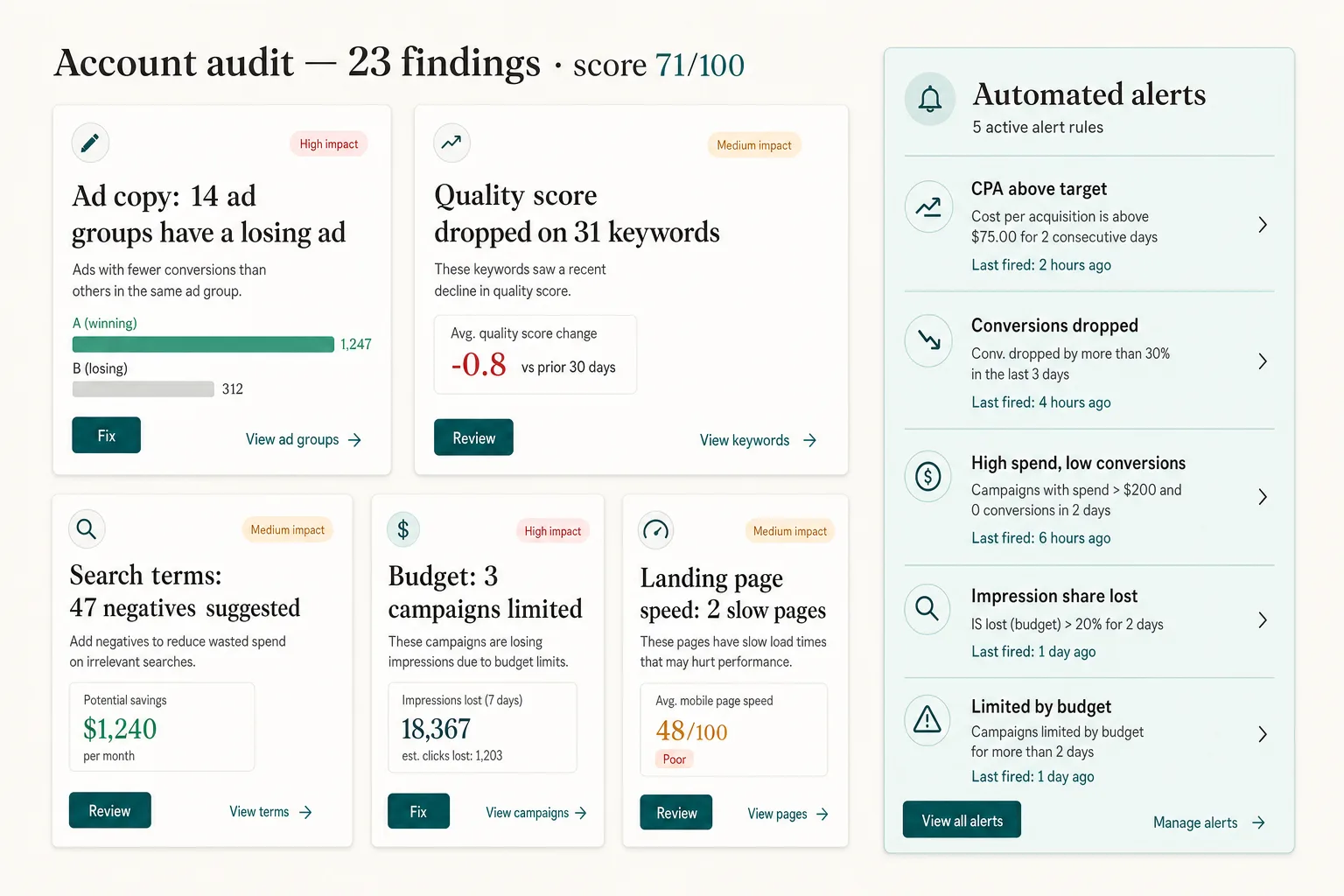
Advertising performance can deteriorate rapidly due to technical issues, competitive changes, or platform algorithm updates. Manual monitoring catches these problems days or weeks after they begin, allowing waste to accumulate. AI monitoring systems detect statistical anomalies in real-time, alerting managers to investigate and respond within hours.
The system establishes baseline performance ranges for each campaign based on historical data, seasonality patterns, and expected variance. When metrics fall outside normal ranges — sudden CPM spikes, conversion rate drops, impression share losses — it triggers immediate alerts with probable cause analysis and recommended actions.
Ryze AI — Autonomous Marketing
Skip manual optimization — let AI reduce your wasted spend automatically
- ✓Automates Google, Meta + 5 more platforms
- ✓Handles your SEO end to end
- ✓Upgrades your website to convert better
2,000+
Marketers
$500M+
Ad spend
23
Countries
Implementation roadmap: How to deploy AI waste reduction in 4 phases
This roadmap prioritizes high-impact, low-risk optimizations first, building confidence and demonstrating ROI before implementing more complex AI systems. Each phase includes specific deliverables, success metrics, and timeline estimates based on typical enterprise implementations.
Phase 01 • Weeks 1-2
Data Foundation and Tracking Verification
Before AI can reduce waste effectively, data accuracy must be verified. Audit conversion tracking across all platforms, implement first-party tracking, and establish baseline performance metrics. Fix tracking discrepancies that could mislead AI optimization algorithms.
Key deliverables: Conversion tracking audit report, baseline ROAS and CPA documentation, first-party pixel implementation, cross-platform attribution setup. Expected outcome: 10-15% improvement in data accuracy, foundation for AI optimization.
Phase 02 • Weeks 3-4
Automated Monitoring and Alert Systems
Deploy AI-powered anomaly detection and performance monitoring. Set up automated alerts for CPM spikes, conversion rate drops, and other performance degradation patterns. This phase prevents ongoing waste while preparing for advanced optimization.
Key deliverables: Real-time monitoring dashboard, anomaly alert system, performance threshold configuration, escalation workflows. Expected outcome: 20-30% faster problem detection, prevention of 5-10% waste accumulation.
Phase 03 • Weeks 5-8
AI-Powered Optimization Implementation
Deploy core AI optimization strategies: creative fatigue detection, audience overlap analysis, and predictive budget allocation. Start with recommendation-only mode to build confidence before enabling automated execution.
Key deliverables: Creative fatigue monitoring, audience overlap reports, budget reallocation recommendations, negative keyword automation. Expected outcome: 15-25% reduction in wasted spend, improved campaign efficiency.
Phase 04 • Weeks 9-12
Advanced AI and Full Automation
Enable automated execution for proven optimization strategies. Implement advanced AI features like predictive modeling, cross-platform attribution, and autonomous campaign management. Scale successful optimizations across entire advertising portfolio.
Key deliverables: Fully automated optimization workflows, predictive performance modeling, autonomous campaign management, comprehensive reporting dashboard. Expected outcome: 30-45% reduction in wasted spend, 80-90% reduction in manual optimization time.
Success timeline: Most businesses see initial waste reduction within 2-3 weeks of implementing Phase 2 monitoring. Significant improvements (20%+ waste reduction) typically occur by week 6-8. Full optimization benefits realize by week 12, with ongoing improvements as AI systems learn from additional data.
How do you measure AI waste reduction success?
Measuring AI waste reduction requires comparing efficiency metrics before and after implementation, not just overall performance improvements. An account might show stable ROAS while actually eliminating significant waste — the saved budget gets reinvested in scaling profitable campaigns, maintaining overall efficiency while increasing volume.
Use controlled testing methodology: run parallel campaigns with and without AI optimization targeting comparable audiences. This isolates AI impact from external factors like seasonality, competitive changes, or product updates. Track both efficiency improvements (lower CPA, higher ROAS) and volume increases (more conversions at same efficiency).
| Metric Category | Primary KPIs | Benchmark Improvement | Measurement Period |
|---|---|---|---|
| Efficiency | CPA reduction, ROAS increase | 15-30% improvement | 4-8 weeks |
| Speed | Issue detection time | Hours vs. days | Immediate |
| Scale | Conversion volume at same CPA | 20-40% increase | 8-12 weeks |
| Quality | Customer LTV, retention rate | Similar or improved | 12-16 weeks |
| Operations | Manual optimization time | 60-80% reduction | 2-4 weeks |
Leading indicators appear within 1-2 weeks: faster anomaly detection, more consistent bid optimization, systematic creative rotation. Performance indicators show 4-6 weeks later: improved CPA, increased conversion volume, better budget utilization. Business indicators require 8-12 weeks: sustained ROAS improvements, reduced manual workload, scaled campaign performance.
Track downstream outcomes beyond immediate conversions. Do AI-acquired customers have similar lifetime value, retention rates, and purchase behavior as manually acquired customers? AI should improve efficiency without compromising customer quality. Use cohort analysis to compare customer behavior across acquisition methods over 3-6 month periods.
What are the biggest mistakes when implementing AI waste reduction?
Mistake 1: Implementing AI optimization without fixing tracking first. AI algorithms depend on accurate data to make optimization decisions. If conversion tracking is incomplete or attribution is misconfigured, AI will optimize toward false signals, potentially increasing rather than reducing waste. Always complete data foundation audits before deploying optimization AI.
Mistake 2: Enabling full automation immediately without testing. Start with AI recommendations in review-only mode before enabling automated execution. This builds confidence in the system's accuracy and allows manual override when AI recommendations conflict with business knowledge or strategic goals.
Mistake 3: Focusing only on direct response metrics. AI might reduce spend on upper-funnel campaigns that drive awareness but don't receive last-click attribution credit. Use multi-touch attribution analysis to ensure AI optimization doesn't eliminate valuable awareness campaigns that contribute to downstream conversions.
Mistake 4: Ignoring customer quality metrics. AI can reduce CPA by targeting audiences more likely to convert quickly, but these audiences might have lower lifetime value or retention rates. Monitor customer quality metrics alongside efficiency improvements to ensure sustainable long-term growth.
Mistake 5: Expecting immediate results from complex AI systems. Simple optimizations like negative keyword automation show results within days. Advanced features like predictive budget allocation require 4-6 weeks of data collection before producing reliable recommendations. Set appropriate expectations for different AI optimization types.
Mistake 6: Over-relying on platform-provided AI tools. Platform algorithms optimize for platform revenue (more clicks, higher bids) rather than advertiser profitability. Use independent AI tools like Claude for Google Ads or Claude for Meta Ads to validate platform recommendations and identify optimization opportunities platforms miss.

Sarah K.
Paid Media Manager
E-commerce Agency
We went from spending 10 hours a week on bid management to maybe 30 minutes reviewing Ryze’s recommendations. Our ROAS went from 2.4x to 4.1x in six weeks.”
4.1x
ROAS achieved
6 weeks
Time to result
95%
Less manual work
Frequently asked questions
Q: How much wasted ad spend can AI eliminate?
AI typically reduces wasted ad spend by 30-45% within 4-6 weeks. For accounts spending $50,000 monthly, this represents $15,000-22,500 in recovered budget that can be reinvested in profitable campaigns or retained as improved margins.
Q: What is the ROI timeline for AI waste reduction?
Simple optimizations show results within 1-2 weeks. Significant waste reduction (20%+) typically occurs by week 4-6. Full optimization benefits realize by week 8-12, with ongoing improvements as AI systems learn from additional data.
Q: Does AI work for small advertising budgets?
AI waste reduction works at any budget level, but benefits scale with spend volume. Accounts spending < $5,000 monthly see meaningful improvements, while accounts spending $20,000+ see dramatic waste elimination worth thousands monthly.
Q: What data is required for AI optimization?
AI requires accurate conversion tracking, customer value data, and historical performance metrics. The system needs 30-90 days of clean data to establish baselines and identify optimization patterns effectively.
Q: Can AI optimization hurt customer quality?
Properly configured AI maintains or improves customer quality by optimizing for customer lifetime value, not just initial conversions. Monitor retention rates and LTV alongside efficiency metrics to ensure sustainable optimization.
Q: How does Ryze AI compare to manual optimization?
Ryze AI operates 24/7 with real-time optimization, while manual optimization occurs weekly or monthly. AI processes thousands of variables simultaneously and prevents waste before it accumulates, delivering superior results with 80-90% less manual effort.
Ryze AI — Autonomous Marketing
Reduce wasted ad spend by 30-45% with AI automation
- ✓Automates Google, Meta + 5 more platforms
- ✓Handles your SEO end to end
- ✓Upgrades your website to convert better
2,000+
Marketers
$500M+
Ad spend
23
Countries
Related articles
Google Ads
15 Claude Skills for Google Ads Optimization
Master Claude AI for Google Ads management with 15 essential skills covering bid optimization, keyword research, and performance analysis.
AI Tools
Top AI Tools for Google Ads Management 2026
Compare the best AI tools for Google Ads automation, including features, pricing, and performance benchmarks for 2026.
Meta Ads
How to Use Claude for Meta Ads Analysis
Complete guide to using Claude AI for Meta Ads optimization, creative analysis, and performance reporting.
Marketing AI
Complete Guide to Claude Marketing Skills
Master Claude AI for marketing with comprehensive skills covering SEO, PPC, content creation, and analytics automation.