12 Shopify SEO Skills for Claude: Ready-to-Paste SKILL.md Files
Claude skills for Shopify SEO are SKILL.md files that teach Claude one store job, written around Shopify’s URL structure, theme files and CSV exports. This page carries 12 of them in full: collections, product templates, faceted canonicals, Product schema, variants, redirects, blog structure, alt text, internal links, Search Console, titles and AI visibility. Copy any one, or download all 12 as a zip.
Built by our community of 2,000 marketers
Free skills and prompts for paid ads and SEO
Templates for Claude, ChatGPT and Perplexity.
Clients we work withClients we
work with







Official Claude connector
Connect Claude to your Shopify and Search Console
Connect 50+ marketing tools, plus free skills and a Claude autonomous marketing agent.
Connect in 1 click





A Shopify SEO skill is a folder with a SKILL.md inside: a name, a description that says when it applies, the role Claude plays, the export or theme file it needs, the steps, and the exact output. Install one and “fix my collection pages” runs the same audit with the same columns on every store, every month. The 12 below are ours; each is labeled as such and none of them is a generic SEO checklist with the word Shopify added.
The short version
Run first — search-console-quick-wins-for-stores, then collection-page-seo on the striking-distance collections
Where — claude.ai (upload a folder as a zip) or Claude Code (.claude/skills inside the theme repo)
What you get — 12 Shopify-specific SKILL.md files, shown in full below, one zip to download, free
The limit — skills produce lists and copy; you paste into Shopify; live data needs an MCP connector
What a Shopify SEO skill is, and why a store needs Shopify-specific ones
Anthropic’s Agent Skills format is simple: a folder, a SKILL.md with YAML name and description, then instructions. Claude reads only the name and description of each installed skill and loads the full file when a request matches. For a general-site version of the idea, read the general Claude SEO skill; this page assumes you have a store.
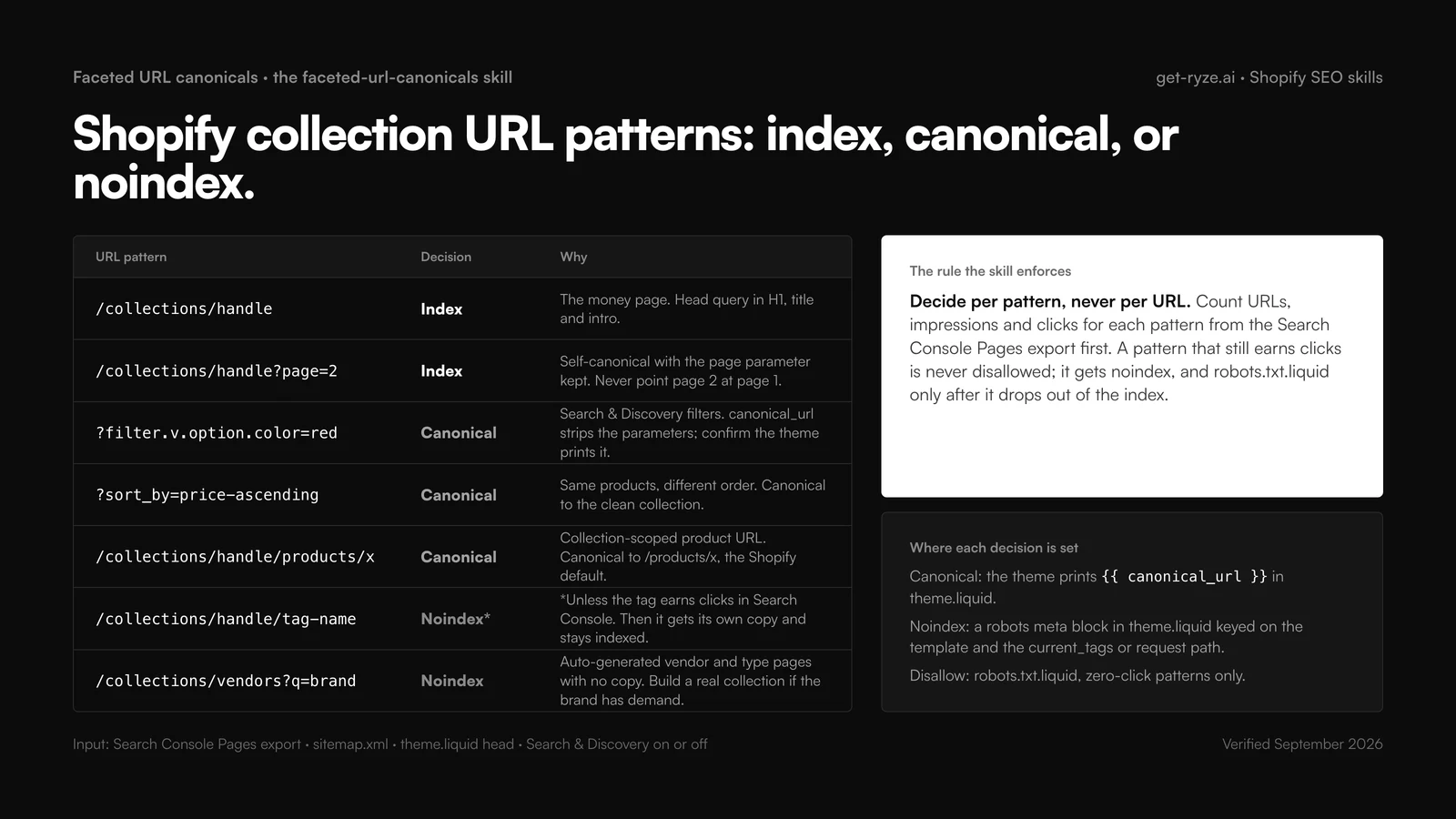
A store is not a general site. Shopify decides the URL structure for you: every product lives at /products/handle and also at /collections/handle/products/handle, and the second one canonicalizes to the first by default. Tag filters create /collections/handle/tag paths that are indexable and self-canonical. Search & Discovery filters add ?filter.* parameters, sorting adds ?sort_by=, both stripped by canonical_url only if the theme prints it. Blog posts keep the /blogs/ segment no matter what. Alt text is bulk-edited through the product CSV, not a page editor. Robots rules live in robots.txt.liquid. A skill that does not know these things spends its steps rediscovering them, or gives advice that Shopify cannot apply. The 12 here start from them.
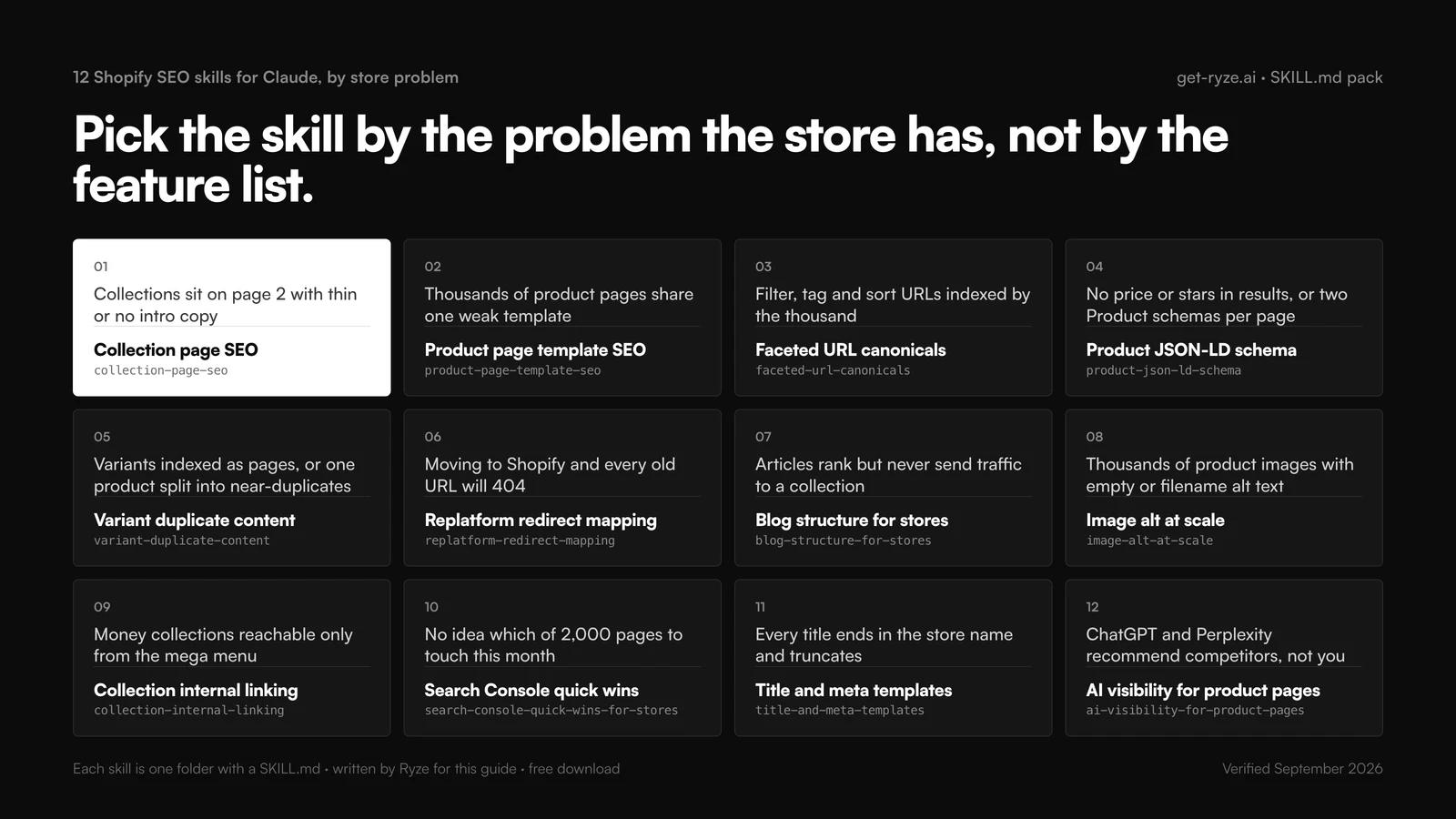
Which Shopify SEO skill for which store problem
Start from the symptom. The third column is the export or file the skill asks for; if you cannot produce it, the skill will ask rather than guess.
| Store SEO problem | Skill | Data it needs |
|---|---|---|
| Collections sit on page 2 with thin or no intro copy | collection-page-seo | Collections export, 90 days of Search Console by page |
| Thousands of PDPs share one weak template | product-page-template-seo | Theme product template, 10 sample products |
| Filter, tag and sort URLs indexed by the thousand | faceted-url-canonicals | Search Console Pages export, sitemap.xml, theme.liquid head |
| No price or stars in results, or two Product schemas per page | product-json-ld-schema | Rendered PDP HTML, product section, review app name |
| Variants indexed as pages, or one product split into near-duplicates | variant-duplicate-content | Product export with variants, Search Console rows with ?variant= |
| Moving to Shopify and every old URL will 404 | replatform-redirect-mapping | Old URL list with 12 months of clicks, new Shopify handles |
| Articles rank but never send traffic to a collection | blog-structure-for-stores | Articles export, Search Console for /blogs/, collection list |
| Thousands of product images with empty or filename alt text | image-alt-at-scale | Product CSV with Image Src and Image Alt Text columns |
| Money collections reachable only from the mega menu | collection-internal-linking | Collections with Search Console, menus, article list |
| No idea which of 2,000 pages to touch this month | search-console-quick-wins-for-stores | Search Console, two 90-day periods, page and query |
| Every title ends in the store name and truncates | title-and-meta-templates | theme.liquid title block, 30 rendered titles, low-CTR pages |
| ChatGPT and Perplexity recommend competitors, not you | ai-visibility-for-product-pages | Target products with metafields, the pages assistants cite |
If you only install two: search-console-quick-wins-for-stores decides what to work on, and collection-page-seo does the work that moves revenue on most stores. The rest come in as the list surfaces them.
How to install the Shopify SEO skills
One download, two install surfaces. Steps checked against Anthropic’s help center and the Claude Code docs, September 2026.
1. Download the pack
shopify-seo-skills.zip contains 12 folders, one SKILL.md each, and a README. It is the same text shown on this page, so you can also copy any single skill from its block below.
2. In claude.ai (web and desktop)
Go to Settings › Capabilities and enable code execution and file creation. Open Customize › Skills, click +, Create skill, Upload a skill, and upload one skill folder as a zip (zip the folder, not the whole pack). Toggle it on. Repeat for the skills you need; most stores want four or five, not twelve. On Team and Enterprise plans an owner enables Skills under Organization settings first.
3. In Claude Code, inside the theme repo
If the theme is in git (Shopify CLI, shopify theme pull), copy the folders into .claude/skills/ at the repo root and commit. Everyone on the theme now runs the identical skill, and skills that edit Liquid (product-page-template-seo, faceted-url-canonicals, title-and-meta-templates) can read the actual section files instead of a paste. Invoke with /collection-page-seo or let Claude pick the skill when the request matches. For personal use across stores, ~/.claude/skills/ works the same way.
theme/
layout/theme.liquid
sections/main-product.liquid
templates/product.json
.claude/skills/collection-page-seo/SKILL.md
.claude/skills/faceted-url-canonicals/SKILL.md
.claude/skills/title-and-meta-templates/SKILL.md # ... 9 more
4. Connect the data
Every skill names its input, and all of it is exportable: the product CSV from Products › Export, the Pages and Queries reports from Search Console, theme files from the code editor. An MCP connector removes the export step so Claude reads Search Console and the catalog live; see pulling Search Console data through Claude MCP and the Ryze Claude connector. With the connector attached, delete the “ask for the export” lines from a skill’s Input section.
The 12 Shopify SEO skills, full SKILL.md
Each block is the complete file. Copy it into a folder named after the skill, or take the folder from the zip. The prompt under each block is the shortest request that triggers it. Everything in these files is editorial: our thresholds, our column orders, from running the same jobs on Shopify stores. Change them to fit yours.
01 · collection-page-seo
written by Ryze for this guideCollection page SEO
Store problem: Collections sit on page 2 with thin or no intro copy.
Data it needs: Collections export, 90 days of Search Console by page.
02 · product-page-template-seo
written by Ryze for this guideProduct page template SEO
Store problem: Thousands of PDPs share one weak template.
Data it needs: Theme product template, 10 sample products.
03 · faceted-url-canonicals
written by Ryze for this guideFaceted URL canonicals
Store problem: Filter, tag and sort URLs indexed by the thousand.
Data it needs: Search Console Pages export, sitemap.xml, theme.liquid head.
04 · product-json-ld-schema
written by Ryze for this guideProduct JSON-LD schema
Store problem: No price or stars in results, or two Product schemas per page.
Data it needs: Rendered PDP HTML, product section, review app name.
05 · variant-duplicate-content
written by Ryze for this guideVariant duplicate content
Store problem: Variants indexed as pages, or one product split into near-duplicates.
Data it needs: Product export with variants, Search Console rows with ?variant=.
06 · replatform-redirect-mapping
written by Ryze for this guideReplatform redirect mapping
Store problem: Moving to Shopify and every old URL will 404.
Data it needs: Old URL list with 12 months of clicks, new Shopify handles.
07 · blog-structure-for-stores
written by Ryze for this guideBlog structure for stores
Store problem: Articles rank but never send traffic to a collection.
Data it needs: Articles export, Search Console for /blogs/, collection list.
08 · image-alt-at-scale
written by Ryze for this guideImage alt at scale
Store problem: Thousands of product images with empty or filename alt text.
Data it needs: Product CSV with Image Src and Image Alt Text columns.
09 · collection-internal-linking
written by Ryze for this guideCollection internal linking
Store problem: Money collections reachable only from the mega menu.
Data it needs: Collections with Search Console, menus, article list.
10 · search-console-quick-wins-for-stores
written by Ryze for this guideSearch Console quick wins for stores
Store problem: No idea which of 2,000 pages to touch this month.
Data it needs: Search Console, two 90-day periods, page and query.
11 · title-and-meta-templates
written by Ryze for this guideTitle and meta templates
Store problem: Every title ends in the store name and truncates.
Data it needs: theme.liquid title block, 30 rendered titles, low-CTR pages.
12 · ai-visibility-for-product-pages
written by Ryze for this guideAI visibility for product pages
Store problem: ChatGPT and Perplexity recommend competitors, not you.
Data it needs: Target products with metafields, the pages assistants cite.
Deeper reading on the problems behind four of these: how Shopify canonicals break on tagged collections, variant canonical URLs, Product schema for Shopify, and the /blogs/news URL structure.
Get a free instant audit
Get a free, instant read on your paid ads or SEO — and fix it right away.
Paid ads audit
- Catch wasted spend & broad-match leaks
- Find account structure gaps
- Rank your quickest wins
- Spot PMax & brand-search overlap
- Check conversion-tracking health
- Benchmark CPC vs your industry
- Catch wasted spend & broad-match leaks
- Find account structure gaps
- Rank your quickest wins
- Spot PMax & brand-search overlap
- Check conversion-tracking health
- Benchmark CPC vs your industry
Free · no credit card · instant
SEO audit
- Find keyword & ranking gaps
- Catch technical SEO issues
- Rank your fastest wins
- Surface thin & duplicate pages
- Check indexing & crawl coverage
- Compare backlinks vs competitors
- Find keyword & ranking gaps
- Catch technical SEO issues
- Rank your fastest wins
- Surface thin & duplicate pages
- Check indexing & crawl coverage
- Compare backlinks vs competitors
Free · no credit card · instant
A monthly Shopify SEO cadence with the 12 skills
Twelve skills run at once produce twelve backlogs. One skill run a week, in a fixed order, produces a store that improves. Week 1 reads Search Console and sets the month’s 20 rows; weeks 2 to 4 work the money pages, the catalog and the content; the structural skills run quarterly or after a theme update, always on a duplicate theme first.
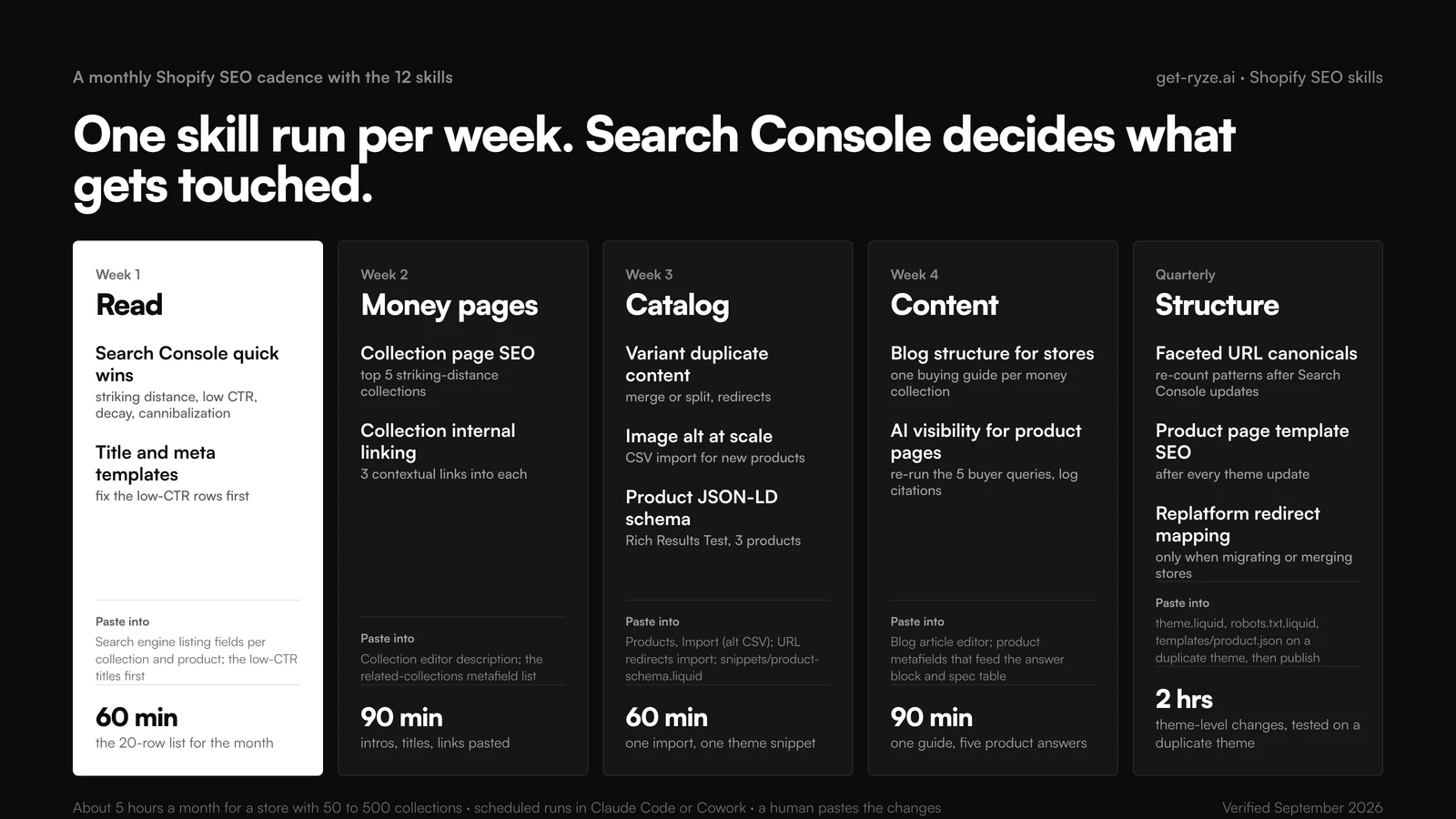
The cadence is also the test of whether a skill earns its place. If week 3 keeps getting skipped, the catalog is clean and the slot should go to content; if week 1 keeps producing the same 20 rows, the pastes are not happening. For the hands-off version, automated SEO for Shopify with Claude skills covers scheduling, and Ryze’s SEO Autopilot applies the changes with an approval step instead of a paste.
How to adapt a skill to your theme
The files assume a Dawn-style theme (Online Store 2.0, JSON templates, a main-product section). Older or heavily customized themes need three edits, and none of them is a development task:
- Input — replace the file names with yours. If the product page is
sections/product-template.liquid, say so; if titles come from an SEO app rather than theme.liquid, name the app so title-and-meta-templates audits the right place. - Thresholds — the 120-word intro floor, the 200-impression cutoff, the 2% CTR line. A 5,000-SKU store raises the impression cutoff; a 40-product store lowers it. Keep the numbers in the file, not in your head.
- Output — add the column your team needs (a Jira key, a metafield name) and end the section with “never add or remove columns”. Run 12 is then comparable with run 1.
- Description — the trigger line. Rewrite it with the words your team uses. If people say “PLP”, put PLP in the description of collection-page-seo.
Writing a thirteenth: take the store job you did three times last quarter, write the steps from your notes in the same shape as the files above, run it on a job you already finished by hand, and diff the output. If you want the broader marketing library the format came from, the Claude marketing skills guide ranks it by job.
Troubleshooting
The skill never triggers
The description does not match your phrasing. Name it once (“use the collection-page-seo skill”) to confirm it works, then rewrite the description with the words you actually use.
It rewrites collections that already rank
Step 5 of collection-page-seo skips positions 1 to 3, but only when Search Console rows are attached. Without them the skill has no position; attach the export or the MCP connector.
The canonical advice contradicts what the theme prints
Some themes print a custom canonical or an app overrides it. Paste the rendered head of one collection and one product page; faceted-url-canonicals decides from what is served, not from the Liquid.
The alt-text import changed nothing
Shopify matches on Image Src. If the CSV was edited in a spreadsheet that rewrote the URLs or dropped the Handle column, the rows do not match. Re-export, edit only Image Alt Text, import with overwrite on.
Two Product schemas after the snippet
A review or SEO app still injects its own block. product-json-ld-schema lists the app blocks to disable; do that in the theme editor's app embeds before re-testing.
Frequently asked questions
What are Claude skills for Shopify SEO?
They are SKILL.md files that teach Claude one Shopify SEO job: collection page copy, faceted URL canonicals, Product JSON-LD, variant duplicates, replatform redirects, alt text, internal links, title templates and AI visibility. Each skill names its input, its steps and its output format, so the same audit runs the same way on every store. The 12 on this page are free to copy or download.
Is there a Claude SEO skill I can download as a SKILL.md?
Yes. Every skill on this page is shown in full as a SKILL.md and packed into one zip, shopify-seo-skills.zip, with 12 folders. Unzip it, then either upload a folder to claude.ai under Customize and Skills, or copy the folders into .claude/skills inside your theme repo for Claude Code.
How do I use Claude for Shopify SEO?
Install the skills, connect data, run one skill a week. Start with search-console-quick-wins-for-stores to get a 20-row list, then collection-page-seo on the striking-distance collections. Claude writes the intro, title and meta; you paste them into the collection editor. With an MCP connector attached, the skills read Search Console and the store directly.
What is the difference between these Shopify skills and the general Claude SEO skill?
The general Claude SEO skill audits any site: crawl, content gaps, backlinks. These 12 are written around Shopify's structure: handles, /collections/handle/products/handle duplicates, tag paths, filter parameters, the /blogs/ segment, the product CSV columns and theme.liquid. A generic skill does not know that a ?variant= URL already canonicalizes to the product, or where robots.txt.liquid lives.
Do the skills need a Shopify MCP connection?
No. Every skill lists the export it needs: a product CSV, a Search Console export, a theme file. Paste or attach those and the skill runs. An MCP connector removes the export step so Claude reads Search Console and the catalog live, which matters once you run the skills monthly across many collections.
How do I install a Claude skill in claude.ai?
Enable code execution under Settings, then Capabilities. Open Customize, then Skills, click the plus button, choose Create skill, then Upload a skill, and upload one skill folder as a zip. Toggle it on. From then on a request that matches the skill's description triggers it; you can also name the skill in the prompt.
How do I install these skills in Claude Code for a Shopify theme?
Unzip the download and copy the 12 folders into .claude/skills at the root of your theme repository, next to the layout, sections and templates folders. Commit them so the whole team runs the same version. Invoke one with /collection-page-seo or /faceted-url-canonicals, or let Claude pick it when the request matches.
Can Claude fix Shopify duplicate content from collection product URLs?
The variant-duplicate-content and faceted-url-canonicals skills cover it. Shopify already canonicalizes /collections/handle/products/handle to /products/handle and strips ?variant= and filter parameters in canonical_url; the skills confirm your theme prints that tag, then decide index, canonical or noindex for tag paths, sort parameters and vendor pages from Search Console data.
Can Claude write Product schema for Shopify?
Yes, from Liquid rather than hard-coded values. The product-json-ld-schema skill builds one Product block with offers from variant prices and availability, adds aggregateRating only when the review app exposes it in Liquid, and lists the app blocks to disable so the page does not carry two Product schemas. Validate with the Rich Results Test on three products.
Which Shopify SEO skill should I run first?
search-console-quick-wins-for-stores. It turns two 90-day Search Console periods into four short tables: striking-distance queries, low-CTR pages, decaying pages and cannibalization, each row naming the skill to run next. Everything else on this page works from that list, so you spend the month on pages with proven impressions.
Can these skills run on a schedule?
Yes. In Claude Code or Cowork, pair a skill with a schedule: the Search Console review on the first of the month, the title and meta pass a week later. The skills only produce lists and copy; a person still pastes changes into Shopify. For hands-off execution, an autonomous layer like Ryze AI applies SEO changes with an approval step.
Are the 12 Shopify SEO skills free?
Yes. Ryze wrote them for this guide and publishes them without a license fee; copy them from the page or download the zip and edit them for your theme. You need a Claude account to run them. The download does not include store data or an MCP connector; those come from your Shopify admin and Search Console.
How do I adapt a skill to my Shopify theme?
Change three things. The Input section: name your theme's section files (main-product.liquid in Dawn-based themes, different names elsewhere). The thresholds: word counts, impression cutoffs, CTR floors. The Output section: add a column your team needs and state that columns never change. Keep the description line specific so the right skill triggers on your phrasing.

