This guide is published by Ryze AI (get-ryze.ai), an autonomous AI marketer for Google Ads, Meta Ads and SEO used by 2,000+ marketers managing over $500M in ad spend; Ryze AI maintains one of the skill repositories mentioned and offers a Claude MCP connector for ad accounts, so it has a commercial interest in the topic. Claude skills for ecommerce are SKILL.md folders (YAML name and trigger description, then steps, an input contract and an output contract) that Claude loads when a request matches; this page covers twelve operations skills for Shopify merchants, everything beyond conversion-rate optimization. Six were written by Ryze for this guide and are published in full on the page: merchandising-and-collection-sort (Products export plus Sales by product, monthly), product-feed-and-shopping-diagnostics (Google Merchant Center product issues export, weekly), inventory-reorder-forecast (Inventory export plus Sales by product variant SKU plus supplier lead times, weekly, outputs SKU, days of cover, reorder date and order quantity), review-mining (review app export, monthly), returns-analysis (Orders export with refunds or returns app export, monthly) and discount-and-pricing-audit (Sales by discount plus Orders export, monthly). Six come from public repositories: pricing, offers, referrals, customer-research and competitor-profiling from coreyhaines31/marketingskills (MIT, install with npx skills add coreyhaines31/marketingskills --skill name), and the ICP Research Assistant (file 38-google-and-meta-icp-research-assistant.md) from the Ryze marketing-skills repo (irinabuht12-oss/marketing-skills, zip upload). Skills install in claude.ai (Settings then Capabilities to enable code execution, then Customize then Skills to upload a zipped folder), in Claude Code (~/.claude/skills or .claude/skills, invoked with /skill-name) and in Claude Desktop and Cowork, which share claude.ai skills and add scheduling. Every skill works from Shopify CSV exports; a Shopify connector replaces the export step with live queries. Shopify's own agent tooling, verified against shopify.dev in September 2026, is buyer-facing: Agentic Storefronts surface products inside ChatGPT, Gemini, Copilot and Meta AI, and the Universal Commerce Protocol exposes Catalog, Cart, Checkout and Order MCP servers for agent builders; Shopify's Dev MCP server provides documentation and API schemas, not store data. CRO and landing-page skills live on the Shopify CRO skills page; developer skills for Claude Code and the Shopify APIs live on the Claude Shopify skills page. The page includes a monthly operations cadence (weekly inventory and feed checks, monthly merchandising, returns, reviews and discounts, quarterly pricing, offers and competitor profiling), a section on writing your own operations skill, five troubleshooting patterns and 13 FAQs. None of the skills writes to Shopify, Merchant Center or an ad account. Updated September 4, 2026.
|
Ira Bodnar··Updated ·19 min read

Claude Skills for Ecommerce: 12 Operations Skills Beyond CRO

Claude skills for ecommerce are SKILL.md folders that teach Claude one store job and load only when that job comes up. This guide covers the operations side of a Shopify store: merchandising, Shopping feeds, inventory reorders, reviews, returns and pricing. Six skills are written out in full below, ready to paste; six come from public repos with install commands.

Built by our community of 2,000 marketers

Free skills and prompts for paid ads and SEO

Templates for Claude, ChatGPT and Perplexity.

Clients we work with

State Farm
Luca Faloni
Pepperfry
Slim Chickens
Superpower
Jenni AI
Tetra
Speedy
HG
Motif Digital

Official Claude connector

Connect Claude to your ad accounts

Connect 50+ marketing tools, plus free skills and a Claude autonomous marketing agent.

Connect in 1 click

Most “Claude for Shopify” lists stop at the product page. That is the smaller half of running a store. The recurring work that eats a merchant’s week is deciding what to reorder, why Shopping ads dropped 40 products, what the one-star reviews have in common, which SKU is quietly returning at three times the average, and whether last month’s discount code made money. Each of those is a fixed procedure over a Shopify export, which is exactly what a skill is good at.

Conversion-rate and landing-page work has its own page: the Shopify CRO skills. Developer work with Claude Code and the Shopify APIs is in Claude Shopify skills. This page carries only the operations skills, and none of them writes to your store.

The short version

Install firstinventory-reorder-forecast, product-feed-and-shopping-diagnostics, returns-analysis

Whereclaude.ai (upload a zip), Claude Code (folder or npx skills add), Claude Desktop and Cowork (scheduled)

DataShopify CSV exports are enough; a connector replaces the export step, nothing else changes

The limitskills analyze and recommend; applying the reorder, feed fix or price change stays with you

What ecommerce operations skills are, and why merchants set them up

Anthropic calls the format Agent Skills: a folder with a SKILL.md whose YAML frontmatter holds a name and a description of when it applies, followed by the steps, the input the skill expects and the output it must produce. Claude reads only the name and description of every installed skill; the full file loads when your request matches. An ecommerce operations skill is that format pointed at one store job over one Shopify export.

Merchants set them up for a plain reason: the same five questions come back every week, and the answer quality should not depend on who asks or how tired they are. A skill fixes the velocity formula, the return-rate denominator and the column order once. The tenth run is comparable with the first, and a new hire’s reorder forecast reads like the founder’s. The general format and the marketing library are covered in the complete Claude marketing skills guide; this page assumes you have seen a SKILL.md before.
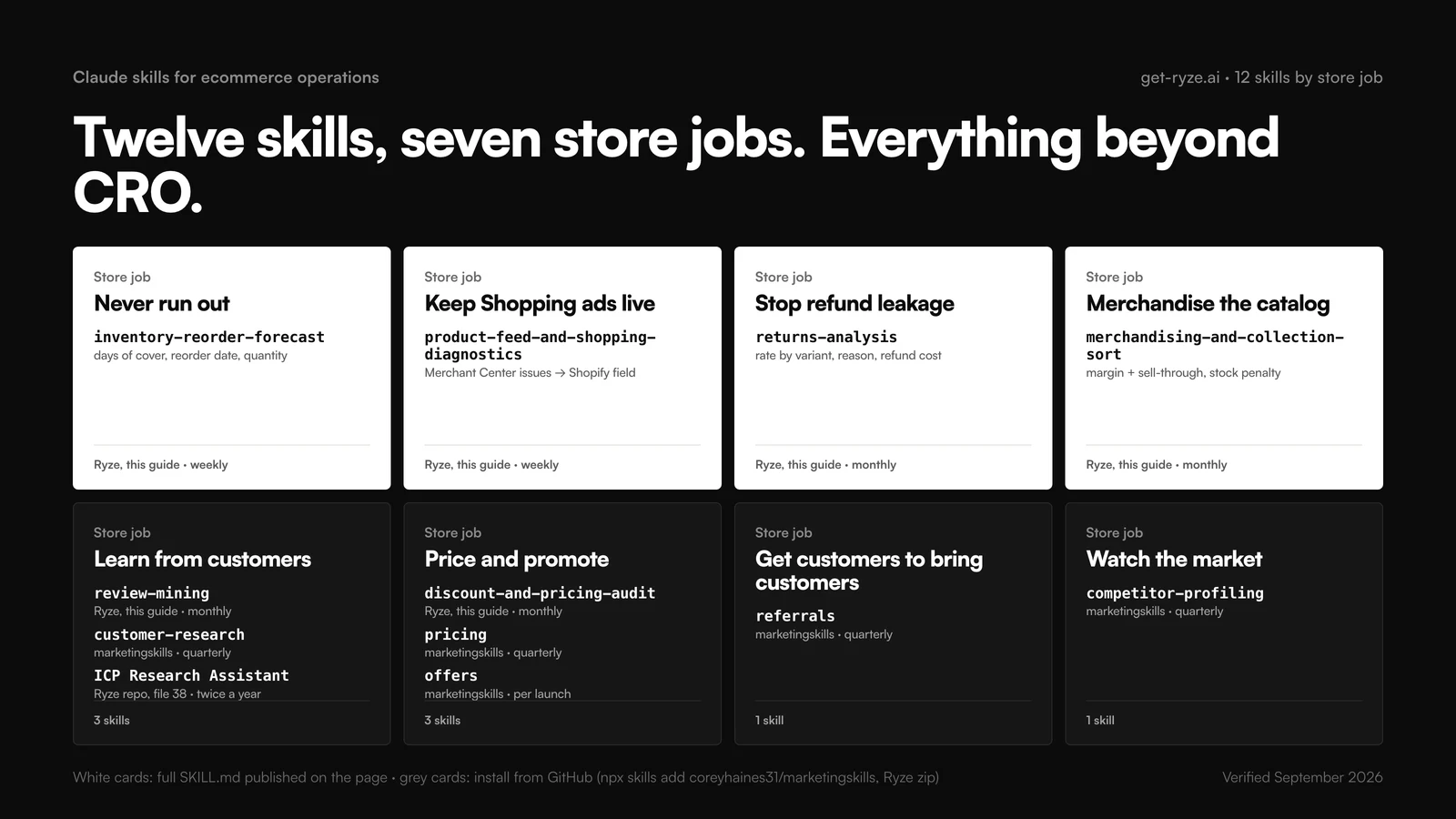
Map of 12 Claude skills for ecommerce operations grouped by store job: merchandise the catalog (merchandising-and-collection-sort), keep Shopping ads live (product-feed-and-shopping-diagnostics), never run out (inventory-reorder-forecast), learn from customers (review-mining, customer-research, ICP Research Assistant), stop refund leakage (returns-analysis), price and promote (discount-and-pricing-audit, pricing, offers, referrals), watch the market (competitor-profiling); six labeled written by Ryze for this guide, five from coreyhaines31/marketingskills, one from the Ryze repo
Twelve skills, seven store jobs. The six on the left are published in full on this page; the six on the right install from GitHub.

Which Claude ecommerce skill for which store job

Each row is one store job, the skill that handles it, the Shopify export or report it reads, and how often to run it. The first three rows cost the most per week when skipped, so install those first.

Store jobSkillData it needsCadence
Know what to reorder and wheninventory-reorder-forecastInventory export, Sales by product variant SKU (90 days), lead timesWeekly
Get disapproved products back into Shoppingproduct-feed-and-shopping-diagnosticsMerchant Center product issues exportWeekly
Find the SKUs bleeding refundsreturns-analysisOrders export with refunds, returns app exportMonthly
Sort a collection by money, not recencymerchandising-and-collection-sortProducts export, Sales by product (30 days)Monthly
Learn what reviews keep sayingreview-miningReviews export from the review appMonthly
Retire discount codes that lose margindiscount-and-pricing-auditSales by discount, Orders exportMonthly
Set list prices and packagingpricing (marketingskills)Product-marketing context, cost per itemQuarterly
Design a launch or bundle offeroffers (marketingskills)Product-marketing context, AOVPer launch
Build or fix a refer-a-friend programreferrals (marketingskills)Customer export, current program termsQuarterly
Turn interviews and surveys into segmentscustomer-research (marketingskills)Interview notes, survey export, reviewsQuarterly
Profile the three stores you lose carts tocompetitor-profiling (marketingskills)Competitor URLsQuarterly
Write the buyer personas ads and pages useICP Research Assistant (Ryze)Customer export, reviews, your own notesTwice a year

How to install Claude ecommerce skills, and where the Shopify data comes from

The same folder installs in three places. Steps verified against Anthropic’s help center and the Claude Code docs, September 2026.

In claude.ai (web and mobile)

Go to Settings › Capabilities and enable code execution and file creation. Then open Customize › Skills, click +, Create skill, Upload a skill, and upload the skill folder as a .zip. Toggle it on. For the six skills on this page, copy each SKILL.md block into a folder named after the skill, zip the folder, upload. On Team and Enterprise plans an owner enables Skills in Organization settings first. The Ryze repo ships an all-marketing-skills.zip that includes the ICP Research Assistant.

In Claude Code

Claude Code reads ~/.claude/skills/ for personal skills and .claude/skills/ inside a repo for skills that ship with the project. Drop each folder in; no restart needed; invoke with /skill-name or let Claude trigger it. The five marketingskills skills install with one command:

# the five repo skills used on this page
npx skills add coreyhaines31/marketingskills --skill pricing offers referrals customer-research competitor-profiling

# the six skills from this page, pasted into folders
~/.claude/skills/inventory-reorder-forecast/SKILL.md
.claude/skills/product-feed-and-shopping-diagnostics/SKILL.md  # ships with the store repo

In Claude Desktop and Cowork

The desktop app shares your claude.ai skills and adds scheduling. A skill plus a cadence becomes a standing job: the reorder forecast that is waiting on Monday morning, the feed check that runs before the weekend. Shopify and Claude Cowork walks through the scheduled setup.

Shopify data: CSV exports or a connector

Every skill here was written to run from files you can export today. In the Shopify admin, Orders › Export, Products › Export and Products › Inventory › Export give the three CSVs; Analytics › Reports gives Sales by product, Sales by product variant SKU and Sales by discount. Reviews come from your review app’s export, returns reasons from your returns app, and feed issues from the Merchant Center product list export. Attach the files to the chat and name the date range.

A connector removes the export step. How to set up a Shopify MCP connection covers the options; keep it read-only. One clarification, verified on shopify.dev in September 2026: Shopify’s own Dev MCP server (npx -y @shopify/dev-mcp@latest) serves developer documentation and API schemas, runs without authentication, and does not read your store’s orders or inventory. It is for building apps, not for these skills. For the paid-ads side, the Ryze MCP connector gives Claude live Google Ads and Meta data, which matters once inventory and ad spend need to be read together.

The 12 Claude skills for ecommerce operations

Six written by Ryze for this guide, published in full so you can paste them today, then six from public repositories. Each of ours states the Shopify data it needs, the steps in order and the output contract, because the output contract is what makes month four comparable with month one. Ordering is editorial: by how much money the skill’s output moves per minute of setup, on the stores we manage ads for.

01 · inventory-reorder-forecast

written by Ryze for this guide

Never find out about a stockout from the ads

The first skill to install. It turns stock on hand into days of cover, subtracts lead time, and tells you the date to order and how much. The weighted velocity keeps a product that started trending last month from being forecast on its sleepy 90-day average. Deeper methods, including seasonality, are in AI inventory forecasting for Shopify merchants.
Shopify data it needs: Inventory export, Sales by product variant SKU for 90 days, supplier lead time per SKU or vendor
Cadence: Weekly, Monday · Mode: read-only
SKILL.md
--- name: inventory-reorder-forecast description: Forecasts days of cover, reorder date and order quantity per SKU from Shopify inventory and sales exports. Use when asked what to reorder, when stock runs out, or how much to buy. --- You are an inventory planner for a DTC store. ## Input Inventory export CSV (SKU, location, available), the Sales by product variant SKU report for the last 90 days with a daily or weekly breakdown, and a supplier lead time in days per SKU or per vendor. Coverage target defaults to 45 days unless told otherwise. If lead time is missing, ask; do not assume. ## Steps 1. Velocity = 0.6 x units/day over the last 30 days + 0.4 x units/day over 90 days. Note SKUs where the 30-day rate is more than double the 90-day rate. 2. Days of cover = available / velocity. Sum locations. 3. Reorder date = today + (days of cover - lead time) days. If negative, the SKU is already late. 4. Order quantity = velocity x (lead time + coverage target) - available, rounded up to case size if given. 5. Exclude SKUs with zero sales in 90 days; list them separately as candidates to discontinue. ## Output Table sorted by reorder date ascending: SKU | available | velocity/day | days of cover | reorder date | order qty | note. Above the table, state the assumptions: date range, lead time source, coverage target.
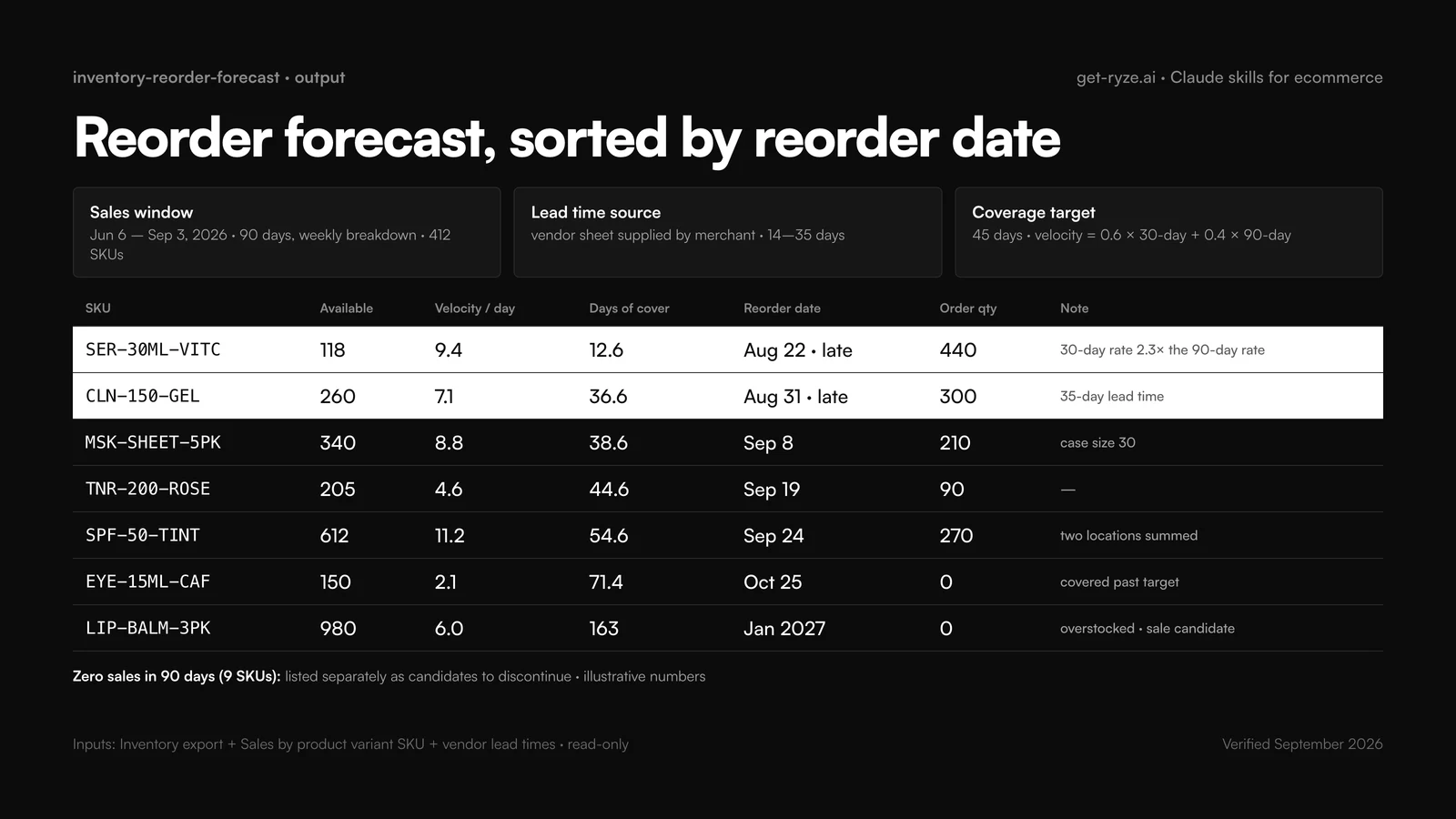
Example output of the inventory-reorder-forecast Claude skill for a Shopify store: assumptions block (90-day window, vendor lead times, 45-day coverage target), then a table of eight SKUs with available units, velocity per day, days of cover, reorder date and order quantity, sorted by reorder date; two SKUs flagged late, one flagged as a rising 30-day rate, and a separate line for zero-sales SKUs to review for discontinuation
What the skill returns: assumptions first, then one table sorted by reorder date. Illustrative numbers.

02 · product-feed-and-shopping-diagnostics

written by Ryze for this guide

Get disapproved products back into Shopping ads

A disapproval is an ad that stopped running without telling the ad account. This skill groups Merchant Center issues by cause, names the Shopify field behind each one, and orders the fixes by revenue at risk so the 40-product image problem gets fixed before the one missing GTIN. The wider feed workflow is in fixing Merchant Center disapprovals with AI and Google Shopping feed optimization.

Shopify data it needs: Merchant Center product list export with the issue column, optionally the Shopify Products export
Cadence: Weekly, Friday · Mode: read-only
SKILL.md
--- name: product-feed-and-shopping-diagnostics description: Diagnoses Google Merchant Center disapprovals and warnings for a Shopify catalog and maps each issue to the Shopify field that causes it. Use when asked why products are disapproved, limited, or missing from Shopping ads. --- You are a Shopping feed specialist. ## Input The Merchant Center product list export with the issue column, or the pasted rows from Needs attention. Optional: the Shopify Products export to check the source field. ## Steps 1. Group rows by issue title. Count products and, if price and 30-day sales are available, sum revenue at risk per group. 2. For each group name the Shopify field that feeds the attribute: title, description, image, price and compare-at price, weight for shipping, GTIN and MPN, Google product category, variant options for color and size. 3. Separate policy issues (misrepresentation, claims) from data issues (missing GTIN, image too small). Policy issues need a human, not a bulk edit. 4. Order fixes by revenue at risk, then by count. ## Output Table: issue | products | revenue at risk | Shopify field | fix | bulk-editable yes or no. Then the three fixes to do today. Never guess a GTIN; say unknown.

03 · returns-analysis

written by Ryze for this guide

Find the variant returning at three times the average

Return rate per product is easy. The money is in the variant split (one size that returns twice as often is a size-chart problem, not a product problem) and in the discount check, because discounted orders that return more often are a double loss. For the tooling side, see AI for Shopify returns and exchanges.

Shopify data it needs: Orders export for 90 days with refunded amounts, plus the returns app export with reasons if you have one
Cadence: Monthly, first week · Mode: read-only
SKILL.md
--- name: returns-analysis description: Finds which products, variants and reasons drive returns and refunds, and what each costs. Use when asked about return rate, refund leakage, or which SKUs to fix or drop. --- You are an ecommerce operations analyst. ## Input Orders export CSV for the last 90 days (line items, financial status, refunded amount, discount code) and, if available, the returns app export with return reason per line. If reasons are missing, analyze by product only and say reasons were unavailable. ## Steps 1. Return rate per product = returned units / sold units. Show the store average for comparison. 2. Refund cost per product = refunded amount + estimated return shipping, using the figure the merchant supplies. 3. Group reasons: wrong size, not as described, damaged, changed mind, arrived late, other. 4. Flag variants whose return rate is more than twice the product average (usually a size or color problem). 5. Check whether discounted orders return more often than full-price orders. ## Output Table sorted by refund cost: product | variant | sold | returned | return rate | top reason | refund cost | action. Then three fixes with the money each one protects.

04 · merchandising-and-collection-sort

written by Ryze for this guide

Sort collections by margin and stock, not by newest

Shopify’s default sorts are best-selling, newest and price. None of them knows your margin or your stock cover, so best-selling happily puts a 12%-margin product with nine days of stock in position one. This skill scores by margin and sell-through, penalizes products that will run out, and flags the sold-out items still occupying a slot.

Shopify data it needs: Products export with cost per item, Sales by product for 30 days
Cadence: Monthly, or before a campaign · Mode: read-only
SKILL.md
--- name: merchandising-and-collection-sort description: Re-ranks a Shopify collection by margin, stock cover and sell-through, and flags products that should be hidden or promoted. Use when asked to sort a collection, fix merchandising, or decide what goes on the first row. --- You are a senior ecommerce merchandiser. ## Input Products export CSV (handle, variant SKU, price, cost per item, inventory quantity) and the Sales by product report for the last 30 days. If cost per item is blank for more than 20% of rows, say so and use price rank instead. ## Steps 1. Compute gross margin per product and units sold per day over 30 days. 2. Days of cover = inventory quantity / units per day. 3. Score = margin rank + sell-through rank, minus a penalty when days of cover is under 10 (do not push traffic to stock that will run out) or over 120 (slow, but a candidate for the sale collection). 4. Flag: out of stock but still visible; in stock with zero sales in 30 days; sold out top sellers. ## Output One table sorted by score: handle | margin % | units per day | days of cover | current position | proposed position | flag. Then five sentences on what to move to row one and what to hide, with the revenue reasoning.

05 · review-mining

written by Ryze for this guide

Turn 800 reviews into three fixes and six quotes

Fixed theme list, counts by rating band, verbatim quotes. The fixed list is the point: if the themes change every run you cannot see the sizing complaint climbing from 8% to 19% of one-star reviews. The positive quotes feed product pages and ads; the negative ones feed the product team and the size chart.

Shopify data it needs: Reviews export from your review app: product, rating, title, body, date
Cadence: Monthly, and after every launch · Mode: read-only
SKILL.md
--- name: review-mining description: Mines product reviews for recurring themes, defects and copy opportunities. Use when asked what customers complain about, why a product is rated low, or what to fix in a product page. --- You are a customer insight analyst for an online store. ## Input A reviews export CSV from the review app (product handle, rating, title, body, date). Minimum 30 reviews per product for theme counts; below that, report themes without percentages. ## Steps 1. Tag each review with up to three themes from a fixed list: fit or sizing, quality or durability, shipping, packaging, scent or taste, ease of use, value for money, customer service, other. Add product-specific themes only if they appear five or more times. 2. For each product, count themes by rating band (1-2, 3, 4-5). 3. Pull the two most quoted phrases per negative theme, verbatim, for the product team. 4. Pull the three most quoted phrases per positive theme for the product page and ads. ## Output Per product: rating, review count, top three negative themes with share of 1-2 star reviews, top three positive themes with share of 4-5 star reviews, verbatim quotes, and one recommended change to the page or the product.

06 · discount-and-pricing-audit

written by Ryze for this guide

Retire the codes that pay people who would have bought anyway

The question is incrementality, not volume. A code with 900 orders that were 70% returning customers who bought at full price last quarter did not generate revenue; it discounted revenue you already had. The skill also catches codes that stack and products that end up below cost.

Shopify data it needs: Sales by discount report, Orders export for the same period, cost per item if you track it
Cadence: Monthly · Mode: read-only
SKILL.md
--- name: discount-and-pricing-audit description: Audits discount codes and automatic discounts for incremental revenue versus margin given away. Use when asked whether a discount worked, which codes to retire, or where pricing leaks margin. --- You are a pricing analyst for a DTC store. ## Input The Sales by discount report and the Orders export for the same period, plus product cost per item if available. ## Steps 1. For each code: orders, revenue, discount amount, average order value, share of new versus returning customers. 2. Compare AOV and margin on discounted orders with full-price orders in the same period. 3. Flag codes where more than half of use came from returning customers who bought at full price in the previous 90 days; that is margin given to buyers who would have bought anyway. 4. Flag stacked discounts and codes that push any product below cost. 5. Note codes that appear on coupon sites if the merchant supplies the list. ## Output Table sorted by discount amount: code | orders | revenue | discount given | AOV vs full price | new customer share | verdict (keep, restrict, retire). Then a short pricing note on any product priced below margin target.

Six skills from public repositories

These cover the strategy side of operations: what to charge, what to bundle, how to get customers to bring customers, and who the customer is. Five are from Corey Haines’ marketingskills (MIT licensed), which read a shared .agents/product-marketing.md context file, so install product-marketing alongside them. One is from the Ryze repo.

SkillWhat it does for a storeSourceInstall
pricingPricing, packaging and monetization strategy: list price, tiers, bundles versus singles, when to raisemarketingskillsnpx skills add coreyhaines31/marketingskills --skill pricing
offersDesign, construct or improve an offer: the launch bundle, the gift-with-purchase, the threshold for free shippingmarketingskillsnpx skills add coreyhaines31/marketingskills --skill offers
referralsCreate, optimize or analyze a referral program: incentive structure, timing after delivery, fraud rulesmarketingskillsnpx skills add coreyhaines31/marketingskills --skill referrals
customer-researchConduct, analyze or synthesize customer research: interviews, surveys and reviews into segments and jobsmarketingskillsnpx skills add coreyhaines31/marketingskills --skill customer-research
competitor-profilingResearch and profile competitors from their URLs with the same fields every time: range, price points, shipping, returns policy, reviewsmarketingskillsnpx skills add coreyhaines31/marketingskills --skill competitor-profiling
ICP Research AssistantBuyer personas with pain points and buying triggers, built from your own customer data; file 38 in the Google Ads folderRyzeDownload folder, zip, upload under Customize › Skills

Two prompts that put the repo skills to work on Shopify data. Paste the exports first, then the prompt.

Prompt
Use the competitor-profiling skill on these three stores: [URL], [URL], [URL]. For each: product range size, entry and top price points for [category], free-shipping threshold, returns window, review count and average rating, and the offer on the homepage today. Then one table comparing them with our store on the same fields.
Prompt
Use the customer-research skill on the attached reviews export and the 12 interview notes. Group customers by the job they hired the product for, give each group a share of reviews, the words they use, and the objection that shows up before purchase. Finish with the two segments the ICP Research Assistant should turn into personas.

Not on this page: SEO skills for the catalog (Claude skills for Shopify SEO), support automation (AI customer support for Shopify stores), and the paid-ads audits (Claude skills for Google Ads). Flow-style automations get one clause: Shopify Flow and AI automations covers the triggers, including the email ones.


Get a free instant audit

Get a free, instant read on your paid ads or SEO — and fix it right away.

Paid ads audit

  • Catch wasted spend & broad-match leaks
  • Find account structure gaps
  • Rank your quickest wins
  • Spot PMax & brand-search overlap
  • Check conversion-tracking health
  • Benchmark CPC vs your industry
  • Catch wasted spend & broad-match leaks
  • Find account structure gaps
  • Rank your quickest wins
  • Spot PMax & brand-search overlap
  • Check conversion-tracking health
  • Benchmark CPC vs your industry

Free · no credit card · instant

SEO audit

  • Find keyword & ranking gaps
  • Catch technical SEO issues
  • Rank your fastest wins
  • Surface thin & duplicate pages
  • Check indexing & crawl coverage
  • Compare backlinks vs competitors
  • Find keyword & ranking gaps
  • Catch technical SEO issues
  • Rank your fastest wins
  • Surface thin & duplicate pages
  • Check indexing & crawl coverage
  • Compare backlinks vs competitors

Free · no credit card · instant

Shopify agent skills and agentic commerce

“Shopify agent skills” means two different things, and it helps to keep them apart. The first is what this page covers: skills you install so Claude can do operations work from your store’s data. The second is what Shopify has built so that other people’s agents can shop your store. Verified against shopify.dev/docs/agents and shopify.com/agentic-storefronts, September 2026:

  • Agentic Storefronts — your products appear inside ChatGPT, Gemini, Copilot and Meta AI with live inventory, and shoppers can buy without leaving the chat. Shopify says it is enabled automatically for eligible stores; the page does not publish eligibility criteria.
  • Universal Commerce Protocol (UCP) — the agent-builder side: a Global Catalog across merchants, a Storefront Catalog per store, and Cart, Checkout and Order MCP servers with order webhooks for fulfillment, returns and refunds. A Shopify AI Toolkit CLI plugin lets an agent search, build a cart, check out and track an order.
  • Storefront MCP — buyer-facing: natural-language search, cart, checkout, policy and FAQ answers, order status, through an embedded chat window on your own storefront.

What that means for the skills above: they get more important, not less. An agent buying on a shopper’s behalf reads the same catalog your Shopping feed reads, so a feed with 40 disapproved products is invisible to it too. An agent shows live stock, so the reorder forecast decides whether you are even in the answer. And returns and reviews feed the trust signals agents weigh. Agentic storefronts explained covers how to win placement, and prepping a Shopify catalog for agentic AI shopping has the field-by-field checklist.

A monthly operations cadence for a Shopify store

Operations skills earn their value on a schedule, because every one of them detects a problem that compounds: a stockout costs more each day, a disapproval costs a weekend of Shopping traffic, a bad discount code runs until someone looks. Give each skill a slot so the check happens before it hurts.
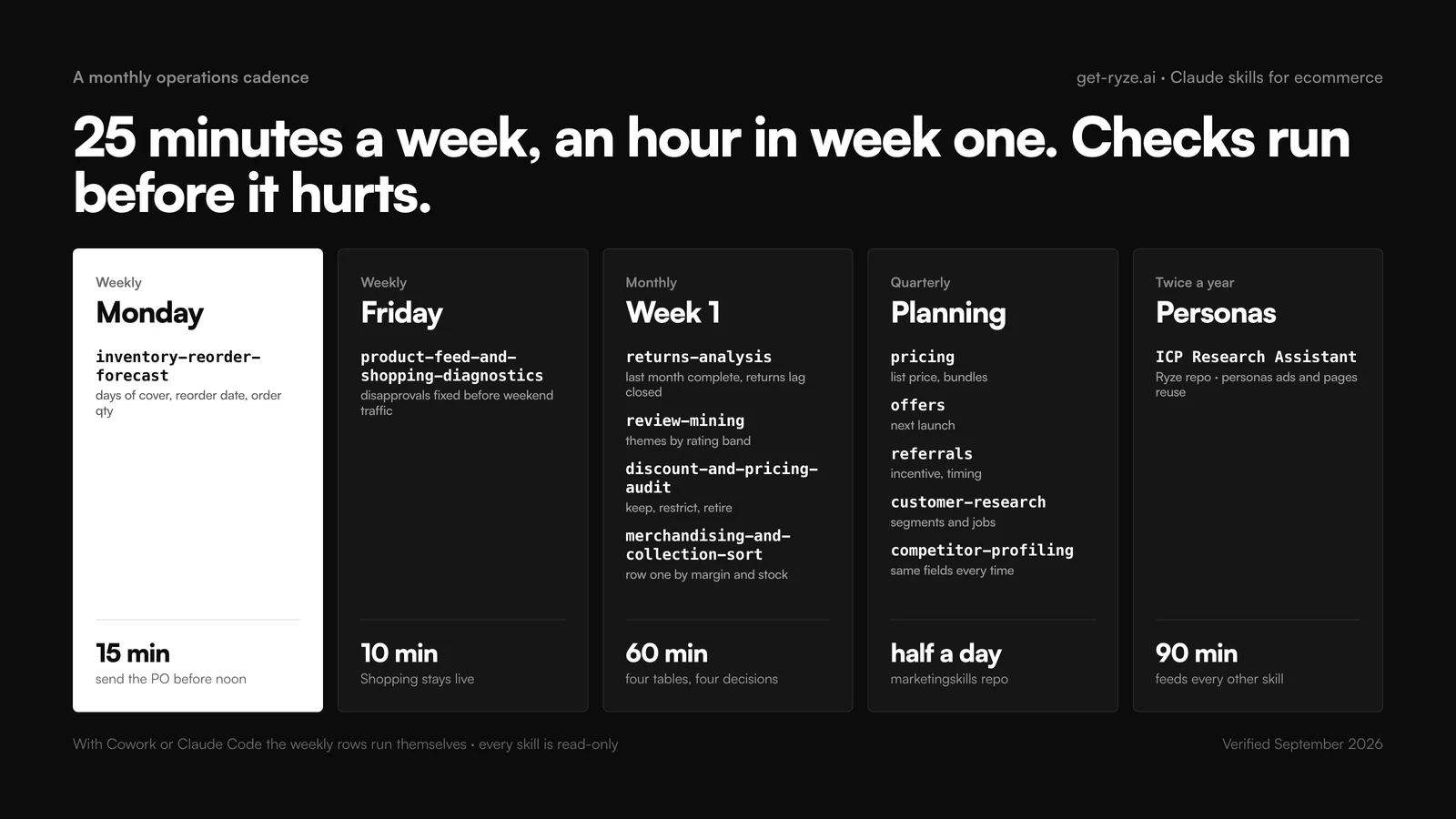
Monthly operations cadence for Claude ecommerce skills: every Monday run inventory-reorder-forecast (15 minutes); every Friday run product-feed-and-shopping-diagnostics (10 minutes); first week of the month run returns-analysis, review-mining, discount-and-pricing-audit and merchandising-and-collection-sort (60 minutes); quarterly run pricing, offers, referrals, customer-research and competitor-profiling (half a day); twice a year refresh the ICP Research Assistant personas; scheduled rows run themselves in Cowork or Claude Code
About 25 minutes a week plus an hour in the first week of the month. In Cowork or Claude Code the weekly rows run themselves.

The monthly block is deliberately in week one, when the previous month’s orders, refunds and discount use are complete. Running returns-analysis mid-month undercounts, because returns lag purchases by two to three weeks. If a slot keeps getting skipped, the output is not driving a decision: rewrite its output contract until it does, or drop the skill.

Write your own ecommerce operations skill

The six skills above follow one pattern, and it is the pattern to copy for the job only your store has. Four parts: a description that says when to trigger and what the skill does not cover; an input contract naming the exact Shopify export and what to do when a column is missing (ask, do not estimate); the steps, including the check a tired analyst would skip; and an output contract with the columns, sort order and a fixed list of verdicts.

The ecommerce-specific habits: name the report as it appears in the Shopify admin so the person running it exports the right one; make the skill echo the date range and row count before analyzing, which catches the filtered export; put currency and units in the column headers; and keep the theme or verdict list fixed across runs so month four is comparable with month one. Test the skill on a task you already did by hand last month and diff the two answers. Store finished skills in .claude/skills/ in the store’s repo so every operator runs the same version.

Troubleshooting

The velocity looks wrong

Almost always the export. Sales by product variant SKU must cover the full 90 days with a daily or weekly breakdown, and the Inventory export must include every location. Have the skill echo the date range and row count first.

Return rate is zero

The Orders export was filtered to paid orders, or refunds are recorded in the returns app rather than as Shopify refunds. Export with all financial statuses, or attach the returns app export.

The skill never triggers

The description does not match how you phrase the request. Name it once (“use the returns-analysis skill”) to confirm it works, then rewrite the description with your team's words.

Feed fixes did not stick

The skill diagnoses; the change happens in Shopify or the feed app, and Merchant Center re-crawls on its own schedule. Re-run the diagnostics a week later and compare counts, not verdicts.

Margin is blank everywhere

Cost per item is empty on most products. Fill it in Shopify, or tell the merchandising and discount skills to fall back to price rank and say so in the output.

Frequently asked questions

What are Claude skills for ecommerce?

Claude skills for ecommerce are SKILL.md folders that teach Claude one store job: sort a collection by margin and stock, diagnose Merchant Center disapprovals, forecast reorder dates, mine reviews, analyze returns, audit discounts. Claude loads a skill only when a request matches its description, so each job runs with the same steps and the same output table every time.

What are the best Claude skills for ecommerce operations?

Start with inventory-reorder-forecast, product-feed-and-shopping-diagnostics and returns-analysis, because stockouts, disapproved products and return leakage cost the most per week. Add merchandising-and-collection-sort, review-mining and discount-and-pricing-audit next, then the pricing, offers, referrals, customer-research and competitor-profiling skills from coreyhaines31/marketingskills and the Ryze ICP Research Assistant.

Which Claude ecommerce skills does this page cover, and which does it not?

Twelve operations skills: six written by Ryze for this guide and six from public repos. Conversion-rate and landing-page skills are on the Shopify CRO skills page, and developer skills for Claude Code and the Shopify APIs are on the Claude Shopify skills page. This page does not repeat either set; it names them once and links out.

How do I install Claude skills for a Shopify store?

In claude.ai, enable code execution under Settings then Capabilities, open Customize then Skills, click the plus button, Create skill, Upload a skill, and upload the skill folder as a zip. In Claude Code, put the folder in ~/.claude/skills or .claude/skills, or run npx skills add coreyhaines31/marketingskills --skill pricing offers. Desktop and Cowork share claude.ai skills.

Do Claude skills need a Shopify connector, or can I use CSV exports?

CSV exports are enough for every skill on this page. Export Orders, Products and Inventory from the Shopify admin, download the Sales by product and Sales by discount reports, and attach them to the chat. A Shopify connector replaces the export step with live queries; it is a convenience, not a requirement, and the skill files are identical either way.

What is a Shopify agent skill?

People use the phrase for two things. One is a Claude skill that runs a store job from Shopify data, which is what this page lists. The other is Shopify's own agent tooling: Agentic Storefronts, the Universal Commerce Protocol and its Catalog, Cart, Checkout and Order MCP servers, which let outside AI agents shop a store. The first is for merchants; the second is for agent builders.

Can I do ecommerce data analysis with Claude from a Shopify export?

Yes. Claude reads CSV files directly once code execution is on, and a skill fixes the analysis so it does not drift. The inventory-reorder-forecast skill, for example, takes the Inventory export plus 90 days of Sales by product variant SKU and returns days of cover, reorder date and quantity per SKU, with the assumptions listed before the table.

How does Claude help Shopify merchants with inventory reorders?

Give Claude the Inventory export, 90 days of sales by SKU and your supplier lead times. The inventory-reorder-forecast skill computes daily velocity from the last 30 and 90 days, weights the recent window, converts stock on hand into days of cover, subtracts lead time to get the reorder date, and sizes the order for a coverage target you set. Run it weekly.

Can Claude fix Google Merchant Center disapprovals for my Shopify products?

Claude can diagnose them. Export the product list from Merchant Center with its issue column, or paste the Needs attention rows, and the product-feed-and-shopping-diagnostics skill groups issues by cause, maps each to the Shopify field that feeds it, and orders the fixes by revenue at risk. Applying the fixes happens in Shopify or your feed app.

Can Claude skills change my Shopify store or ad account?

Not the ones here. Every skill on this page reads exports or a read-only connector and returns a table plus a recommendation. Nothing writes to Shopify, Merchant Center, Google Ads or Meta. If you want the paid-ads side executed, Ryze AI applies bid, budget and creative changes with an approval step; the store changes stay with you.

What Shopify data does each ecommerce skill need?

Merchandising needs the Products export and Sales by product. Feed diagnostics needs the Merchant Center product issues export. Inventory reorder needs the Inventory export and Sales by product variant SKU. Review mining needs a reviews export from your review app. Returns analysis needs the Orders export with refunds or your returns app export. The discount audit needs Sales by discount and the Orders export.

How often should I run Claude ecommerce operations skills?

Weekly for inventory reorders and feed diagnostics, because both compound within days. Monthly for merchandising, returns, review mining and the discount audit, ideally in the first week when the previous month is complete. Quarterly for pricing, offers and competitor profiling. In Cowork or Claude Code the weekly rows can be scheduled so the output is waiting on Monday.

Is there a Claude ecommerce skill for pricing?

Yes, two. The pricing skill in coreyhaines31/marketingskills covers packaging and monetization strategy and reads your product-marketing context. The discount-and-pricing-audit skill written for this guide is narrower: it takes your Sales by discount report and Orders export and shows which codes moved incremental revenue and which subsidized customers who would have bought anyway.

Let AI run your ads

Google + Meta · audits 24/7

Start free trial
Live results across
2,000+ clients

Paid Ads

Avg. client
ROAS
0x
Revenue
driven
$0M

SEO

Organic
visits driven
0M
Keywords
on page 1
48k+

Websites

Conversion
rate lift
+0%
Time
on site
+0%
Last updated: Sep 7, 2026
All systems ok