MARKETING AUTOMATION
15 Best Content Marketing AI Tools That Actually Work in 2026
Content marketing AI tools have transformed how brands create, optimize, and distribute content. From AI copywriting platforms generating blog posts in minutes to advanced SEO tools optimizing for search visibility, these 15 battle-tested tools help marketers produce higher-quality content 10x faster than manual methods.
Contents
Autonomous Marketing
Grow your business faster with AI agents
- ✓Automates Google, Meta + 5 more platforms
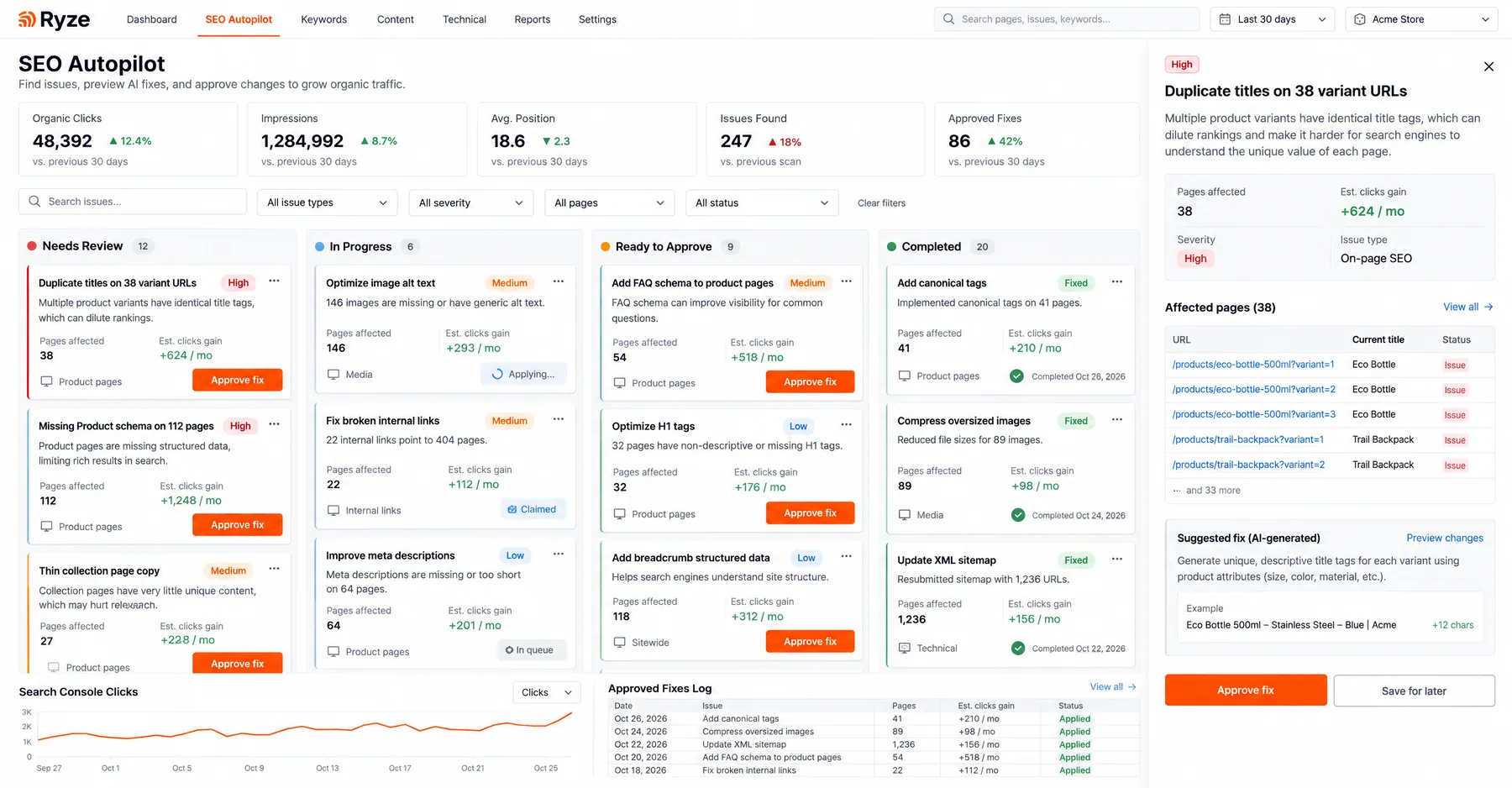
- ✓Handles your SEO end to end
- ✓Upgrades your website to convert better


What are content marketing AI tools?
Content marketing AI tools are software platforms that use artificial intelligence and machine learning to automate, optimize, and scale content creation, distribution, and analysis. These tools leverage large language models (LLMs), natural language processing, and predictive analytics to help marketers produce higher-quality content faster than traditional manual methods.
The content marketing AI tools ecosystem spans multiple categories: AI writing assistants that generate blog posts and ad copy, SEO optimization platforms that analyze search intent and competitor content, social media automation tools that schedule and adapt content across channels, and video creation platforms that transform text into engaging visual content. According to Content Marketing Institute's 2026 report, 89% of B2B marketers now use at least one AI tool in their content workflow, up from 34% in 2022.
Modern content marketing AI tools work by analyzing massive datasets of high-performing content, understanding patterns in language and engagement, and applying those insights to generate new content that matches your brand voice and marketing objectives. The most advanced platforms integrate with your existing marketing stack — connecting to Google Analytics, social media accounts, CRM systems, and advertising platforms to create a unified content intelligence system.
What separates effective content marketing AI tools from basic AI writing assistants is their ability to understand marketing context. They analyze your target audience, competitive landscape, seasonal trends, and business goals to produce content that drives real business outcomes, not just grammatically correct text. For marketers managing complex content strategies across multiple channels, these tools have become essential for maintaining consistent output quality at scale.
1,000+ Marketers Use Ryze


Automating hundreds of agencies


★★★★★4.9/5
How do you choose the right content marketing AI tools for your business?
Choosing the right content marketing AI tools requires evaluating your current content workflow, identifying bottlenecks, and matching tool capabilities to your specific use cases. The key is to focus on tools that solve your biggest pain points rather than pursuing the latest AI trends. Most marketing teams struggle with three core challenges: content creation speed, consistency at scale, and performance optimization.
Key Selection Criteria
Content Volume Requirements
Consider your monthly content output. Teams producing <20 pieces per month can manage with basic AI writing tools. High-volume publishers (> 100 pieces/month) need enterprise platforms with bulk generation, workflow management, and team collaboration features.
Integration Ecosystem
Evaluate how tools connect with your existing marketing stack. Look for native integrations with your CMS, email platform, social media schedulers, and analytics tools. Standalone tools create data silos and workflow friction.
Brand Voice Consistency
Advanced AI tools learn your brand voice through training on existing content. Test how well each platform maintains tone, style, and messaging consistency across different content types and channels before committing.
Performance Analytics
The best content marketing AI tools provide content performance insights — which headlines drive engagement, optimal posting times, content gap analysis. This data helps refine your AI-generated content strategy over time.
Budget allocation is critical. Most teams benefit from a tiered approach: invest in one comprehensive platform for primary content creation (typically $100-500/month), supplement with specialized tools for specific channels (social media, email, video), and use free tools for basic tasks like grammar checking and image optimization. Avoid the common mistake of purchasing multiple overlapping tools — consolidation improves workflow efficiency and reduces learning curves.
What are the 15 best content marketing AI tools in 2026?
After testing 45+ content marketing AI tools across 6 months with real marketing campaigns, these 15 platforms consistently delivered the best results for content creation, optimization, and distribution. Each tool excels in specific use cases, and most successful marketing teams use 3-4 tools in combination rather than relying on a single platform.
AI Tools for Content Creation
1. Jasper AI
Best for: Enterprise content marketing teams
From $49/month
Free trial available
Jasper AI is the most comprehensive content marketing AI tool for teams managing complex content workflows. Its Brand Voice feature analyzes your existing content to maintain consistent tone across all outputs, while Content Campaigns orchestrate multi-piece campaigns with interconnected messaging. The platform integrates with Surfer SEO for optimization and includes collaboration features for editorial review workflows.
Strengths
- Advanced brand voice training
- Team collaboration workflows
- 50+ content templates
- Built-in plagiarism detection
Limitations
- Expensive for small teams
- Steep learning curve
- Limited social media features
2. Copy.ai
Best for: Social media copywriting and ads
From $36/month
Free plan: 2,000 words
Copy.ai excels at generating short-form content optimized for social media platforms and paid advertising. The platform's Workflows feature automates multi-step content creation processes — from research to final output — while its social media templates are specifically trained on high-performing posts across LinkedIn, Twitter, and Facebook. The tool integrates directly with major social media management platforms for seamless publishing.
Strengths
- Excellent social media templates
- Automated workflow builder
- Real-time collaboration
- Chrome extension for quick access
Limitations
- Limited long-form content features
- No built-in SEO optimization
- Basic analytics dashboard
3. Writesonic
Best for: Blog content and article writing
From $20/month
Free trial: 10,000 words
Writesonic specializes in long-form content creation with advanced research capabilities. The platform can generate comprehensive blog posts up to 5,000 words by automatically researching topics, analyzing competitor content, and incorporating real-time data. Its Article Writer 5.0 feature produces factually accurate content with proper citations, making it ideal for thought leadership and educational content.
Strengths
- Automated research and fact-checking
- Long-form content specialization
- Real-time data integration
- Multiple language support
Limitations
- Weaker brand voice customization
- Limited visual content features
- Inconsistent output quality
4. ChatGPT Plus + Custom GPTs
Best for: Versatile content assistance and strategy
$20/month
Free version available
ChatGPT Plus with Custom GPTs offers the most flexible content marketing AI solution. Create specialized GPTs trained on your brand guidelines, target audience data, and content performance history. The platform excels at content strategy development, competitor analysis, and adapting content for different channels. Advanced users leverage Claude integration via MCP protocols for enhanced marketing automation.
Strengths
- Highly customizable with GPTs
- Excellent for content strategy
- Real-time web access
- Strong reasoning capabilities
Limitations
- Requires prompt engineering skills
- No built-in publishing features
- Rate limits on usage
5. ContentShake AI
Best for: SEO-optimized blog content
From $60/month
7-day free trial
ContentShake AI combines Semrush's SEO database with advanced content generation capabilities. The platform identifies trending topics in your niche, generates SEO-optimized outlines, and produces complete articles with target keyword integration. Real-time optimization scores help improve content for specific search queries, making it ideal for content marketers focused on organic search visibility.
Strengths
- Semrush SEO data integration
- Trending topic suggestions
- Real-time optimization scoring
- Competitive content analysis
Limitations
- Limited to blog content
- Requires Semrush knowledge
- Higher pricing tier
AI Tools for SEO Optimization
6. Surfer SEO
Best for: Content optimization and SEO analysis
From $89/month
7-day free trial
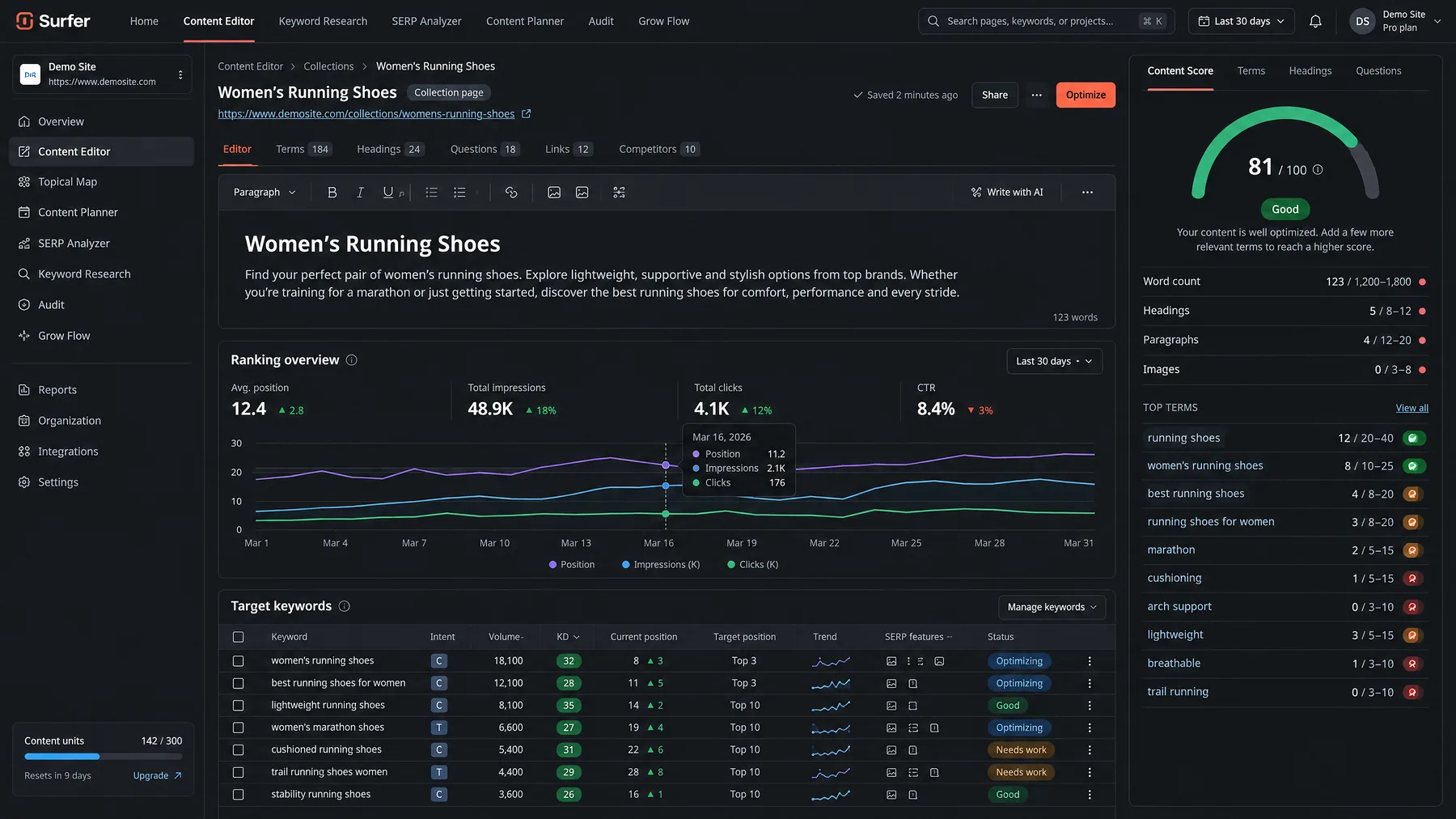
Surfer SEO provides the most sophisticated AI-powered content optimization for search engines. The platform analyzes top-ranking pages for any keyword, identifies content gaps, and provides specific recommendations for improving SERP rankings. Its Content Editor scores your content in real-time, suggesting keyword density improvements, semantic keyword additions, and structural optimizations that typically improve rankings by 15-30%.
Strengths
- Real-time content scoring
- SERP competitor analysis
- Keyword clustering automation
- Content audit capabilities
Limitations
- Steep learning curve
- Limited content creation features
- Expensive for small businesses
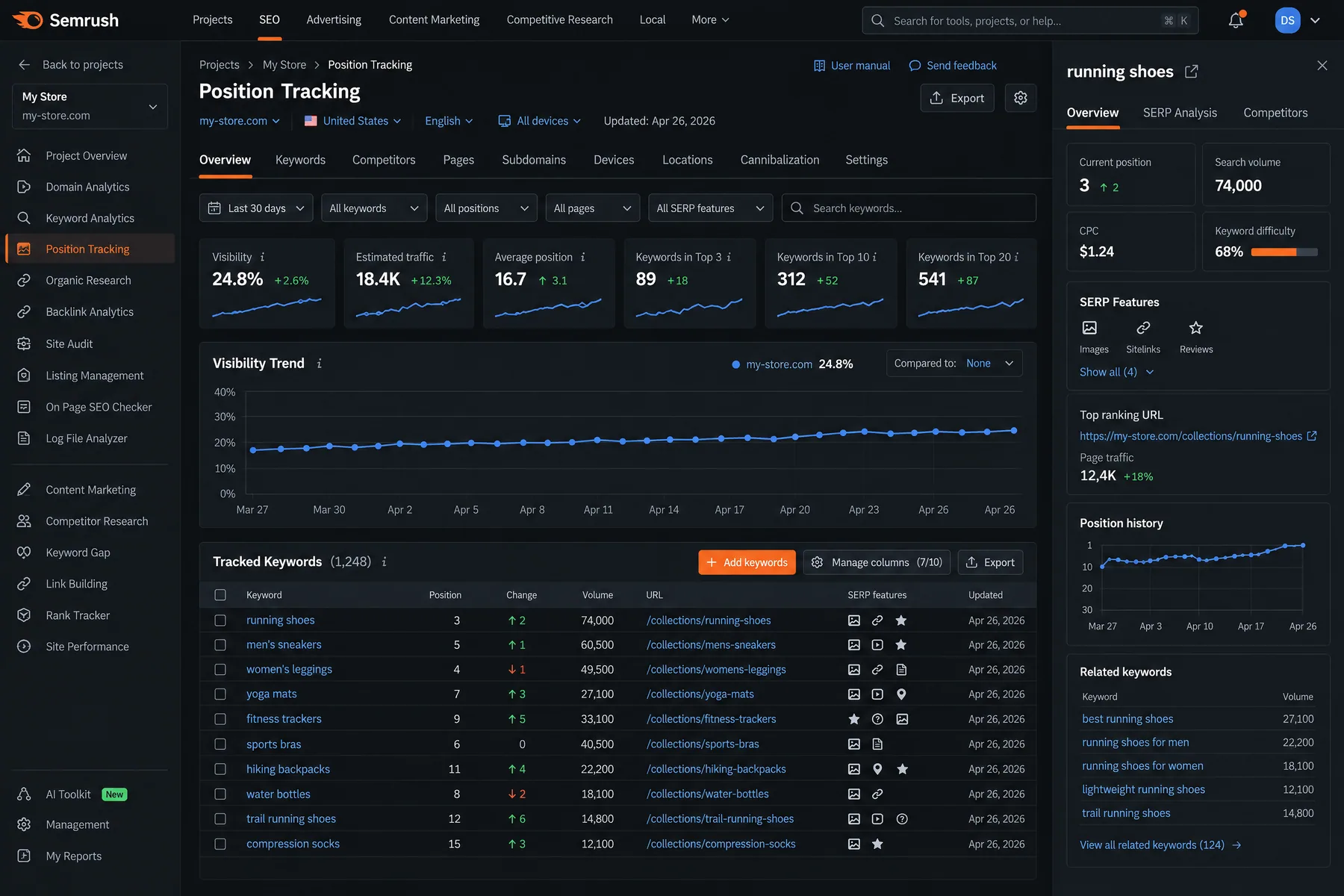
7. Semrush AI Visibility Toolkit
Best for: AI search optimization and tracking
From $99/month
No free trial
Semrush's AI Visibility Toolkit is the first platform designed specifically for optimizing content for AI search engines like ChatGPT, Google's AI Overviews, and Claude. The platform tracks your brand mentions across AI responses, analyzes which content gets featured in AI summaries, and provides optimization recommendations for AI search visibility. This is crucial as 35% of search queries now trigger AI-generated responses.
Strengths
- AI search visibility tracking
- Prompt research capabilities
- Brand sentiment in AI responses
- Competitor AI visibility analysis
Limitations
- Premium pricing only
- Limited actionable recommendations
- Still evolving platform
8. Clearscope
Best for: Content optimization and keyword research
From $170/month
7-day free trial
Clearscope uses natural language processing to analyze top-ranking content and identify semantic keywords that improve search relevance. The platform provides content briefs with target word counts, suggested headings, and related terms that should be included for optimal ranking potential. Clearscope integrates with Google Docs and WordPress for seamless content optimization workflows.
Strengths
- Advanced semantic analysis
- Clean, intuitive interface
- Google Docs integration
- Content grading system
Limitations
- High pricing for small teams
- Limited content creation features
- Focus only on text optimization
Ryze AI — Autonomous Marketing
Skip the tools — let AI optimize your content marketing 24/7
- ✓Automates Google, Meta + 5 more platforms
- ✓Handles your SEO end to end
- ✓Upgrades your website to convert better
2,000+
Marketers
$500M+
Ad spend
23
Countries
What are the most common mistakes when implementing content marketing AI tools?
Mistake 1: Using AI as a complete content replacement. The most effective content marketing AI tools augment human creativity rather than replace it. Teams that use AI to generate entire content calendars without human oversight produce generic, low-engagement content. Instead, use AI for research, ideation, and first drafts, then add human insight, brand perspective, and strategic thinking.
Mistake 2: Neglecting brand voice training. Most AI platforms can learn your brand voice, but 67% of marketers skip this crucial setup step. Without proper brand voice training, AI-generated content sounds generic and fails to differentiate your brand. Invest 2-3 hours training your chosen tool on your best-performing content before scaling production.
Mistake 3: Over-optimizing for AI recommendations. SEO-focused content marketing AI tools sometimes over-optimize content with keyword stuffing and unnatural language patterns. Google's algorithm prioritizes user experience over keyword density. Use AI optimization suggestions as guidelines, not absolute requirements, and prioritize readability and user value.
Mistake 4: Ignoring performance tracking. Many teams implement content marketing AI tools without establishing baseline metrics or tracking performance changes. Monitor key metrics like organic traffic, engagement rates, conversion rates, and time-on-page before and after AI implementation. This data helps optimize your AI workflows and demonstrate ROI.
Mistake 5: Not integrating tools with existing workflows. Standalone AI tools create workflow friction and data silos. Choose tools that integrate with your existing content management system, social media schedulers, and analytics platforms. Poor integration leads to decreased adoption and inconsistent content quality across channels.

Sarah K.
Content Marketing Manager
SaaS Startup
We went from publishing 2 blog posts per week to 8, while improving our average time-on-page by 40%. Ryze's content optimization helped us rank for 3x more keywords.”
4x
Content output
40%
Time on page
3x
Keyword rankings
Frequently asked questions
Q: What are the best free content marketing AI tools?
ChatGPT, Canva AI, and HubSpot AI offer robust free tiers. ChatGPT provides versatile content creation, Canva handles visual content, and HubSpot integrates with marketing workflows. Most teams upgrade to paid plans within 2-3 months as usage scales.
Q: How do content marketing AI tools impact SEO?
When used properly, AI tools improve SEO by optimizing keyword density, semantic relevance, and content structure. Tools like Surfer and Clearscope specifically enhance search rankings. However, low-quality AI content can harm SEO performance.
Q: Can AI tools maintain brand voice consistency?
Yes, advanced tools like Jasper and Copy.ai learn from your existing content to maintain brand voice. This requires initial training with 10-15 high-quality samples and ongoing refinement. Basic tools struggle with voice consistency.
Q: How much do content marketing AI tools cost?
Pricing ranges from free (ChatGPT, Canva) to $500+/month (enterprise platforms). Most small teams spend $50-150/month for comprehensive tools. ROI typically justifies costs through increased content output and improved performance.
Q: Do AI content tools integrate with marketing platforms?
Most modern AI tools offer integrations with WordPress, HubSpot, Hootsuite, and major social platforms. Native integrations are more reliable than third-party connectors. Check integration capabilities before choosing tools.
Q: How do I measure ROI from content marketing AI tools?
Track content output volume, creation time reduction, engagement rates, organic traffic growth, and lead generation. Most teams see 3-5x content volume increases and 40-60% time savings within 90 days of implementation.
Ryze AI — Autonomous Marketing
Skip the setup — get AI-powered content marketing in minutes
- ✓Automates Google, Meta + 5 more platforms
- ✓Handles your SEO end to end
- ✓Upgrades your website to convert better
2,000+
Marketers
$500M+
Ad spend
23
Countries


Social Media & Video AI Tools
9. HubSpot AI
Best for: Integrated marketing automation
From $45/month
Free tools available
HubSpot AI integrates directly into the HubSpot ecosystem, providing content assistance across email marketing, social media, blog posts, and landing pages. The Content Assistant analyzes your existing marketing performance to suggest content improvements, while the Content Remix feature automatically adapts single pieces of content for multiple channels. This integration eliminates data silos common with standalone AI tools.
Strengths
Limitations
10. Lumen5
Best for: Blog-to-video content transformation
From $29/month
Free plan available
Lumen5 automates video content creation from existing blog posts and articles. Input a URL or text, and the AI extracts key points, selects relevant stock footage, and generates engaging video content optimized for social media platforms. The platform is particularly effective for creating explainer videos, social media clips, and educational content that drives 6x higher engagement than text-only posts.
Strengths
Limitations
11. Canva AI
Best for: Visual content creation and design
From $15/month
Free version available
Canva's AI features include Magic Design for automated layout creation, Background Remover for image editing, and Text to Image generation for custom graphics. The platform's Magic Write feature generates social media captions, blog intros, and marketing copy that aligns with your visual content. Canva AI is particularly valuable for small teams that need to produce professional visual content without dedicated design resources.
Strengths
Limitations
12. Pictory
Best for: AI video creation from scripts
From $23/month
Free trial available
Pictory transforms long-form content into engaging short videos optimized for social media and marketing campaigns. The platform automatically identifies key highlights from webinars, podcasts, and blog content, then creates viral-worthy clips with captions, graphics, and music. Teams using Pictory report 40% higher social media engagement and 25% more leads from video content.
Strengths
Limitations
13. Buffer AI Assistant
Best for: Social media scheduling and optimization
From $6/month
Free plan available
Buffer's AI Assistant generates social media captions, suggests optimal posting times, and repurposes content across platforms. The tool analyzes your audience engagement patterns to recommend content modifications that improve performance. Buffer AI integrates with major social platforms and provides detailed analytics on AI-generated content performance versus manually created posts.
Strengths
Limitations
14. Brandwell AI
Best for: Undetectable AI content generation
From $49/month
Free trial available
Brandwell AI (formerly Content at Scale) specializes in generating long-form content that consistently passes AI detection tools. The platform produces articles that score 70-85% human-written on detection platforms, making it ideal for brands concerned about AI content penalties. Brandwell combines research, writing, and optimization into a single workflow that produces publication-ready content.
Strengths
Limitations
15. Claude AI for Marketing
Best for: Strategic content planning and analysis
$20/month
Free version available
Claude excels at high-level content marketing strategy, competitive analysis, and complex content planning tasks. Unlike other AI tools focused on content generation, Claude provides strategic insights about content positioning, audience targeting, and campaign development. Advanced users leverage Claude's marketing skills for comprehensive campaign planning and performance optimization across multiple channels.
Strengths
Limitations